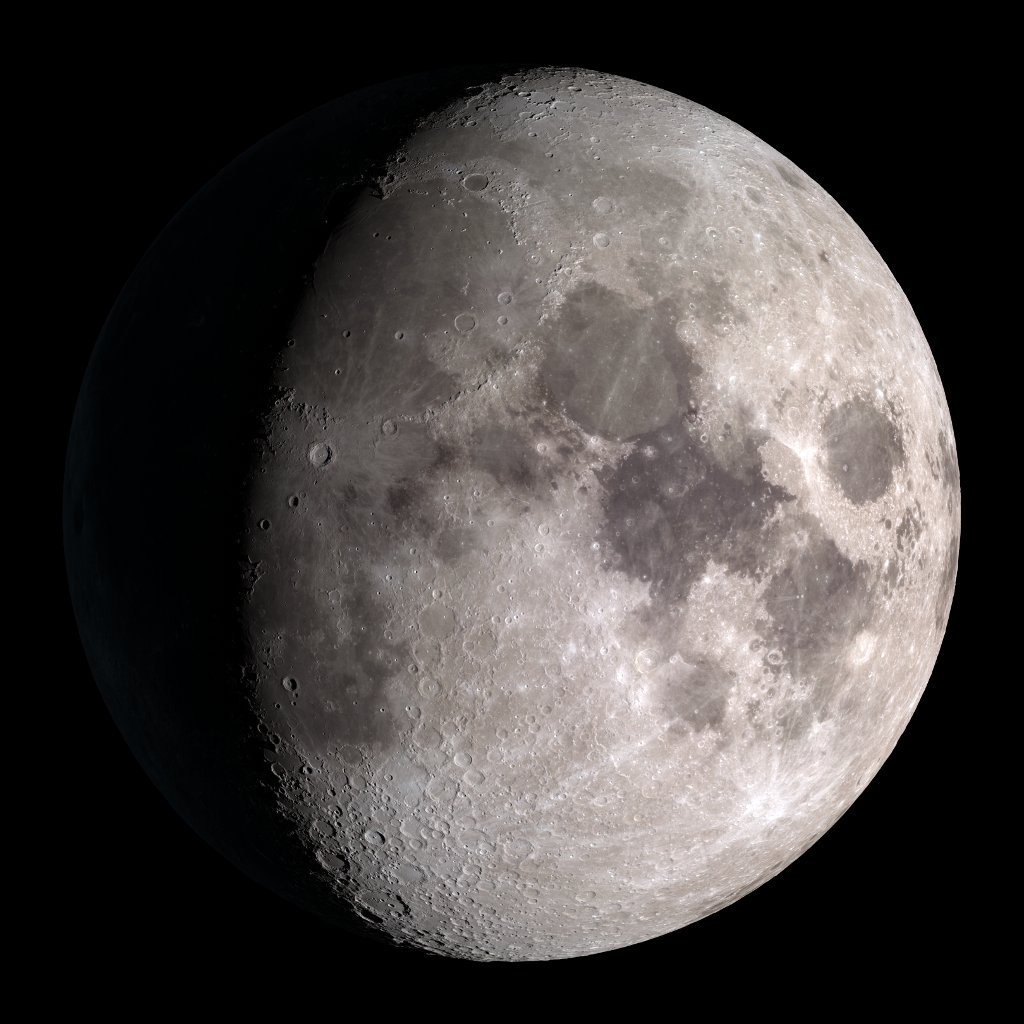
A cool video from NASA showing the phases of the Moon for every hour throughout 2018:
This 4K visualization shows the Moon’s phase and libration at hourly intervals throughout 2018, as viewed from the Northern Hemisphere. Two ‘supermoons’ will ring in the New Year on Jan. 1, 2018 and Jan. 31, 2018.
Each frame represents one hour. In addition, this visualization shows the moon’s orbit position, sub-Earth and subsolar points, distance from the Earth at true scale, and labels of craters near the terminator.
Credit: NASA’s Goddard Space Flight Center/David Ladd (USRA)
Ernie Wright (USRA): Lead Visualizer John Keller (NASA/GSFC): Scientist Noah Petro (NASA/GSFC): Scientist
Music Credits: Killer Tracks: “Illuminating” – Kelly McCollough. “Touching Clouds” – Kelly Mccullough.
This video is public domain and along with other supporting visualizations can be downloaded from the Scientific Visualization Studio at: https://svs.gsfc.nasa.gov/4604
Waxing gibbous. Visible to the southeast in early evening, up for most of the night. NASA Scientific Visualization Studio.
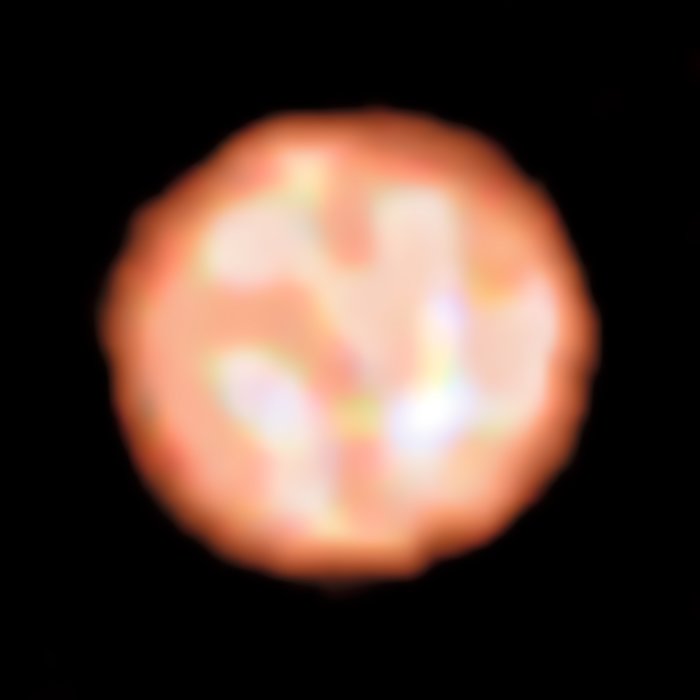
Astronomers using ESO’s Very Large Telescope have directly observed granulation patterns on the surface of a star outside the Solar System — the ageing red giant π1 Gruis. This remarkable new image from the PIONIER instrument reveals the convective cells that make up the surface of this huge star. Each cell covers more than a quarter of the star’s diameter and measures about 120 million kilometres across. [Larger image.]Astronomers using ESO’s Very Large Telescope have for the first time directly observed granulation patterns on the surface of a star outside the Solar System — the ageing red giant π1 Gruis. This remarkable new image from the PIONIER instrument reveals the convective cells that make up the surface of this huge star, which has 350 times the diameter of the Sun. Each cell covers more than a quarter of the star’s diameter and measures about 120 million kilometres across. These new results are being published this week in the journal Nature.
Located 530 light-years from Earth in the constellation of Grus (The Crane), π1 Gruis is a cool red giant. It has about the same mass as our Sun, but is 350 times larger and several thousand times as bright [1]. Our Sun will swell to become a similar red giant star in about five billion years.
An international team of astronomers led by Claudia Paladini (ESO) used the PIONIER instrument on ESO’s Very Large Telescope to observe π1 Gruis in greater detail than ever before. They found that the surface of this red giant has just a few convective cells, or granules, that are each about 120 million kilometres across — about a quarter of the star’s diameter [2]. Just one of these granules would extend from the Sun to beyond Venus. The surfaces — known as photospheres — of many giant stars are obscured by dust, which hinders observations. However, in the case of π1 Gruis, although dust is present far from the star, it does not have a significant effect on the new infrared observations [3].
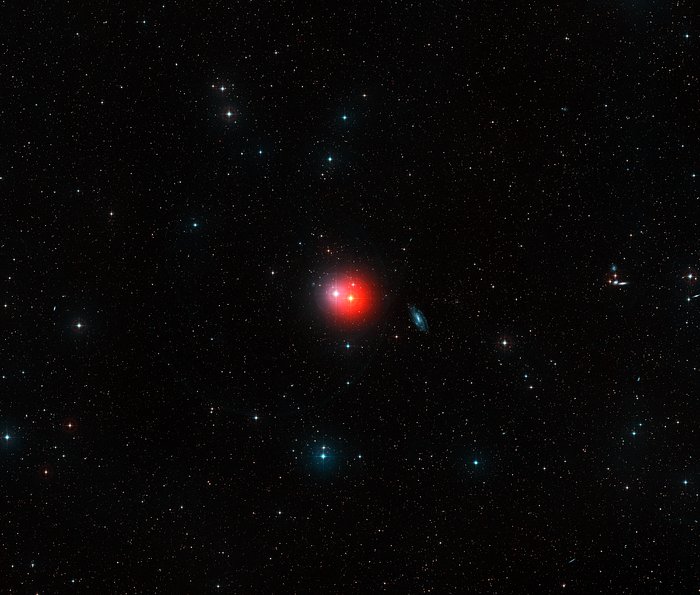
This colourful image shows the sky around the bright pair of stars π1 Gruis (centre-right, very red) and π2 Gruis (centre-left, bluish-white). Just right of centre the bright spiral galaxy IC 5201 is also visible and many other fainter galaxies are scattered across this wide-field image from the Digitized Sky Survey 2. [Larger images]When π1 Gruis ran out of hydrogen to burn long ago, this ancient star ceased the first stage of its nuclear fusion programme. It shrank as it ran out of energy, causing it to heat up to over 100 million degrees. These extreme temperatures fueled the star’s next phase as it began to fuse helium into heavier atoms such as carbon and oxygen. This intensely hot core then expelled the star’s outer layers, causing it to balloon to hundreds of times larger than its original size. The star we see today is a variable red giant. Until now, the surface of one of these stars has never before been imaged in detail.
By comparison, the Sun’s photosphere contains about two million convective cells, with typical diameters of just 1500 kilometres. The vast size differences in the convective cells of these two stars can be explained in part by their varying surface gravities. π1 Gruis is just 1.5 times the mass of the Sun but much larger, resulting in a much lower surface gravity and just a few, extremely large, granules.
While stars more massive than eight solar masses end their lives in dramatic supernovae explosions, less massive stars like this one gradually expel their outer layers, resulting in beautiful planetary nebulae. Previous studies of π1 Gruis found a shell of material 0.9 light-years away from the central star, thought to have been ejected around 20 000 years ago. This relatively short period in a star’s life lasts just a few tens of thousands of years – compared to the overall lifetime of several billion – and these observations reveal a new method for probing this fleeting red giant phase.
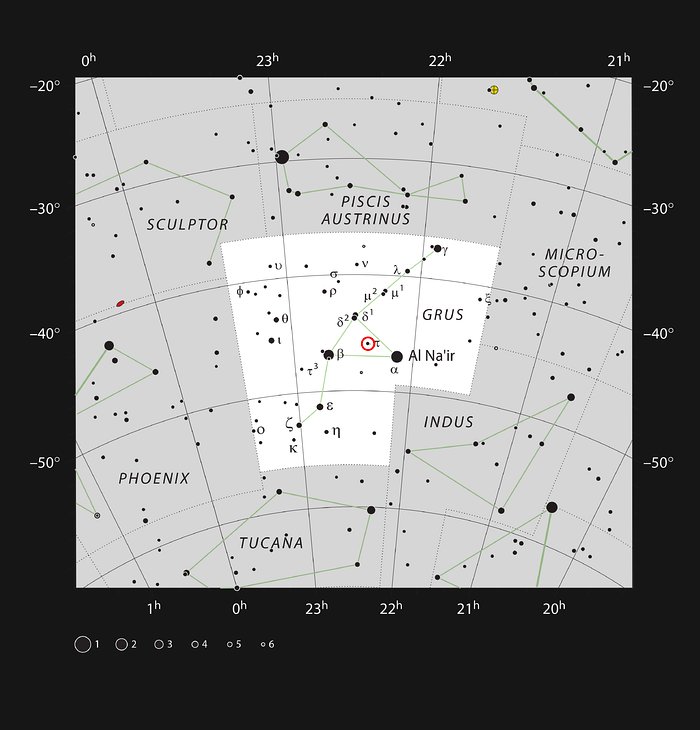
This chart shows the southern constellation of Grus (The Crane) and marks most stars that can be seen with the unaided eye on a clear dark night. The red circle indicates the location of the red giant star π1 Gruis, which forms a colourful pairing with π2 Gruis, visible with a small telescope or binoculars.
Notes [1] π1 Gruis is named following the Bayer designation system. In 1603 the German astronomer Johann Bayer classified 1564 stars, naming them by a Greek letter followed by the name of their parent constellation. Generally, stars were assigned Greek letters in rough order of how bright they appeared from Earth, with the brightest designated Alpha (α). The brightest star of the Grus constellation is therefore Alpha Gruis.
π1 Gruis is one of an attractive pair of stars of contrasting colours that appear close together in the sky, the other one naturally being named π2 Gruis. They are bright enough to be well seen in a pair of binoculars. Thomas Brisbane realised in the 1830s that π1 Gruis was itself also a much closer binary star system. Annie Jump Cannon, credited with the creation of the Harvard Classification Scheme, was the first to report the unusual spectrum of π1 Gruis in 1895.
[2] Granules are patterns of convection currents in the plasma of a star. As plasma heats up at the centre of the star it expands and rises to the surface, then cools at the outer edges, becoming darker and more dense, and descends back to the centre. This process continues for billions of years and plays a major role in many astrophysical processes including energy transport, pulsation, stellar wind and dust clouds on brown dwarfs.
[3] π1 Gruis is one of the brightest members of the rare S class of stars that was first defined by the American astronomer Paul W. Merrill to group together stars with similarly unusual spectra. π1 Gruis, R Andromedae and R Cygni became prototypes of this type. Their unusual spectra is now known to be the result of the “s-process” or “slow neutron capture process” — responsible for the creation of half the elements heavier than iron.
A NASA / Google collaboration used artificial intelligence (AI) techniques to discover an eighth planet around the star Kepler-90i, which resides just over 2500 light years from earth.
Our solar system now is tied for most number of planets around a single star, with the recent discovery of an eighth planet circling Kepler-90, a Sun-like star 2,545 light-years from Earth. The planet was discovered in data from NASA’s Kepler Space Telescope.
The newly-discovered Kepler-90i – a sizzling hot, rocky planet that orbits its star once every 14.4 days – was found using machine learning from Google. Machine learning is an approach to artificial intelligence in which computers “learn.” In this case, computers learned to identify planets by finding in Kepler data instances where the telescope recorded signals from planets beyond our solar system, known as exoplanets.
NASA will host a Reddit Ask Me Anything at 3 p.m. EST [Thursday, Dec.14.2017] on this discovery.
“Just as we expected, there are exciting discoveries lurking in our archived Kepler data, waiting for the right tool or technology to unearth them,” said Paul Hertz, director of NASA’s Astrophysics Division in Washington. “This finding shows that our data will be a treasure trove available to innovative researchers for years to come.”
The discovery came about after researchers Christopher Shallue and Andrew Vanderburg trained a computer to learn how to identify exoplanets in the light readings recorded by Kepler – the minuscule change in brightness captured when a planet passed in front of, or transited, a star. Inspired by the way neurons connect in the human brain, this artificial “neural network” sifted through Kepler data and found weak transit signals from a previously-missed eighth planet orbiting Kepler-90, in the constellation Draco.
While machine learning has previously been used in searches of the Kepler database, this research demonstrates that neural networks are a promising tool in finding some of the weakest signals of distant worlds.
Other planetary systems probably hold more promise for life than Kepler-90. About 30 percent larger than Earth, Kepler-90i is so close to its star that its average surface temperature is believed to exceed 800 degrees Fahrenheit, on par with Mercury. Its outermost planet, Kepler-90h, orbits at a similar distance to its star as Earth does to the Sun.
“The Kepler-90 star system is like a mini version of our solar system. You have small planets inside and big planets outside, but everything is scrunched in much closer,” said Vanderburg, a NASA Sagan Postdoctoral Fellow and astronomer at the University of Texas at Austin.
Shallue, a senior software engineer with Google’s research team Google AI, came up with the idea to apply a neural network to Kepler data. He became interested in exoplanet discovery after learning that astronomy, like other branches of science, is rapidly being inundated with data as the technology for data collection from space advances.
“In my spare time, I started googling for ‘finding exoplanets with large data sets’ and found out about the Kepler mission and the huge data set available,” said Shallue. “Machine learning really shines in situations where there is so much data that humans can’t search it for themselves.”
Kepler’s four-year dataset consists of 35,000 possible planetary signals. Automated tests, and sometimes human eyes, are used to verify the most promising signals in the data. However, the weakest signals often are missed using these methods. Shallue and Vanderburg thought there could be more interesting exoplanet discoveries faintly lurking in the data.
First, they trained the neural network to identify transiting exoplanets using a set of 15,000 previously-vetted signals from the Kepler exoplanet catalogue. In the test set, the neural network correctly identified true planets and false positives 96 percent of the time. Then, with the neural network having “learned” to detect the pattern of a transiting exoplanet, the researchers directed their model to search for weaker signals in 670 star systems that already had multiple known planets. Their assumption was that multiple-planet systems would be the best places to look for more exoplanets.
“We got lots of false positives of planets, but also potentially more real planets,” said Vanderburg. “It’s like sifting through rocks to find jewels. If you have a finer sieve then you will catch more rocks but you might catch more jewels, as well.”
Kepler-90i wasn’t the only jewel this neural network sifted out. In the Kepler-80 system, they found a sixth planet. This one, the Earth-sized Kepler-80g, and four of its neighboring planets form what is called a resonant chain – where planets are locked by their mutual gravity in a rhythmic orbital dance. The result is an extremely stable system, similar to the seven planets in the TRAPPIST-1 system.
Their research paper reporting these findings has been accepted for publication in The Astronomical Journal. Shallue and Vanderburg plan to apply their neural network to Kepler’s full set of more than 150,000 stars.
Kepler has produced an unprecedented data set for exoplanet hunting. After gazing at one patch of space for four years, the spacecraft now is operating on an extended mission and switches its field of view every 80 days.
“These results demonstrate the enduring value of Kepler’s mission,” said Jessie Dotson, Kepler’s project scientist at NASA’s Ames Research Center in California’s Silicon Valley. “New ways of looking at the data – such as this early-stage research to apply machine learning algorithms – promises to continue to yield significant advances in our understanding of planetary systems around other stars. I’m sure there are more firsts in the data waiting for people to find them.”
Ames manages the Kepler and K2 missions for NASA’s Science Mission Directorate in Washington. NASA’s Jet Propulsion Laboratory in Pasadena, California, managed Kepler mission development. Ball Aerospace & Technologies Corporation operates the flight system with support from the Laboratory for Atmospheric and Space Physics at the University of Colorado in Boulder. This work was performed through the Carl Sagan Postdoctoral Fellowship Program executed by the NASA Exoplanet Science Institute.
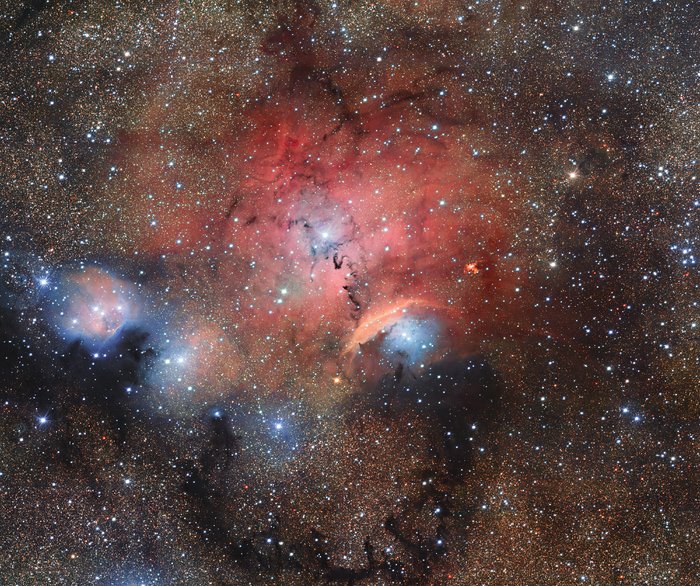
The OmegaCAM imager on ESO’s VLT Survey Telescope has captured this glittering view of the stellar nursery called Sharpless 29. Many astronomical phenomena can be seen in this giant image, including cosmic dust and gas clouds that reflect, absorb, and re-emit the light of hot young stars within the nebula. [Full size image.]The OmegaCAM camera on ESO’s VLT Survey Telescope has captured this glittering view of the stellar nursery called Sharpless 29. Many astronomical phenomena can be seen in this giant image, including cosmic dust and gas clouds that reflect, absorb, and re-emit the light of hot young stars within the nebula.
The region of sky pictured is listed in the Sharpless catalogue of H II regions: interstellar clouds of ionised gas, rife with star formation. Also known as Sh 2-29, Sharpless 29 is located about 5500 light-years away in the constellation of Sagittarius (The Archer), next door to the larger Lagoon Nebula. It contains many astronomical wonders, including the highly active star formation site of NGC 6559, the nebula at the centre of the image.
This central nebula is Sharpless 29’s most striking feature. Though just a few light-years across, it showcases the havoc that stars can wreak when they form within an interstellar cloud. The hot young stars in this image are no more than two million years old and are blasting out streams of high-energy radiation. This energy heats up the surrounding dust and gas, while their stellar winds dramatically erode and sculpt their birthplace. In fact, the nebula contains a prominent cavity that was carved out by an energetic binary star system. This cavity is expanding, causing the interstellar material to pile up and create the reddish arc-shaped border.
When interstellar dust and gas are bombarded with ultraviolet light from hot young stars, the energy causes them to shine brilliantly. The diffuse red glow permeating this image comes from the emission of hydrogen gas, while the shimmering blue light is caused by reflection and scattering off small dust particles. As well as emission and reflection, absorption takes place in this region. Patches of dust block out the light as it travels towards us, preventing us from seeing the stars behind it, and smaller tendrils of dust create the dark filamentary structures within the clouds.
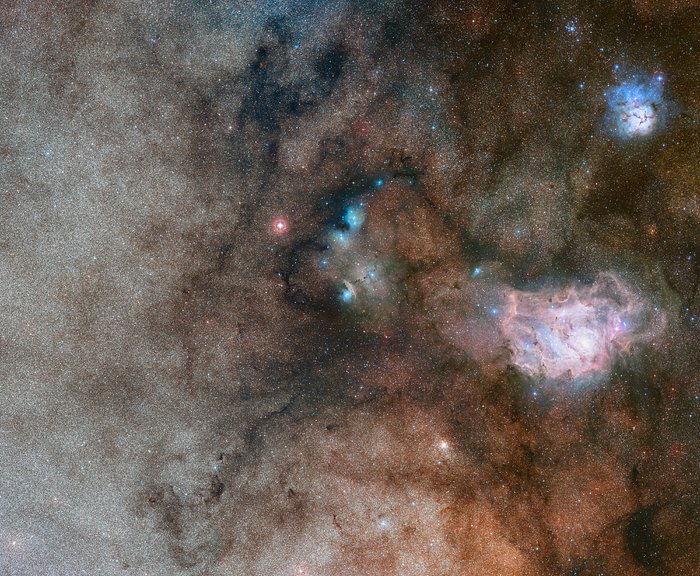
This very rich region of the Milky Way in the constellation of Sagittarius (The Archer) includes huge numbers of stars as well as several spectacular regions of star formation. At the centre lies Sharpless 29, which includes NGC 6559. To the right lies the very bright and famous Lagoon Nebula (Messier 8) and at the upper-right the Triffid Nebula (Messier 20) can be seen. This picture was created from images in the Digitized Sky Survey 2. Credit: ESO/Digitized Sky Survey 2 [Full size image.]The rich and diverse environment of Sharpless 29 offers astronomers a smorgasbord of physical properties to study. The triggered formation of stars, the influence of the young stars upon dust and gas, and the disturbance of magnetic fields can all be observed and examined in this single area.
But young, massive stars live fast and die young. They will eventually explosively end their lives in a supernova, leaving behind rich debris of gas and dust. In tens of millions of years, this will be swept away and only an open cluster of stars will remain.
Sharpless 29 was observed with ESO’s OmegaCAM on the VLT Survey Telescope (VST) at Cerro Paranal in Chile. OmegaCAM produces images that cover an area of sky more than 300 times greater than the largest field of view imager of the NASA/ESA Hubble Space Telescope, and can observe over a wide range of wavelengths from the ultraviolet to the infrared. Its hallmark feature is its ability to capture the very red spectral line H-alpha, created when the electron inside a hydrogen atom loses energy, a prominent occurrence in a nebula like Sharpless 29.
More information
ESO is the foremost intergovernmental astronomy organisation in Europe and the world’s most productive ground-based astronomical observatory by far. It is supported by 16 countries: Austria, Belgium, Brazil, the Czech Republic, Denmark, France, Finland, Germany, Italy, the Netherlands, Poland, Portugal, Spain, Sweden, Switzerland and the United Kingdom, along with the host state of Chile and by Australia as a strategic partner. ESO carries out an ambitious programme focused on the design, construction and operation of powerful ground-based observing facilities enabling astronomers to make important scientific discoveries. ESO also plays a leading role in promoting and organising cooperation in astronomical research. ESO operates three unique world-class observing sites in Chile: La Silla, Paranal and Chajnantor. At Paranal, ESO operates the Very Large Telescope, the world’s most advanced visible-light astronomical observatory and two survey telescopes. VISTA works in the infrared and is the world’s largest survey telescope and the VLT Survey Telescope is the largest telescope designed to exclusively survey the skies in visible light. ESO is a major partner in ALMA, the largest astronomical project in existence. And on Cerro Armazones, close to Paranal, ESO is building the 39-metre Extremely Large Telescope, the ELT, which will become “the world’s biggest eye on the sky”.
Dr. Natalie Batalha of NASA’s Kepler Mission Project gives a public lecture about A Planet for Goldilocks: Kepler & the Search for Living Worlds –
NASA’s Kepler Mission launched in 2009 with the objective of finding “Goldilocks planets” orbiting other stars like our Sun. The space telescope opened our eyes to the many terrestrial-sized planets that populate the galaxy (including several right in our neighborhood,) as well as to exotic worlds unlike anything that exists in the solar system. Dr. Batalha gives an overview of the science legacy of the Kepler Mission and other key planet discoveries (including some results only a few weeks old). She also gives a preview of planet-finding missions to come.