a bright, blinking satellite now orbiting Earth, visible to the naked eye in the night sky. Launched on #StillTesting, The Humanity Star is designed to encourage everyone to look up and consider our place in the universe.
More about the project:
Visible from space with the naked eye, the Humanity Star is a highly reflective satellite that blinks brightly across the night sky to create a shared experience for everyone on the planet.
Created by Rocket Lab founder and CEO Peter Beck, the Humanity Star is a geodesic sphere made from carbon fibre with 65 highly reflective panels. It spins rapidly, reflecting the sun’s rays back to Earth, creating a flashing light that can be seen against a backdrop of stars.
Orbiting the Earth every 90 minutes and visible from anywhere on the globe, the Humanity Star is designed to be a bright symbol and reminder to all on Earth about our fragile place in the universe.
The sphere will stay in orbit for about 9 months. You can use the tracking app on the website to find when it will pass over your location.
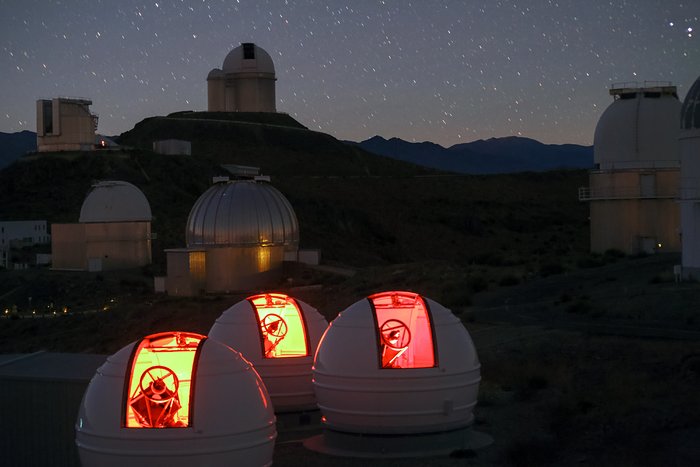
The ExTrA telescopes are sited at ESO’s La Silla Observatory in Chile. They will be used to search for and study Earth-sized planets orbiting nearby red dwarf stars. ExTrA’s novel design allows for much improved sensitivity compared to previous searches. This nighttime view shows the three ExTra domes in the foreground and many of the other telescopes at ESO’s La Silla Observatory behind. [Hi-res images.]A new national facility at ESO’s La Silla Observatory has successfully made its first observations. The ExTrA telescopes will search for and study Earth-sized planets orbiting nearby red dwarf stars. ExTrA’s novel design allows for much improved sensitivity compared to previous searches. Astronomers now have a powerful new tool to help in the search for potentially habitable worlds.
The newest addition to ESO’s La Silla observatory in northern Chile, Exoplanets in Transits and their Atmospheres (ExTrA), has made its first successful observations. ExTrA is designed to search for planets around nearby red dwarf stars and study their properties. ExTrA is a French project funded by the European Research Council and the French Agence National de la Recherche. The telescopes will be operated remotely from Grenoble, France.
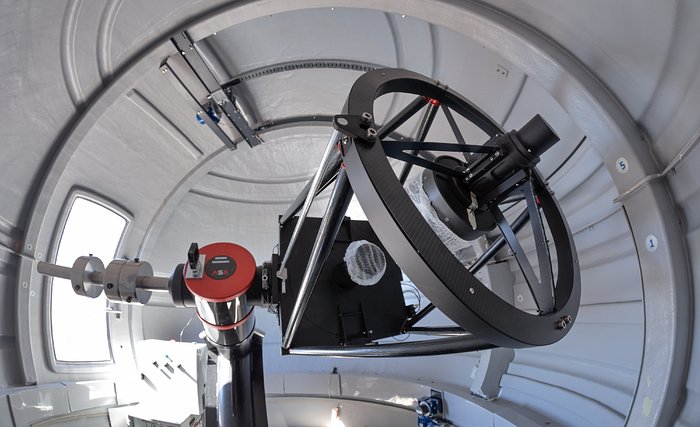
The ExTrA telescopes are sited at ESO’s La Silla Observatory in Chile. They will be used to search for and study Earth-sized planets orbiting nearby red dwarf stars. ExTrA’s novel design allows for much improved sensitivity compared to previous searches. This view shows one of the three ExTrA in its dome. [Hi-res images]To detect and study exoplanets, ExTrA uses three 0.6-metre telescopes [1]. They regularly monitor the amount of light received from many red dwarf stars and look for a slight dip in brightness that could be caused by a planet passing — transiting — across a star’s disc and obscuring some of its light.
“La Silla was selected as the home of the telescopes because of the site’s excellent atmospheric conditions,” explains the project’s lead researcher, Xavier Bonfils. “The kind of light we are observing — near-infrared — is very easily absorbed by Earth’s atmosphere, so we required the driest and darkest conditions possible. La Silla is a perfect match to our specifications.”
The transit method involves comparing the brightness of the star under study with other reference stars to spot tiny changes. However, from the ground it is difficult to make sufficiently precise measurements this way to detect small, Earth-sized planets [2]. By using a novel approach that also incorporates information about the brightness of the stars in many different colours, however, ExTrA overcomes some of these limitations.
The three ExTra telescopes collect light from the target star and four comparison stars and that light is then fed through optical fibres into a multi-object spectrograph. This innovative approach of adding spectroscopic information to traditional photometry helps to mitigate the disruptive effect of Earth’s atmosphere, as well as effects introduced by instruments and detectors — increasing the precision achievable.
Because a transiting planet will block a greater proportion of the light from a smaller star, ExTrA will focus on targeting nearby examples of a specific kind of small, bright star known as M dwarfs, which are common in the Milky Way. Such stars are expected to host many Earth-sized planets, making them prime targets for astronomers looking to discover and study distant worlds that could be amenable to life. The nearest star to the Sun, Proxima Centauri, is an M dwarf and has been found to have an orbiting Earth-mass planet.
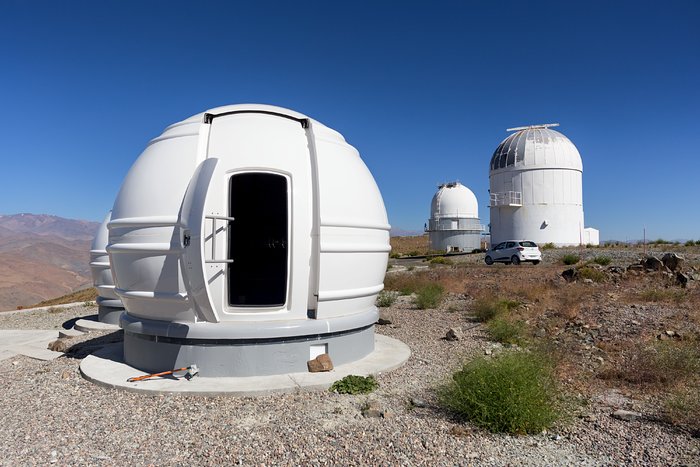
The ExTrA telescopes are sited at ESO’s La Silla Observatory in Chile. They will be used to search for and study Earth-sized planets orbiting nearby red dwarf stars. ExTrA’s novel design allows for much improved sensitivity compared to previous searches. This view shows one of the three ExTrA domes with its access door open.[Hi-res images]Finding these previously undetectable Earth-like worlds is only one of two key objectives for ExTrA. The telescope will also study the planets it finds in some detail, assessing their properties and deducing their composition to determine how similar to Earth they could be.
“With ExTrA, we can also address some fundamental questions about planets in our galaxy. We hope to explore how common these planets are, the behaviour of multi-planet systems, and the sorts of environments that lead to their formation,” adds team member Jose-Manuel Almenara.
Bonfils is excited for the future:
“With the next generation of telescopes, such as ESO’s Extremely Large Telescope, we may be able to study the atmospheres of exoplanets found by ExTra to try to assess the viability of these worlds to support life as we know it. The study of exoplanets is bringing what was once science fiction into the world of science fact.”
Notes
[1] The telescopes and their mounts were supplied by Astrosysteme Austria, the domes come from the German company ScopeDome and the infrared camera was made by the US company Princeton Instruments with the detector array from the Belgium company Xenics. Additional information about the facility is available here.
[2] This approach, known as differential photometry, involves observing the target star along with other stars nearby in the sky. By correcting for variations that are common to all stars due to the Earth’s disruptive atmosphere, more accurate measurements can be obtained for the target star. However, the dips in light caused by Earth-sized planets are so slight that even this technique is not always sufficient.
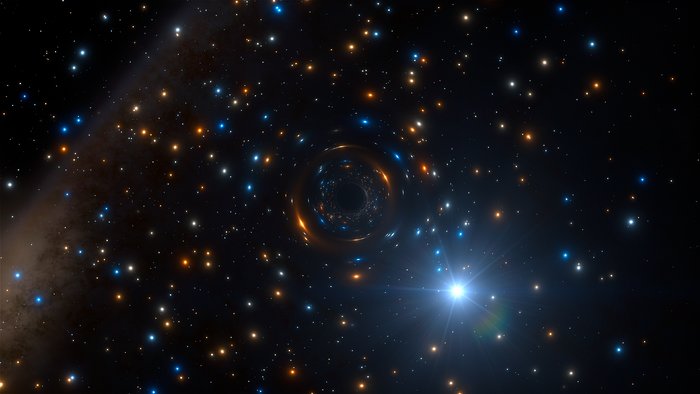
Artist’s impression of the black hole binary system in NGC 3201. Astronomers using ESO’s MUSE instrument on the Very Large Telescope in Chile have discovered a star in the cluster NGC 3201 that is behaving very strangely. It appears to be orbiting an invisible black hole with about four times the mass of the Sun — the first such inactive stellar-mass black hole found in a globular cluster. This important discovery impacts on our understanding of the formation of these star clusters, black holes, and the origins of gravitational wave events.This artist’s impression shows how the star and its massive but invisible black hole companion may look, in the rich heart of the globular star cluster. [Larger images]Astronomers using ESO’s MUSE instrument on the Very Large Telescope in Chile have discovered a star in the cluster NGC 3201 that is behaving very strangely. It appears to be orbiting an invisible black hole with about four times the mass of the Sun — the first such inactive stellar-mass black hole found in a globular cluster and the first found by directly detecting its gravitational pull. This important discovery impacts on our understanding of the formation of these star clusters, black holes, and the origins of gravitational wave events.
Astronomers using ESO’s MUSE instrument on the Very Large Telescope in Chile have discovered a star in the cluster NGC 3201 that is behaving very strangely. It appears to be orbiting an invisible black hole with about four times the mass of the Sun — the first such inactive stellar-mass black hole found in a globular cluster. This important discovery impacts on our understanding of the formation of these star clusters, black holes, and the origins of gravitational wave events. This short ESOcast takes a look at this discovery and its significance.
Globular star clusters are huge spheres of tens of thousands of stars that orbit most galaxies. They are among the oldest known stellar systems in the Universe and date back to near the beginning of galaxy growth and evolution. More than 150 are currently known to belong to the Milky Way.
One particular cluster, called NGC 3201 and situated in the southern constellation of Vela (The Sails), has now been studied using the MUSE instrument on ESO’s Very Large Telescope in Chile. An international team of astronomers has found that one of the stars [1] in NGC 3201 is behaving very oddly — it is being flung backwards and forwards at speeds of several hundred thousand kilometres per hour, with the pattern repeating every 167 days [2].
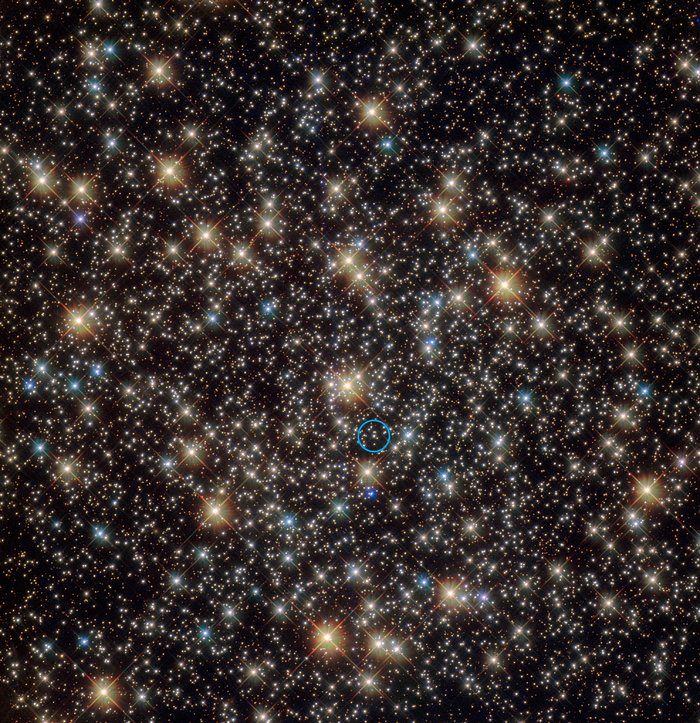
This image from the NASA/ESA Hubble Space Telescope shows the central region of the rich globular star cluster NGC 3201 in the southern constellation of Vela (The Sails). A star that has been found to be orbiting a black hole with four times the mass of the Sun is indicated with blue circle. [Larger images.]Lead author Benjamin Giesers (Georg-August-Universität Göttingen, Germany) was intrigued by the star’s behaviour:
“It was orbiting something that was completely invisible, which had a mass more than four times the Sun — this could only be a black hole! The first one found in a globular cluster by directly observing its gravitational pull.”
The relationship between black holes and globular clusters is an important but mysterious one. Because of their large masses and great ages, these clusters are thought to have produced a large number of stellar-mass black holes — created as massive stars within them exploded and collapsed over the long lifetime of the cluster [3][4].
This video takes us towards the southern constellation of Vela (The Sails), where we find the bright globular star cluster NGC 3201. This huge and ancient ball of stars has been found to harbour an invisible black hole with four times the mass of the Sun. The final sharp view of the centre of the cluster comes from the NASA/ESA Hubble Space Telescope. Credit: ESO/ESA/NASA/Digitized Sky Survey 2/N. Risinger (skysurvey.org). Music: Astral Electronic
ESO’s MUSE instrument provides astronomers with a unique ability to measure the motions of thousands of far away stars at the same time. With this new finding, the team have for the first time been able to detect an inactive black hole at the heart of a globular cluster — one that is not currently swallowing matter and is not surrounded by a glowing disc of gas. They could estimate the black hole’s mass through the movements of a star caught up in its enormous gravitational pull [5].
From its observed properties the star was determined to be about 0.8 times the mass of our Sun, and the mass of its mysterious counterpart was calculated at around 4.36 times the Sun’s mass — almost certainly a black hole [6].
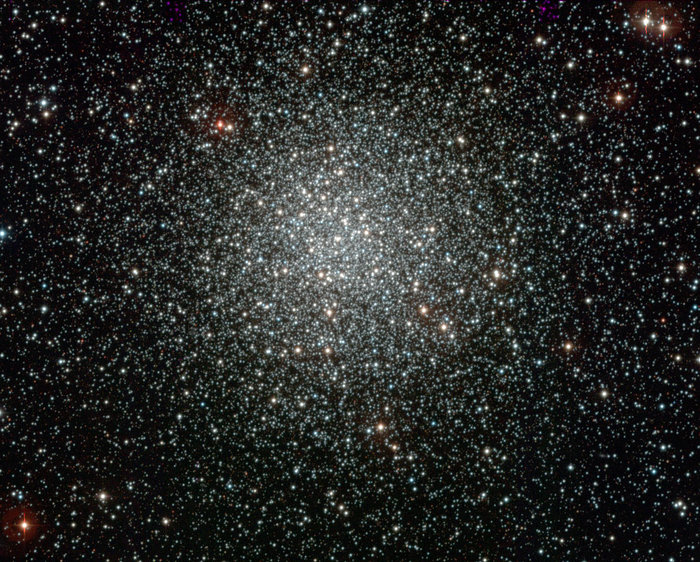
Colour-composite image of the globular cluster NGC 3201, obtained with the WFI instrument on the ESO/MPG 2.2-m telescope at La Silla. Globular clusters are large aggregates of stars, that can contain up to millions of stars. They are among the oldest objects observed in the Universe and were presumably formed at about the same time as the Milky Way Galaxy, in the early phase after the Big Bang. This particular globular cluster is located about 16 000 light-years away towards the Southern Vela constellation. The data were obtained as part of the ESO Imaging Survey (EIS), a public survey being carried out by ESO and member states, in preparation for the VLT First Light. The original image and astronomical data can be retrieved from the EIS Pre-Flames Survey Data Release pages, where many other nice images are also available. [Larger images]Recent detections of radio and X-ray sources in globular clusters, as well as the 2016 detection of gravitational-wave signals produced by the merging of two stellar-mass black holes, suggest that these relatively small black holes may be more common in globular clusters than previously thought.
Giesers concludes:
“Until recently, it was assumed that almost all black holes would disappear from globular clusters after a short time and that systems like this should not even exist! But clearly this is not the case — our discovery is the first direct detection of the gravitational effects of a stellar-mass black hole in a globular cluster. This finding helps in understanding the formation of globular clusters and the evolution of black holes and binary systems — vital in the context of understanding gravitational wave sources.”
Notes
[1] The star found is a main sequence turn-off star, meaning it is at the end of the main sequence phase of its life. Having exhausted its primary hydrogen fuel supply it is now on the way to becoming a red giant.
[2] A large survey of 25 globular clusters around the Milky Way is currently being conducted using ESO’s MUSE instrument with the support of the MUSE consortium. It will provide astronomers with the spectra of 600 to 27 000 stars in each cluster. The study includes analysis of the “radial velocity” of individual stars — the speed at which they move away from and toward the Earth, along the line of sight of the observer. With radial velocity measurements the orbits of stars can be determined, as well as the properties of any massive object they may be orbiting.
[3] In the absence of continuous star formation, as is the case for globular clusters, stellar-mass black holes soon become the most massive objects present. Generally, stellar-mass black holes in globular clusters are about four times as massive as the surrounding low-mass stars. Recent theories have concluded that black holes form a dense nucleus within the cluster, which then becomes detached from the rest of the globular material. Movements at the centre of the cluster are then thought to eject the majority of black holes, meaning only a few would survive after a billion years.
[4] Stellar-mass black holes — or collapsars — are formed when massive stars die, collapsing under their own gravity and exploding as powerful hypernovae. Left behind is a black hole with most of the mass of the former star, which can range from a few times the mass of our Sun to several tens of times as massive.
[5] As no light is able to escape black holes because of their tremendous gravity, the primary method of detecting them is through observations of radio or X-ray emissions coming from hot material around them. But when a black hole is not interacting with hot matter and so not accumulating mass or emitting radiation, as in this case, the black hole is “inactive” and invisible, so another method of detection is required.
[6] Because the non-luminous object in this binary system cannot be directly observed there are alternative, although much less persuasive, explanations for what it could be. It is perhaps a triple star system made up of two tightly bound neutron stars, with the observed star orbiting around them. This scenario would require each tightly bound star to be at least twice the mass of our Sun, a binary system that has never been observed before.
Unprecedented Fly-through Combines the Visible and Infrared Vision of the Hubble and Spitzer Space Telescopes
By combining the visible and infrared capabilities of the Hubble and Spitzer space telescopes, astronomers and visualization specialists from NASA’s Universe of Learning program have created a spectacular, three-dimensional, fly-through movie of the magnificent Orion nebula, a nearby stellar nursery. Using actual scientific data along with Hollywood techniques, a team at the Space Telescope Science Institute in Baltimore, Maryland, and the Caltech/IPAC in Pasadena, California, has produced the best and most detailed multi-wavelength visualization yet of the Orion nebula. The three-minute movie allows viewers to glide through the picturesque star-forming region and experience the universe in an exciting new way.
Astronomers and visualization specialists from NASA’s Universe of Learning program have combined visible and infrared vision of the Hubble and Spitzer space telescopes to create an unprecedented, three-dimensional, fly-through view of the picturesque Orion Nebula, a nearby star-forming region.
Viewers experience this nearby stellar nursery “close up and personally” as the new digital visualization ferries them among newborn stars, glowing clouds heated by intense radiation, and tadpole-shaped gaseous envelopes surrounding protoplanetary disks.
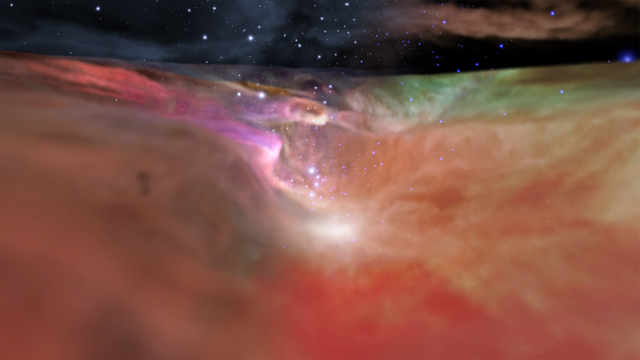
Visible and Infrared Visualization of the Orion Nebula (Artist’s Concept) : This image showcases both the visible-light and the infrared-light visualizations of the Orion Nebula. This view from the movie sequence looks down the “valley” leading to the star cluster at the far end. The left side of the image shows the visible-light visualization, which fades to the infrared visualization on the right. These two contrasting models derive from observations by the Hubble and Spitzer space telescopes.
Using actual scientific imagery and other data, combined with Hollywood techniques, a team at the Space Telescope Science Institute in Baltimore, Maryland, and the Caltech/IPAC in Pasadena, California, has created the best and most detailed multi-wavelength visualization yet of this photogenic nebula. The fly-through enables people to experience and learn about the universe in an exciting new way.
The three-minute movie, which shows the Orion Nebula in both visible and infrared light, was released to the public today. It is available to planetariums and other centers of informal learning worldwide to help audiences explore fundamental questions in science such as, “How did we get here?”
“Being able to fly through the nebula’s tapestry in three dimensions gives people a much better sense of what the universe is really like,” explained the Space Telescope Science Institute’s visualization scientist Frank Summers, who led the team that developed the movie. “By adding depth and structure to the amazing images, this fly-through helps elucidate the universe for the public, both educating and inspiring,”
added Summers.
“Looking at the universe in infrared light gives striking context for the more familiar visible-light views. This movie provides a uniquely immersive chance to see how new features appear as we shift to wavelengths of light normally invisible to our eyes,”
said Robert Hurt, lead visualization scientist at IPAC.
One of the sky’s brightest nebulas, the Orion Nebula is visible to the naked eye. It appears as the middle “star” in the sword of the constellation Orion, the Hunter, and is located about 1,350 light-years away. At only 2 million years old, the nebula is an ideal laboratory for studying young stars and stars that are still forming. It offers a glimpse of what might have happened when the Sun was born 4.6 billion years ago.
The three-dimensional video provides a look at the fantastic topography of the nebula. A torrent of ultraviolet radiation and stellar winds from the massive, central stars of the Trapezium star cluster have carved out a cavernous bowl-like cavity in the wall of a giant cloud of cold molecular hydrogen laced with dust.
Astronomers and visualizers worked together to make a three-dimensional model of the depths of this cavernous region, like plotting mountains and valleys on the ocean floor. Colorful Hubble and Spitzer images were then overlaid on the terrain.
The scientific visualization video takes the viewer on a breathtaking flight through the nebula, following the contours of the gas and dust. By toggling between the Hubble and Spitzer’s views, the movie shows strikingly different details of the Orion Nebula.
Hubble sees objects that glow in visible light, which are typically in the thousands of degrees. Spitzer is sensitive to cooler objects with temperatures of just hundreds of degrees. Spitzer’s infrared vision pierces through obscuring dust to see stars embedded deep into the nebula, as well as fainter and less massive stars, which are brighter in the infrared than in visible light. The new visualization helps people experience how the two telescopes provide a more complex and complete picture of the nebula.
The visualization is one of a new generation of products and experiences being developed by the NASA’s Universe of Learning program. The effort combines a direct connection to the science and scientists of NASA’s Astrophysics missions with attention to audience needs to enable youth, families, and lifelong learners to explore fundamental questions in science, experience how science is done, and discover the universe for themselves.
The three-dimensional interpretation is guided by scientific knowledge and scientific intuition. Starting with the two-dimensional Hubble and Spitzer images, Summers and Hurt worked with experts to analyze the structure inside the nebula. They first created a visible-light surface, and then an underlying structure of the infrared features.
To give the nebula its ethereal feel, Summers wrote a special rendering code for efficiently combining the tens of millions of semi-transparent elements of the gas. The customized code allows Summers to run this and other visualizations on desktop workstations, rather than on a supercomputing cluster.
The other components of the nebula were isolated into image layers and modeled separately. These elements included stars, protoplanetary disks, bow shocks, and the thin gas in front of the nebula called “the veil.” After rendering, these layers and the gaseous nebula are brought back together to create the visualization.
The three-dimensional structures serve as scientifically reasonable approximations for imagining the nebula.
“The main thing is to give the viewer an experiential understanding, so that they have a way to interpret the images from telescopes,” explained Summers. “It’s a really wonderful thing when they can build a mental model in their head to transform the two-dimensional image into a three-dimensional scene.”
This movie demonstrates the power of multi-wavelength astronomy. It helps audiences understand how science is done — how and why astronomers use multiple regions of the electromagnetic spectrum to explore and learn about our universe. It is also whetting astronomers’ appetites for what they will see with NASA’s James Webb Space Telescope, which will show much finer details of the deeper, infrared features.
More visualizations and connections between the science of nebulas and learners can be explored through other products produced by NASA’s Universe of Learning such as ViewSpace. ViewSpace is a video exhibit currently at almost 200 museums and planetariums across the United States. Visitors can go beyond video to explore the images produced by space telescopes with interactive tools now available for museums and planetariums.
NASA’s Universe of Learning materials are based upon work supported by NASA under award number NNX16AC65A to the Space Telescope Science Institute, working in partnership with Caltech/IPAC, Jet Propulsion Laboratory, Smithsonian Astrophysical Observatory, and Sonoma State University.