This test image from one of the four cameras aboard the Transiting Exoplanet Survey Satellite (TESS) captures a swath of the southern sky along the plane of our galaxy. TESS is expected to cover more than 400 times the amount of sky shown in this image when using all four of its cameras during science operations. Credits: NASA/MIT/TESS
NASA’s next planet hunter, the Transiting Exoplanet Survey Satellite (TESS), is one step closer to searching for new worlds after successfully completing a lunar flyby on May 17. The spacecraft passed about 5,000 miles from the Moon, which provided a gravity assist that helped TESS sail toward its final working orbit.
As part of camera commissioning, the science team snapped a two-second test exposure using one of the four TESS cameras. The image, centered on the southern constellation Centaurus, reveals more than 200,000 stars. The edge of the Coalsack Nebula is in the right upper corner and the bright star Beta Centauri is visible at the lower left edge. TESS is expected to cover more than 400 times as much sky as shown in this image with its four cameras during its initial two-year search for exoplanets. A science-quality image, also referred to as a “first light” image, is expected to be released in June.
TESS will undergo one final thruster burn on May 30 to enter its science orbit around Earth. This highly elliptical orbit will maximize the amount of sky the spacecraft can image, allowing it to continuously monitor large swaths of the sky. TESS is expected to begin science operations in mid-June after reaching this orbit and completing camera calibrations.
Launched from Cape Canaveral Air Force Station in Florida on April 18, TESS is the next step in NASA’s search for planets outside our solar system, known as exoplanets. The mission will observe nearly the entire sky to monitor nearby, bright stars in search of transits — periodic dips in a star’s brightness caused by a planet passing in front of the star. TESS is expected to find thousands of exoplanets. NASA’s upcoming James Webb Space Telescope, scheduled for launch in 2020, will provide important follow-up observations of some of the most promising TESS-discovered exoplanets, allowing scientists to study their atmospheres.
TESS is a NASA Astrophysics Explorer mission led and operated by MIT in Cambridge, Massachusetts, and managed by NASA’s Goddard Space Flight Center in Greenbelt, Maryland. Dr. George Ricker of MIT’s Kavli Institute for Astrophysics and Space Research serves as principal investigator for the mission. Additional partners include Orbital ATK, based in Dulles, Virginia; NASA’s Ames Research Center in California’s Silicon Valley; the Harvard-Smithsonian Center for Astrophysics in Cambridge, Massachusetts; and the Space Telescope Science Institute in Baltimore. The TESS science instruments were jointly developed by MIT’s Kavli Institute for Astrophysics and Space Research and MIT’s Lincoln Laboratory. More than a dozen universities, research institutes and observatories worldwide are participants in the mission.
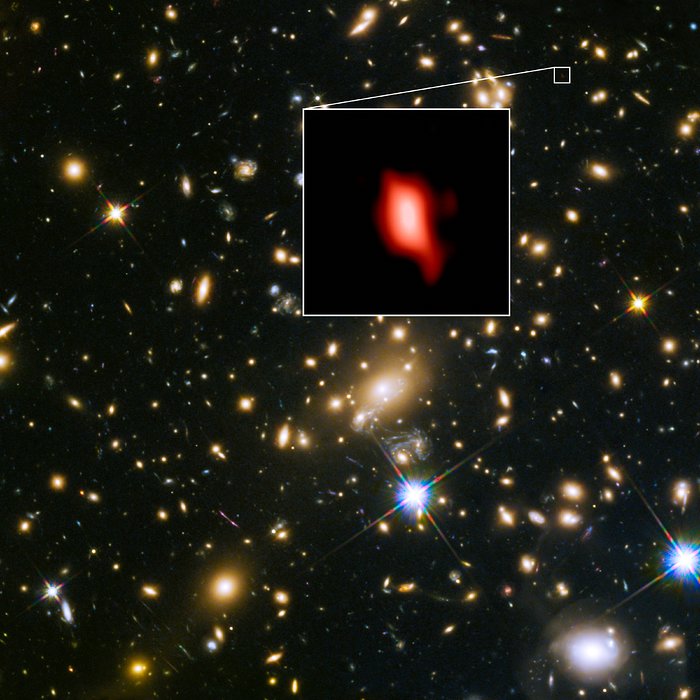
This image shows the galaxy cluster MACS J1149.5+2223 taken with the NASA/ESA Hubble Space Telescope; the inset image is the very distant galaxy MACS1149-JD1, seen as it was 13.3 billion years ago and observed with ALMA. Here, the oxygen distribution detected with ALMA is depicted in red. [Larger images]
Astronomers have used observations from the Atacama Large Millimeter/submillimeter Array (ALMA) and ESO’s Very Large Telescope (VLT) to determine that star formation in the very distant galaxy MACS1149-JD1 started at an unexpectedly early stage, only 250 million years after the Big Bang. This discovery also represents the most distant oxygen ever detected in the Universe and the most distant galaxy ever observed by ALMA or the VLT. The results will appear in the journal Nature on 17 May 2018.
An international team of astronomers used ALMA to observe a distant galaxy called MACS1149-JD1. They detected a very faint glow emitted by ionised oxygen in the galaxy. As this infrared light travelled across space, the expansion of the Universe stretched it to wavelengths more than ten times longer by the time it reached Earth and was detected by ALMA. The team inferred that the signal was emitted 13.3 billion years ago (or 500 million years after the Big Bang), making it the most distant oxygen ever detected by any telescope [1]. The presence of oxygen is a clear sign that there must have been even earlier generations of stars in this galaxy.
“I was thrilled to see the signal of the distant oxygen in the ALMA data,” says Takuya Hashimoto, the lead author of the new paper and a researcher at both Osaka Sangyo University and the National Astronomical Observatory of Japan. “This detection pushes back the frontiers of the observable Universe.”
In addition to the glow from oxygen picked up by ALMA, a weaker signal of hydrogen emission was also detected by ESO’s Very Large Telescope (VLT). The distance to the galaxy determined from this observation is consistent with the distance from the oxygen observation. This makes MACS1149-JD1 the most distant galaxy with a precise distance measurement and the most distant galaxy ever observed with ALMA or the VLT.
“This galaxy is seen at a time when the Universe was only 500 million years old and yet it already has a population of mature stars,” explains Nicolas Laporte, a researcher at University College London (UCL) in the UK and second author of the new paper. “We are therefore able to use this galaxy to probe into an earlier, completely uncharted period of cosmic history.”
For a period after the Big Bang there was no oxygen in the Universe; it was created by the fusion processes of the first stars and then released when these stars died. The detection of oxygen in MACS1149-JD1 indicates that these earlier generations of stars had been already formed and expelled oxygen by just 500 million years after the beginning of the Universe.
But when did this earlier star formation occur? To find out, the team reconstructed the earlier history of MACS1149-JD1 using infrared data taken with the NASA/ESA Hubble Space Telescope and the NASA Spitzer Space Telescope. They found that the observed brightness of the galaxy is well-explained by a model where the onset of star formation corresponds to only 250 million years after the Universe began [2].
The maturity of the stars seen in MACS1149-JD1 raises the question of when the very first galaxies emerged from total darkness, an epoch astronomers romantically term “cosmic dawn”. By establishing the age of MACS1149-JD1, the team has effectively demonstrated that galaxies existed earlier than those we can currently directly detect.
Richard Ellis, senior astronomer at UCL and co-author of the paper, concludes:
“Determining when cosmic dawn occurred is akin to the Holy Grail of cosmology and galaxy formation. With these new observations of MACS1149-JD1 we are getting closer to directly witnessing the birth of starlight! Since we are all made of processed stellar material, this is really finding our own origins.”
Notes
[1] ALMA has set the record for detecting the most distant oxygen several times. In 2016, Akio Inoue at Osaka Sangyo University and his colleagues used ALMA to find a signal of oxygen emitted 13.1 billion years ago. Several months later, Nicolas Laporte of University College London used ALMA to detect oxygen 13.2 billion years ago. Now, the two teams combined their efforts and achieved this new record, which corresponds to a redshift of 9.1.
[2] This corresponds to a redshift of about 15.
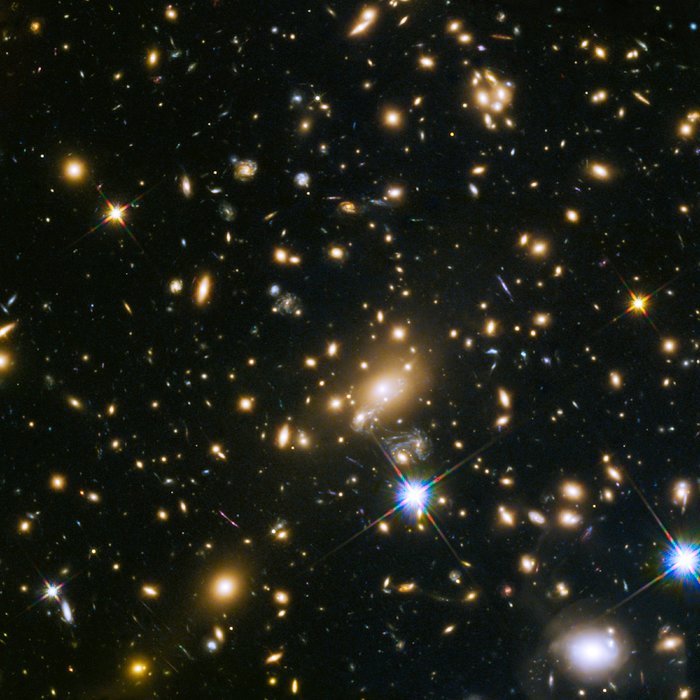
This image shows the huge galaxy cluster MACS J1149.5+223, whose light took over 5 billion years to reach us. The huge mass of the cluster is bending the light from more distant objects. The light from these objects has been magnified and distorted due to gravitational lensing. The same effect is creating multiple images of the same distant objects. [ Larger images]
The new documentary film In Saturn’s Rings, narrated by LeVar Burton, shows striking scenes of space travel and exploration using only actual images observed with telescopes, space probes, and astronaut cameras. No computer generated artists’ creations are included but techniques developed by Ken Burns and Walt Disney give 3-D impressions of objects like Saturn and its rings. The super high-resolution film will be available on “Giant Screen, IMAX, Fulldome Planetariums“. Check out the trailer for the film:
From the caption:
In Saturn’s Rings is a groundbreaking giant-screen movie adventure that takes audiences on a space exploration journey of the mind, heart, and spirit, from the Big Bang to the awe-inspiring rings of Saturn.
Narrated by LeVar Burton, In Saturn’s Rings is created entirely of more than 7.5 million stunning images of Earth, the Milky Way, and the Saturn taken by Hubble, Cassini, and other NASA space telescopes looking deep into the past.
The film is made with 2D multiplane parallax techniques developed by Walt Disney combined with Ken Burns technique to avoid using any type of camera projection, 3D models, visual FX, texture maps etc. We also feature some high resolution time lapse photography.
Visit insaturnsrings.com to learn more about how this film was made, screening and release info and more.
Trailer music is custom version of track from Neumann Films.
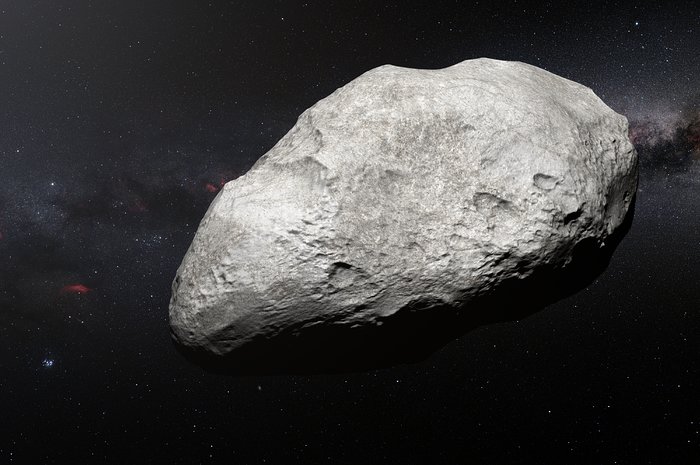
This artist’s impression shows the exiled asteroid 2004 EW95, the first carbon-rich asteroid confirmed to exist in the Kuiper Belt and a relic of the primordial Solar System. This curious object likely formed in the asteroid belt between Mars and Jupiter and must have been transported billions of kilometres from its origin to its current home in the Kuiper Belt. [Larger images]An international team of astronomers has used ESO telescopes to investigate a relic of the primordial Solar System. The team found that the unusual Kuiper Belt Object 2004 EW95 is a carbon-rich asteroid, the first of its kind to be confirmed in the cold outer reaches of the Solar System. This curious object likely formed in the asteroid belt between Mars and Jupiter and has been flung billions of kilometres from its origin to its current home in the Kuiper Belt.
The early days of our Solar System were a tempestuous time. Theoretical models of this period predict that after the gas giants formed they rampaged through the Solar System, ejecting small rocky bodies from the inner Solar System to far-flung orbits at great distances from the Sun [1]. In particular, these models suggest that the Kuiper Belt — a cold region beyond the orbit of Neptune — should contain a small fraction of rocky bodies from the inner Solar System, such as carbon-rich asteroids, referred to as carbonaceous asteroids[2].
Now, a recent paper has presented evidence for the first reliably-observed carbonaceous asteroid in the Kuiper Belt, providing strong support for these theoretical models of our Solar System’s troubled youth. After painstaking measurements from multiple instruments at ESO’s Very Large Telescope (VLT), a small team of astronomers led by Tom Seccull of Queen’s University Belfast in the UK was able to measure the composition of the anomalous Kuiper Belt Object 2004 EW95, and thus determine that it is a carbonaceous asteroid. This suggests that it originally formed in the inner Solar System and must have since migrated outwards [3].
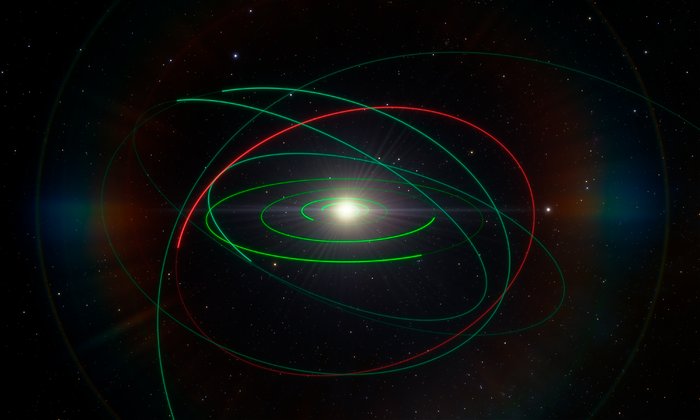
An international team of astronomers has used ESO telescopes to investigate a relic of the primordial Solar System. The team found that the unusual Kuiper Belt Object 2004 EW95 is a carbon-rich asteroid, the first of its kind to be confirmed in the cold outer reaches of the Solar System. The red line in this image shows the orbit of 2004 EW95, with the orbits of other Solar System bodies shown in green for comparison. [Larger images]The peculiar nature of 2004 EW95 first came to light during routine observations with the NASA/ESA Hubble Space Telescope by Wesley Fraser, an astronomer from Queen’s University Belfast who was also a member of the team behind this discovery. The asteroid’s reflectance spectrum — the specific pattern of wavelengths of light reflected from an object — was different to that of similar small Kuiper Belt Objects (KBOs), which typically have uninteresting, featureless spectra that reveal little information about their composition.
“The reflectance spectrum of 2004 EW95 was clearly distinct from the other observed outer Solar System objects,” explains lead author Seccull. “It looked enough of a weirdo for us to take a closer look.”
The team observed 2004 EW95 with the X-Shooter and FORS2 instruments on the VLT. The sensitivity of these spectrographs allowed the team to obtain more detailed measurements of the pattern of light reflected from the asteroid and thus infer its composition.
However, even with the impressive light-collecting power of the VLT, 2004 EW95 was still difficult to observe. Though the object is 300 kilometres across, it is currently a colossal four billion kilometres from Earth, making gathering data from its dark, carbon-rich surface a demanding scientific challenge.
“It’s like observing a giant mountain of coal against the pitch-black canvas of the night sky,”
says co-author Thomas Puzia from the Pontificia Universidad Católica de Chile.
“Not only is 2004 EW95 moving, it’s also very faint,” adds Seccull. “We had to use a pretty advanced data processing technique to get as much out of the data as possible.”
Two features of the object’s spectra were particularly eye-catching and corresponded to the presence of ferric oxides and phyllosilicates. The presence of these materials had never before been confirmed in a KBO, and they strongly suggest that 2004 EW95 formed in the inner Solar System.
Seccull concludes:
“Given 2004 EW95’s present-day abode in the icy outer reaches of the Solar System, this implies that it has been flung out into its present orbit by a migratory planet in the early days of the Solar System.”
[ Olivier Hainaut, an ESO astronomer who was not part of the team, comments, ]
“While there have been previous reports of other ‘atypical’ Kuiper Belt Object spectra, none were confirmed to this level of quality,” … “The discovery of a carbonaceous asteroid in the Kuiper Belt is a key verification of one of the fundamental predictions of dynamical models of the early Solar System.”
Notes
[1] Current dynamical models of the evolution of the early Solar System, such as the grand tack hypothesis and the Nice model, predict that the giant planets migrated first inward and then outward, disrupting and scattering objects from the inner Solar System. As a consequence, a small percentage of rocky asteroids are expected to have been ejected into orbits in the Oort Cloud and Kuiper belt.
[2] Carbonaceous asteroids are those containing the element carbon or its various compounds. Carbonaceous — or C-type — asteroids can be identified by their dark surfaces, caused by the presence of carbon molecules.
[3] Other inner Solar System objects have previously been detected in the outer reaches of the Solar System, but this is the first carbonaceous asteroid to be found far from home in the Kuiper Belt.
Near-Earth asteroids are a population of small bodies whose orbits around the Sun cross or come near our planet’s orbit. They turn out to be unusual physical environments: essentially rubble piles. They represent a natural hazard we ignore at our peril, because some of these bodies have the potential to impact Earth. Dr. Busch reviews the near-Earth population, programs to track and characterize near-Earth asteroids, and current efforts to address the danger of asteroid impacts.