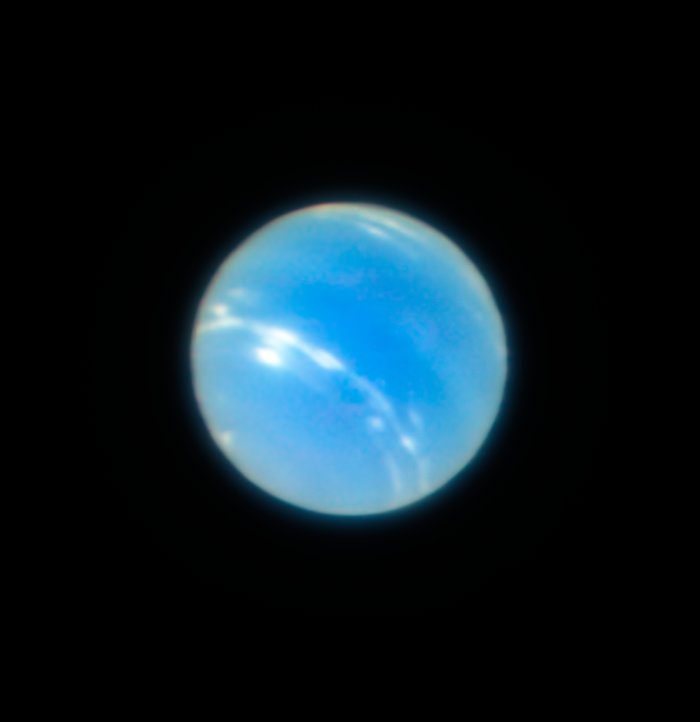
This image of the planet Neptune was obtained during the testing of the Narrow-Field adaptive optics mode of the MUSE/GALACSI instrument on ESO’s Very Large Telescope. The corrected image is sharper than a comparable image from the NASA/ESA Hubble Space Telescope. [Higher-res images]ESO’s Very Large Telescope (VLT) has achieved first light with a new adaptive optics mode called laser tomography — and has captured remarkably sharp test images of the planet Neptune, star clusters and other objects. The pioneering MUSE instrument in Narrow-Field Mode, working with the GALACSI adaptive optics module, can now use this new technique to correct for turbulence at different altitudes in the atmosphere. It is now possible to capture images from the ground at visible wavelengths that are sharper than those from the NASA/ESA Hubble Space Telescope. The combination of exquisite image sharpness and the spectroscopic capabilities of MUSE will enable astronomers to study the properties of astronomical objects in much greater detail than was possible before.
The MUSE (Multi Unit Spectroscopic Explorer) instrument on ESO’s Very Large Telescope (VLT) works with an adaptive optics unit called GALACSI. This makes use of the Laser Guide Star Facility, 4LGSF, a subsystem of the Adaptive Optics Facility (AOF). The AOF provides adaptive optics for instruments on the VLTs Unit Telescope 4 (UT4). MUSE was the first instrument to benefit from this new facility and it now has two adaptive optics modes — the Wide Field Mode and the Narrow Field Mode [1].
The MUSE Wide Field Mode coupled to GALACSI in ground-layer mode corrects for the effects of atmospheric turbulence up to one kilometre above the telescope over a comparatively wide field of view. But the new Narrow Field Mode using laser tomography corrects for almost all of the atmospheric turbulence above the telescope to create much sharper images, but over a smaller region of the sky [2].
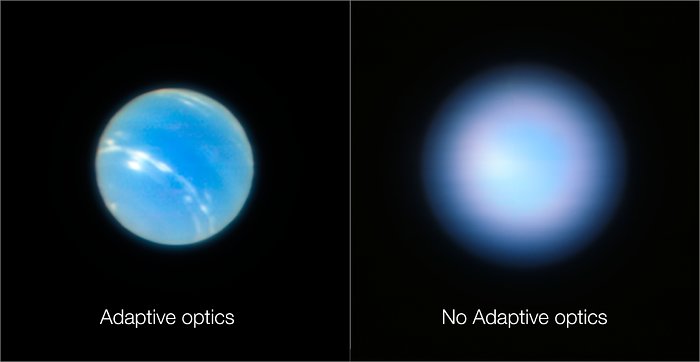
These images of the planet Neptune were obtained during the testing of the Narrow-Field adaptive optics mode of the MUSE/GALACSI instrument on ESO’s Very Large Telescope. The image on the right is without the adaptive optics system in operation and the one on the left after the adaptive optics are switched on. [Higher-res images]With this new capability, the 8-metre UT4 reaches the theoretical limit of image sharpness and is no longer limited by atmospheric blur. This is extremely difficult to attain in the visible and gives images comparable in sharpness to those from the NASA/ESA Hubble Space Telescope. It will enable astronomers to study in unprecedented detail fascinating objects such as supermassive black holes at the centres of distant galaxies, jets from young stars, globular clusters, supernovae, planets and their satellites in the Solar System and much more.
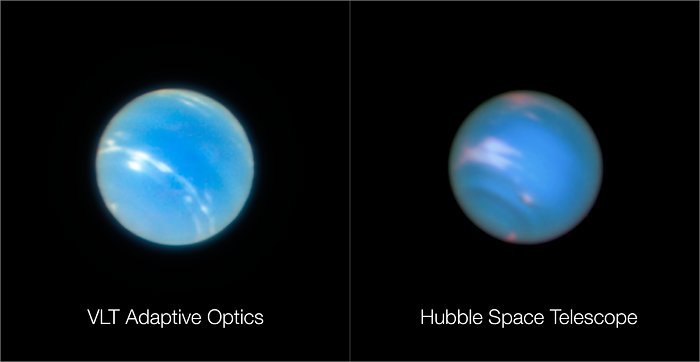
The image of the planet Neptune on the left was obtained during the testing of the Narrow-Field adaptive optics mode of the MUSE instrument on ESO’s Very Large Telescope. The image on the right is a comparable image from the NASA/ESA Hubble Space Telescope. Note that the two images were not taken at the same time so do not show identical surface features. [Higher-res images]Adaptive optics is a technique to compensate for the blurring effect of the Earth’s atmosphere, also known as astronomical seeing, which is a big problem faced by all ground-based telescopes. The same turbulence in the atmosphere that causes stars to twinkle to the naked eye results in blurred images of the Universe for large telescopes. Light from stars and galaxies becomes distorted as it passes through our atmosphere, and astronomers must use clever technology to improve image quality artificially.
To achieve this four brilliant lasers are fixed to UT4 that project columns of intense orange light 30 centimetres in diameter into the sky, stimulating sodium atoms high in the atmosphere and creating artificial Laser Guide Stars. Adaptive optics systems use the light from these “stars” to determine the turbulence in the atmosphere and calculate corrections one thousand times per second, commanding the thin, deformable secondary mirror of UT4 to constantly alter its shape, correcting for the distorted light.
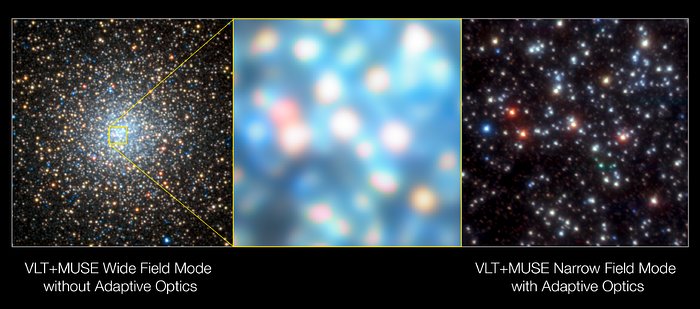
These images of the globular star cluster NGC 6388 were obtained during the testing of the Narrow-Field adaptive optics mode of the MUSE instrument on ESO’s Very Large Telescope. The image on the left is from MUSE in Wide Field Mode, without the adaptive optics system in operation and the centre panel is an enlargement of a small part of this view. The image on the right is the view from the Narrow-Field Mode of MUSE when adaptive optics are switched on. [Higher-res images]MUSE is not the only instrument to benefit from the Adaptive Optics Facility. Another adaptive optics system, GRAAL, is already in use with the infrared camera HAWK-I. This will be followed in a few years by the powerful new instrument ERIS. Together these major developments in adaptive optics are enhancing the already powerful fleet of ESO telescopes, bringing the Universe into focus.
This new mode also constitutes a major step forward for the ESO’s Extremely Large Telescope, which will need Laser Tomography to reach its science goals. These results on UT4 with the AOF will help to bring ELT’s engineers and scientists closer to implementing similar adaptive optics technology on the 39-metre giant.
Notes
[1] MUSE and GALACSI in Wide-Field Mode already provides a correction over a 1.0-arcminute-wide field of view, with pixels 0.2 by 0.2 arcseconds in size. This new Narrow-Field Mode from GALACSI covers a much smaller 7.5-arcsecond field of view, but with much smaller pixels just 0.025 by 0.025 arcseconds to fully exploit the exquisite resolution.
[2] Atmospheric turbulence varies with altitude; some layers cause more degradation to the light beam from stars than others. The complex adaptive optics technique of Laser Tomography aims to correct mainly the turbulence of these atmospheric layers. A set of pre-defined layers are selected for the MUSE/GALACSI Narrow Field Mode at 0 km (ground layer; always an important contributor), 3, 9 and 14 km altitude. The correction algorithm is then optimised for these layers to enable astronomers to reach an image quality almost as good as with a natural guide star and matching the theoretical limit of the telescope.
New observations by three of the world’s largest radio telescopes have revealed that an asteroid discovered last year is actually two objects, each about 3,000 feet (900 meters) in size, orbiting each other.
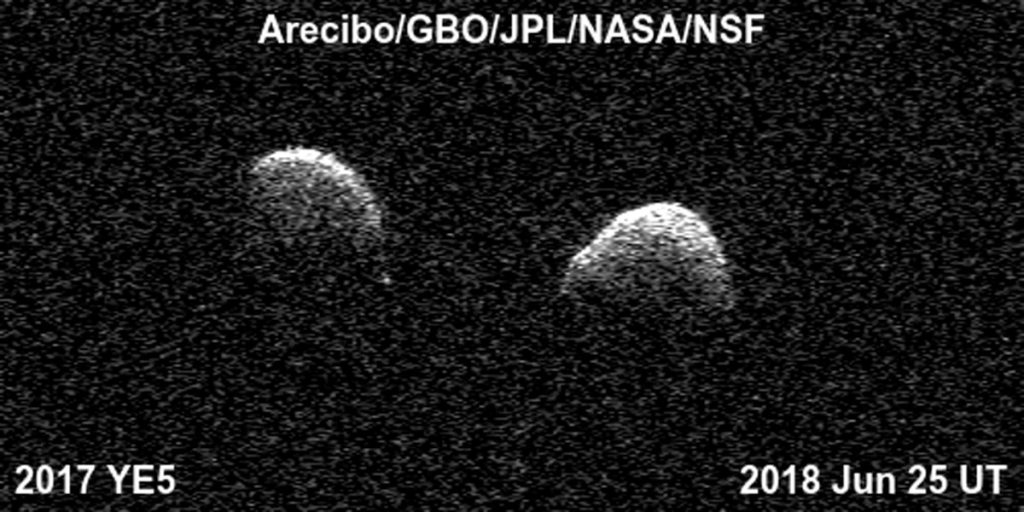
Near-Earth asteroid 2017 YE5 was discovered with observations provided by the Morocco Oukaimeden Sky Survey on Dec. 21, 2017, but no details about the asteroid’s physical properties were known until the end of June. This is only the fourth “equal mass” binary near-Earth asteroid ever detected, consisting of two objects nearly identical in size, orbiting each other. The new observations provide the most detailed images ever obtained of this type of binary asteroid.
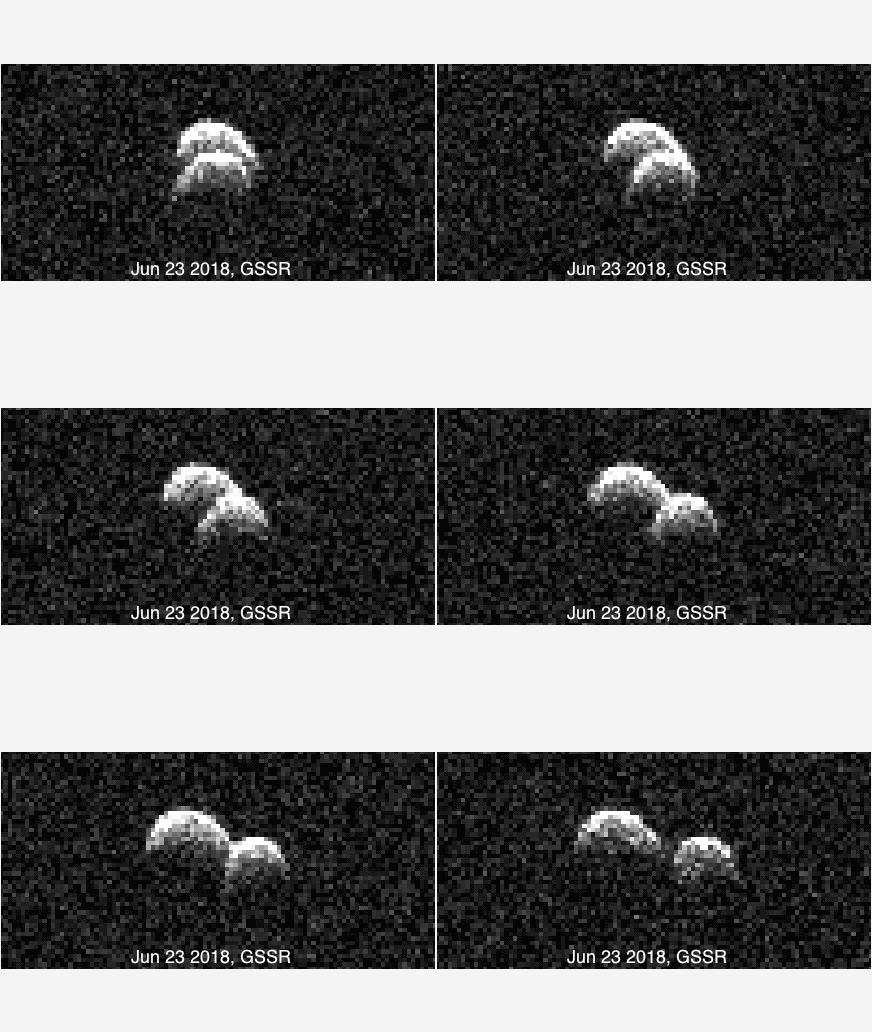
On June 21, the asteroid 2017 YE5 made its closest approach to Earth for at least the next 170 years, coming to within 3.7 million miles (6 million kilometers) of Earth, or about 16 times the distance between Earth and the Moon. On June 21 and 22, observations by NASA’s Goldstone Solar System Radar (GSSR) in California showed the first signs that 2017 YE5 could be a binary system. The observations revealed two distinct lobes, but the asteroid’s orientation was such that scientists could not see if the two bodies were separate or joined. Eventually, the two objects rotated to expose a distinct gap between them.
Bi-static radar images of the binary asteroid 2017 YE5 from the Arecibo Observatory and the Green Bank Observatory on June 25. The observations show that the asteroid consists of two separate objects in orbit around each other. Credit: Arecibo/GBO/NSF/NASA/JPL-Caltech. Full image and caption
Scientists at the Arecibo Observatory in Puerto Rico had already planned to observe 2017 YE5, and they were alerted by their colleagues at Goldstone of the asteroid’s unique properties. On June 24, the scientists teamed up with researchers at the Green Bank Observatory (GBO) in West Virginia and used the two observatories together in a bi-static radar configuration (in which Arecibo transmits the radar signal and Green Bank receives the return signal). Together, they were able to confirm that 2017 YE5 consists of two separated objects. By June 26, both Goldstone and Arecibo had independently confirmed the asteroid’s binary nature.
The new observations obtained between June 21 and 26 indicate that the two objects revolve around each other once every 20 to 24 hours. This was confirmed with visible-light observations of brightness variations by Brian Warner at the Center for Solar System Studies in Rancho Cucamonga, California.
Radar imaging shows that the two objects are larger than their combined optical brightness originally suggested, indicating that the two rocks do not reflect as much sunlight as a typical rocky asteroid. 2017 YE5 is likely as dark as charcoal. The Goldstone images taken on June 21 also show a striking difference in the radar reflectivity of the two objects, a phenomenon not seen previously among more than 50 other binary asteroid systems studied by radar since 2000. (However, the majority of those binary asteroids consist of one large object and a much smaller satellite.) The reflectivity differences also appear in the Arecibo images and hint that the two objects may have different densities, compositions near their surfaces, or different surface roughnesses.
Scientists estimate that among near-Earth asteroids larger than 650 feet (200 meters) in size, about 15 percent are binaries with one larger object and a much smaller satellite. Equal-mass binaries like 2017 YE5 are much rarer. Contact binaries, in which two similarly sized objects are in contact, are thought to make up another 15 percent of near-Earth asteroids larger than 650 feet (200 meters) in size.
The discovery of the binary nature of 2017 YE5 provides scientists with an important opportunity to improve understanding of different types of binaries and to study the formation mechanisms between binaries and contact binaries, which may be related. Analysis of the combined radar and optical observations may allow scientists to estimate the densities of the 2017 YE5 objects, which will improve understanding of their composition and internal structure, and of how they formed.
Radar images of the binary asteroid 2017 YE5 from NASA’s Goldstone Solar System Radar (GSSR). The observations, conducted on June 23, 2018, show two lobes, but do not yet show two separate objects. Credit: GSSR/NASA/JPL-Caltech. Full image and caption
Study contributors
The Goldstone observations were led by Marina Brozovi, a radar scientist at NASA’s Jet Propulsion Laboratory in Pasadena, California.
Anne Virkki, Flaviane Venditti and Sean Marshall of the Arecibo Observatory and the University of Central Florida led the observations using the Arecibo Observatory.
Patrick Taylor of the Universities Space Research Association (USRA), scientist at the Lunar and Planetary Institute, led the bi-static radar observations with GBO, home of the Green Bank Telescope (GBT), the world’s largest fully steerable radio telescope.
The Arecibo, Goldstone and USRA planetary radar projects are funded through NASA’s Near-Earth Object Observations Program within the Planetary Defense Coordination Office (PDCO), which manages the Agency’s Planetary Defense Program. The Arecibo Observatory is a facility of the National Science Foundation operated under cooperative agreement by the University of Central Florida, Yang Enterprises, and Universidad Metropolitana. GBO is a facility of the National Science Foundation, operated under a cooperative agreement by Associated Universities, Inc.
In addition to the resources NASA puts into understanding asteroids, the PDCO also partners with other U.S. government agencies, university-based astronomers, and space science institutes across the country, often with grants, interagency transfers and other contracts from NASA. They also collaborate with international space agencies and institutions that are working to track and better understand these smaller objects of the Solar System. In addition, NASA values the work of numerous highly skilled amateur astronomers, whose accurate observational data helps improve asteroid orbits after discovery.
More information about asteroids and near-Earth objects is at these sites:
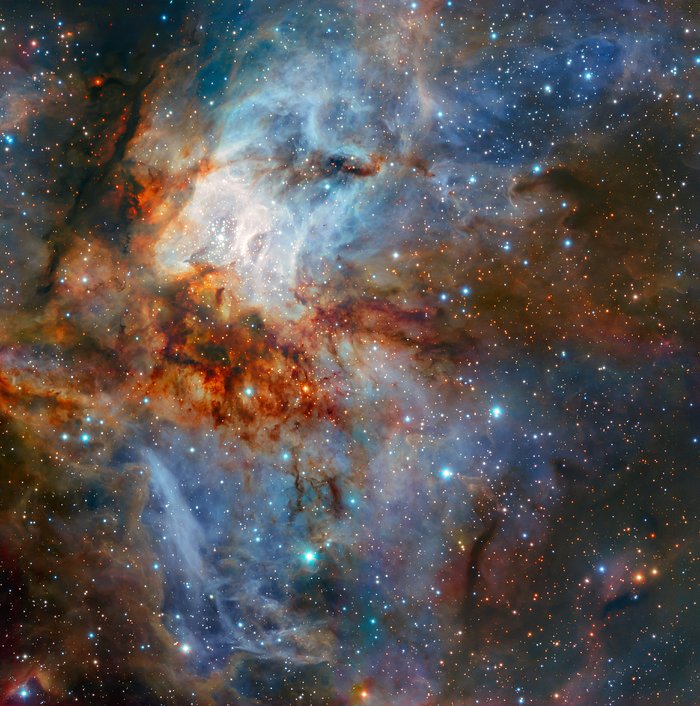
New observations with ESO’s Very Large Telescope show the star cluster RCW 38 in all its glory. This image was taken during testing of the HAWK-I camera with the GRAAL adaptive optics system. It shows the cluster and its surrounding clouds of brightly glowing gas in exquisite detail, with dark tendrils of dust threading through the bright core of this young gathering of stars. [Higher res images]New observations with ESO’s Very Large Telescope show the star cluster RCW 38 in all its glory. This image was taken during testing of the HAWK-I camera with the GRAAL adaptive optics system. It shows RCW 38 and its surrounding clouds of brightly glowing gas in exquisite detail, with dark tendrils of dust threading through the bright core of this young gathering of stars.
This image shows the star cluster RCW 38, as captured by the HAWK-I infrared imager mounted on ESO’s Very Large Telescope (VLT) in Chile. By gazing into infrared wavelengths, HAWK-I can examine dust-shrouded star clusters like RCW 38, providing an unparalleled view of the stars forming within. This cluster contains hundreds of young, hot, massive stars, and lies some 5500 light-years away in the constellation of Vela (The Sails).
The central area of RCW 38 is visible here as a bright, blue-tinted region, an area inhabited by numerous very young stars and protostars that are still in the process of forming. The intense radiation pouring out from these newly born stars causes the surrounding gas to glow brightly. This is in stark contrast to the streams of cooler cosmic dust winding through the region, which glow gently in dark shades of red and orange. The contrast creates this spectacular scene — a piece of celestial artwork.
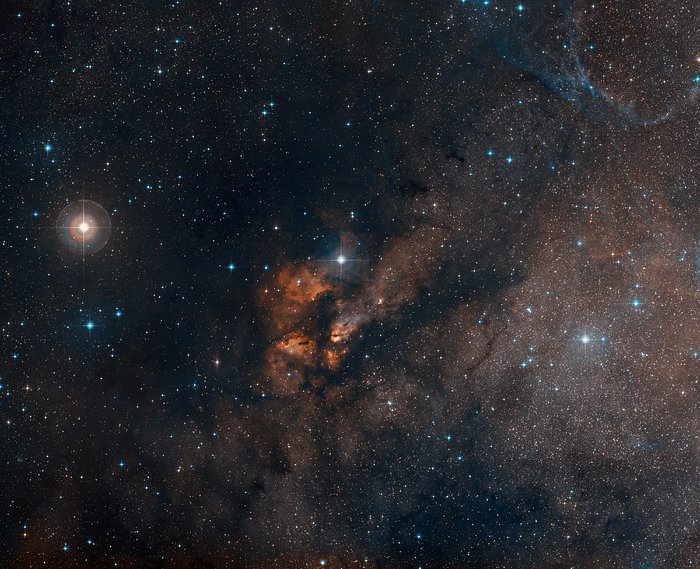
This image is a colour composite made from exposures from the Digitized Sky Survey 2 (DSS2). The field of view is approximatelly 2.4 x 2.0 degrees. [Higher-res images]Previous images of this region taken in optical wavelengths are strikingly different — optical images appear emptier of stars due to dust and gas blocking our view of the cluster. Observations in the infrared, however, allow us to peer through the dust that obscures the view in the optical and delve into the heart of this star cluster.
HAWK-I is installed on Unit Telescope 4 (Yepun) of the VLT, and operates at near-infrared wavelengths. It has many scientific roles, including obtaining images of nearby galaxies or large nebulae as well as individual stars and exoplanets. GRAAL is an adaptive optics module which helps HAWK-I to produce these spectacular images. It makes use of four laser beams projected into the night sky, which act as artificial reference stars, used to correct for the effects of atmospheric turbulence — providing a sharper image.
This image was captured as part of a series of test observations — a process known as science verification — for HAWK-I and GRAAL. These tests are an integral part of the commissioning of a new instrument on the VLT, and include a set of typical scientific observations that verify and demonstrate the capabilities of the new instrument.
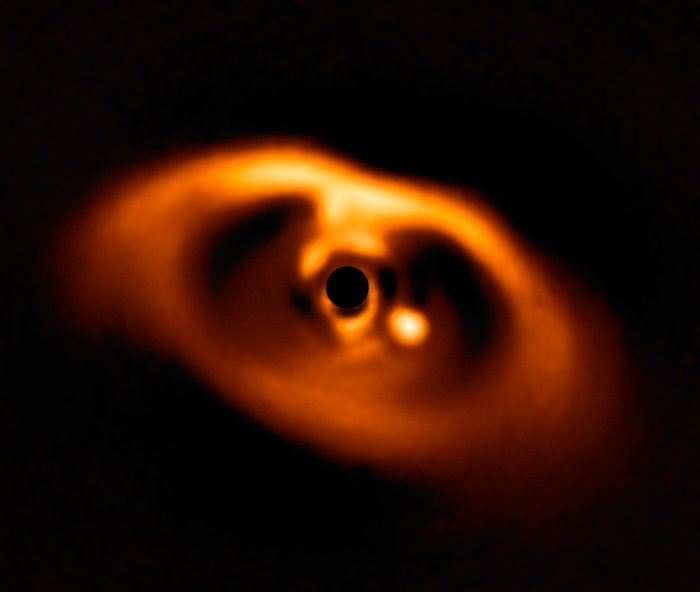
This spectacular image from the SPHERE instrument on ESO’s Very Large Telescope is the first clear image of a planet caught in the very act of formation around the dwarf star PDS 70. The planet stands clearly out, visible as a bright point to the right of the centre of the image, which is blacked out by the coronagraph mask used to block the blinding light of the central star. [Higher-res images]SPHERE, a planet-hunting instrument on ESO’s Very Large Telescope, has captured the first confirmed image of a planet caught in the act of forming in the dusty disc surrounding a young star. The young planet is carving a path through the primordial disc of gas and dust around the very young star PDS 70. The data suggest that the planet’s atmosphere is cloudy.
Astronomers led by a group at the Max Planck Institute for Astronomy in Heidelberg, Germany have captured a spectacular snapshot of planetary formation around the young dwarf star PDS 70. By using the SPHERE instrument on ESO’sVery Large Telescope (VLT) — one of the most powerful planet-hunting instruments in existence — the international team has made the first robust detection of a young planet, named PDS 70b, cleaving a path through the planet-forming material surrounding the young star [1].
The SPHERE instrument also enabled the team to measure the brightness of the planet at different wavelengths, which allowed properties of its atmosphere to be deduced.
The planet stands out very clearly in the new observations, visible as a bright point to the right of the blackened centre of the image. It is located roughly three billion kilometres from the central star, roughly equivalent to the distance between Uranus and the Sun. The analysis shows that PDS 70b is a giant gas planet with a mass a few times that of Jupiter. The planet’s surface has a temperature of around 1000°C, making it much hotter than any planet in our own Solar System.
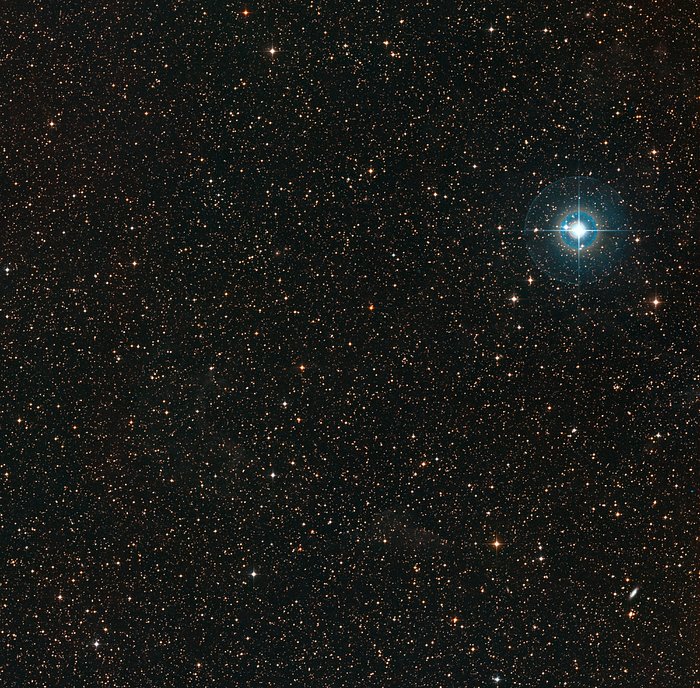
This colourful image shows the sky around the faint orange dwarf star PDS 70 (in the middle of the image). The bright blue star to the right is χ Centauri. [Larger images]The dark region at the centre of the image is due to a coronagraph, a mask which blocks the blinding light of the central star and allows astronomers to detect its much fainter disc and planetary companion. Without this mask, the faint light from the planet would be utterly overwhelmed by the intense brightness of PDS 70.
“These discs around young stars are the birthplaces of planets, but so far only a handful of observations have detected hints of baby planets in them,” explains Miriam Keppler, who lead the team behind the discovery of PDS 70’s still-forming planet. “The problem is that until now, most of these planet candidates could just have been features in the disc.”
The discovery of PDS 70’s young companion is an exciting scientific result that has already merited further investigation. A second team, involving many of the same astronomers as the discovery team, including Keppler, has in the past months followed up the initial observations to investigate PDS 70’s fledgling planetary companion in more detail. They not only made the spectacularly clear image of the planet shown here, but were even able to obtain a spectrum of the planet. Analysis of this spectrum indicated that its atmosphere is cloudy.
PDS 70’s planetary companion has sculpted a transition disc — a protoplanetary disc with a giant “hole” in the centre. These inner gaps have been known about for decades and it has been speculated that they were produced by disc-planet interaction. Now we can see the planet for the first time.
“Keppler’s results give us a new window onto the complex and poorly-understood early stages of planetary evolution,” comments André Müller, leader of the second team to investigate the young planet. “We needed to observe a planet in a young star’s disc to really understand the processes behind planet formation.”
By determining the planet’s atmospheric and physical properties, the astronomers are able to test theoretical models of planet formation.
This glimpse of the dust-shrouded birth of a planet was only possible thanks to the impressive technological capabilities of ESO’s SPHERE instrument, which studies exoplanets and discs around nearby stars using a technique known as high-contrast imaging — a challenging feat. Even when blocking the light from a star with a coronagraph, SPHERE still has to use cleverly devised observing strategies and data processing techniques to filter out the signal of the faint planetary companions around bright young stars [2] at multiple wavelengths and epochs.
Thomas Henning, director at the Max Planck Institute for Astronomy and leader of the teams, summarises the scientific adventure:
“After more than a decade of enormous efforts to build this high-tech machine, now SPHERE enables us to reap the harvest with the discovery of baby planets!”
Notes [1] The disc and planet images and the planet’s spectrum have been captured in the course of the two survey programmes called SHINE (SpHere INfrared survey for Exoplanets) and DISK (sphere survey for circumstellar DISK). SHINE aims to image 600 young nearby stars in the near-infrared using SPHERE’s high contrast and high angular resolution to discover and characterise new exoplanets and planetary systems. DISK explores known, young planetary systems and their circumstellar discs to study the initial conditions of planetary formation and the evolution of planetary architectures.
[2] In order to tease out the weak signal of the planet next to the bright star, astronomers use a sophisticated method that benefits from the Earth’s rotation. In this observing mode, SPHERE continuously takes images of the star over a period of several hours, while keeping the instrument as stable as possible. As a consequence, the planet appears to slowly rotate, changing its location on the image with respect to the stellar halo. Using elaborate numerical algorithms, the individual images are then combined in such a way that all parts of the image that appear not to move during the observation, such as the signal from the star itself, are filtered. This leaves only those that do apparently move — making the planet visible.