An announcement from the International Lunar Observatory Association (ILOA):
‘FIRST WOMEN ON THE MOON’ ESSAY CONTEST RULES
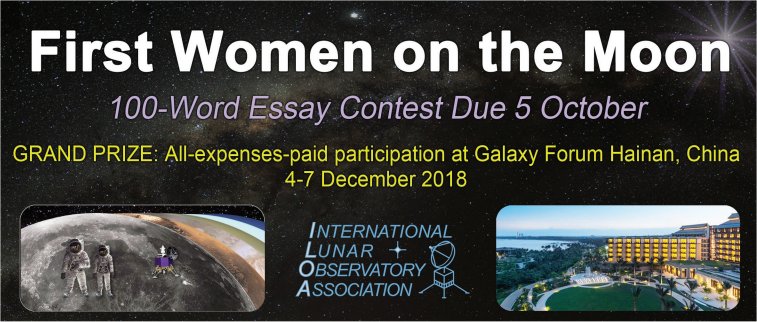
100-Word Submission Due 5 October 2018
Grand Prize: All-expenses-paid participation at Galaxy Forum Hainan, China 4-7 December 2018
INTRODUCTION: The first men walked upon the Moon in 1969. Since then, 61 women from multiple nations have traveled into Space. Several countries are now actively aiming for the Moon, including a Human Return to the Moon. The First Woman to the Moon is walking among us.
GRAND PRIZE: Winner will attend all sessions, ceremonies and activities at ILOA Galaxy Forum Hainan 2018, China on 4-7 December, and participate in the “First Women on the Moon” special luncheon panel featuring Astronauts Soyeon Yi, Naoko Yamazaki, other women Astronauts from China and USA (TBD); and potentially an Apollo Moonwalker. Direct purchase by ILOA will cover round-trip regular class airline travel to Hainan Island, hotel accommodation at Hilton Wenchang, Galaxy Forum registration fee and meals. Reimbursement for reasonable traveling incidentals such as meals at airports and ground transportation will be covered. Reimbursement for passport and visa, and expedited fees, will also be provided, if necessary.
HOW TO ENTER: Describe in 100 words or less why you would like to be the First Woman or one of the First Women on the Moon, and the significance of the First Woman landing on the Moon. Send your essay with subject line of “First Women on the Moon” to 1stWomenontheMoon@iloa.org along with your full name, age, mailing address, and telephone number listed at the bottom.
DEADLINE: All email entries due by 5 October 2018, 12:00 Hawaii Standard Time (UTC-10) to email address: 1stWomenontheMoon@iloa.org
ELIGIBILITY: Contest is open to all women 21 years of age or older by 1 December 2018, from any country, nation, continent, background and ability. English is the main language of Galaxy Forum Hainan, therefore we ask for essays to be written in English. Contestant must already have or be eligible to receive a Passport and a Visa to travel to Hainan, China for 4-7 December 2018.
WINNER SELECTION: ILOA Associates will review and select a Contest Winner based on the merit of the written essay.
WINNER NOTIFICATION: Grand Prize Winner will be informed via email or phone by 17 October 2018 and announced to media shortly thereafter. A Second Grand Prize or Runner Up may be chosen at ILOA’s discretion and may include an identical Grand Prize trip to ILOA Galaxy Forum Hainan, publicity of contestant’s essay, and / or a ‘First Women on the Moon’ mailing packet with posters and pins designed by ILOA.
SPONSOR: International Lunar Observatory Association (ILOA) an interglobal enterprise incorporated in Hawai’i as a 501(c)(3) non-profit to realize the multifunctional ILO — to advance human knowledge of the Cosmos through observation from our Moon, and to participate in lunar base build-out with Aloha. The ILOA also since 2008 has cosponsored with its Space Age Publishing Company affiliate an international series of 85 Galaxy Forums.
ODDS OF WINNING: The odds of winning this Contest will depend upon the number of Contest Contestants.
GALAXY FORUM HAINAN 2018, CHINA: Full public details for Galaxy Forum Hainan 2018 may be found here: https://galaxyforum.org/galaxy-forum-china-2018-hainan/
FURTHER INFORMATION AND CONTACT: Please visit the websites for International Lunar Observatory Association, Galaxy Forum, or affiliated Space Age Publishing Company. ILOA may or may not have time or ability to respond to contestant questions, however contestants are welcome to send questions to 1stWomenontheMoon@iloa.org
GENERAL CONDITIONS & BINDING AGREEMENTS: By entering this CONTEST (the “Contest”) and accepting the terms herein, you (the “Contestant” or “Winner”) agree to be bound by the conditions and terms outlined in this document. ILOA is not liable for any problems that may prevent your entry in the contest, or for events that delay or cancel the contest. No purchase is necessary to win.
These rules are subject to change and interpretation at the discretion of ILOA. Failure to adhere to the contest rules will be subject for removal from the contest.
Contestant is solely responsible for reviewing and understanding the policies regarding eligibility to participate in the Contest, its rules, regulations and responsibilities.
Contestant / Winner agrees that neither ILOA nor any affiliate, officer, director, employee, attorney, or agent of ILOA shall have any liability for any indirect or direct damages, inconveniences or issues that may arise from sources including, but not limited to, media attention, publicity, travel, ‘acts of god’, force majeure, or personal medical problems / sickness that could occur; the Contestant / Winner hereby waives, releases, and agrees not to sue any of them upon, any claim for any special, indirect, incidental, or consequential damages suffered or incurred by this Contest or ILOA in connection with, arising out of, or in any way related to this Contest.
CONTEST CANCELLATION, SUSPENSION OR MODIFICATION: ILOA reserves the right to cancel, terminate, modify or suspend this Contest if the Contest is not capable of being completed as planned for any reason. The decision of ILOA to cancel, terminate, modify or suspend this Contest shall be final in all respects.
PUBLICITY RELEASE: Unless prohibited by applicable law, Contestant / Winner authorizes and irrevocably grants to ILOA permission to, from time to time, reference and discuss Contestant / Winner and their participation in the Contest on-air and/or on their website(s) in photographs, video recordings, digital images, audio recordings, as well as in publications, newsletters, news releases, other printed materials, and in materials made available on the Internet or in other media now known or hereafter developed for any purpose ILOA deems proper. Such reference and discussion may involve Contestant’s name and voice, and other personal/biographical material or their participation.
RULES CHANGES AND INTERPRETATIONS: ILOA reserves the right in its sole discretion to supplement or make changes to the rules of this Contest at any time without notice. ILOA reserves the right in its sole discretion to interpret the rules of any contest, and such interpretation shall be binding upon all contestants.
CONTEST ENTITY AND IMMEDIATE FAMILY MEMBER DISQUALIFICATION: The officers, directors, employees, contractors, and agents of ILOA, as well as their immediate family members (and those living in the same household, whether or not related), are prohibited from participating in this Contest and do not qualify as Contestants. “Immediate family members” shall include spouses, siblings, parents, children, grandparents, and grandchildren, whether as “in-laws”, or by current or past marriage, remarriage, adoption, co-habitation or other familial extension.
FIRST WOMAN ON THE MOON POLL: ILOA invites anonymous voting from anyone for the “First Woman on the Moon” poll located on Space Calendar http://www.spacecalendar.com/ and Lunar Enterprise Daily http://www.lunarenterprisedaily.com/
Participating in this poll does not in any way affect this Contest or its results.
MEDIA INQUIRES: We welcome any MEDIA inquiries to be sent directly to ILOA at info@iloa.org
MAHALO / THANK YOU: ILOA sends a warm Mahalo and Thank You to all Contestants who enter this Contest and to all readers that share and support the ‘First Women on the Moon’ vision for the benefit of all humankind. Ad Astra with Aloha!
====