In November, look for Pisces, Aries, and Triangulum in the night sky. Also be sure to catch the Taurid meteor shower, which features 5 to 10 meteors per hour on its peak night of November 5 to 6, and for meteors radiating from the constellation of Leo in the evening of November 17 and early morning of November 18.
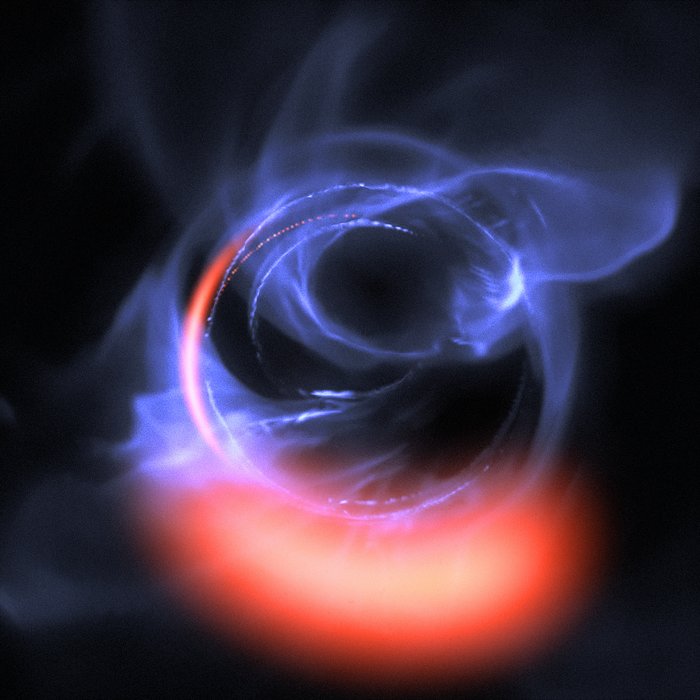
ESO’s exquisitely sensitive GRAVITY instrument has added further evidence to the long-standing assumption that a supermassive black hole lurks in the centre of the Milky Way. New observations show clumps of gas swirling around at about 30% of the speed of light on a circular orbit just outside a four million solar mass black hole — the first time material has been observed orbiting close to the point of no return, and the most detailed observations yet of material orbiting this close to a black hole. This visualisation uses data from simulations of orbital motions of gas swirling around at about 30% of the speed of light on a circular orbit around the black hole. [Higher-res images] ESO’s exquisitely sensitive GRAVITY instrument has added further evidence to the long-standing assumption that a supermassive black hole lurks in the centre of the Milky Way. New observations show clumps of gas swirling around at about 30% of the speed of light on a circular orbit just outside its event horizon — the first time material has been observed orbiting close to the point of no return, and the most detailed observations yet of material orbiting this close to a black hole.
ESO’s GRAVITY instrument on the Very Large Telescope (VLT) Interferometer has been used by scientists from a consortium of European institutions, including ESO [1], to observe flares of infrared radiation coming from the accretion disc around Sagittarius A*, the massive object at the heart of the Milky Way. The observed flares provide long-awaited confirmation that the object in the centre of our galaxy is, as has long been assumed, a supermassive black hole. The flares originate from material orbiting very close to the black hole’s event horizon — making these the most detailed observations yet of material orbiting this close to a black hole.
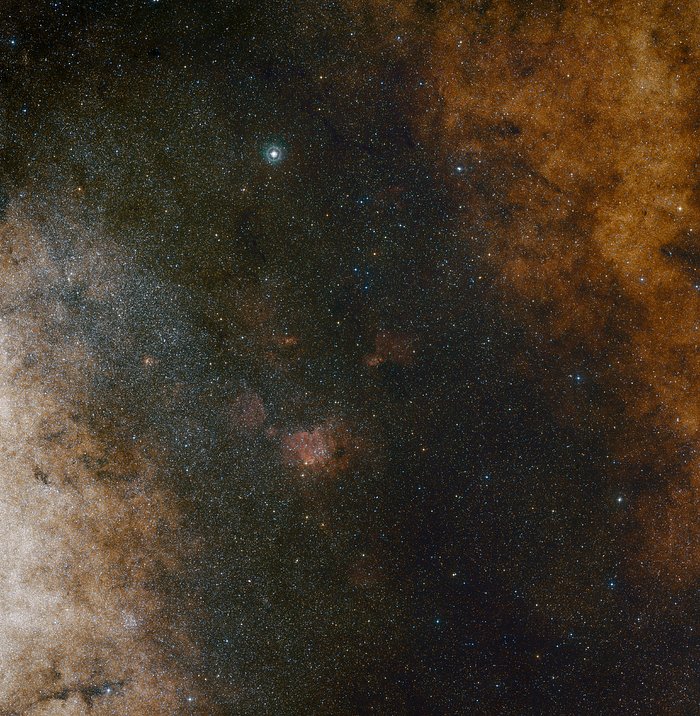
This visible light wide-field view shows the rich star clouds in the constellation of Sagittarius (the Archer) in the direction of the centre of our Milky Way galaxy. The entire image is filled with vast numbers of stars — but far more remain hidden behind clouds of dust and are only revealed in infrared images. This view was created from photographs in red and blue light and forming part of the Digitized Sky Survey 2. The field of view is approximately 3.5 degrees x 3.6 degrees. [ Higher-res images]. While some matter in the accretion disc — the belt of gas orbiting Sagittarius A* at relativistic speeds [2] — can orbit the black hole safely, anything that gets too close is doomed to be pulled beyond the event horizon. The closest point to a black hole that material can orbit without being irresistibly drawn inwards by the immense mass is known as the innermost stable orbit, and it is from here that the observed flares originate.
“It’s mind-boggling to actually witness material orbiting a massive black hole at 30% of the speed of light,” marvelled Oliver Pfuhl, a scientist at the MPE. “GRAVITY’s tremendous sensitivity has allowed us to observe the accretion processes in real time in unprecedented detail.“
These measurements were only possible thanks to international collaboration and state-of-the-art instrumentation [3]. The GRAVITY instrument which made this work possible combines the light from four telescopes of ESO’s VLT to create a virtual super-telescope 130 metres in diameter, and has already been used to probe the nature of Sagittarius A*.
Earlier this year, GRAVITY and SINFONI, another instrument on the VLT, allowed the same team to accurately measure the close fly-by of the star S2 as it passed through the extreme gravitational field near Sagittarius A*, and for the first time revealed the effects predicted by Einstein’s general relativity in such an extreme environment. During S2’s close fly-by, strong infrared emission was also observed.
“We were closely monitoring S2, and of course we always keep an eye on Sagittarius A*,” explained Pfuhl. “During our observations, we were lucky enough to notice three bright flares from around the black hole — it was a lucky coincidence!“
This emission, from highly energetic electrons very close to the black hole, was visible as three prominent bright flares, and exactly matches theoretical predictions for hot spots orbiting close to a black hole of four million solar masses [4]. The flares are thought to originate from magnetic interactions in the very hot gas orbiting very close to Sagittarius A*.
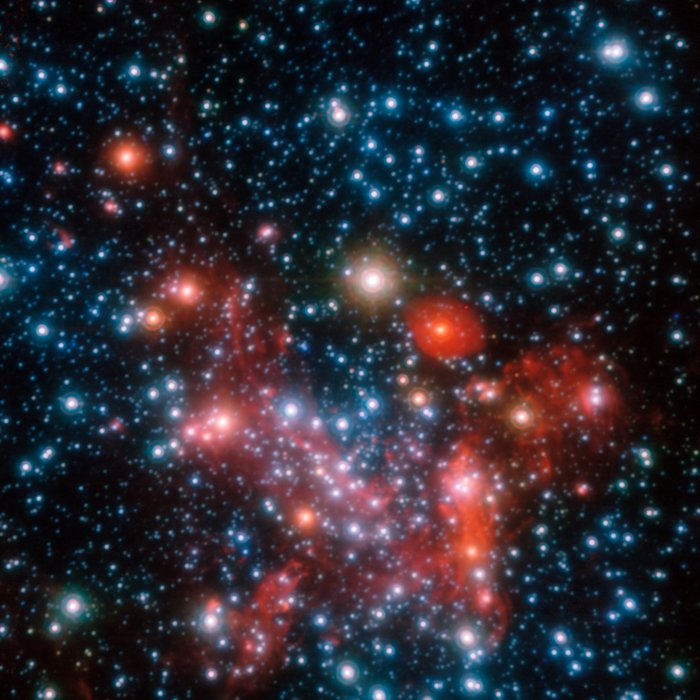
The central parts of our Galaxy, the Milky Way, as observed in the near-infrared with the NACO instrument on ESO’s Very Large Telescope. By following the motions of the most central stars over more than 16 years, astronomers were able to determine the mass of the supermassive black hole that lurks there. [Higher-res images] Reinhard Genzel, of the Max Planck Institute for Extraterrestrial Physics (MPE) in Garching, Germany, who led the study, explained:
“This always was one of our dream projects but we did not dare to hope that it would become possible so soon.” Referring to the long-standing assumption that Sagittarius A* is a supermassive black hole, Genzel concluded that “the result is a resounding confirmation of the massive black hole paradigm.“
[2] Relativistic speeds are those which are so great that the effects of Einstein’s Theory of Relativity become significant. In the case of the accretion disc around Sagittarius A*, the gas is moving at roughly 30% of the speed of light.
[3] GRAVITY was developed by a collaboration consisting of the Max Planck Institute for Extraterrestrial Physics (Germany), LESIA of Paris Observatory–PSL/CNRS/Sorbonne Université/Univ. Paris Diderot and IPAG of Université Grenoble Alpes/CNRS (France), the Max Planck Institute for Astronomy (Germany), the University of Cologne (Germany), the CENTRA–Centro de Astrofísica e Gravitação (Portugal) and ESO.
[4] The solar mass is a unit used in astronomy. It is equal to the mass of our closest star, the Sun, and has a value of 1.989 × 1030 kg. This means that Sgr A* has a mass 1.3 trillion times greater than the Earth.
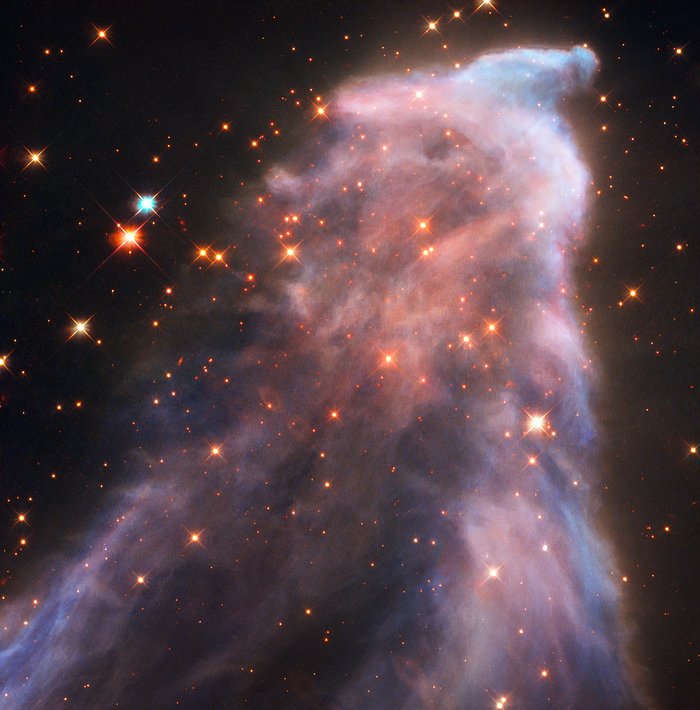
IC 63 — nicknamed the Ghost Nebula — is about 550 light-years from Earth. The nebula is classified as both a reflection nebula — as it is reflecting the light of a nearby star — and as an emission nebula — as it releases hydrogen-alpha radiation. Both effects are caused by the gigantic star Gamma Cassiopeiae. The radiation of this star is also slowly causing the nebula to dissipate. [Higher-res images] About 550 light-years away in the constellation of Cassiopeia lies IC 63, a stunning and slightly eerie nebula. Also known as the ghost of Cassiopeia, IC 63 is being shaped by radiation from a nearby unpredictably variable star, Gamma Cassiopeiae, which is slowly eroding away the ghostly cloud of dust and gas. This celestial ghost makes the perfect backdrop for the upcoming feast of All Hallow’s Eve — better known as Halloween.
The constellation of Cassiopeia, named after a vain queen in Greek mythology, forms the easily recognisable “W” shape in the night sky. The central point of the W is marked by a dramatic star named Gamma Cassiopeiae.
This video zooms in on the emission and reflection nebula IC 63 — nicknamed the Ghost Nebula — about 550 light-years away. It starts with a view of the night sky as seen from the ground. It then zooms through observations from the Digitized Sky Survey 2, and ends with a view of the nebula obtained with the NASA/ESA Hubble Space Telescope. Credit: Hubble, Digitized Sky Survey 2, N. Risinger (skysurvey.org). Music: Astral Electronic.
The remarkable Gamma Cassiopeiae is a blue-white subgiantvariable star that is surrounded by a gaseous disc. This star is 19 times more massive and 65 000 times brighter than our Sun. It also rotates at the incredible speed of 1.6 million kilometres per hour — more than 200 times faster than our parent star. This frenzied rotation gives it a squashed appearance. The fast rotation causes eruptions of mass from the star into a surrounding disk. This mass loss is related to the observed brightness variations.
The radiation of Gamma Cassiopeiae is so powerful that it even affects IC 63, sometimes nicknamed the Ghost Nebula, that lies several light years away from the star. IC 63 is visible in this image taken by the NASA/ESA Hubble Space Telescope.
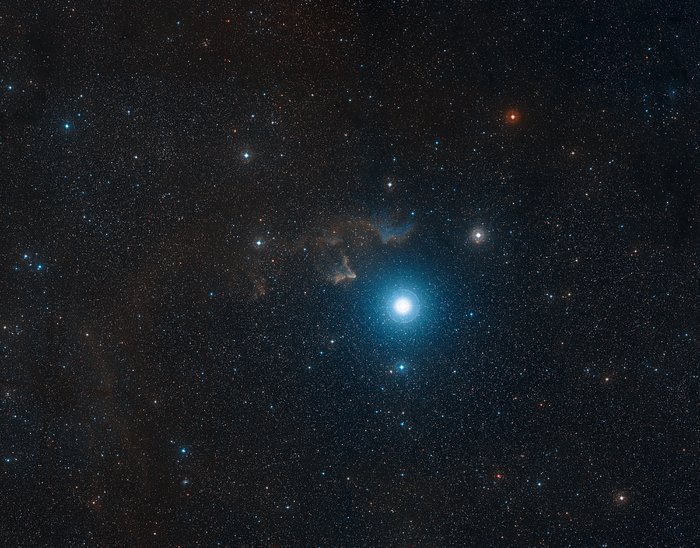
This image shows the sky around the nebula IC 63, nicknamed the Ghost Nebula. It was created from images forming part of the Digitized Sky Survey 2. The field of view is dominated by the bright star Gamma Cassiopeiae, which is having a profound influence on IC 63. IC 63 is only one of several nebulous structures surrounding Gamma Cassiopeiae — all of which are affected by the radiation emitted by the blue-white subgiant star. Credit: ESA/Hubble, NASA, Digitized Sky Survey 2. Acknowledgement: Davide de Martin [Higher-res images] The colours in the eerie nebula showcase how the nebula is affected by the powerful radiation from the distant star. The hydrogen within IC 63 is being bombarded with ultraviolet radiation from Gamma Cassiopeiae, causing its electrons to gain energy which they later release as hydrogen-alpha radiation — visible in red in this image.
This hydrogen-alpha radiation makes IC 63 an emission nebula, but we also see blue light in this image. This is light from Gamma Cassiopeiae that has been reflected by dust particles in the nebula, meaning that IC 63 is also a reflection nebula.
This colourful and ghostly nebula is slowly dissipating under the influence of ultraviolet radiation from Gamma Cassiopeiae. However, IC 63 is not the only object under the influence of the mighty star. It is part of a much larger nebulous region surrounding Gamma Cassiopeiae that measures approximately two degrees on the sky — roughly four times as wide as the full Moon.
This video pans across the nebula IC 63, often nicknamed the Ghost Nebula. This nebula is classified as both an emission and a reflection nebula. The hydrogen within IC 63 is being bombarded with radiation from the nearby star Gamma Cassiopeiae, causing its electrons to gain energy which they later emit as hydrogen-alpha radiation — visible in red in this image. The blue parts of IC 63 are created by dust particles in the nebula which reflect the light from Gamma Cassiopeiae. Credit: Hubble. Music: Johan B. Monell (www.johanmonell.com).
This region is best seen from the Northern Hemisphere during autumn and winter. Though it is high in the sky and visible all year round from Europe, it is very dim, so observing it requires a fairly large telescope and dark skies.
From above Earth’s atmosphere, Hubble gives us a view that we cannot hope to see with our eyes. This photo is possibly the most detailed image that has ever been taken of IC 63, and it beautifully showcases Hubble’s capabilities.
More information
The Hubble Space Telescope is a project of international cooperation between ESA and NASA.
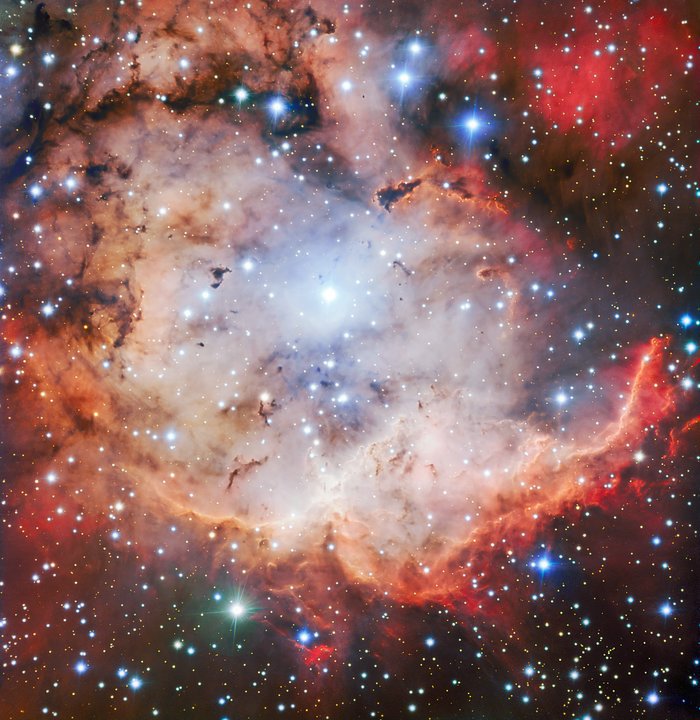
This vivid picture of an active star forming region — NGC 2467, otherwise known as the Skull and Crossbones nebula — is as sinister as it is beautiful. This image of dust, gas and bright young stars, gravitationally bound into the form of a grinning skull, was captured with the FORS instrument on ESO’s Very Large Telescope (VLT). Whilst ESO’s telescopes are usually used for the collection of science data, their immense resolving power makes them ideal for capturing images such as this — which are beautiful for their own sake. [Higher-res images] FORS2, an instrument mounted on ESO’s Very Large Telescope, has observed the active star-forming region NGC 2467 — sometimes referred to as the Skull and Crossbones Nebula. The image was captured as part of the ESO Cosmic Gems Programme, which makes use of the rare occasions when observing conditions are not suitable for gathering scientific data. Instead of sitting idle, the ESO Cosmic Gems Programme allows ESO’s telescopes to be used to capture visually stunning images of the southern skies.
This zoom video starts with a wide view of the Milky Way and ends with a close-up look at a vivid picture of an active star forming region — NGC 2467, otherwise known as the Skull and Crossbones nebula. This image of dust, gas and bright young stars, gravitationally bound into the form of a grinning skull, was captured with the FORS instrument on ESO’s Very Large Telescope (VLT). Whilst ESO’s telescopes are usually used for the collection of science data, their immense resolving power makes them ideal for capturing images such as this — which are beautiful for their own sake. Credit: ESO/Digitized Sky Survey 2/N. Risinger (skysurvey.org). Music: astral electronic
This vivid picture of an active star-forming region — NGC 2467, sometimes referred to as the Skull and Crossbones Nebula — is as sinister as it is beautiful. This image of dust, gas and bright young stars, gravitationally bound into the form of a grinning skull, was captured with the FORS instrument on ESO’s Very Large Telescope (VLT). Whilst ESO’s telescopes are usually used for the collection of science data, they can also capture images such as this — which are beautiful for their own sake.
It is easy to see the motivation for the nickname Skull and Crossbones. This young, bright formation distinctly resembles an ominous hollow face, of which only the gaping mouth is visible here. NGC 2467 skulks in the constellation Puppis, which translates rather unromantically as The Poop Deck.
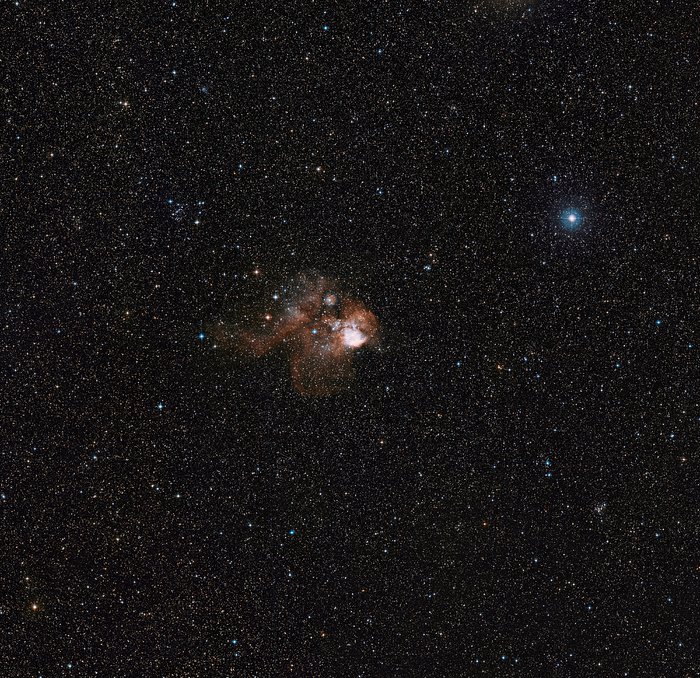
This vivid picture of an active star forming region — NGC 2467, otherwise known as the Skull and Crossbones nebula — is as sinister as it is beautiful. This image of dust, gas and bright young stars, gravitationally bound into the form of a grinning skull, was captured with the FORS instrument on ESO’s Very Large Telescope (VLT). Whilst ESO’s telescopes are usually used for the collection of science data, their immense resolving power makes them ideal for capturing images such as this — which are beautiful for their own sake. The image is a colour composite made from exposures from the Digitized Sky Survey 2 (DSS2), and shows the region surrounding NGC 2467. The field of view is approximately 2.4 x 2.0 degrees. [Higher-res images] This nebulous collection of stellar clusters is the birthplace of many stars, where an excess of hydrogen gas provided the raw material for stellar creation. It is not, in fact, a single nebula, and its constituent stellar cluster are moving at different velocities. It is only a fortuitous alignment along the line of sight from the Earth that makes the stars and gas form a humanoid face. This luminous image might not tell astronomers anything new, but it provides us all with a glimpse into the churning southern skies, bright with wonders invisible to the human eye.
Puppis is one of three nautically named constellations that sail the southern skies, and which used to make up the single, giant Argo Navis constellation, named after the ship of the mythical Jason and the Argonauts. Argo Navis has since been divided into three: Carina (the keel), Vela (the sails) and Puppis, where this nebula finds its home. Whilst a heroic figure, Jason is most famous for his theft of the golden fleece, so NGC 2467 rests not only in the midst of a vast celestial ship, but amongst thieves — an appropriate abode for this piratical nebula.
This image was created as part of the ESO Cosmic Gems programme, an outreach initiative to produce images of interesting, intriguing or visually attractive objects using ESO telescopes, for the purposes of education and public outreach. The programme makes use of telescope time that cannot be used for science observations. All data collected may also be suitable for scientific purposes, and are made available to astronomers through ESO’s science archive.
This pan video explores a vivid active star forming region — NGC 2467, otherwise known as the Skull and Crossbones nebula. This image of dust, gas and bright young stars, gravitationally bound into the form of a grinning skull, was captured with the FORS instrument on ESO’s Very Large Telescope (VLT). Whilst ESO’s telescopes are usually used for the collection of science data, their immense resolving power makes them ideal for capturing images such as this — which are beautiful for their own sake. Credit: ESO. Music: Johan B. Monell (www.johanmonell.com)
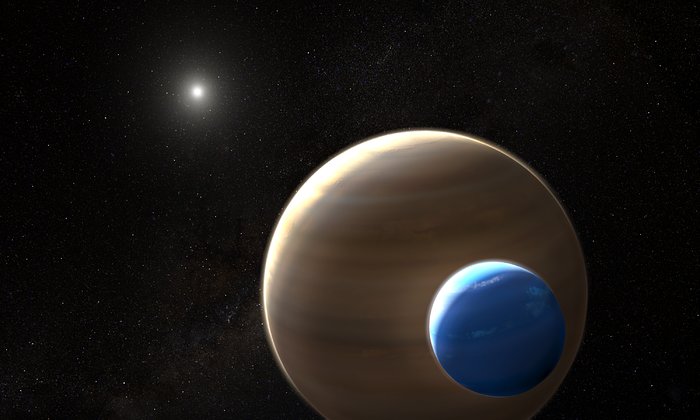
This artist’s impression depicts the exomoon candidate Kepler-1625b-i, the planet it is orbiting and the star in the centre of the star system. Kepler-1625b-i is the first exomoon candidate and, if confirmed, the first moon to be found outside the Solar System. Like many exoplanets, Kepler-1625b-i was discovered using the transit method. Exomoons are difficult to find because they are smaller than their companion planets, so their transit signal is weak, and their position in the system changes with each transit because of their orbit. This requires extensive modelling and data analysis. [Higher-res images] Using the NASA/ESA Hubble Space Telescope and older data from the Kepler Space Telescope two astronomers have found the first compelling evidence for a moon outside our own Solar System. The data indicate an exomoon the size of Neptune, in a stellar system 8000 light-years from Earth. The new results are presented in the journal Science Advances.
The hunt for exoplanets — planets outside our own Solar System — provided its first results only 30 years ago. While astronomers now find these planets on a regular basis, the search for moons orbiting exoplanets wasn’t successful — until today.
This animation demonstrates how the measured light curve from the star Kepler-1625b led to the conclusion that the system may consist of not only a planet, but also at least one moon.
When the planet moves in front of its parent star a tiny portion of its light is blocked by the disc of the planet, so we observe a dimming of the light from the star. Right after the exoplanet has finished its transit the starlight is seen to dim slightly again, suggesting the presence of a moon trailing the planet. Credit: ESA/Hubble, L. Calçada
In 2017 NASA’s Kepler Space Telescope detected hints of an exomoon orbiting the planet Kepler-1625b. Now, two scientists from Columbia University in New York (USA) have used the incomparable capabilities of the NASA/ESA Hubble Space Telescope to study the star Kepler-1625, 8000 light-years away, and its planet in more detail. The new observations made with Hubble show compelling evidence for a large exomoon orbiting the only known planet of Kepler-1625. If confirmed, this would be the first discovery of a moon outside our Solar System.
The candidate moon, with the designation Kepler-1625b-i, is unusual because of its large size; it is comparable in diameter to the planet Neptune. Such gargantuan moons are unknown in our own Solar System.
“This may yield new insights into the development of planetary systems and may cause astronomers to revisit theories of how moons form,”
Alex Teachey, a graduate student who led the study, explained excitedly [1].
Like its moon, Kepler-1625b is also bigger than its counterparts in the Solar System. The exoplanet is a gas giant, several times more massive than Jupiter [2]. It orbits its parent star at a distance similar to the distance between the Sun and Earth, which puts it — and its candidate moon — at the inner edge of the habitable zone of the star system [3].
To find evidence for the existence of the exomoon, the team observed the planet while it was in transit in front of its parent star, causing a dimming of the starlight.
“We saw little deviations and wobbles in the light curve that caught our attention,”
David Kipping, second author of the study, said.
The planet was observed by Hubble before and during its 19-hour-long transit. After the transit ended, Hubble detected a second and much smaller decrease in the star’s brightness approximately 3.5 hours later, consistent with the effect of a moon trailing the planet.
“It was definitely a shocking moment to see that light curve — my heart started beating a little faster and I just kept looking at that signature,”
David Kipping described his feelings. Unfortunately, the scheduled Hubble observations ended before the complete transit of the moon could be captured.
In addition to this second dip in the light curve, Hubble provided compelling supporting evidence for the moon hypothesis by detecting the planet’s transit more than an hour earlier than predicted. This is consistent with a model of the system in which the planet and its moon orbit a common centre of gravity, causing the planet to wobble away from its predicted location [4].
In principle this anomaly could also be caused by the gravitational pull of a hypothetical second planet in the system, but the Kepler Space Telescope found no evidence for additional planets around the star during its four year mission. Still, further observations by Hubble are needed to fully confirm the existence of Kepler-1625b-i.
“If confirmed, Kepler-1625b-i will certainly provide an interesting puzzle for theorists to solve,” said Kipping. Teachey concluded: “It is an exciting reminder of how little we really know about distant planetary systems and the great spirit of discovery exoplanetary science embodies.”
Notes
[1] The moons of Jupiter and Saturn likely formed through the agglomeration into a disc of material orbiting the planets, so it is possible that this exomoon also formed in a circumplanetary disc. Another possibility is that a passing object was captured by the planet’s gravity. Tidal forces between the two objects would rob momentum from the less massive companion and eventually pull it into a permanent orbit. There are no indications of tidal capture among our Solar System’s moons. In the case of the Earth–Moon system, an early collision with a larger body is hypothesised to have blasted off material that later coalesced into a moon. However, Kepler-1625b and its candidate moon are gaseous, not rocky, so such a collision would not have led to the condensation of a satellite.
[2] Despite its size, the mass of the candidate moon is estimated to be only 1.5 percent of the mass of its companion planet. This value is close to the mass ratio between Earth and the Moon.
[3] While both the planet and its candidate moon are within the habitable zone, where moderate temperatures allow for the existence of liquid water, both bodies are considered to be gaseous and therefore unsuitable for life as we know it.
[4] A distant observer watching the Earth and Moon transit the Sun would note similar anomalies in the timing of Earth’s transit.
More information
The Hubble Space Telescope is a project of international cooperation between ESA and NASA.
The results were presented in the paper Evidence for a large exomoon orbiting Kepler-1625b in the journal Science Advances.
The team of astronomers in this study consists of Alex Teachey and David M. Kipping (Columbia University, New York, USA).