** What’s Up: June 2022 Skywatching Tips from NASA – NASA JPL
What are some skywatching highlights in June 2022? The morning quartet of Jupiter, Saturn, Venus, and Mars continues to shine, though they will spread farther apart over the next couple of months. Globular cluster M13, aka the Hercules Cluster, is best observed with a telescope, but binoculars will reveal it as a fuzzy spot. And the constellation Lyra is easily located thanks to its brightest star, Vega.
0:00 Intro 0:11 Morning planets spread out 0:44 Globular Cluster M13
2:20 Find the Constellation Lyra
3:42 June Moon phases
Additional information about topics covered in this episode of What’s Up, along with still images from the video, and the video transcript, are available at https://solarsystem.nasa.gov/skywatch….
Though the nights are shorter in June, they are filled with fine sights. Look for the Hercules constellation, which will lead you to a globular star cluster with hundreds of thousands of densely packed stars. You can also spot Draco the dragon, which will point you to the Cat’s Eye Nebula. Keep watching for space-based views of globular star clusters and the nebula.
About this Series: “Tonight’s Sky” is a monthly video of constellations you can observe in the night sky. The series is produced by the Space Telescope Science Institute, home of science operations for the Hubble Space Telescope, in partnership with NASA’s Universe of Learning. This is a recurring show, and you can find more episodes—and other astronomy videos—at TONIGHT’S SKY
** What’s Up: May 2022 Skywatching Tips from NASA – NASA JPL
What are some skywatching highlights in May 2022? May provides some great planet spotting, including a close conjunction of Jupiter and Mars. At mid-month, a total eclipse of the Moon should delight skywatchers across the Americas, Europe, and Africa. And all month long, the Coma star cluster (aka, the Coma Berenices star cluster, or Melotte 111) is a great target for binoculars in the evening. YouTube Full Description (i.e., “Show More”)
0:00 Intro 0:11 Planet-spotting opportunities 1:02 Lunar eclipse
2:27 The Coma star cluster 3:33 May Moon phases
Additional information about topics covered in this episode of What’s Up, along with still images from the video, and the video transcript, are available at https://solarsystem.nasa.gov/skywatch….
In May, we are looking away from the crowded, dusty plane of our own galaxy toward a region where the sky is brimming with distant galaxies. Locate Virgo to find a concentration of roughly 2,000 galaxies and search for Coma Berenices to identify many more. Keep watching for space-based views of galaxies like the Sombrero Galaxy, M87, and M64. About this Series “Tonight’s Sky” is a monthly video of constellations you can observe in the night sky. The series is produced by the Space Telescope Science Institute, home of science operations for the Hubble Space Telescope, in partnership with NASA’s Universe of Learning. This is a recurring show, and you can find more episodes—and other astronomy videos—at https://hubblesite.org/resource-galle….
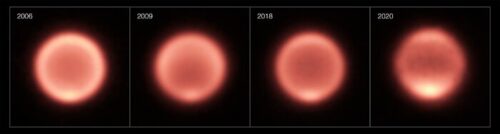
This composite shows thermal images of Neptune taken between 2006 and 2020. The first three images (2006, 2009, 2018) were taken with the VISIR instrument on ESO’s Very Large Telescope while the 2020 image was captured by the COMICS instrument on the Subaru Telescope (VISIR wasn’t in operation in mid-late 2020 because of the pandemic). After the planet’s gradual cooling, the south pole appears to have become dramatically warmer in the past few years, as shown by a bright spot at the bottom of Neptune in the images from 2018 and 2020.
An international team of astronomers have used ground-based telescopes, including the European Southern Observatory’s Very Large Telescope (ESO’s VLT), to track Neptune’s atmospheric temperatures over a 17-year period. They found a surprising drop in Neptune’s global temperatures followed by a dramatic warming at its south pole.
“This change was unexpected,” says Michael Roman, a postdoctoral research associate at the University of Leicester, UK, and lead author of the study published today in The Planetary Science Journal. “Since we have been observing Neptune during its early southern summer, we expected temperatures to be slowly growing warmer, not colder.”
Like Earth, Neptune experiences seasons as it orbits the Sun. However, a Neptune season lasts around 40 years, with one Neptune year lasting 165 Earth years. It has been summertime in Neptune’s southern hemisphere since 2005, and the astronomers were eager to see how temperatures were changing following the southern summer solstice.
Astronomers looked at nearly 100 thermal-infrared images of Neptune, captured over a 17-year period, to piece together overall trends in the planet’s temperature in greater detail than ever before.
These data showed that, despite the onset of southern summer, most of the planet had gradually cooled over the last two decades. The globally averaged temperature of Neptune dropped by 8 °C between 2003 and 2018.
The astronomers were then surprised to discover a dramatic warming of Neptune’s south pole during the last two years of their observations, when temperatures rapidly rose 11 °C between 2018 and 2020. Although Neptune’s warm polar vortex has been known for many years, such rapid polar warming has never been previously observed on the planet.
“Our data cover less than half of a Neptune season, so no one was expecting to see large and rapid changes,”
says co-author Glenn Orton, senior research scientist at Caltech’s Jet Propulsion Laboratory (JPL) in the US.
The astronomers measured Neptune’s temperature using thermal cameras that work by measuring the infrared light emitted from astronomical objects. For their analysis the team combined all existing images of Neptune gathered over the last two decades by ground-based telescopes. They investigated infrared light emitted from a layer of Neptune’s atmosphere called the stratosphere. This allowed the team to build up a picture of Neptune’s temperature and its variations during part of its southern summer.
Because Neptune is roughly 4.5 billion kilometres away and is very cold, the planet’s average temperature reaching around –220°C, measuring its temperature from Earth is no easy task.
“This type of study is only possible with sensitive infrared images from large telescopes like the VLT that can observe Neptune clearly, and these have only been available for the past 20 years or so,”
says co-author Leigh Fletcher, a professor at the University of Leicester.
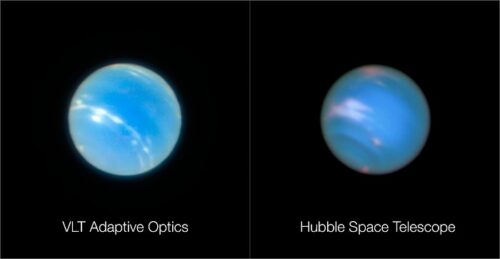
The image of the planet Neptune on the left was obtained during the testing of the Narrow-Field adaptive optics mode of the MUSE instrument on ESO’s Very Large Telescope. The image on the right is a comparable image from the NASA/ESA Hubble Space Telescope. Note that the two images were not taken at the same time so do not show identical surface features.
Around one third of all the images taken came from the VLT Imager and Spectrometer for mid-InfraRed (VISIR) instrument on ESO’s VLT in Chile’s Atacama Desert. Because of the telescope’s mirror size and altitude, it has a very high resolution and data quality, offering the clearest images of Neptune. The team also used data from NASA’s Spitzer Space Telescope and images taken with the Gemini South telescope in Chile, as well as with the Subaru Telescope, the Keck Telescope, and the Gemini North telescope, all in Hawai‘i.
Because Neptune’s temperature variations were so unexpected, the astronomers do not know yet what could have caused them. They could be due to changes in Neptune’s stratospheric chemistry, or random weather patterns, or even the solar cycle. More observations will be needed over the coming years to explore the reasons for these fluctuations. Future ground-based telescopes like ESO’s Extremely Large Telescope (ELT) could observe temperature changes like these in greater detail, while the NASA/ESA/CSA James Webb Space Telescope will provide unprecedented new maps of the chemistry and temperature in Neptune’s atmosphere.
“I think Neptune is itself very intriguing to many of us because we still know so little about it,” says Roman. “This all points towards a more complicated picture of Neptune’s atmosphere and how it changes with time.”
** What’s Up: April 2022 Skywatching Tips from NASA – NASA JPL
What are some skywatching highlights in April 2022?
The gathering of planets in the morning sky increases from three to four, as Jupiter joins the party. Two close conjunctions – between Mars and Saturn, and Venus and Jupiter – provide highlights at the beginning and end of the month. And the Big Dipper hosts a surprise: a double star you just might be able to “split” with your own eyes.
0:00 Intro 0:09 Morning planets & TWO conjunctions!
1:28 The Big Dipper’s hidden “double star”
3:09 April moon phases
Additional information about topics covered in this episode of What’s Up, along with still images from the video, and the video transcript, are available at https://solarsystem.nasa.gov/skywatch….
Clear April nights are filled with starry creatures. Near the Big Dipper, you will find several interesting binary stars. You can also spot galaxies like the Pinwheel Galaxy, M82, and M96—the last of which is an asymmetric galaxy that may have been gravitationally disrupted by encounters with its neighbors. Keep watching for space-based views of these celestial objects. About this Series “Tonight’s Sky” is a monthly video of constellations you can observe in the night sky. The series is produced by the Space Telescope Science Institute, home of science operations for the Hubble Space Telescope, in partnership with NASA’s Universe of Learning. This is a recurring show, and you can find more episodes—and other astronomy videos—at https://hubblesite.org/resource-galle….
With the arrival of April, you’re likely to spend more time outdoors under the stars. So why not bring along our monthly Sky Tour astronomy podcast? It provides an informative and entertaining 12-minute guided tour of the nighttime sky. Download the April episode to explore the fascinating movement of four planets in the sky before dawn.
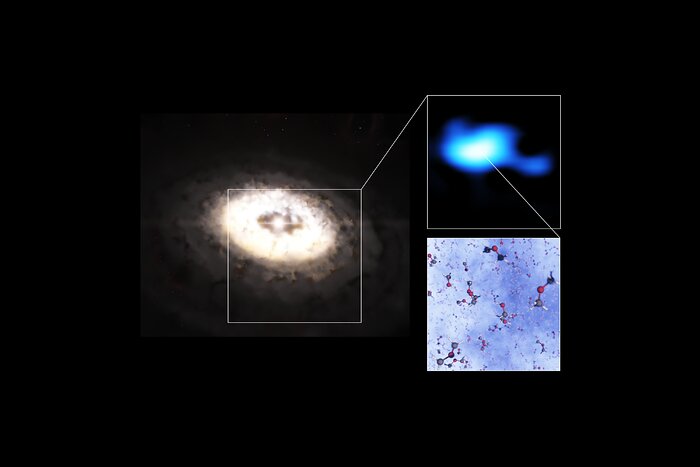
This composite image features an artistic impression of the planet-forming disc around the IRS 48 star, also known as Oph-IRS 48. The disc contains a cashew-nut-shaped region in its southern part, which traps millimetre-sized dust grains that can come together and grow into kilometre-sized objects like comets, asteroids and potentially even planets. Recent observations with the Atacama Large Millimeter/submillimeter Array (ALMA) spotted several complex organic molecules in this region, including dimethyl ether, the largest molecule found in a planet-forming disc to date. The emission signaling the presence of this molecule (real observations shown in blue) is clearly stronger in the disc’s dust trap. A model of the molecule is also shown in this composite.
Using the Atacama Large Millimeter/submillimeter Array (ALMA) in Chile, researchers at Leiden Observatory in the Netherlands have for the first time detected dimethyl ether in a planet-forming disc. With nine atoms, this is the largest molecule identified in such a disc to date. It is also a precursor of larger organic molecules that can lead to the emergence of life.
“From these results, we can learn more about the origin of life on our planet and therefore get a better idea of the potential for life in other planetary systems. It is very exciting to see how these findings fit into the bigger picture,“
says Nashanty Brunken, a Master’s student at Leiden Observatory, part of Leiden University, and lead author of the study published today in Astronomy & Astrophysics.
Dimethyl ether is an organic molecule commonly seen in star-forming clouds, but had never before been found in a planet-forming disc. The researchers also made a tentative detection of methyl formate, a complex molecule similar to dimethyl ether that is also a building block for even larger organic molecules.
“It is really exciting to finally detect these larger molecules in discs. For a while we thought it might not be possible to observe them,”
says co-author Alice Booth, also a researcher at Leiden Observatory.
The molecules were found in the planet-forming disc around the young star IRS 48 (also known as Oph-IRS 48) with the help of ALMA, an observatory co-owned by the European Southern Observatory (ESO). IRS 48, located 444 light-years away in the constellation Ophiuchus, has been the subject of numerous studies because its disc contains an asymmetric, cashew-nut-shaped “dust trap”. This region, which likely formed as a result of a newly born planet or small companion star located between the star and the dust trap, retains large numbers of millimetre-sized dust grains that can come together and grow into kilometre-sized objects like comets, asteroids and potentially even planets.
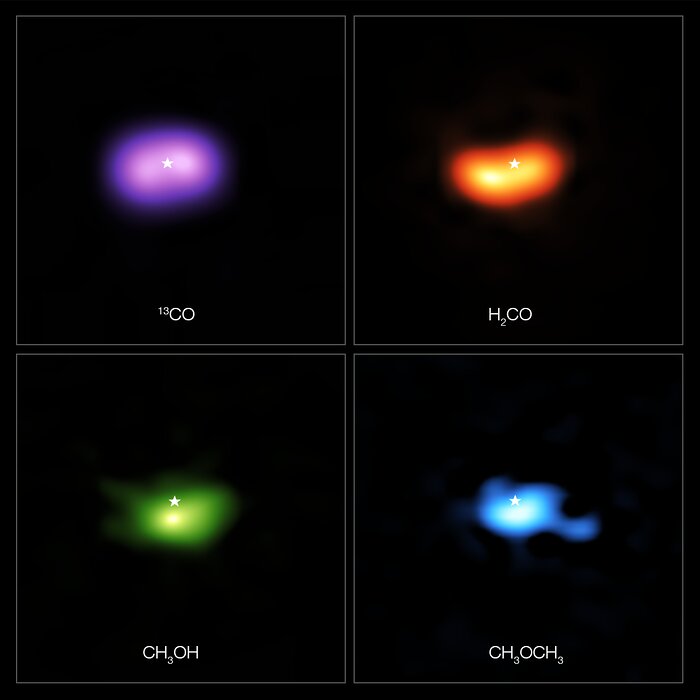
These images from the Atacama Large Millimeter/submillimeter Array (ALMA) show where various gas molecules were found in the disc around the IRS 48 star, also known as Oph-IRS 48. The disc contains a cashew-nut-shaped region in its southern part, which traps millimetre-sized dust grains that can come together and grow into kilometre-sized objects like comets, asteroids and potentially even planets. Recent observations spotted several complex organic molecules in this region, including formaldehyde (H2CO; orange), methanol (CH3OH; green) and dimethyl ether (CH3OCH3; blue), the last being the largest molecule found in a planet-forming disc to date. The emission signaling the presence of these molecules is clearly stronger in the disc’s dust trap, while carbon monoxide gas (CO; purple) is present in the entire gas disc. The location of the central star is marked with a star in all four images. The dust trap is about the same size as the area taken up by the methanol emission, shown on the bottom left.
Many complex organic molecules, such as dimethyl ether, are thought to arise in star-forming clouds, even before the stars themselves are born. In these cold environments, atoms and simple molecules like carbon monoxide stick to dust grains, forming an ice layer and undergoing chemical reactions, which result in more complex molecules. Researchers recently discovered that the dust trap in the IRS 48 disc is also an ice reservoir, harbouring dust grains covered with this ice rich in complex molecules. It was in this region of the disc that ALMA has now spotted signs of the dimethyl ether molecule: as heating from IRS 48 sublimates the ice into gas, the trapped molecules inherited from the cold clouds are freed and become detectable.
“What makes this even more exciting is that we now know these larger complex molecules are available to feed forming planets in the disc,” explains Booth. “This was not known before as in most systems these molecules are hidden in the ice.”
The discovery of dimethyl ether suggests that many other complex molecules that are commonly detected in star-forming regions may also be lurking on icy structures in planet-forming discs. These molecules are the precursors of prebiotic molecules such as amino acids and sugars, which are some of the basic building blocks of life.
By studying their formation and evolution, researchers can therefore gain a better understanding of how prebiotic molecules end up on planets, including our own.
“We are incredibly pleased that we can now start to follow the entire journey of these complex molecules from the clouds that form stars, to planet-forming discs, and to comets. Hopefully with more observations we can get a step closer to understanding the origin of prebiotic molecules in our own Solar System,”
says Nienke van der Marel, a Leiden Observatory researcher who also participated in the study.
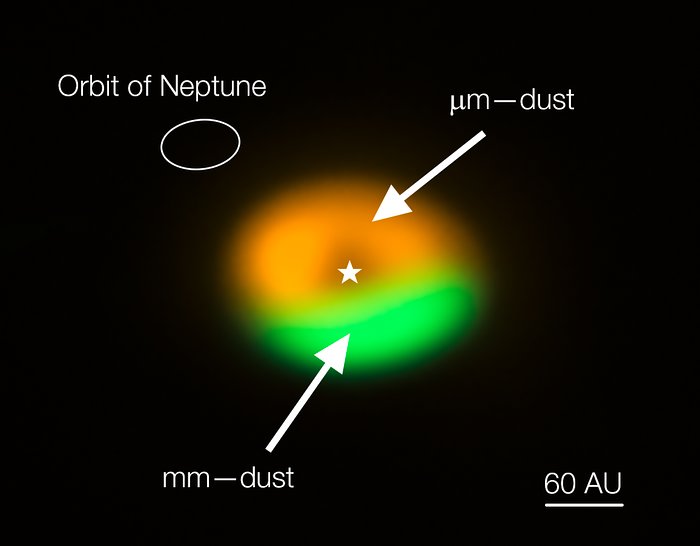
Annotated image from the Atacama Large Millimeter/submillimeter Array (ALMA) showing the dust trap in the disc that surrounds the system Oph-IRS 48. The dust trap provides a safe haven for the tiny dust particles in the disc, allowing them to clump together and grow to sizes that allow them to survive on their own. The green area is the dust trap, where the bigger particles accumulate. The size of the orbit of Neptune is shown in the upper left corner to show the scale.
Future studies of IRS 48 with ESO’s Extremely Large Telescope (ELT), currently under construction in Chile and set to start operations later this decade, will allow the team to study the chemistry of the very inner regions of the disc, where planets like Earth may be forming.