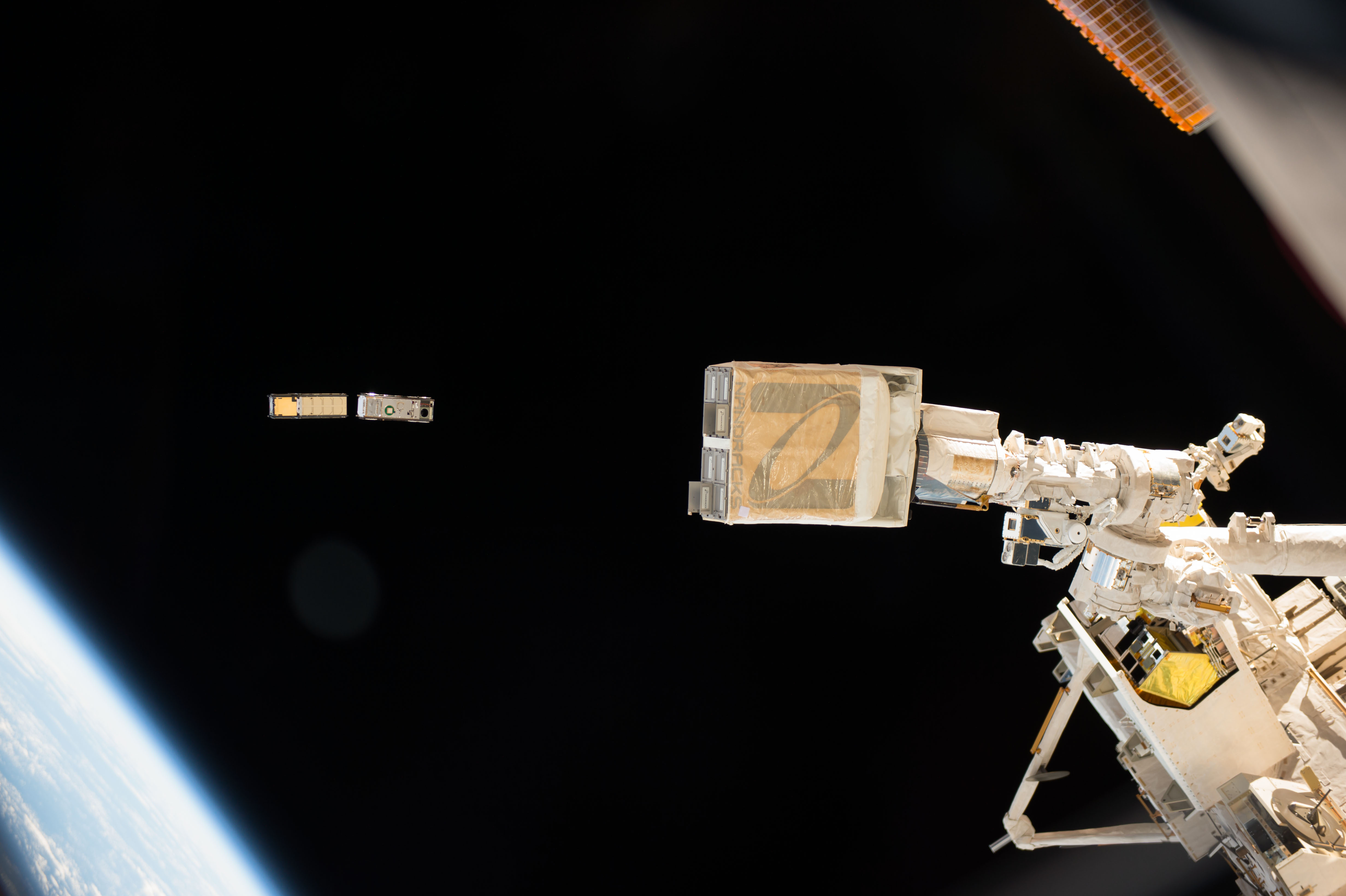
This week over a dozen small satellites called CubeSats have been injected into orbit from the International Space Station using a system developed by NanoRacks. This video of the deployment of a NASA satellite on Tuesday:
A cubesat is shot into orbit from the ISS; Credits NanoRacks.
The deployments included satellites from the QB50 Mission
The QB50 Mission consists of dozens of universities located around the world – including Israel, Canada, Australia, Korea, Spain, Germany, France and more. Coordinated by the von Karman Institute and sponsored by the European Commission, the QB50 CubeSats will take advantage of the space station orbit to study the lower thermosphere (200-380 kilometers) collecting scientific climate data, in what is considered by experts a relatively unexplored part of Earth’s atmosphere.
The ISS portion of the QB50 Mission involves over 300 students and 50 professionals, which brings the program together.
Astronaut Thomas Pesquet tells us about the QB50 Mission being deployed via NanoRacks and our NRCSD (NanoRacks CubeSat Deployer) on the International Space Station.
The Cubes in Space is a program to provide opportunities for students age 11 to 18 to design and build experiments that will be launched into space and near-space:
Cubes in Space™ is the only program in the world to provide students (ages 11-18) with a free opportunity to design experiments to be launched into space on a NASA rocket or balloon!
This is a Science, Technology, Engineering, Arts and Mathematics (STEAM) based global education program, enabling kids to learn about space exploration utilizing innovative problem-solving inquiry-based learning methods. By participating in this program, students and educators are provided with engaging content and activities in preparation for the design and development of an experiment to be integrated into a small cube.
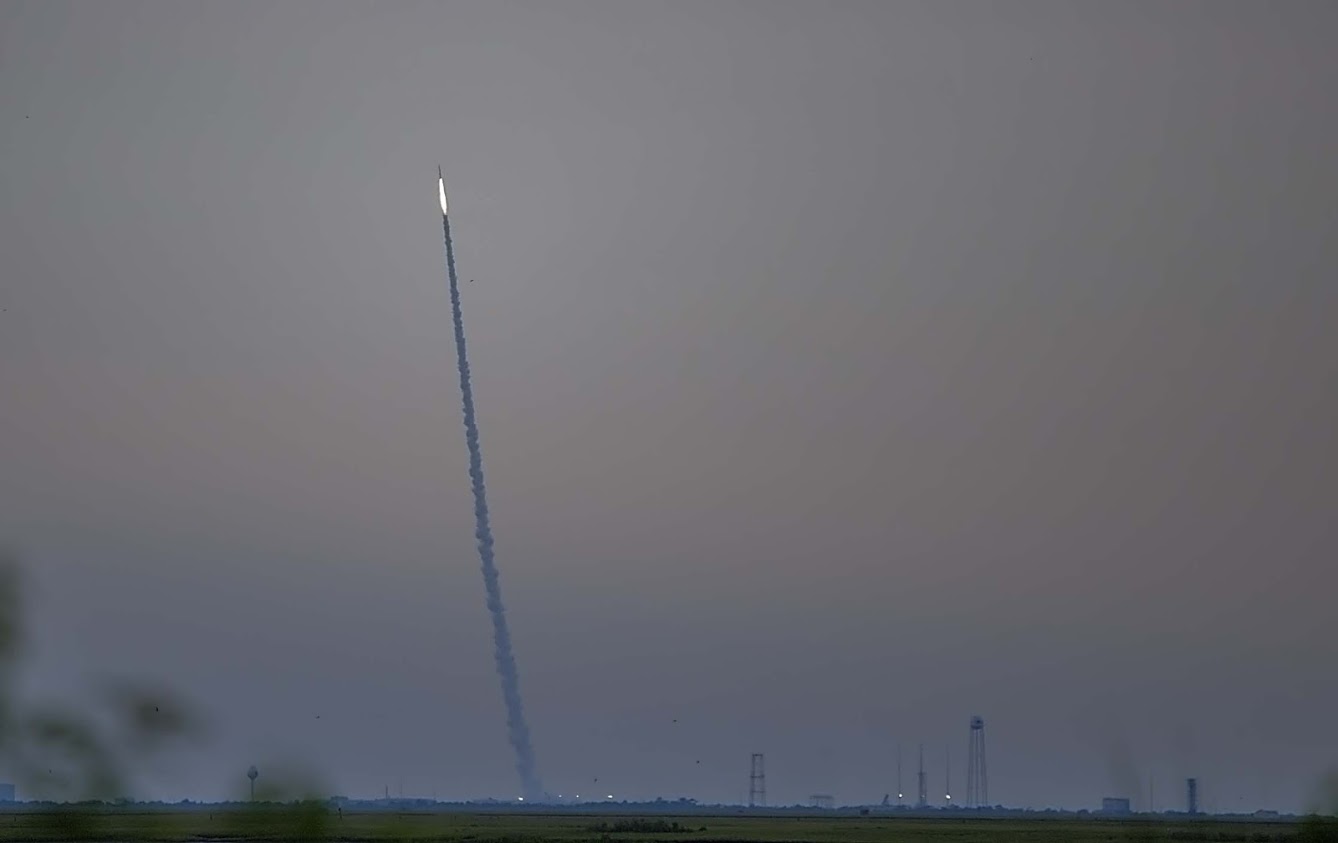
This year, successful experiments/cubes will be launched into space via sounding rocket from NASA Wallops Flight Facility on Wallops Island, Virginia in late June 2017 or on a high altitude balloon launched from the NASA Columbia Scientific Balloon Facility at Fort Sumner, New Mexico in August 2017.
Since we first began the Cubes in Space program in 2014, we have had over 5000 participants from 37 countries, and counting! Come and join us!
The program is sponsored by education organization idoodlelearning in partnership with NASA.
idoodlelearning is proud to partner with the Colorado Space Grant Consortium with support from NASA’s Science Mission Directorate and Sounding Rocket Program Offices to bring Cubes in Space™ to this new generation of future inventors, scientists, engineers, artists and innovators.
idoodlelearning is excited to be working with NASA’s Balloon Program Office, to bring high altitude balloon opportunities to students around the world.
Talk description: There are about a dozen communications satellites orbiting the earth that were designed and built by teams of amateur enthusiasts. Dave talks about what they are, how they got there, and how you can build simple equipment to listen to their transmissions.
Check out the HobbySpace Satellite Building and Space Radio sections for more info and web resources on the making of and radio communications with amateur satellites. (These sections need updating but still have lots of useful material.)
There is also a new AMSAT guide on amateur satellites:
The company NanoRacks has a system installed in the Japanese Kibo module on the Int. Space Station that ejects small CubeSat satellites into orbit. Over 100 satellites have now been deployed by NanoRacks. This video shows the deployment of satellites in 2014:
CubeSats fly free after leaving the NanoRacks CubeSat Deployer on the International Space Station on May 17, 2016. Seen here are two Dove satellites. The satellites are part of a constellation designed, built and operated by Planet Labs Inc. to take images of Earth from space. The images have several humanitarian and environmental applications, from monitoring deforestation and urbanization to improving natural disaster relief and agricultural yields in developing nations. A total of 17 CubeSats have been released since Monday from a small satellite deployer on the outside of the Kibo experiment module’s airlock. CubeSats are a new, low-cost tool for space science missions. Instead of the traditional space science missions that carry a significant number of custom-built, state-of-the-art instruments, CubeSats are designed to take narrowly targeted scientific observations, with only a few instruments, often built from off-the-shelf components.One of the CubeSats deployed in the past week includes STMSat-1, which was assembled and tested by elementary students at St. Thomas More Cathedral School in Arlington, Virginia: Elementary School Students Make History with Help from Orbital ATK.
St. Thomas More Cathedral School is now the first elementary school in the world to launch a CubeSat into orbit thanks to financial and volunteer support from Orbital ATK’s Space Systems Group. Over the last three years, 400 pre-kindergarten through eighth grade students have participated in all aspects of the project, from design, to construction, to testing.
The CubeSat, officially known as St. Thomas More (STM) Sat-1, will photograph the Earth and transmit images to remote ground stations throughout the country, engaging more than 10,000 grade school students who will participate via Remote Mission Operations Centers.
The CubeSat, STMSat-1(Credit: St. Thomas More Cathedral School)
Joe Pellegrino, Orbital ATK engineer, NASA deputy project manager and a parent at the school, served as the team’s mission manager and led the students through all aspects of getting a mission off the ground.
“Usually these are built by universities or even grad students, so it’s quite remarkable that we’ve been able to do this with grade students,” said Pellegrino. “We taught the students about design philosophy how to do computerized design. The students also helped us with a vibration test. We even did a high altitude test in the parking lot of the school.”
St. Thomas More Cathedral School students gather to watch their CubeSat deploy from the International Space Station. (Credit: St. Thomas More Cathedral School)
The CubeSat is four inches long and weighs close to three pounds. It was carried to space on Orbital ATK’s Cygnus cargo resupply spacecraft as part of NASA’s Education Launch of Nanosatellites IX mission in December of 2015. Along with CubeSats from the University of Colorado Boulder and the University of Michigan, STMSat-1 deployed from the NanoRacks CubeSat Deployer on May 16. The students expect to start receiving their first images this week.
STMSat-1 (bottom right) deploys from the International Space Station on May 16, 2016. (Credit: NASA).