Category Archives: Living in Space

Space habitat reports – Feb.5.2025

Here is a new selection of videos, articles, and news items about space habitats (govt and commercial), living in space, and space settlement.

=== International Space Station & NASA

** Space to Ground: Historic Spacewalk: Jan. 31, 2025 NASA Johnson

NASA’s Space to Ground is your weekly update on what’s happening aboard the International Space Station.

** An animated view of ISS assembly:

=== Commercial space habitats

** Axiom Space

— Space Minds with Kam GhaffarianSpaceNews on Youtube

In this week’s episode our guest is Kam Ghaffarian, Chairman, Axiom Space, Intuitive Machines and other companies. Inspired by the Apollo 11 moon landing, starting in his basement, and finally reaching the moon. This is Kam Ghaffarian’s inspirational story.

** Sierra Space

** VAST

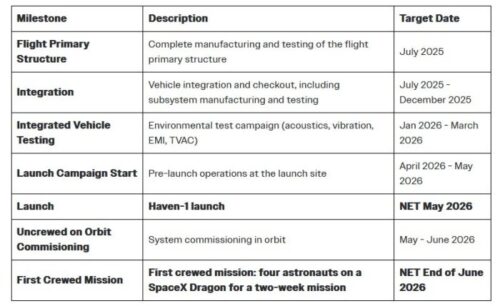
** Vast and SpaceX request proposals for research projects on the Haven-1 Lab that will advance progress in long-term human habitation in space: Vast and SpaceX Issue Joint Request for Research Proposals to Advance Long-Term Human Habitation in Space | VAST – Jan.28.2025

Vast and SpaceX announced a joint request for research proposals from the global space science community aimed at advancing long-term human habitation and exploration in space. Building on their established partnership, the two companies seek high-impact research projects to support humanity on Earth and advance our capacity to live and work in Earth orbit and beyond. Submitted proposals will be evaluated based on scientific and technical merit, feasibility, and alignment with mission objectives. Approved research proposals will be able to leverage the capabilities of the Haven-1 Lab, Dragon spacecraft, and/or private astronaut missions to the International Space Station (ISS).

Haven-1 is scheduled to be the world’s first commercial space station and crewed microgravity research, development, and manufacturing platform. This groundbreaking facility will enable cutting-edge research and technological advancements, opening new frontiers in space science.

While no direct funding will be provided to the research project, Vast and SpaceX will offer selected researchers access to a hosted orbital laboratory, on-orbit crew time, and support for project design and flight qualification—at no cost.

For additional information and details on how to submit a proposal, please visit SpaceX.com/research.

** Haven-1 Development Update – January 2025VAST Youtube

Here is the latest as we build the team, facilities, and hardware to launch the world’s first commercial space station. Every step brings us closer to redefining space exploration. Stay tuned for more milestones as we make history. We are proud to bring space station primary structure manufacturing back to the United States.

=== Chinese space habitats

** Chinese astronauts welcome Year of the Snake in spaceVideoFromSpace

China’s Shenzhou-19 astronauts sent their Lunar New Year greetings home from the nation’s Tiangong space station to welcome in the Year of the Snake.

SOUNDBITE (Chinese) Shenzhou-19 space mission crew:
“We are in the space home of the Chinese people, wishing you all a happy Chinese New Year! We wish the people of the whole country good health and all the best in the Year of Snake! May our great motherland enjoy harmony and prosperity!”

** Chinese Astronaut Shares Joys of Life in SpaceCCTV Video News Agency

Chinese astronaut Wang Haoze of the Shenzhou 19 crew shared that her favorite activity in space is to gaze at the breathtaking sceneries of the mountains and rivers of her homeland, savoring the beauty of the Earth from orbit.

Wang Haoze, China’s first female space flight engineer, along with fellow astronauts Cai Xuzhe and Song Lingdong, is on a six-month mission aboard the Tiangong space station. The trio arrived at the orbiting station following the launch of the Shenzhou-19 crewed spaceship on Oct 30 last year.

** Shenzhou-19 Commander Reflects on Mid-Mission Progress, Says Good to Be Back to Space StationCCTV Video News Agency

Chinese astronaut and commander of the Shenzhou-19 space mission Cai Xuzhe shared his experience of returning to the Chinese space station while delivering a mid-mission progress review.

China launched the Shenzhou-19 crewed spaceship on Oct 30 last year, sending three astronauts, Cai Xuzhe, Song Lingdong and Wang Haoze, to the orbiting space station for a six-month mission.

Cai first joined the journey into space as a crew member of the Shenzhou-14 mission in 2022. He was honored with the title “Heroic Astronaut” for his service and accomplishments during that mission.

=== In-space habitat technologies

** ThinkOrbital wins NASA NIAC grant to study in-space assembly of large structures: NASA NIAC selects ThinkOrbital | ThinkOrbital – Jan.16.2025

With the Construction Assembly Destination NIAC award, ThinkOrbital will

perform a study to identify the challenges associated with fabricating a shipyard in space using technologies and assets available today. Building on their ISAM&C [In Space Assembly, Manufacturing, & Construction] technology and their expertise in the field, ThinkOrbital will develop CONOPS, preliminary designs, and a cost analysis of deploying a shipyard to low Earth orbit.

More at Space Shipyards Could Build Missions in Orbit | Universe Today – Jan.28.2025

… ThinkOrbital has some pedigree in doing ISAM&C tasks that no one else has done before. In May 2024, they launched and successfully tested the first-ever weld in space. The mission flew on a Falcon 9, spot-welded together some quarter-inch pieces of aluminum, and returned it to Earth, where the welds were closely examined.

They used a method called electron beam welding, which has several advantages for use in space. First, it doesn’t require as much power as a traditional arc welder—only around 2KW, equivalent to a household iron. Second, it doesn’t create a lot of heat, which can degrade the metal being welded and cause issues like splintering, which can become dangerous in zero-gravity situations.

— ThinkOrbital ThinkPlatform-3 Assembly videoThinkOrbital on Youtube

— ThinkOrbital Flight-1: world’s first autonomous in-space weldingThinkOrbital on Youtube

We have launched world’s first autonomous in-space welding system!

We are thrilled to announce that we’ve achieved the majority of our Flight-1 objectives, marking a significant leap forward in space innovation. Our journey has been nothing short of extraordinary, from the groundbreaking first-ever autonomous in-space weld to the historic return of flown-in-space Electron-beam welder samples. These samples will be meticulously analyzed by NASA and the European Space Agency, paving the way for groundbreaking discoveries.

Throughout this milestone-filled journey, we have:

Designed and built the world’s first autonomous in-space welding system.
Conducted and passed rigorous vibration, shock, and thermal testing.
Garnered FAA and FCC flight authorization.
Successfully launched and landed on Falcon 9 on May 6, 2024.

This is just the beginning of our continued commitment to pushing the boundaries of possibility in space exploration. Stay tuned for more exciting updates as we chart a course towards new frontiers!

— NASA Just Funded This Project. Assembling Large Structures in Space [NIAC 2025]Fraser Cain

Space Docks are everywhere in science fiction. It’s the most logical way to build big constructions in space. So, NASA funded a futuristic project that studies the possibility of assembling structures in space.

Guest: Dr Vojtech Holub
https://thinkorbital.com/

NIAC award, Construction Assembly Destination:
https://www.universetoday.com/170640/…
https://www.nasa.gov/directorates/stm…

00:00 Intro
01:26 Welding in space experiment
08:03 The NIAC award
27:39 Current obsessions
30:01 Final thoughts and more interviews

** Overview article about rotating habitats to simulate gravity: A potpourri of artificial gravity topics | Space Settlement Progress – Jan.29.2025

In this month’s post we explore a few concepts and challenges related to artificial gravity (AG) that when explored and understood will enable human’s to live healthy lives and thrive in space. First up, Austria-based architect and civil engineer Werner Grandl, a researcher of space stations and space colonies, and mechanical engineer Clemens Böck describe their concept for the evolving construction of a spinning Artificial Gravity Orbital Station (AGOS) in this Research Gate working paper. AGOS is envisioned as a potential successor to the International Space Station (ISS).

=== Lunar habitation

** How NASA Plans to Revolutionize Lunar ExcavationNASA’s Kennedy Space Center

How does NASA plan to use resources on the surface of the Moon?

One method is the ISRU Pilot Excavator, or IPEx!

Designed by Kennedy Space Center’s Swamp Works team, the primary goal of IPEx is to dig up lunar soil, known as regolith, and transport it across the Moon’s surface.

Learn more about IPEx: https://www.nasa.gov/isru-pilot-excav…

** Derek Webber on The Space Show – Jan.24.2025 – Lunar Commerce, Moon vs Mars, etc

Derek Webber returned to the program to discuss his excellent new book, “Lunar Commerce: A Primer [Amazon commission link].” During the hour and 45 minutes we engaged in a detailed discussion about lunar commerce from what we can do now to a long time in the future. Part of this discussion centered on going to Mars, the Moon as a digression, then new Trump Administration lunar and/or Mars policy, cislunar, launchers, Elon Musk, Jeff Bezos and so much more. We had several listener calls plus multiple emails with a few listeners sending us multiple emails as extensions of their first one. Derek’s book names companies, policies, all sorts of good items are jam packed into the nearly 200 pages jammed pack with excellent information.

=== Mars habitation

** “A science-driven program that could get astronauts on the Red Planet by 2031”: The Mars Dream Is Back — Here’s How to Make It Actually Happen | Robert Zubrin/The New Atlantis – Spring 2025

America now has a once-in-a-generation opportunity to open the space frontier by initiating a sustained program of human exploration of Mars. Elon Musk’s SpaceX Starship launch system will soon be operational, offering payload delivery capability comparable to a Saturn V Moon rocket at about five percent of the cost. Musk has positioned himself close to President Donald Trump, who at his inauguration in January promised that his administration would be “launching American astronauts to plant the Stars and Stripes on the planet Mars.” As far as meeting the central political and technical conditions for making a bold reach to the Red Planet are concerned, it’s game on.

There are, however, several problems. First and foremost, the National Aeronautics and Space Administration, the government agency that one would expect to lead such an endeavor, is currently not competent to do so. And while SpaceX is far more competent, it should not be put into the position of executing a Mars mission alone, as some would like. NASA needs to be leading the effort because America should go to Mars, not just a private space enterprise. But to effectively lead human space exploration, NASA first needs to be fixed.

=== Space settlement

** Broadcast 4325 JOHN JOSSY, Space Settlement 2025 | The Space Show

We welcomed John Jossy back to the show, especially at the last minute when the planned guest cancelled due to illness. John brought us current on space settlement matters as we start the new year with a new administration. Our topics in the mentioning of a new space film documentary, the Gerald Black Space Review article on phasing out SLS and Orion, Starship impact, the new Dr. Joel Sercel of TransAstraYouTube video on creating civilizations in space, plus John’s own list of special items including links to the relative subjects and materials. John also posted a short agenda items list of his discussion point on the blog for this program.

=== Other space habitat and settlement news and articles:

=== Earth views from ISS

** Night Lights and AuroraUCTVInsight

Enjoy the creativity of astronaut Don Pettit, currently on his 4th mission aboard the ISS, as he captures surreal photos of Earth. His long-duration exposures reveal tracks of urban night lights as the ISS passes over. The stars show their own curving pattern, and the aurora adds even more mystery. This magical dance is accompanied by the music of Chilean composer Mario Quiroga. He is a “musico-terapista” (musical therapist), who creates floating music with his digital synthesizers, designed to help soothe the soul. Here we feature his “Aurora Boreal” composition, like a musical magic carpet as we soar over these ethereal views. Recorded on 11/9/2024. 

** Live Video from the International Space Station (Official NASA Stream) – NASA

Watch live video from the International Space Station, including inside views when the crew aboard the space station is on duty. Views of Earth are also streamed from an external camera located outside of the space station. During periods of signal loss due to handover between communications satellites, a blue screen is displayed.

The space station orbits Earth about 250 miles (425 kilometers) above the surface. An international partnership of five space agencies from 15 countries operates the station, and it has been continuously occupied since November 2000. It’s a microgravity laboratory where science, research, and human innovation make way for new technologies and research breakthroughs not possible on Earth. More: https://go.nasa.gov/3CkVtC8

Did you know you can spot the station without a telescope? It looks like a fast-moving star, but you have to know when to look up. Sign up for text messages or email alerts to let you know when (and where) to spot the station and wave to the crew: https://spotthestation.nasa.gov

====

ISS after undocking of STS-132

=== Amazon Ads ===

Lego Ideas International Space Station
Toy Blocks, Present, Space, Boys, Girls, Ages 16 and Up

====

Outpost in Orbit:
A Pictorial & Verbal History of the Space Station

Space habitat reports – Jan.20.2025

Here is a new selection of videos, articles, and news items about space habitats (govt and commercial), living in space, and space settlement.

=== International Space Station & NASA

** Space to Ground: Spacewalk 273: Jan. 17, 2025 NASA Johnson

** Space to Ground: In the Year 2025: Jan. 10, 2025NASA Johnson

NASA has big plans for science, research, and exploration aboard the International Space Station in 2025. From spacewalks, to hydroponic and aeroponic plant growth techniques, there’s a lot to look forward to in low Earth orbit. This November, we will celebrate 25 years of continuous human presence on the International Space Station.

** NASA astronaut Suni Williams sees orbital sunrise during spacewalk – Time-lapseVideoFromSpace

NASA astronaut Suni Williams works outside the International Space Station on Jan. 16, 2025.

** NASA Astronaut Don Pettit Talks with AstroKobi – January 8, 2025NASA Video

Aboard the International Space Station, Expedition 72 Flight Engineer Don Pettit of NASA discussed life and work aboard the orbital outpost during an in-flight interview Jan. 8 with the AstroKobi YouTube channel. Pettit is in the midst of a long-duration mission living and working aboard the microgravity laboratory to advance scientific knowledge and demonstrate new technologies for future human and robotic exploration flights as part of NASA’s Moon and Mars exploration approach, including lunar missions through NASA’s Artemis program.

** How Do Astronauts Exercise in Space? –  NASA Johnson

Astronauts aboard the International Space Station typically exercise for two hours each day. From running to cycling to weightlifting, learn how crew members complete fitness regimens in space and commit to staying healthy – even in microgravity.

=== India

** India’s SPADEX docking mission

The India space agency ISRO recently launched the SpaDeX Mission, which consisted of two satellites that carried out a rendezvous and docking operation to demonstrate technology for future ISRO space stations.

SpaDeX mission is a cost-effective technology demonstrator mission for the demonstration of in-space docking using two small spacecraft launched by PSLV. This technology is essential for India’s space ambitions such as Indian on Moon, sample return from the Moon, the building and operation of Bharatiya Antariksh Station (BAS), etc. In-space docking technology is essential when multiple rocket launches are required to achieve common mission objectives. Through this mission, India is marching towards becoming the fourth country in the world to have space docking technology.

On January 16th, the docking took place successfully: ISRO successfully completed docking of two SPADEX satellites (SDX-01 & SDX-02) in the early hours of 16 January, 2025.| ISRO – Jan.16.2025

More at:

** ISRO Successfully Conducts Space-Docking Test Under SpaDex Mission | WION

ISRO has completed the docking of satellites under its Space Docking Experiment – SpaDex mission. ISRO has released a video of successful docking on social media.

=== China

** Shenzhou-19 Crew Carry out In-Orbit Verification of Smart AssistantCCTV Video News Agency

[Jan.5.2025] Last week, the crew aboard the Shenzhou-19 spacecraft conducted a series of in-orbit verifications for China’s first space station intelligent flight robot, “Xiao Hang.”

=== Commercial space habitats

** Axiom Space

— Kam Ghaffarian, CEO and founder of  Axiom Space,  posts an op-edon why commercial space stations are essential for driving a thriving space economy and ensuring the U.S. remains a leader in space exploration” –  The Trump administration should leverage private space stations to counter China | SpaceNews – Jan.13.2025

The combination of NASA’s ambitious commercialization proclamations with the reality of its slow follow-through underscores the urgency for a strategic intervention. By forcing sharper focus on commercial space development, particularly on identifying the next U.S.-led space station, the administration can lay a solid foundation for sustained U.S. presence and leadership in space. The U.S. has long been a leader in space exploration, a position that is not only a matter of national pride but one of strategic importance. That leadership is contingent upon the ability to adapt quickly and effectively to the evolving landscape, and today, to quickly adjust from government-led to commercial-led space activities. With the new administration taking the helm, an exciting opportunity arises to enact meaningful change and drive remarkable progress. With bold and swift action, the U.S. can preserve its pioneering spirit, transcend terrestrial limits and sustain humanity’s journey beyond our planet.

— Plans for 2025:

** Gravitics

** StarlabVoyager Space

— Starlab expands in Europe: Starlab Space launches European subsidiary to boost international collaboration on its commercial space station | Starlab-Space – Jan.14.2025

Starlab Space LLC today announced the opening of its first overseas subsidiary, Starlab Space GmbH. Located in Bremen, Germany, it will extend the company’s capabilities and demonstrates its commitment to its international partners, maintaining global cooperation and permanent human presence, and expanding microgravity research opportunities in a commercial LEO economy.

“Successful and sustainable operation of a commercial space station requires international partners, and therefore, a presence beyond America’s borders,” said Tim Kopra, Starlab CEO. “We’re thrilled to launch Starlab Space Europe, a regional hub that will facilitate industrial efficiencies and expanded partnerships with allied space agencies, including the European Space Agency and its member countries. More importantly, joining American and European presence sets the stage for life beyond the ISS, one that has a global, permanent crew thriving in low-Earth orbit and leading research that can transform all of humanity.”

— Starlab’s CCO, Brad Henderson, discusses the future of space exploration, the role of commercial space stations, the decommissioning of the ISS, and how new technologies allow for affordable access and operation of commercial stations: Entering the Commercial Space Station Era | Kratos Constellations – Jan.16.2025

But while more cost-effective and frequent commercial space launch options will make it easier to get to the space station, they can’t solve a larger economic problem – the incredible cost of operating a space station. Thankfully, that’s one area where advanced artificial intelligence (AI) and machine learning (ML) technologies could play a role.

“How do we optimize our operations? That is really important to the transition – increasing the efficiency to drive down costs. How do we optimize our operations, crew schedules, and logistics streams?” Henderson asked. “Use the technology of today. The AI. The edge computing. Use the different tools that are available to find efficiencies.”

Ultimately, these advancements in affordable commercial space launch, advanced AI solutions, and cutting-edge data relay services combine with many other advancements in life-support systems and other innovative technologies to open the door to a new era in space – the commercial space station era. This new era will be one of increased access to orbit – democratizing scientific research and advancement in microgravity, enabling space tourism, and making space a possible location for data centers and other critical infrastructure.

** VAST

— Haven set to begin structural testing of habitat module qualification article:

— Explore Vast’s in-house space station manufacturing capabilityVAST Youtube

A space station primary structure hasn’t been manufactured in the United States in decades. Haven-1 will be the world’s first commercial space station—a major step toward succeeding the ISS and advancing U.S. innovation and leadership in space. At the core of this effort is the Haven-1 qualification article, a full-scale model designed to rigorously test the structure’s strength, safety, and performance.

=== Space settlement

** In-space settlements

A Home on the High Frontier: Jeff Bezos is inspired by a vision that does not involve living on Mars—or on any planet besides Earth—but inhabiting artificial worlds in free space. | by Peter Hague, Quillette – Jan.20.2025

As a professor at Princeton, O’Neill developed, alongside his students, an alternative vision for space colonisation in which habitats would be constructed at gravitationally stable points called Lagrange Points in the vicinity of the Earth and Moon and made to rotate so that the centrifugal force felt by occupants would simulate gravity. Such stations would offer vastly more living space than is available on all the planetary surfaces in the solar system, and he therefore concluded that they would provide better locations for an expanding interplanetary civilisation in a repudiation of what Isaac Asimov jokingly referred to as the “planetary chauvinism” of science fiction.

O’Neill published a book entitled The High Frontier, which fleshed out his ideas, and lent his support to a NASA study that investigated the practicability of building such a habitat. He was reasonably well known at the time, having been interviewed on television about his ideas, but despite his immense influence in the space community he has since been largely forgotten by the broader public. His concepts enjoyed a brief popularity but then fell out of favour both because of political attacks from critics who disliked the idea of NASA spending money on such things, and because of the growing understanding that the Space Shuttle was never going to provide the cheap, regular access to space that such a project would require.

** Living in SpaceSpace Renaissance

Join Joseph Pelton, Adriano Autino, Tommaso Sgobba, Robert Zubrin, Simonetta di Pippo, Madhu Thangavelu, Henk Rogers, Gary Barnhard, Pascalle Efrenfreund, Susan Jewell, discussing about Living in Space.

=== Other space habitat and settlement news and articles:

=== Earth views from ISS

** Image captured by Astronaut Don Pettit on ISS:

See also A NASA astronaut may have just taken the best photo from space—ever | Ars Technica – Jan.14.2025.

** Live Video from the International Space Station (Official NASA Stream) – NASA

Watch live video from the International Space Station, including inside views when the crew aboard the space station is on duty. Views of Earth are also streamed from an external camera located outside of the space station. During periods of signal loss due to handover between communications satellites, a blue screen is displayed.

The space station orbits Earth about 250 miles (425 kilometers) above the surface. An international partnership of five space agencies from 15 countries operates the station, and it has been continuously occupied since November 2000. It’s a microgravity laboratory where science, research, and human innovation make way for new technologies and research breakthroughs not possible on Earth. More: https://go.nasa.gov/3CkVtC8

Did you know you can spot the station without a telescope? It looks like a fast-moving star, but you have to know when to look up. Sign up for text messages or email alerts to let you know when (and where) to spot the station and wave to the crew: https://spotthestation.nasa.gov

====

ISS after undocking of STS-132

=== Amazon Ads ===

Lego Ideas International Space Station
21321 Toy Blocks, Present, Space, Boys, Girls, Ages 16 and Up

====

Outpost in Orbit:
A Pictorial & Verbal History of the Space Station
Space habitat reports – Jan.5.2025

Here is a new selection of videos, articles, and news items about space habitats (govt and commercial), living in space, and space settlement.

=== International Space Station & NASA

** Space to Ground: 2024 NASA Johnson

2024 on the International Space Station was a year filled with excitement, challenges, and milestones as we mark 25 unbroken years of humans living, working, and flying in humanity’s home in low-earth orbit.

** Five spaceships were attached to ISS on Dec.16.2024:

“Dec. 16, 2024: International Space Station Configuration. Five spaceships are parked at the space station including the SpaceX Dragon Freedom, the Northrop Grumman Cygnus resupply ship, the Soyuz MS-26 crew ship, and the Progress 89 and 90 resupply ships.” Credits: NASA

** NASAs SpaceX 31st Commercial Resupply Services Undocking – Monday, December 16, 2024 – NASA Video

Loaded with scientific experiments and supplies, an unpiloted SpaceX Dragon undocked from the International Space Station Dec.16, completing a month-long mission to the outpost for the company’s 31st commercial resupply services mission for NASA. The SpaceX Dragon undocked from the forward port of the Harmony module, headed for a splashdown off the coast of Florida Dec.17 to complete its flight that delivered several tons of experiments and hardware to the station.

** SpaceX CRS-31 Dragon spacecraft drifts away from space station after undocking VideoFromSpace

SpaceX’s CRS-31 Dragon cargo capsule undocked from the International Space Station on Dec. 16, 2024 at 11:05 a.m. EST (1605 GMT). See footage of the capsule post-undocking here.

** NASA Astronaut Don Pettit Talks with the Everyday Astronaut – Tuesday, December 17, 2024 – NASA Video

Aboard the International Space Station, Expedition 72 Flight Engineer Don Pettit of NASA discussed life and work aboard the orbital outpost during an in-flight interview Dec. 17 with Tim Todd, the “Everyday Astronaut” on YouTube. Pettit is in the midst of a long-duration mission living and working aboard the microgravity laboratory to advance scientific knowledge and demonstrate new technologies for future human and robotic exploration flights as part of NASA’s Moon and Mars exploration approach, including lunar missions through NASA’s Artemis program.

** Roscosmos Spacewalk Conducted Outside Space Station NASA Johnson

Outside the International Space Station, Roscosmos cosmonauts Alexey Ovchinin and Ivan Vagner of the Expedition 72 crew conducted a spacewalk on Dec. 19 to install an experiment package designed to monitor celestial x-ray sources and new electrical connector patch panels, remove several experiments for disposal, and relocate a control panel for the European Robotic Arm that is attached to the Nauka multipurpose laboratory module. It was the 272nd spacewalk in support of station maintenance and upgrades, the second for Ovchinin and the first for Vagner.

** Can The International Space Station Make It Until 2030?NASASpaceflight

Since 2000, the International Space Station has been continuously inhabited, orbiting Earth as a symbol of international collaboration and human innovation. But after 25 years in space, the ISS is showing its age with leaks, outdated hardware, and operational challenges. From Zvezda’s pressure loss to spacewalk delays and cutting-edge IROSA solar arrays, we explore how the ISS is being maintained and upgraded to ensure it can last until its planned deorbit in 2030. Can the station hold on for another five years? Let’s dive into the details.

=== Commercial space habitats

** Axiom Space

** Axiom speeds up station assembly by two years:

** Gravitics

** StarlabVoyager Space

** Starlab making progress in habitat development: NASA Sees Progress on Starlab Commercial Space Station Development | NASA – Dec.16.2024

A NASA-funded commercial space station, Starlab, recently completed four key developmental milestones, marking substantial progress in the station’s design and operational readiness.

The four milestones are part of a NASA Space Act Agreement awarded in 2021 and focused on reviews of the habitat structural test article preliminary design, systems integration, integrated operations, and a habitat structural test plan.

“These milestone achievements are great indicators to reflect Starlab’s commitment to the continued efforts and advancements of their commercial destination,” said Angela Hart, program manager for NASA’s Commercial Low Earth Orbit Development Program. “As we look forward to the future of low Earth orbit, every successful milestone is one step closer to creating a dynamic and robust commercialized low Earth orbit.”

The commercial space station is designed to launch on a single flight and includes a large habitation and laboratory module with a smaller service module for power and propulsion.

** VAST

— Vast contracts SpaceX for two Dragon missions to the ISS with privately financed astronaut crews:

Vast says,

… that SpaceX’s Falcon 9 rocket will launch up to two Dragon missions to the International Space Station (ISS) in support of Vast’s future bid for NASA’s private astronaut missions (PAM). These missions, contingent on Vast being selected by NASA, will be the fifth and sixth PAMs ever awarded by the agency.

While Vast is developing its private space station, Haven-1, the company plans to leverage additional missions to the ISS in partnership with NASA to draw on the agency’s extensive expertise. These missions provide opportunities to collaborate with private individuals and international space agency customers through the NASA PAM program and strengthen current partnerships. This is an important step as Vast prepares to compete with its Haven-2 design in NASA’s upcoming Commercial Low Earth Orbit Destination (CLD) Phase II program, which is positioned to select a successor to the ISS.‍

‍”Enabling payload and crewed missions to the ISS is a key part of Vast’s strategy, allowing us to further our collaboration with NASA and global space agencies. These missions not only strengthen our expertise in human spaceflight operations and collaboration with NASA, but also position Vast as a leading contender to deliver the next-generation successor to the ISS, advancing the future of human space exploration,” said Max Haot, Chief Executive Officer of Vast.‍

‍These two missions expand Vast’s launch manifest with SpaceX, which includes the company’s Falcon 9 rocket delivering Haven-1 to low-Earth orbit and a subsequent Dragon mission to fly crew to the commercial space station. Haven-1 will also be supported by Starlink laser-based high-speed internet. ‍

— NASA commercial space station policy

** Why NASA is changing commercial space station plansLaura Forczyk

Axiom Space announced today plans to accelerate its commercial space station by changing how it assembles Axiom Station and help NASA prepare to deorbit the International Space Station. Earlier this week, NASA published its Low Earth Orbit Microgravity Strategy which outlines why NASA wants a “continuous heartbeat” in space (and what that even means) with a diversity of commercial LEO destination providers. And Roscosmos clarified when Russia plans to exit the ISS partnership.

I discuss the likelihood NASA’s LEO plans are going to happen as envisioned in the new administration and the major research that is not being done but needs to happen to expand humanity off-Earth.

The NASA LEO doc discussed: NASA’s LEO Microgravity Strategy | NASA – Dec.2024 (pdf)

=== Chinese space habitats

** China’s Shenzhou 19 crew conducts spacewalk outside Tiangong space stationVideoFromSpace

Chinese astronauts Cai Xuzhe and Song Lingdong conducted a spacewalk outside the Tiangong Space Station on Dec. 18, 2024. Their tasks includes the “installation of the space station’s debris protection device and inspection of extravehicular equipment,” according to China Central Television.

** China release space station progress report: China’s Space Station: A Progress Report | Leonard David – Dec.31.2024

The China Manned Space Agency on Monday released a first-ever progress report on the output from the country’s space station.

This CMSA report provides an overview of the work accomplished over the past two years.

Over those years, China carried out four crewed flights, three cargo resupply missions, and four spacecraft return missions.

Five “taikonaut” crews carried out 15 long-term stays in orbit, with 10 taikonauts performing extravehicular activities.

=== Lunar

** Commodities & Tech of a Lunar Architecture, with Tim Cichan & Christie Iacomini (Lockheed Martin)Payload

In the second episode of our special three-part Pathfinder series on lunar architecture—brought to you by our partners at Lockheed Martin—we’re zooming in on the technologies and design principles that will help establish a sustainable, long-term presence on the Moon and pave the way for future missions to Mars. Joining us are Christie Iacomini, who manages Lockheed Martin’s lunar infrastructure technology portfolio, and Tim Cichan, the company’s space exploration architect.

Christie and Tim walk us through the building blocks of lunar infrastructure, from robust power systems and reliable communications networks to habitats and mobility solutions. They also highlight the importance of resource utilization, the evolving role of public-private partnerships, and the collaborative efforts needed to turn ambitious concepts into practical solutions.

We discuss:
– The role of vertical solar arrays, nuclear fission systems, and power grids in supporting lunar operations
– Communications challenges and the roadmap for building an interoperable lunar network
– Innovative habitats and rovers designed to withstand extreme lunar conditions
– Strategies for in-situ resource utilization, including extracting water ice and other key materials
– The significance of international collaboration and commercial engagement in achieving lasting lunar sustainability

And much, much more…

• Chapters •
00:00 – Intro
03:45 – What is a space architect?
04:42 – Lockheed’s goal for Mars
08:23 – Technological advancements that have made a long-term Moon mission possible
09:52 – What does a successful Lunar mission look like?
11:46 – Power systems for Lunar and Mars missions and state of development cycles
18:15 – Tech in Artemis II and III
20:04 – Challenges for creating a seamless communications network for the Moon
22:34 – Effect of modern tech in space
27:10 – Lunar mobility capabilities
30:44 – Habitation
33:14 – Inflatable vs modular habitats
34:20 – Lunar resource utilization
36:42 – How to create seamless integration between mission-critical tech
41:55 – Planned contingencies
43:49 – Seemingly futuristic technology
45:54 – Getting around on the Moon
47:48 – How Lockheed works with other companies building Lunar architecture
49:01 – Technical milestones
50:58 – What will it take to land on the Moon on time?
52:07 – Inspirations for your work

=== In-space habitation

** High Frontier, The HardcoverSSI: Space Studies Institute on Youtube

We were going to wait for the full 50 years and do it in 2027 but…

For the post here: https://ssi.org/happy-holidays-x2/

Happy, Safe, Effective, Future-building Holidays from SSI

=== Other space habitat and settlement news and articles:

=== Earth views from ISS

** Live Video from the International Space Station (Official NASA Stream) – NASA

Watch live video from the International Space Station, including inside views when the crew aboard the space station is on duty. Views of Earth are also streamed from an external camera located outside of the space station. During periods of signal loss due to handover between communications satellites, a blue screen is displayed.

The space station orbits Earth about 250 miles (425 kilometers) above the surface. An international partnership of five space agencies from 15 countries operates the station, and it has been continuously occupied since November 2000. It’s a microgravity laboratory where science, research, and human innovation make way for new technologies and research breakthroughs not possible on Earth. More: https://go.nasa.gov/3CkVtC8

Did you know you can spot the station without a telescope? It looks like a fast-moving star, but you have to know when to look up. Sign up for text messages or email alerts to let you know when (and where) to spot the station and wave to the crew: https://spotthestation.nasa.gov

====

ISS after undocking of STS-132

=== Amazon Ads ===

Lego Ideas International Space Station
21321 Toy Blocks, Present, Space, Boys, Girls, Ages 16 and Up

====

Outpost in Orbit:
A Pictorial & Verbal History of the Space Station

Space habitat reports – Dec.11.2024

Here is a new selection of videos, articles, and news items about space habitats (govt and commercial), living in space, and space settlement.

=== International Space Station & NASA

** Views of Starship Flight 6 from International Space Station NASA Johnson

While orbiting approximately 250 miles above Earth, external cameras aboard the International Space Station captured the sixth test flight of SpaceX’s Starship after liftoff at 4 p.m. CST on Tuesday, Nov. 19. For Artemis III, the first crewed return to the Moon in over 50 years, NASA is working with SpaceX to develop Starship as a lunar lander. Prior to the crewed Artemis III mission, SpaceX will perform an uncrewed landing demonstration mission on the Moon.

** One Earth MissionUCTVInsight

In his last public performance, Maestro Seiji Ozawa conducts Beethoven’s Egmont Overture, as broadcast directly to the International Space Station. His aged yet masterful conducting shows the depth and power of music in our souls. In this emotional production, he conducts the Saito Kinen Orchestra which he co-founded in 1984 as an annual gathering of musicians from around the world. This performance was transmitted by JAXA (Japanese Space Agency) directly to the ISS, where astronaut Koichi Wakata represented humanity as the audience. This One Earth Mission conveys our shared home on this One Earth, a vision that drove Maestra Ozawa throughout his musical career. The dramatic fly-over shows Italy to dusk over the Red Sea.

** NASA Astronaut Nick Hague Talks with Kansas Aviation Museum – Thursday, December 5, 2024NASA Video

Aboard the International Space Station, Expedition 72 Flight Engineer Nick Hague of NASA discussed life and work aboard the orbital outpost during an in-flight interview Dec. 5 with the Kansas Aviation Museum in Wichita, Kansas. Hague is a Kansas native and is in the midst of a long-duration mission living and working aboard the microgravity laboratory to advance scientific knowledge and demonstrate new technologies for future human and robotic exploration flights as part of NASA’s Moon and Mars exploration approach, including lunar missions through NASA’s Artemis program.

=== Commercial space habitats

** NASA posts updates on several commercial habitat technology companies that have gotten support from the agency: NASA’s Commercial Partners Make Progress on Low Earth Orbit Projects | NASA – Nov.25.2024

NASA and its commercial partners continue to drive innovation in space exploration, achieving milestones that will ultimately benefit human spaceflight and commercial low Earth orbit efforts. These recent achievements from NASA’s industry partners include completed safety milestones, successful flight tests, and major technological advancements.

** Axiom Space

** Orbital Outpost X

Orbital Outpost X (OOX), previously called Space Villages, aims to

lead in the development of cost-effective, customizable space modular infrastructure, empowering diverse and sustainable growth.

— Negar Feher, Orbital Outpost XSpaceNews on Youtube

In this episode of the SpaceNews Leading Women in Space series, correspondent Debra Werner speaks with Negar Feher, CEO, Orbital Outpost X.

Through this series SpaceNews is shining a spotlight on some of the extraordinary women at the helm of space programs and organizations. We’re delving into their backgrounds, discussing their accomplishments and highlighting their ongoing work at prime contractors, startups, government agencies, and federally funded research and development centers. We’re speaking with women in key leadership roles.

Time Markers –
00:06 – Welcome
00:41 – How would you describe Orbital Outpost X for those not familiar with the company?
02:23 – Why did you join the company? And why as CEO?
04:41 – Our commercial space stations part of the future that you see?
07:14 – What are the opportunities and challenges for your company?
10:22 – Why did you switch from working at Primes to startups?
13:03 – Do you have advice for people who may not fit the traditional stereotype looking to work in space?
21:06 – Final thoughts

See also:

** Sierra Space

— Tour an Inflatable Space Habitat!Sierra Space Youtube

Join NOVA Education for a tour of a new generation of inflatable space habitats that are being designed to allow humans to live and work in space and eventually on Mars.

Featured in NOVA’s “Building Stuff” series, Sierra Space is an aerospace company working with NASA to create an inflatable space habitat called LIFE, Large Integrated Flexible Environment. In this virtual field trip, Sierra Space engineer and program manager Beth Licavoli will walk us through the production of the inflatable habitat, explain how they test the structure of the habitat, and give us a tour inside a fully inflated habitat.

— Using space stations for semiconductor production:

** VAST

** StarlabVoyager Space

— Starlab Partners – Heritage in ManufacturingVoyager Space on Vimeo

=== Chinese space habitats

** China’s Shenzhou-19 Crew Finishes Tasks During Over-Month-Long Flight on Space StationCCTV Video News Agency

China’s Shenzhou-19 crew members have completed various tasks during their over-one-month stay aboard the orbiting Tiangong space station, including scientific research and experiments and space station maintenance work.

=== Lunar habitation

** The architecture of a Moon VillageSpace Renaissance

The Off-world Anthropologic Space Infrastructure Settlement (OASIS) project systems engineering entails addressing the flow down of all mission/system-level requirements into every element and distributed system, orchestrating the overall design, and evaluating the efficacy of derived requirements implementation by testing, verification, and validation.
Key Considerations include:

Orchestrating Symbiosis: shared control between Humans, Robots, and Advanced Autonoma
In Situ Resource Utilization is learned science, engineering, and art
Integrated Interoperable Sustainable Systems that translate archology from principle to practice
Human Landing Systems (HLS) volume and performance metrology

The OASIS systems engineering considerations start with the launch and functional mass of everything that must be transported to the Moon. The payload volumetrics of the NASA HLS further constrain the maximum stowed volume. This resolves to a logistics train with handling requirements and allocatable mass and volume fractions for each manifested flight. The geopolitical considerations mandate that OASIS implement the letter and spirit of the Artemis Accords and maintain compliance with the 1967 Outer Space Treaty.

OASIS shall be scalable by expansion and replication to accommodate, at a minimum, a genetically viable human population (50+ people to combat inbreeding), implement a reasonable division of labor (50+ people to provide all the required skill sets), implement at least two-fault tolerant cross-training (3+ people for any skill set), and the capability to accommodate up to 500 people (to mitigate genetic drift).
Until shelter-in-place is assured, at least one Starship per 100 people must be on the lunar surface at a given time.

** Lunar Module Engineering: Designing for a Harsh Environmentapollo11space

Explore the engineering marvels that made the Apollo Lunar Module possible as it faced the extreme temperatures, vacuum, and dust of the moon’s surface. Learn about the innovative solutions developed for its lightweight structure, thermal control systems, landing gear, life support systems, and propulsion systems. Discover the challenges overcome and the lasting legacy of the LM on modern space exploration.

=== Other space habitat and settlement news and articles:

=== Earth views from ISS

** NASA astronaut and Expedition 72 Flight Engineer Matthew Dominick documented his ISS experience with an extensive portfolio of images and videos:  Matt Dominick’s X Account: A Visual Journey From Space | NASA – Dec.5.2024

Amid his daily astronaut duties, Dominick dedicated personal time to this endeavor, amassing nearly 500,000 captivating photos of Earth and snapshots of life aboard the International Space Station, while having traveled 99,708,603 total statue miles around our home planet. Through his lens(es), he invited us to experience the awe of space while highlighting the realities of life in orbit, fostering an authentic connection with those who engage with his work.

Building on this commitment to connect, Dominick participated in the first-ever live X Spaces event from space, marking a new way for NASA astronauts to connect personally with followers. He shared insider tips on astrophotography from orbit and discussed the challenges and joys of capturing stunning images in microgravity. Concluding the event, he vividly narrated his live experience floating into the Cupola at sunset while orbiting over Paris just days before the 2024 Summer Olympic Games.

Dominick’s journey as an astronaut unfolds in real-time on his X account. He has captured the arrivals and departures of various spacecraft, documented dynamic weather events, and even participated in Olympic festivities. His stunning timelapses and behind-the-scenes videos offer an intimate look at life aboard the space station, beautifully illustrating the intricate interplay between science and wonder.

A couple of examples of his posts on X:

** Space to Ground: Six Minutes of Serenity: Nov. 27, 2024 NASA Johnson

Take some time during this holiday season and enjoy a few minutes of serenity as we offer a glimpse of the beauty of our home planet from the vantage point of the International Space Station.

** SpaceX Dragon and the Milky Way seen from ISS in stunning time-lapseVideoFromSpace

See the SpaceX Dragon spacecraft and the Milky Way galaxy in this time-lapse view from the International Space Station. Full Story: https://www.space.com/space-explorati… 

** Live Video from the International Space Station (Official NASA Stream) – NASA

Watch live video from the International Space Station, including inside views when the crew aboard the space station is on duty. Views of Earth are also streamed from an external camera located outside of the space station. During periods of signal loss due to handover between communications satellites, a blue screen is displayed.

The space station orbits Earth about 250 miles (425 kilometers) above the surface. An international partnership of five space agencies from 15 countries operates the station, and it has been continuously occupied since November 2000. It’s a microgravity laboratory where science, research, and human innovation make way for new technologies and research breakthroughs not possible on Earth. More: https://go.nasa.gov/3CkVtC8

Did you know you can spot the station without a telescope? It looks like a fast-moving star, but you have to know when to look up. Sign up for text messages or email alerts to let you know when (and where) to spot the station and wave to the crew: https://spotthestation.nasa.gov

====

ISS after undocking of STS-132

=== Amazon Ads ===

Lego Ideas International Space Station
21321 Toy Blocks, Present, Space, Boys, Girls, Ages 16 and Up

====

Outpost in Orbit:
A Pictorial & Verbal History of the Space Station

Space habitat reports – Nov.25.2024

A selection of recent videos, articles, and news items about space habitats (govt and commercial), living in space, and space settlement.

=== International Space Station & NASA

** NASA Astronaut Suni Williams Talks with New England Sports Network – Tuesday, November 12, 2024 – NASA Video

Aboard the International Space Station, Expedition 72 Commander Suni Williams of NASA discussed life and work aboard the orbital outpost during an in-flight interview Nov. 12 with the New England Sports Network for the New England Sports Network Clubhouse Kids Show. Williams is in the midst of a long-duration mission living and working aboard the microgravity laboratory to advance scientific knowledge and demonstrate new technologies for future human and robotic exploration flights as part of NASA’s Moon and Mars exploration approach, including lunar missions through NASA’s Artemis program.

=== Commercial space habitats

** Axiom Space

** Blue Origin

A brief view of the reaction of passengers in the capsule of the New Shepard during a flight on Nov. 22nd to suborbital space:

— New Shepard Mission NS-28: ApogeeBlue Origin Youtube

** Sierra Space

— The latest burst test of a Sierra inflatable habitat prototype model brings them a step closer to certification and the construction of operational habitats.

We have successfully completed our sixth stress test and fourth Ultimate Burst Pressure (UBP) test for our LIFE® 10 commercial space station technology, achieving a rupture at 255 psi, the highest pressure yet.

This test exceeded NASA’s Factor of Safety recommendations, demonstrating a safety factor greater than 16x in Low Earth Orbit (LEO) and 23x in lunar environments.

Our team continues to lead in the development of expandable structures for various space applications, as we build the world’s first commercial space station.

— This article includes an update on development of Sierra Space’s inflatable modules: Sierra Space expands spaceplane fleet with in-house mission control | SpaceNews – Nov.8.2024

In the same work area as the Shooting Star modules, Sierra Space engineers are also working on the Large Integrated Flexible Environment (LIFE) habitat. A key aspect of that project is evaluating and testing the use of softgoods to fashion expandable structures using Vectran, a weave of high-performance liquid crystal polymer fiber that’s stronger than steel when inflated.

** VAST

— VAST partners with Czech Republic :Czech Ministry of Transport Signs Memorandum of Understanding (MoU) with Vast to Partner on Engagement with Czech Space Industry | VAST – Nov.7.2024

The Czech Ministry of Transport has signed a Memorandum of Understanding (MoU) with Vast, the U.S.-based pioneer in space habitation technologies. The Memorandum, signed as part of Czech Space Week, outlines a commitment by Vast and the Ministry of Transport to explore ways to partner on future human spaceflight projects, whether through private astronaut missions (PAM) to the International Space Station (ISS) before it is retired in 2030, or on missions to Vast’s own Haven space stations, and to engage with a growing Czech Space industry and start-up ecosystem.

More at:

** StarlabVoyager Space

=== Chinese space habitats

** Shenzhou-19 Crew Receive Delivery from EarthCCTV Video News Agency

China’s Shenzhou-19 crew aboard the orbiting Tiangong space station received a shipment of supplies from Earth on Saturday, after the Tianzhou-8 cargo spacecraft successfully docked with the space station.

** Shenzhou-19 Crew Conduct Tasks in Orderly Manner After Receiving Supplies from EarthCCTV Video News Agency

China’s Shenzhou-19 crew aboard the orbiting Tiangong space station has been carrying out space experiments, performing equipment maintenance, and conducting other tasks in an orderly manner over the past week after receiving supplies from the Earth in mid-November.

=== Mars habitation

** Dr. Peter Hague on The Space Show – Nov.15.2024

We welcomed Peter to discuss one of his recent blog posts, Planetocracy.org, regarding the steps needed to be completed before humans to Mars happens. Peter’s article is on the blog for this program. Not only did we go over the steps Peter outlined in his excellent article, he got calls and listener questions asking about other issues for humans to Mars. Most often he heard comments about Musk, SpaceX and how the human factors or medical issues might be resolved for those going to Mars. This mostly focused on microgravity and radiation. Don’t miss these discussions.

=== Other space habitat and settlement news and articles:

=== Earth views from ISS

** Live Video from the International Space Station (Official NASA Stream) – NASA

Watch live video from the International Space Station, including inside views when the crew aboard the space station is on duty. Views of Earth are also streamed from an external camera located outside of the space station. During periods of signal loss due to handover between communications satellites, a blue screen is displayed.

The space station orbits Earth about 250 miles (425 kilometers) above the surface. An international partnership of five space agencies from 15 countries operates the station, and it has been continuously occupied since November 2000. It’s a microgravity laboratory where science, research, and human innovation make way for new technologies and research breakthroughs not possible on Earth. More: https://go.nasa.gov/3CkVtC8

Did you know you can spot the station without a telescope? It looks like a fast-moving star, but you have to know when to look up. Sign up for text messages or email alerts to let you know when (and where) to spot the station and wave to the crew: https://spotthestation.nasa.gov

====

ISS after undocking of STS-132

=== Amazon Ads ===

Lego Ideas International Space Station
21321 Toy Blocks, Present, Space, Boys, Girls, Ages 16 and Up

====

Outpost in Orbit:
A Pictorial & Verbal History of the Space Station