A sampling of recent articles, videos, and images dealing with space transport (find previous roundups here):
** A SpaceX Falcon 9 successfully placed a Dragon into orbit on Saturday with astronauts Doug Hurley and Robert Behnken on board. About 19 hours later, the spacecraft successfully docked to the Int. Space Station. This was the first time that a commercial, privately developed launch system put humans into orbit.
As on the first launch attempt last Wednesday, weather had been poor on Saturday but cleared up in the last hour before the scheduled liftoff time and the launch went very smoothly. The first stage booster landed safely as well on a platform at sea. During a live broadcast from the Dragon (see video below), the astronauts announced that the Dragon had been christened Endeavor.
On Sunday morning the Dragon reached the Station and docked with it about 20 minutes earlier than expected. An hour or so later, the crew opened the hatch and entered the station to hugs from the three station occupants – NASA astronaut Chris Cassidy and Russian cosmonauts Anatoly Ivanishin and Ivan Vagner.
And here she is!!! First stage arrival of #Demo2 #B1058 🔥 #spacex image: theresacross for @SpaceflightIns #LaunchAmerica pic.twitter.com/zqp40dYDbO
— theresacross (@THERESA35906612) June 2, 2020
See also:
- International Space Station welcomes first SpaceX Crew Dragon with NASA Astronauts – Commercial Crew Program/NASA
- Crew Dragon Docks to Space Station – Space Station/NASA
- Separation! Crew Dragon, SpaceX Demo-2 Crew Arrive in Orbit – Commercial Crew Program/NASA
- “The trampoline is working”—SpaceX returns human spaceflight to America | Ars Technica
- Dragon Endeavour Docks to the ISS, Bob and Doug Capture the Flag – NASASpaceFlight.com
- SpaceX Crew Dragon chalks up picture-perfect docking at International Space Station – William Harwood/CBS News
More about DM-2 and other SpaceX activities below.
** Virgin Orbit‘s first launch attempt of the LauncherOne rocket failed when the engine cut off shortly after firing. Virgin Orbit Ignites LauncherOne Rocket During First Launch Demo, Mission Safely Terminated – Virgin Orbit
Virgin Orbit, the California-based satellite launch company, conducted a launch demonstration of its innovative air-launched rocket today in the skies over the Pacific Ocean just off the California coast. The company successfully completed all of its pre-launch procedures, the captive carry flight out to the drop site, clean telemetry lock from multiple dishes, a smooth pass through the racetrack, terminal count, and a clean release. After being released from the carrier aircraft, the LauncherOne rocket successfully lighted its booster engine on cue — the first time the company had attempted an in-air ignition. An anomaly then occurred early in first stage flight, and the mission safely terminated. The carrier aircraft Cosmic Girl and all of its crew landed safely at Mojave Air and Space Port, concluding the mission.
“Our team performed their prelaunch and flight operations with incredible skill today. Test flights are instrumented to yield data and we now have a treasure trove of that. We accomplished many of the goals we set for ourselves, though not as many as we would have liked,” said Virgin Orbit CEO Dan Hart. “Nevertheless, we took a big step forward today. Our engineers are already poring through the data. Our next rocket is waiting. We will learn, adjust, and begin preparing for our next test, which is coming up soon.”
The company’s next rocket is in final stages of integration at its Long Beach manufacturing facility, with a half-dozen other rockets for subsequent missions not far behind. Virgin Orbit’s decision to begin production of multiple rockets well in advance of this test flight will enable the team to progress to the next attempt at a significantly faster pace, shortly after making any necessary modifications to the launch system.
More about the launch attempt: Mission Recap: Our First Launch Demo | Virgin Orbit
About 9 seconds after drop, something malfunctioned, causing the booster stage engine to extinguish, which in turn ended the mission. We cannot yet say conclusively what the malfunction was or what caused it, but we feel confident we have sufficient data to determine that as we continue through the rigorous investigation we’ve already begun. With the engine extinguished, the vehicle was no longer able to maintain controlled flight — but the rocket did not explode. It stayed within the predicted downrange corridors of our projections and our Federal Aviation Administration (FAA) launch license as the vehicle fell to the ocean, posing no risk to public safety, no danger our aircrew or aircraft, and no significant environmental impact.
CEO Dan Hart on today’s mission: “Our team performed their pre-launch & flight operations with incredible skill today. Test flights are instrumented to yield data and we now have a treasure trove of that… we took a big step forward today.” Read more ↓ https://t.co/XxZV72aPDT
— Virgin Orbit (@Virgin_Orbit) May 25, 2020
We said the main product of this flight would be data, and wow, did we get a lot of it! After diving into our early analyses, we wanted to share more about the flight — including both the many things that went well and what we know about the areas where we’ll need to improve. pic.twitter.com/g9Wi1d33bK
— Virgin Orbit (@Virgin_Orbit) May 27, 2020
See also:
- Virgin Orbit’s First Orbital Launch Attempt Terminated Shortly After Release – NASASpaceFlight.com
- Virgin Orbit first launch attempt fails – SpaceNews.com
- Virgin’s Orbit’s Failed Rocket Launch & The History Of Air Lauched Rockets To Orbit – Scott Manley:
** The Japanese HTV-9 cargo vessel berthed to the ISS on May 25th following its launch on a H-IIB rocket on May 20th.: Japan’s Resupply Ship Installed on Station’s Harmony Module – Space Station/NASA
** China launched Long March 2D rocket with two satellites on Sunday, May 31st from the Jiuquan Satellite Launch Center in China’s northwest Gansu Province: China sends two satellites into planned orbit – Xinhua
As an optical remote sensing satellite, Gaofen-9 is capable of providing photographs with a resolution of about one meter.
It will be used in land surveys, urban planning, road network design and crop yield estimates, as well as disaster relief. It can also serve projects along the Belt and Road.
The other satellite, HEAD-4, was developed by Beijing-based HEAD Aerospace Technology Co. Ltd. It can carry out on-orbit information collection, including that on ships and aircraft, and the Internet of Things.
See also Long March 2D lofts Gaofen-9 – NASASpaceFlight.com.
** China launched two technology demo satellites on a Long March-11 launch vehicle on Friday, May 29th from the Xichang Satellite Launch Center, Sichuan Province in southwest China.
- Debut of new carrier rocket being planned – Chinadaily.com.cn
- Long March 11 launches out of Xichang for the first time. – NASASpaceFlight.com
An enhanced LM-11 is in development: Designers working on new, more powerful Long March 11 rocket – Chinadaily.com.cn.
** Rocket Lab returning to launchpad following stand-down due to the corona virus. The Don’t Stop Me Now mission (pdf) aims to send an Electron into orbit during a window that between June 11 – 24. The Electron
will launch several small satellites, including the ANDESITE (Ad-Hoc Network Demonstration for Extended Satellite-Based Inquiry and Other Team Endeavors) satellite created by electrical and mechanical engineering students and professors at Boston University. The satellite will launch as part of NASA’s CubeSat Launch Initiative (CSLI) and will conduct groundbreaking scientific study into Earth’s magnetic field. Once in space, the ANDESITE satellite will initiate measurements of the magnetosphere with onboard sensors, later releasing eight pico satellites carrying small magnetometer sensors to track electric currents flowing in and out of the atmosphere, a phenomenon also known as space weather. These variations in the electrical activity racing through space can have a big impact on our lives here on Earth, causing interruptions to things like radio communications and electrical systems. The ANDESITE satellite follows on from Rocket Lab’s first ELaNa (Educational Launch of Nanosatellites) launch for NASA, the ELaNa-19 mission, which launched a host of educational satellites to orbit on Electron in December 2018.
The mission also carries three payloads designed, built and operated by the NRO. The mission was procured under the agency’s Rapid Acquisition of a Small Rocket (RASR) contract vehicle. RASR allows the NRO to explore new launch opportunities that provide a streamlined, commercial approach for getting small satellites into space, as well as provide those working in the small satellite community with timely and cost-effective access to space. This mission follows Rocket Lab’s first dedicated mission for the NRO, Birds of a Feather, which was launched on 31 January 2020 NZT from Rocket Lab Launch Complex 1.
The ANDESITE and NRO payloads will be joined on the mission by the M2 Pathfinder satellite, a collaboration between the University of New South Wales (UNSW) Canberra Space and the Australian Government. The M2 Pathfinder will test communications architecture and other technologies that will assist in informing the future space capabilities of Australia. The satellite will demonstrate the ability of an onboard software-based radio to operate and reconfigure while in orbit.
Who’s ready for another Electron launch? The window for our 12th Electron mission opens 11 June UTC with lift-off scheduled between 04:43 – 06:32 UTC. We’re excited to be launching for @NatReconOfc, @NASA, and UNSW Canberra Space! pic.twitter.com/CJbRjj1Fb6
— Rocket Lab (@RocketLab) May 28, 2020
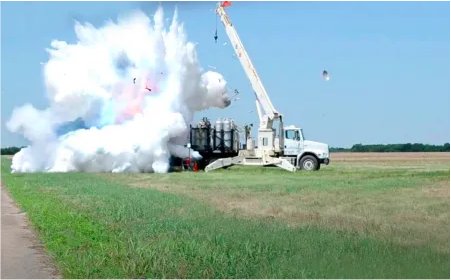
** EXOS Aerospace engine test a success but ends with test stand tank failure: Dramatic Engine Test Dubbed Success Amidst Explosion | EXOS Aerospace
Set upon the Caddo Mills (Texas) Airport Testpad, Exos Aerospace’s new SARGE R2 rocket engine was ready for testing. The efficient eight-man Operations Team of Exos prepared to conduct a 55- second engine run test.
In the briefest moment, as the valves opened and the liquid oxygen mixed with the Ethanol fuel the ambient noise was sucked into a vapor of silence, then blasted by the roar of a clean-burning engine. For 15 seconds, the perfect fiery exhaust gave a glimpse into the thrust that will fly the Exos’ SARGE R2 rocket.
But the impressive display of power was cut short by the failure of the LOX tank on the test stand, resulting in the near-instantaneous release of the liquid oxygen and ignition of the residual Ethanol in the supply lines between the tanks and the engine. This created all the pomp & circumstance expected of such an energetic event. After the level-two Safety event was under control, the Exos team was in good spirits, as they seemed more focused on the new data and slight performance boost of the SARGE engine than with the theatrics that accompanied the test.
** Interview with Masten Space CEO: Evadot Podcast #116 – Sean Mahoney CEO of Masten Space Systems – Evadot
We talk about a huge range of subjects, from how he got there, to entrepreneurial strategies and how the current Space industry is preparing us for a future worth looking forward to.
Sean has over 15 years of corporate and technology industry experience, having founded and led a number of technology start-up ventures, and raised multiple rounds of private funding. Sean received his MBA from Emory University’s Goizueta Business School and serves in a leadership capacity for a number of entrepreneurship and environmental non-profit organizations, including serving as Chairman of the Board of the Space Frontier Foundation.
** Briefs:
- Why those sometimes annoying launch, landing weather rules exist – NASASpaceFlight.com
- Equatorial Space Systems Signs MoU With Southern Launch Australia – SpaceWatch.Global
- Tests start on 3D-printed thrust chamber – ESA
- Astra Rocket Engine — Delphin 3.0 | This is the current desi… – Steve Jurvetson/Flickr
==================
Check out the
The Lurio Report
for news and analysis of key developments in NewSpace
The latest issue:
Masten Goes Lunar, Rocket Lab, New Space and a Virus
Vol. 15, No. 3, May 2, 2020
Space Frontier Foundation Award for NewSpace Journalism
==================
** SpaceX:
**** SpaceX achieves human orbital spaceflight after a hectic 18 year trek. In an interview with Irene Klotz recorded before the launch, Elon Musk describes some of the trials and tribulations that he and SpaceX endured during the long struggle to reach the point where a SpaceX rocket will send people to orbit for the first time: Podcast: Interview with SpaceX’s Elon Musk – Aviation Week Network (subscription not required). He also briefly recounted the SpaceX story during the post-launch briefing on Saturday:
**** Misc. DM-2 resources:
- Diagram of launch, orbital approach, rendezvous and docking (pdf)
- Examining Crew Dragon’s launch abort modes and splashdown locations – NASASpaceFlight.com
- Commercial Crew – Press Kit – NASA (pdf)
- SpaceX-Chefingenieur zum Start des Crew Dragon: Wilde Party kommt noch – DER SPIEGEL – Interview with Hans Königsmann, VP of Flight Reliability for SpaceX
- Post-docking briefing:
**** SpaceX Falcon 9 launch of 60 Starlink satellites set for Wednesday, June 3rd. They aim to
Of Course I Still Love You is returning from the Demo-2 mission with Falcon 9.
Just Read the Instructions is en-route to the landing zone for the Starlink mission.
This is the first time that SpaceX has operated two droneships in the same ocean simultaneously for real missions. pic.twitter.com/YAsuEjBXB8
— Gavin – SpaceXFleet.com (@SpaceXFleet) May 31, 2020
They aim to capture the nosecone fairings as well:
Ms. Tree ans Ms. Chief are headed out of Port Canaveral in support of the Starlink 7 mission. Lets hope they make a good catch with the “new software”. @SpaceXFleet Its amazing seeing 2 pieces of incredible machinery in 1 Image. I believe the sub is due to leave very shortly. pic.twitter.com/P1CTkXFKB0
— Miguel Cruz (@eg0911) June 1, 2020
See also SpaceX to ring in Crew Dragon’s success with a Starlink launch and landing – Teslararti
**** Starship
The Starship program, currently centered at Boca Chica Beach in South Texas, continues to exhibit an amazing mixture of assembly-line vehicle construction running at a furious pace with prototype tests that fluctuate between incremental successes and hugely energetic failures.
On May 19th, the third test firing of the SN4 prototype seemed to go well but as the plume dissipated, small fires could be seen around the base of the vehicle and the launch mount. Remote controlled water sprays eventually got the flames under control but it was more than a day before anyone approached the vehicle.
Another test fire happened on Thursday May 28th without any subsequent extraneous fires breaking out:
Before that test, there was an announcement from the FAA that SpaceX had been awarded a license to carry out suborbital test launches for the Starship:
- SpaceX fires up Starship’s Raptor engine hours before huge regulatory milestone – Teslarati
- SpaceX gets FAA approval for Starship flight tests – SpaceNews.com
While it appeared from this successful test that the SN4 was poised to do a brief hop, Elon Musk had said in the Aviation Week interview (see above) that they would wait to do a flight after the Crew Dragon launch. This was presumably to prevent any distraction from the most important SpaceX mission since the founding of the company and to avoid any negative vibes that could result from a mishap. The road closure schedule and FAA NOTAMs hinted, however, that a test flight might be attempted during the week after the Dragon launch. SpaceX’s first Starship hop on hold for historic Crew Dragon astronaut launch – Teslarati
Pushing its luck, SpaceX tried another engine tests on Friday, May 29th. The Raptor firing appeared to go well but a minute or so after the engine shut off, methane began pouring out at a point on the interface between the support stand and the vehicle. A few seconds later, a huge fiery explosion enveloped the vehicle when the methane ignited. After the flames and smoke died down, it appeared that the vehicle had vanished but in fact its mangled remains lay on the ground be the test stand. SpaceX Starship SN4 prototype explodes in dramatic fireball – Teslarati.
Elon said in comments following the post-DM2 briefing that the methane leak was due to a problem with a test of the quick disconnect mechanism that allows the fuel line to separate from the vehicle as it lifts off the pad:
Elon Musk, leaving the KSC press site just now, said of yesterday’s Starship test in Boca Chica Texas: “Unfortunately what we thought was going to be a minor test of a quick disconnect ended up being a big problem,” referring to the explosion.
With two out of three engine tests marred by serious problems at the interface between the vehicle and the ground support equipment, it might seem that SpaceX needs to take a pause to do some redesign and component testing. Note that using liquid methane in a large rocket and feeding propellants from the base rather than from umbilical towers are both new technological challenges. It will take SpaceX some time to get them right.
Scott Manley discusses “What Can We Learn From The Explosion Of The Latest SpaceX Prototype?”:
After several weeks of testing Starship prototype SN4 something went wrong minutes after a successful engine test. A massive fuel leak caused an explosion which wrecked the vehicle and cause significant damage to the test stand. As far as we know nobody was injured and there are prototypes already waiting in the wings to continue tests. …
… I believe that unlike the first few failures due to welding quality this is not related to the manufacture of the rocket, but in the way it’s connected to the ground service equipment that resulted in the propellent loading lines coming loose and spraying liquid methane everywhere.
****** Elon Musk said at the post-launch briefing for DM-2 that he hopes Starship to be operational within 2-4 years, though he admits scheduling is not his strong point. Gwynne Shotwell is on the same page:
Outlook from @spacex‘s Gwynne Shotwell: “We’ve learned so much in the last six years, I’m sure we will have people flying in Starship in less than six years. It would be a major company fail if we’re not flying people in like half that amount of time or less.” -AvWeek interview
— Irene Klotz (@Free_Space) May 25, 2020
****** SpaceX has raised additional funding for development of Starships as well as for the Starlink broadband Internet constellation : SpaceX raises more than half a billion dollars for Starship, Starlink programs – Teslarati
****** Aerial views of the Boca Chica construction and pad sites – Starship SN4 Ultimate Fly Over! – May 25 – LabPadre – YouTube
Feast your eyes on this exquisite aerial footage of SpaceX’s Starship SN4. These images will knock your socks off! SpaceX Boca Chica, Texas is more like a new city now. All images are explicitly owned by LabPadre Media and may not be used without written permission.
****** May.26: SpaceX Ultimate Rocket Shipyard Fly Over! LabPadre – YouTube
Feast your eyes on this exquisite aerial footage of SpaceX’s Starship Shipyard facility. These images will knock your socks off! SpaceX Boca Chica, Texas is more like a new city now. All images are explicitly owned by LabPadre Media and may not be used without written permission.
**** Construction of Prototypes SN5, SN6, and SN7 continues. The videos below show that SN5 is stacked except for a nosecone. SN6 is nearly fully stacked as well. Parts for SN7 have been seen. Here is a diagram showing the state of SN6 assembly:
Starship SN6 is back in the game🚀 Two sections have been stacked in the high bay and it could soon catch up to SN5🤯
📸 by @BocaChicaGal for @NASASpaceflight https://t.co/5qC0eR4RpF pic.twitter.com/VbhwRkCoW4— Rafael Adamy (@fael097) June 1, 2020
****** May 23: SpaceX Boca Chica – Starship SN6 Section in the High Bay – NASASpaceflight – YouTube
While SN4 undergoes work at the launch site, SN5 is waiting in the VAB/High Bay, with a SN6 section paying a visit. Video also includes new – and very cool – SpaceX Food Truck! Video and Photos from Mary (@bocachicagal).
****** May 30: SpaceX Boca Chica – Starship SN4 Aftermath – Successors Line Up – NASASpaceflight – YouTube
****** May 31: SpaceX Boca Chica – New Starships Prepare during Launch Site clearing – NASASpaceflight – YouTube
Several Starships are waiting for their turn at testing on the Boca Chica launch mount(s) as the clearing of SN4’s remains continues – notably under a Sunday Rainbow. Video and Photos from Mary (@bocachicagal). Edited by Jack Beyer (@thejackbeyer).
****** June 1: SpaceX Boca Chica – Starships SN5 and SN6 in the High Bay – SN7 Sleeved – NASASpaceflight – YouTube
****** June 2: SpaceX Boca Chica – SPadre – YouTube
** Webcast rocket reports:
**** Starship SN4 Explodes, Crew Dragon Demo 2, Rocket Lab’s 3 years and Virgin Orbit LauncherOne test – Marcus House
**** SpaceX Starship Updates – Crew Dragon Demo 2 Launch Attempt Summary – What about it!?
=== Amazon Ad ===