Check out the night sky this month, September 2026. Here are videos and links to websites highlighting the top sights to observe.
** What’s Up: September 2026 Skywatching Tips from NASA | NASA JPL
The Moon joins a tea party, Venus reaches peak brilliance, the seasons change, and the Harvest Moon meets up with some planetary neighbors.
From September 14 through 20, use the Moon as a guide to spot Antares, the Teapot asterism, and – under especially dark skies – the center of our Milky Way galaxy.
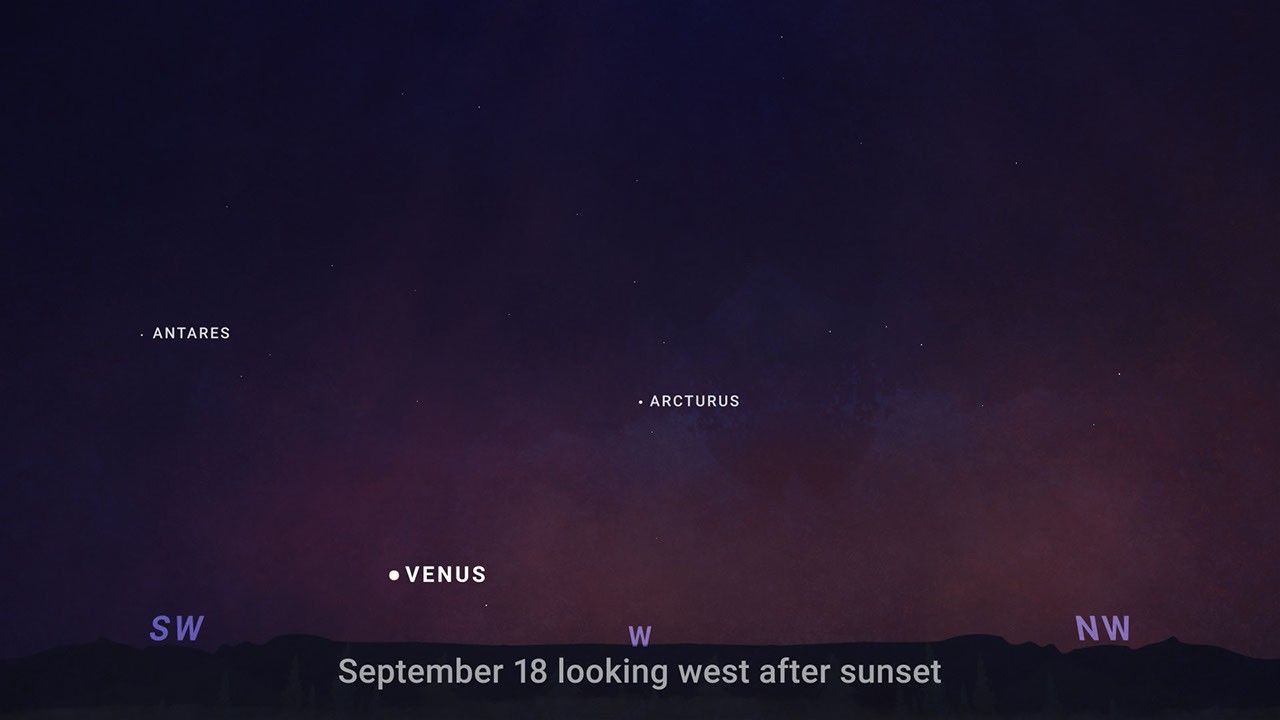
On September 18, look low in the west shortly after sunset as Venus reaches peak brilliance for this evening appearance.
On September 19, celebrate International Observe the Moon Night! People around the world are invited to look up and connect with our nearest celestial neighbor while learning more about lunar science, exploration, and the many ways the moon has shaped cultures around the world.
The September equinox arrives on September 22, marking the start of fall in the Northern Hemisphere and spring in the Southern Hemisphere.
Then on September 26, the Harvest Moon rises near Saturn, with faint Neptune completing a wide triangle in the sky. Saturn is visible to the unaided eye, while Neptune requires binoculars or a telescope.
0:00 Intro 0:12 Moon near Antares and the Teapot 1:02 Venus reaches peak brilliance 1:49 September equinox 2:13 Harvest Moon, Saturn and Neptune 2:50 Moon phases
Additional information about topics covered in this episode of What’s Up, along with still images from the video, and the video transcript, are available at https://science.nasa.gov/skywatching/whats-up/.
Sky chart view of the west just after sunset on Sept.18.2026. Credits: NASA/JPL
As the dark skies of autumn return, astronomers Pete Lawrence and Paul Abel reveal the best things to see in the night sky, from the 2026 Harvest Moon to planets, stars, constellations and deep-sky objects.
This episode takes you on a tour of the stars and planets that you’ll see overhead during September. First, we’ll check out this month’s equinox and Harvest Moon; then we’ll track down the bright planets, explore some lesser-known constellations, and bounce around the Summer Triangle. It’s a great introduction to the late-summer sky. So grab your curiosity, and come along on this month’s Sky Tour.
** September 2026 Night Sky: Moon Covers Jupiter & Venus + The Trifid Nebula | Late Night Astronomy
Wondering what you can see in the night sky the September? This monthly guide covers the Moon moving in front of Jupiter and Venus, a pair of comets and the Trifid Nebula.
…
Timestamps: 0:00 Lunar Occultation of Jupiter 1:25 Lunar Occultation of Venus 2:23 Comet 220P/McNaught 3:05 Comet Tempel 2 3:35 Wosports Ad 4:54 Lunar Phases 5:34 The Planets 7:15 Deep Sky Challenge
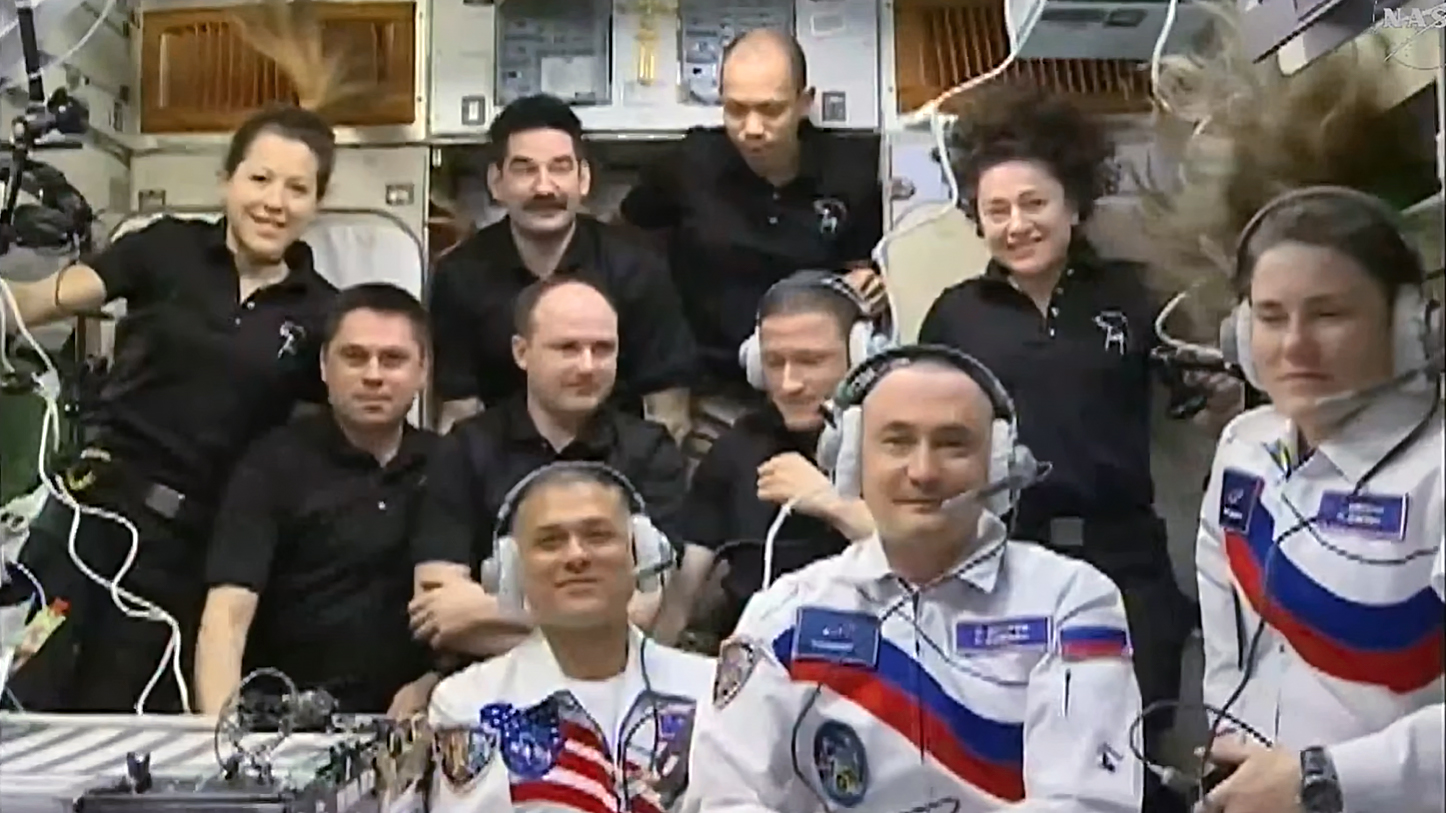
On July 14th a Russian Soyuz delivered Anil Menon of NASA and Roscosmos cosmonauts Pyotr Dubrov and Anna Kikina to the station.
A group photo of ISS residents on July 14th after the arrival of (front row from left) new Expedition 74 crew members Anil Menon of NASA and Roscosmos cosmonauts Pyotr Dubrov and Anna Kikina The second row includes Roscosmos cosmonauts Andrey Fedyaev, Sergei Mikaev, and Sergey Kud-Sverchkov. And the back row includes Sophie Adenot of ESA and NASA astronauts Jack Hathaway, Chris Williams, and Jessica Meir. Credits: NASA
Until the departure on July 26 of NASA astronaut Chris Williams and Roscosmos cosmonauts Sergey Kud-Sverchkov and Sergei Mikaev, there were 10 people on the ISS, making for a total of 13 in orbit, counting the 3 Tiangong residents.
The Soyuz MS-28 spacecraft undocked from the Rassvet module of the International Space Station (ISS) on 26 July 2026, at 07:03 UTC (03:03 EDT). Roscosmos cosmonauts Sergey Kud-Sverchkov (Сергей Кудь-Сверчков), Sergei Mikaev (Сергей Микаев) and NASA astronaut Chris Williams are scheduled to land in Kazakhstan on 26 July 2026, at 10:25 UTC (06:25 EDT).
** NASA Astronaut Discusses Life in Space with Naval Academy Alumni Magazine – Tuesday, July 28, 2026 | NASA Video
Aboard the International Space Station, NASA astronaut Jack Hathaway discussed life and work aboard the orbital outpost during an in-flight interview July 28 with U.S. Naval Academy’s “Shipmate” alumni magazine. Hathaway, a graduate of the U.S. Naval Academy, is in the midst of a long-duration mission aboard the microgravity laboratory to advance scientific knowledge and demonstrate new technologies for future human and robotic exploration flights as part of NASA’s Moon and Mars exploration approach, including lunar missions through NASA’s Artemis program.
Sophie is halfway through the εpsilon mission onboard the ISS, and she has already accomplished so much. Between hundreds of hours of scientific research and thousands of photographs taken from space, she has taken the time to share many unforgettable moments with us — inspiring millions along the way on social media.
“Many thanks to all of you following along on social media, and to all the incredible teams behind εpsilon! It’s been an amazing adventure so far, and I couldn’t be more grateful for your support. Looking forward to sharing the second half of the journey with you all!”, says Sophie.
Following its arrival on board the International Space Station, Sophie completed the checkout and activation of the European Enhanced Exploration Exercise Device (E4D), marking the start of a two-year technology demonstration led by ESA in Columbus. During this period, astronauts will evaluate the device’s design, operational performance and effectiveness in counteracting the physical deconditioning caused by life in microgravity.
** Why Can’t Russia Fix The Leaks In Their Space Station Modules? | Scott Manley
We’ve been hearing stories about the ongoing leaks on the ISS for years now, but a recent story highlighted NASA’s concerns with a plan that might have been far more risky. I wanted to go back and explain the nature of the problem, and how the repairs are more than just slapping flex seal tape over the cracks. An accepted way to fix cracks in thin sheets is to drill a clean hole to distribute the stress over a larger area, stopping the crack from propagating further.
…
0:00 Intro 2:07 AI 3:54 Finding The Leaks 6:27 Cracks 7:42 Stop Drilling 9:19 The Repairs 11:29 Going Deeper 12:58 Old Hardware 15:33 Toppings
— Building Axiom Station, a Next-Gen Commercial Space Station | Exclusive Interview | Australia in Space TV
What does it take to build the next generation space station that will replace the International Space Station?
In this exclusive interview from Axiom Space headquarters in Houston, Aaron Tullos, Vice President of Station Engineering, gives Australia in Space TV an inside look at the engineering behind the Axiom Station, a commercial space station designed to operate in low Earth orbit.
Aaron explains how Axiom Space is building on decades of lessons learned from the International Space Station, while introducing new technologies and design approaches to support future space research, manufacturing, and human exploration.
Standing in front of a full-scale wooden mock-up of the Habitation Module (Hab1), Aaron walks us through how engineers test designs, reduce costs, optimise mass and power, and prepare the station modules for assembly and launch.
the final close of its previously reported financing at more than $525 million, oversubscribed amid growing investor demand.
The upsize reflected an opportunistic extension driven by continued institutional and strategic interest in Axiom Space’s leadership of the commercial low-Earth orbit transition and the United States’ return to the Moon.
The close brought new capital onto Axiom Space’s cap table alongside the investors who anchored the round earlier this year. This positions the company to accelerate execution against its core programs: human spaceflight, spacesuits, and Axiom Station – the commercial successor to the International Space Station.
Balerion Senior Associate Aidan Daoussis sits down with Colin Doughan, Co-Founder & CEO of Gravitics, to discuss space infrastructure.
— Orbital Carrier Pathfinder under construction:
Machining is officially underway on our first primary structures panel for our Orbital Carrier “Pathfinder” spacecraft.
Known internally as the -X panel, this is the spacecraft’s most complex panel, serving as the critical interface between the launch adapter and the propulsion… pic.twitter.com/BkM2xYTrmW
Have you ever wondered what will replace the International Space Station once it’s de-orbited? Well, I sure have, and I’ve wondered what will replace it. So today I get to go inside Starlab by Voyager Technologies with their CEO Dylan Taylor to see what it’s all about!
— Several organizations have reserved space on Starlab:
The future of research in low Earth orbit is already taking shape.
Before Starlab launches, organizations across biotechnology, pharmaceuticals, advanced materials and semiconductor manufacturing have already reserved space aboard the station.
SES Space & Defence, a wholly owned subsidiary of SES, has signed an agreement with Starlab to develop a communications architecture that will provide continuous, resilient and low-latency connectivity for the commercial space station throughout its operational lifecycle.
…
The partnership will utilise SES Space & Defense’s Low Earth Orbit Relay Services (LRS), powered by the company’s next-generation O3b mPOWER medium Earth orbit (MEO) constellation. The system is designed to overcome the intermittent connectivity typically experienced by low Earth orbit (LEO) spacecraft by relaying data through MEO satellites to ground networks in near real time.
— Starlab announces new agreements with customers reserving station access for research activities and payloads:
DigitalBlast, Inc. (Chiyoda-ku, Tokyo; President and CEO: Shingo Horiguchi), a company that supports the growth of the space industry and the creation of new businesses, today announced that it has signed a Reservation Agreement for the use of the commercial space station “Starlab” with Starlab Space LLC (headquartered in Houston, Texas, U.S.), the developer and operator of Starlab, and recently held a signing ceremony….
… As interest in the commercial use of low Earth orbit (LEO) grows toward the post-ISS era, DigitalBlast will serve as a user-integration partner for R&D that puts the space environment to practical use, and will work to build itself into one of the gateways through which companies and research institutions in Japan and the wider Asia region can access orbit.
Our space stations and satellites use fluid systems to transport oxygen, water, coolant, and fuel. We manufacture, test, and integrate these systems in-house with the speed, precision, and scale required to build next-generation space infrastructure, starting with Haven-1. pic.twitter.com/7Ze90uNCyG
Our wet trash system is one of several life-support systems aboard Haven-1. The system manages wet waste containment with integrated odor control and vacuum venting. It’s part of a comprehensive support system designed to keep crews safe in space. pic.twitter.com/MVv0PSecFI
— This New Space Station Is Full Of Modern Touches | Core Memory
The International Space Station is 25 years old, cost $155 billion, and leaks. A startup called Vast thinks it can build the replacement for about a billion dollars, and it plans to launch the first piece in 2027. In this episode, Ashlee Vance heads to Vast’s headquarters in Long Beach, California for a full tour of Haven-1, the spacecraft the company expects to be the world’s first commercial space station. Vast is the wildcard in the race to replace the ISS, moving faster than rivals like Axiom, Blue Origin and Starlab, and it’s doing it the SpaceX way: everything designed, built and tested in house, from the hatch to the micrometeorite shielding to the actual flight hull sitting next to the cafeteria.
The money comes from Jed McCaleb, the crypto billionaire who believes humanity needs a frontier and is willing to spend a fortune to open one. The building falls to CEO Max Haot, who walks Ashlee through mission control, the hull welding operation, and the numbers that make competitors nervous. Vast builds pressure vessels in six months for under $5 million while others pay 55 million euros and wait four years. NASA showed up in 2023 expecting a science fair. They’ve been coming back every quarter since.
Then NASA astronaut Drew Feustel, who spent 225 days on the ISS, takes over for the fun part: a space food taste test featuring freeze dried tiramisu and tales of trading for duck confit in orbit, the largest window ever flown to space, a zero gravity sleep pod that hugs you, and a walkthrough of Haven-1’s surprisingly roomy interior. Four people will live aboard for two week missions, with a SpaceX Dragon serving as taxi, lifeboat and bathroom. Ashlee walked in skeptical after 15 years of covering commercial space delays. He walked out believing this thing is actually going to fly.
…
Chapters 00:00 Intro 01:31 Who’s Paying a Billion Dollars for This? 05:14 Why Vast Builds Everything Itself 07:43 Touching the Real Haven-1 10:12 Space Food Taste Test with an Astronaut 12:49 The Biggest Window to Ever Fly 14:10 How Do You Sleep in Space? 15:59 Is This Really Big Enough for Four People? 20:07 Is Vast Actually Going to Pull This Off?
The three astronauts on China’s Shenzhou-23 mission performed a haul of experiments and interacted with a robotic assistant on the Tiangong space station over the past week as they were pressing ahead with scientific research and routine maintenance in orbit.
Seattle-based Interlune is expanding its partnership with Vermeer, an Iowa-based industrial equipment manufacturer, to develop construction tools for use on the moon.
The two companies forged their initial strategic partnership to further Interlune’s plans to extract helium-3 from tons of moon dirt and rocks, also known as regolith. Their full-scale prototype of a lunar excavator was unveiled a little more than a year ago.
At the time, Interlune was focused on mining helium-3 and bringing it back to Earth for applications ranging from quantum computing to medical imaging and nuclear fusion. But a major shift came in March when NASA announced a 10-year, $30 billion initiative to build the infrastructure for a moon base.
In this video, Jacob Keeley of Vermeer describes the Interlune x Vermeer space harvester:
Astroport Space Technologies, Inc., a leader in lunar construction, today announced at the 20th International Conference on Engineering, Science, Construction and Operations in Challenging Environments (ASCE Earth & Space 2026), a collaboration with global agricultural and industrial equipment manufacturer Vermeer Corporation to help in the development of autonomous construction machinery to aid in building a permanent human presence on the Moon.
The collaboration contributes Vermeer’s surface mining expertise to Astroport’s specialized work in robotic autonomy and lunar soil (regolith). The primary focus of this collaboration is on “lunarization” of Vermeer surface mining machinery using Astroport’s Universal Tool Implement Payload Adapter (UTIPA) technology, a modular adapter system of interchangeable tools designed for robotic construction in the Moon’s extreme environment. Beginning with a surface miner application, the teams will utilize UTIPA technology to adjust heavy equipment’s traditional reliance on mass and weight, in order to operate in the Moon’s low gravity environment and survive massive temperature swings and harsh lunar surface conditions.
The Mars Society, through its Seattle Chapter, and South Seattle College (SSC) have signed a 10-year Memorandum of Agreement (MOA) establishing a multi-program partnership to build a Moon and Mars analog research station on the South Seattle College campus in West Seattle and create a regional education and workforce pathway for the next generation of aerospace researchers, technicians and engineers.
The agreement, signed by SSC President Dr. Monica Brown and Mars Society Executive Director James L. Burk, covers four interconnected efforts: a Moon and Mars analog research station on the SSC campus, a joint space studies curriculum and stackable certificate pathway, a student capstone project and internship program tied to industry partners, and a regional workforce pipeline and community engagement effort.
The Society
… currently operates research stations in Utah and Canada, where crews live and work under simulated Mars mission conditions. This work includes human factors studies, equipment testing, biology and geology field research, medical testing and safety drills. A research station on SSC’s campus would extend the hands-on side of this research, which aligns naturally with the strengths of a skilled trades-focused institution.
** Space Habitats: The Megastructures We’ll Call Home | Isaac Arthur
Explore the future of space habitats, from rotating cylinders and torus colonies to orbital cities, asteroid homes, and the megastructures humanity may one day live inside.
…
0:00 Intro 4:37 The Sunflower 14:07 The O’Neill Cylinder 49:00 Lewis One 57:40 Stanford Torus 1:22:19 Kalpana One 1:28:14 Nebula 1:29:27 Bernal Sphere 1:54:13 Bishop Ring 2:03:23 Topopolis 2:27:36 McKendree Cylinder 2:33:57 Hammer Habs 2:59:01 Rungworlds 3:04:35 Conglomerations 3:38:45 Epilogue
** Jerry Stone – Island Zero, A Study of A First Space Settlement – NSS Space Ambassadors Presentation | National Space Society
Jerry Stone from the British Interplanetary Society joins the NSS Space Ambassadors and gives his first presentation on the topic of “Island Zero,” a large space station providing artificial gravity. In mid-1969, Professor Gerard K. O’Neill put a question to a study group at Princeton University: “Is a planetary surface the right place for an expanding technological civilization?”
The unexpected result from their studies was that the answer was “No.” A much better place, it seemed, would be in vast habitats constructed in high orbit, at a special location known as the Lagrange points L4 and L5.
It is now almost 40 years since the original studies were conducted, and many advancement shave been made since the 1970s. There have been improvements in materials science, engineering, computing and robotics, and other areas that can make this program more efficient.
The aims of Island Zero will include:
Living under simulated gravity Construction from modular units and space -produced components Growing a large percentage of food in space Development of a space manufacturing facility
Island Zero units could be used to house the construction force for Island One, the first large space settlement. Overall, Island Zero presents a relatively low-cost means of providing a logical progressive approach towards the construction of large settlements in space.
In a presentation at this year’s International Space Development Conference, which took place in McLean, Virginia, June 4th through June 7th, National Space Society (NSS) COO/SVP Dale Skran announced the kickoff of an open-source Rotating Space Settlement Design (RSSD) Project. The initiative has been under active development for over a year within the NSS Space Settlement Advocacy Committee (SSAC) and the NSS Board of Scientific and Technical Advisors (BSTA). Full disclosure: Yours truly is a member of the SSAC. It was officially approved as an NSS Project last March. The content of this post is based on Skran’s presentation, supplemented with subsequent material presented to the SSAC, with permission.
The current RSSD project Study Group core team consists of Dale Skran, Frederick (Rick) Jenet, PhD, and Bryce Meyer, with all BSTA and SSAC members actively involved in review and discussion. Work is currently focused on establishing a foundational set of design inputs in the form of “Questions” (see below). A dedicated workshop to refine these questions will be held at the NSS Space Settlement Summit taking place at the University of Central Florida, October 25th and 26th. This will be followed by a public announcement and formal request for comment from the broader community. In addition, the “RSSD Terms of Reference” (TOR) will be published in the NSS Space Settlement Journal.
…
What is the Objective of the RSSD Project?
The core goal is to produce the first complete buildable engineering design for a rotating space settlement. The project is primarily an engineering and systems-design effort, not a policy activity, although legal and economic aspects are necessarily included because they affect feasibility.
=== Technologies and strategies for space settlement
** Additive Manufacturing in Microgravity | Isaac Arthur
The most expensive part of space travel isn’t the fuel. It’s the cargo. Additive manufacturing isn’t a sci-fi magic trick; it’s the key to building shipyards and telescopes at scales rockets were never meant to handle. We aren’t just launching ships anymore; we’re moving the factory to the void.
…
Chapters 0:00 Intro 2:10 Additive Manufacturing Is Not a Printer 8:04 The Physics of Printing in Freefall 12:23 Low Gravity, Regolith, and the “Messy Middle” 17:01 CT Scan 17:59 Printing at Scales Rockets Can’t Touch
=== Other space habitat and settlement news, articles, reports, etc.
ISS in Real Time – “Explore 25 years onboard the International Space Station. This multimedia project replays every day of the past 25 years onboard and consists entirely of historical mission material.”
Blue jets above Earth: a rare atmospheric phenomenon captured from the ISS.
One of the rarest atmospheric light phenomena—a so-called “blue jet”—was captured from the space station orbiting approximately 400 km above Earth’s surface. The event was observed above a storm front… pic.twitter.com/zra9gq4VVv
** Live Video from the International Space Station (Official NASA Stream) | NASA
Watch live video from the International Space Station, including inside views when the crew aboard the space station is on duty. Views of Earth are also streamed from an external camera located outside of the space station. During periods of signal loss due to handover between communications satellites, a blue screen is displayed.
The space station orbits Earth about 250 miles (425 kilometers) above the surface. An international partnership of five space agencies from 15 countries operates the station, and it has been continuously occupied since November 2000. It’s a microgravity laboratory where science, research, and human innovation make way for new technologies and research breakthroughs not possible on Earth. More: https://go.nasa.gov/3CkVtC8
Did you know you can spot the station without a telescope? It looks like a fast-moving star, but you have to know when to look up. Sign up for text messages or email alerts to let you know when (and where) to spot the station and wave to the crew: https://spotthestation.nasa.gov
Check out the night sky this month, August 2026. Highlights include the Perseid meteor shower, a bright Venus in the evening, and both a partial solar eclipse and a partial lunar eclipse. The sights are described in these videos and links to websites:
A solar eclipse, one of the year’s best meteor showers, Venus at its brightest in the evening sky, and a partial lunar eclipse to close out the month.
On August 12, a total solar eclipse crosses northern Russia, Greenland, Iceland, northern Spain, and a small corner of Portugal. In parts of the United States, from Alaska to North Carolina, the eclipse will be partial. Use certified eclipse glasses or a safe solar viewer whenever any part of the Sun is visible.
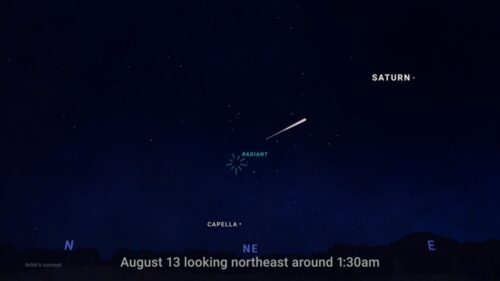
Later that night, the Perseid meteor shower peaks under the dark skies of the New Moon. Around August 14 through 16, Venus shines low in the west after sunset, and on August 27-28, a partial lunar eclipse is visible from much of the Americas and parts of Europe and Africa.
0:00 Intro 0:11 Solar eclipse 0:41 Perseid meteor shower 1:27 Venus after sunset 1:41 Partial lunar eclipse 2:22 August Moon phases
Additional information about topics covered in this episode of What’s Up, along with still images from the video, and the video transcript, are available at https://science.nasa.gov/skywatching/whats-up/.
“….where in the night sky to look for the Perseid meteor shower.” Credits: NASA/JPL-Caltech
Astronomers Pete Lawrence and Paul Abel reveal the best things to see in the night sky this month, including the August 2026 solar eclipse and the peak of one of the year’s best meteor showers.
This month we’ve got three big celestial events to cover: eclipses of the Sun and Moon, and especially good prospects for the Perseid meteor shower. Plus we’ll track down a few planets, and gaze at the center of our galaxy. So load up on the bug juice, and come along on this month’s Sky Tour.
** August 2026 Night Sky: Total Solar Eclipse, Perseid Meteor Shower & Comet Tempel 2 | Late Night Astronomy
Wondering what you can see in the night sky this August? This monthly guide covers the Total Solar Eclipse, the peak of the Perseid meteor shower, Comet 10P/Tempel, and a partial lunar eclipse.
…
Timestamps: 0:00 Night Sky August 2026 0:30 Total Solar Eclipse (August 12) 2:12 Perseid Meteor Shower Peak 3:20 Partial Lunar Eclipse (August 27) 4:10 Ouranos Sponsored Ad 5:29 Comet 10P/Tempel 2 Viewing Guide 6:23 The Moon 7:04 The Planets 8:46 Deep Sky Challenge
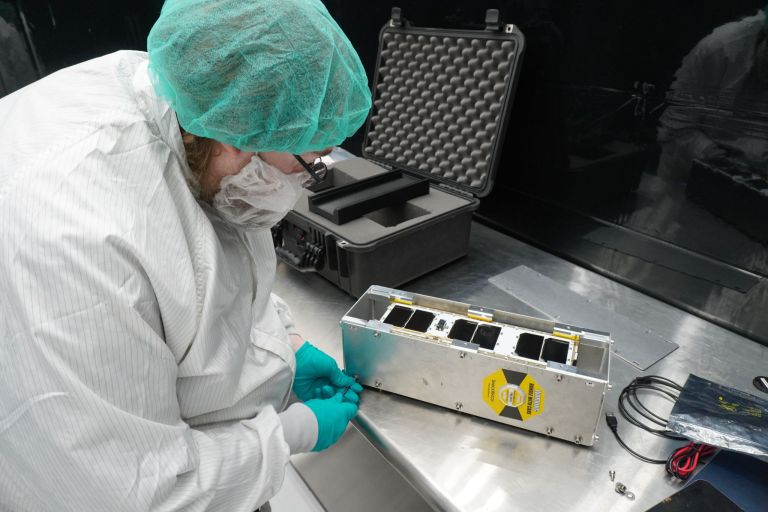
For many decades, students in university programs have designed and built small satellites and operated them in orbit. With the arrival of standardized Cubesat designs and hardware, high school and even grade school students have joined in the smallsat fun. Such endeavors grew out of the AMSAT initiative of the amateur radio community, which launched the first non-government satellites in 1961. (For more smallsat history, see Satellite Building in the HS archives.) Note that the term Amateur Satellites refers to the use of amateur radio bands for communications, not the quality of the satellites.
Here is a brief sampling of recent student smallsat projects and programs:
On April 11, student-built satellite Lion Cub arrived at the International Space Station aboard a SpaceX rocket. The nanosatellite is scheduled to remain docked at the ISS until June 29, when it will be deployed into low Earth orbit in what Smith described as “very ceremoniously for us, kind of unceremoniously in video, it just sort of gets ejected out of a launch rail.” At that point, Lion Cub will attempt its central mission: releasing a small stuffed Roaree and photographing it against the backdrop of space.
The CubeSat team first formed in 2022, when a group of students set out to build a satellite without fully knowing how they would get it to space. In 2023, the team proposed Lioness, CSI’s larger scientific satellite mission, and secured a NASA launch contract. The team later joined a multi-university collaboration led by California State Polytechnic University, Pomona, to build Lion Cub, a smaller proof-of-concept satellite that Archer Ankrum, SEAS ’29, a member of the structures team, described as “a test to prepare ourselves” for the full process before the stakes were higher.
More than 180 Grade-8 students at Qatar Academy Doha (QAD), a member of Qatar Foundation (QF), took part in the CubeSat Explorer Challenge- a hands-on learning experience organised by Boeing, INJAZ Qatar and Pure Minds Academy to spark early interest in space, satellite technology and other STEM-related careers.
“This programme didn’t just introduce students to space – it brought space to them. It’s no longer a distant concept, but an accessible, exciting career path they can pursue and build here in Qatar,” said Wael Zaoud, Boeing managing director for the Middle East and North Africa. “Qatar is steadily expanding its space capabilities and creating opportunities for the next generation of engineers and researchers. As a company that helped put the first human on the Moon, Boeing is proud to support young talent who will shape Qatar’s aerospace industry.”
The CubeSat Explorer Challenge introduced school students to the role satellites play in modern economies. Working in teams, students designed and built miniature satellite prototypes equipped with environmental sensors, programmed microcontrollers, collected live data and presented their findings. Through the experience, students gained insight into how satellite technologies support decision-making in areas such as air quality monitoring and climate research.
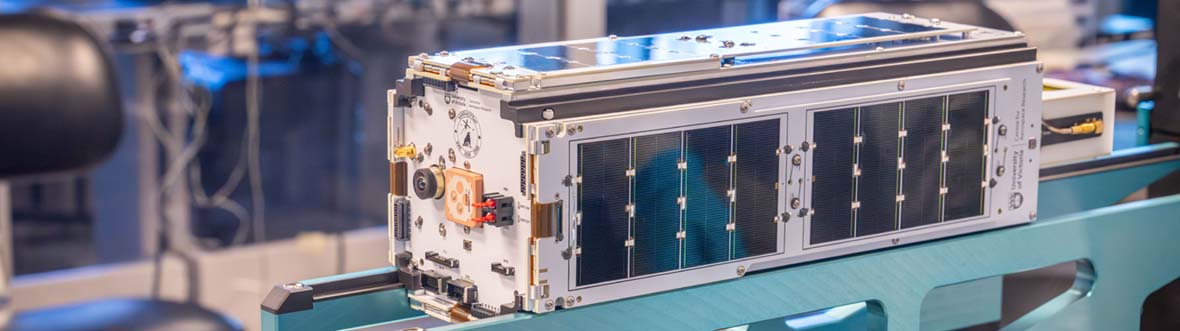
MARMOTSat, the second CubeSat from UVic’s Centre for Aerospace Research (CfAR) and the UVic Satellite Design Team (UVSD) is set to launch in July aboard a SpaceX Falcon 9 from the Vandenberg Space Force Base in California. The satellite has already been integrated into its deployment canister at the Canadian Space Agency, and the team expects it to reach orbit and deploy within hours of liftoff.
Once in orbit, MARMOTSat will collect data on the structure and composition of the ionosphere, the charged layer of the Earth’s atmosphere that plays a role in everything from radio propagation to satellite navigation. Researchers are particularly interested in how the ionosphere is shifting in response to human-caused climate change, which is a connection that is still not well understood.
“MarmotSat: Student-Built Canadian CubeSat Brings Open-Source Amateur Experiments to VHF and 10 Meters” – ANS-186 AMSAT News Service Weekly Bulletins – ANS – mailman.amsat.org – July.5.2026 – “For amateurs, the interesting part of MarmotSat is its payload, which marks the debut of the Modular CubeSat Radio (MCR), an open-source, GNU Radio-compatible software-defined radio platform developed by the team. Built around a low-power HF SDR derived from the Hermes Lite 2, the MCR for this mission includes the SDR, an onboard computer, a camera, HF and VHF RF front ends, and simple wire antennas: a base-loaded half-wave tape-measure whip for HF and a half-wave tape-measure dipole for VHF.”
** SNAPPY, the Solar Neutrino Astro-Particle PhYsics CubeSat. was developed by students and researchers at Wichita State University. The NASA funded spacecraft reached orbit on May 3, 2026 aboard a SpaceX Falcon 9 rocket launched from Vandenberg AFB in California.
Two College of Charleston students built ultraviolet imaging systems, one of which went to the ISS in April of 2026 and another was integrated into a Cubesat that reached orbit on July 7th:
** SPARCS ( Star-Planet Activity Research CubeSat) at Arizona State University
The Star-Planet Activity Research CubeSat (SPARCS) is a small space telescope about the size and shape of a family-size cereal box, launched on SpaceX rocket into low-earth orbit on January 11, 2026.
The science mission which SPARCS will undertake is monitoring the flares and sunspot activity of low-mass stars of M and K spectral type, in the far- and near-ultraviolet to assess how habitable the space environment is for planets orbiting these kinds of stars.
BRODIE: What have you learned by doing this? Not necessarily just about sort of the data and what it is telling you, but maybe what have you learned about things that might interest you or about yourself or about sort of the universe more broadly?
SINK: Yeah, there’s there’s so many things that I’ve learned from this project. I think the realm of satellites in general, I really didn’t understand and the potential for science. So if our little toaster that’s out in space with a telescope is able to contribute to something as big as like looking for habitable planets and things like that, I think it really put in perspective like how cool science really is and how cool space is.
And on the technical side of things, I’ve learned a whole lot of data this, satellite that, right? But I think the absolute coolest thing is just the potential for what we can actually do out there.
The club brings together more than 50 students passionate about aerospace, astrophysics and space technology. Through technical projects, outreach initiatives and industry engagement, the team has built a growing presence within Canada’s space sector while giving students direct experience in mission design, systems engineering and research collaboration.
Today, the team is working on one of its most ambitious initiatives yet: the development of Carleton’s first student-led 3U CubeSat focused on wildfire detection. Alongside the CubeSat mission, CUonOrbit has also completed three high-altitude balloon launches, with a fourth mission planned for summer 2026.
By 2030, the PHAT-Sat project plans to launch a three-unit CubeSat equipped with advanced, hyperspectral cameras that can point toward Kansas and the surrounding region and help detect crop health anomalies. Farmers and drought managers could then analyze that satellite imagery to implement precision agriculture techniques for better irrigation, resource management and sustainability.
In the meantime, the class decided to formulate a “pathfinder” mission to PHAT-Sat by spinning off what had previously been a smaller, secondary payload into NuKAT, a two-unit satellite tentatively set to launch in 2027.
Students at Cal Poly’s hands-on aerospace lab watched months of design and late-night fabrication reach orbit when their latest CubeSat rode a launch vehicle out of Vandenberg late last month. The mission not only puts a small satellite into space — it also underlines how undergraduate labs are training the next generation of engineers in real flight operations. …
… Cal Poly’s PolySat Lab — a multidisciplinary, student-run workshop that builds compact research satellites — confirmed the CubeSat reached orbit after a launch from Vandenberg Space Force Base at about 4 a.m. on March 30. Ground teams have established two-way contact and continue to track and receive data from the spacecraft.
is named after Astronaut Dr. Sally Ride, the first American woman in Space and an inspiration for women and the LGBTQ+ community. The objectives of this mission are to evaluate CPCL’s capability of designing, manufacturing, and testing a CubeSat while simultaneously providing a project management basis for future CPCL flight missions. SAL-E launched successfully on SpaceX’s Transporter 16 rideshare mission and first contact was made soon after.
The CubeSat concept was actually first developed by a collaboration between teams at Cal Poly and Stanford.
A live CubeSat tracking demonstration and outreach sessions on space technology, healthcare and defence applications drew school students’ attention on the second day of the 5th IEEE Wireless, Antenna and Microwave Symposium (WAMS-2026) at a college in Narsapur.
[CubeCats President Everett Metzler] said leaks on the International Space Station pushed back the deployment and that he only learned a few days ago it was going ahead. The deployment is the final step in a 10-year plan to deliver LeopardSat-1 from the maker space into the hands of a NASA astronaut.
“An astronaut is going put it inside of an airlock, and then put the deployer outside, and it’s going to launch into space. So, at first, it’s going to start tumbling, then it’s slowly going to detumble over time, and then after a few hours, it’s going to start and – hopefully – transmit back to us,” Metzler said.
Metzler said the satellite carries different carbon-based materials to test how they hold up against radiation in space. He said finding the right material could help make longer missions to the moon and even Mars possible.
The CubeCats’ work will continue after deployment. The group still has to record the data and is already planning its next satellite.
** KENSAT is a one person run project that will send a CubeSat
carrying an LLM into low earth orbit — designed, owned, and operated by a single individual rather than a state or a corporation. It performs inference in space, and beams the answer back to anyone listening.
… a large language model on-orbit. A power-gated NVIDIA Jetson Orin Nano executes neural-network inference in space, and the results are downlinked over a custom UHF radio link to amateur ground stations.
… a 520 km sun-synchronous orbit and circle the planet about sixteen times a day.
On board: a tiny always-on flight computer that keeps the satellite alive, a GPU that runs the language model, a UHF radio for talking to the ground, and a small lithium battery topped up by body-mounted solar panels.
The radio antenna is a pair of tape-measure strips that spring open the moment the satellite is ejected from its deployer. No motors, no actuators, no moving parts that can fail.
Getting a complex electronics project off the ground is never easy, but Ken Chan’s latest creation presents some unique challenges. That’s because Chan’s project is designed to literally get off the ground — way off. It is called KENSAT, and it is a 2U CubeSat that is scheduled to go into orbit around the Earth this fall. Perhaps the coolest thing about KENSAT is that it’s not being built in a NASA clean room, but in Chan’s home lab.
Getting Started with Amateur Satellites – “a complete guide to working amateur satellites, covering tracking, antennas, radio selection, and step-by-step operation for FM, SSB, and digital modes.”
Cal Poly’s CubeSat Laboratory (CPCL) – “where the CubeSat standard originated, and where the CubeSat Design Specification is maintained and published. In addition to providing the CDS, CPCL hosts the annual CubeSat Developer’s Workshop in San Luis Obispo, and provides a central point for CubeSat community resources.”
CubeSatSim Lite Fully Assembled – AMSAT – This “low-cost, fully assembled satellite simulator” is designed to help users learn about satellite communications by transmitting simulated telemetry signals that can be received with common amateur radio equipment.Operating on the 70 cm amateur band at 434.900 MHz, the CubeSatSim Lite allows users to receive and decode signals using a wide range of radios and software-defined radio (SDR) setups. Digital telemetry and images can be decoded using software such as FoxTelem, APRS decoders, or SSTV applications.”
Check out the night sky this month, July 2026. Here are videos and links to websites highlighting the top sights to observe.
** What’s Up: July 2026 Skywatching Tips from NASA | NASA JPL
A predawn meetup between the Moon and planets, a returning comet, dark skies for the Milky Way, and Saturn’s unusually thin rings.
Before sunrise on July 11 and 12, look east/southeast for the waning crescent Moon, Mars, and Saturn. Uranus is in the same part of the sky, but you will need binoculars or a telescope to spot it.
Around July 14, use binoculars or a telescope to seek Comet 10P/Tempel 2 under dark skies of the New Moon. Those nights are also a great time to look for the Milky Way, while later in the month Saturn’s rings appear strikingly thin through a telescope.
0:00 Intro 0:11 Moon, Mars, Saturn, and Uranus before dawn 0:47 Comet 10P/Tempel 2 1:35 Dark skies for the Milky Way 2:34 Saturn’s thin rings 2:57 July Moon phases
Additional information about topics covered in this episode of What’s Up, along with still images from the video, and the video transcript, are available at https://science.nasa.gov/skywatching/whats-up/.
Pete Lawrence and Paul Abel reveal the best things to see in the night sky this month, from the Moon and planets to the constellations and deep-sky objects.
This month’s episode offers great tips on how to be a better stargazer. It also highlights the bright star Spica, now prominent high in the southwest after evening twilight. It’s leading the parade of constellations, along with the brilliant planet Venus, that will grace the Northern Hemisphere’s summer skies. So grab curiosity and come along on this month’s Sky Tour.
** The Night Sky | July 2026 | Comet Tempel 2 | Delta Aquarids Meteor Shower | Late Night Astronomy
A major meteor shower peaks and we continue to track a comet traveling through our solar system. Let’s take a look at what you can go out to see in the night sky for July of 2026.
…
Timestamps: 0:00 Delta Aquarids Meteor Shower 1:34 The Moon 2:10 Ouranos Ad 3:21 The Planets 4:12 Comet Tempel 2 4:56 Deep Sky Challenge