Here is a new selection of videos, articles, and news items about space habitats (govt and commercial), living in space, and space settlement.
=== International Space Station & NASA
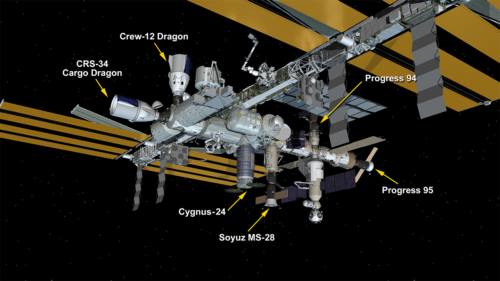
** SpaceX Dragon Docks to Station Filled with New Science Experiments | NASA – May.17.2026
At 6:37 a.m. EDT, the SpaceX Dragon spacecraft docked to the forward port of the International Space Station’s Harmony module, carrying nearly 6,500 pounds of food, supplies, and equipment for the Expedition 74 crew. This is the 34th SpaceX commercial resupply services mission to the space station for NASA.
In addition to cargo for the crew aboard the space station, Dragon will deliver several new experiments, including a project to determine how well Earth-based simulators mimic microgravity conditions, a bone scaffold made from wood that could produce new treatments for fragile bone conditions like osteoporosis, and equipment to help researchers evaluate how red blood cells and the spleen change in space. The Dragon spacecraft also will carry a new instrument to study charged particles around the Earth that can impact power grids and satellites, an investigation that could provide a fundamental understanding of how planets form, and a instrument designed to take highly accurate measurements of sunlight reflected by Earth and the Moon.
The mission launched at 6:05 p.m. May 15 aboard a SpaceX Falcon 9 rocket from Space Launch Complex 40 at Cape Canaveral Space Force Station in Florida.
** NASA’s SpaceX 34th Commercial Resupply Services Rendezvous and Docking | NASA
** NASA Astronauts Discuss Life In Space With U.S. Naval War College – Friday, April 24, 2026 | NASA Video
Aboard the International Space Station, Expedition 74 flight engineers Jack Hathaway and Chris Williams of NASA, discussed life and work aboard the orbital outpost during an in-flight interview April 24 with the U.S. Naval War College in Newport, Rhode Island. Hathaway is a graduate of the college. The two astronauts are in the midst of a long-duration mission living and working aboard the microgravity laboratory to advance scientific knowledge and demonstrate new technologies for future human and robotic exploration flights as part of NASA’s Moon and Mars exploration approach, including lunar missions through NASA’s Artemis program.
** The International Space Station: 25 Years of Innovation and Inspiration | AIAA
In November, the International Space Station (ISS) reached a historic milestone—25 years of continuous human presence in orbit. Over that time, more than 290 astronauts have lived and worked aboard the space station, driving research and development that benefits life on Earth and expands NASA’s reach into space. This session will highlight some of the most innovative advancements enabled by the ISS and explore what’s next for low Earth orbit as we look toward the future of space exploration.
MODERATOR: Patrick O’Neill, INTERNATIONAL SPACE STATION NATIONAL LABORATORY
Michael Roberts, Chief Science Officer, ISS National Lab
Robyn Gatens, Director, International Space Station and Commercial Spaceflight Divisions, NASA (Invited)”
=== Commercial space habitats
** Axiom Space
— What Comes Next | Axiom on Youtube
“What Comes Next” showcases Axiom Space’s vision to transcend Earth by building era-defining space infrastructure that drives exploration and fuels a vibrant space economy for the benefit of every human everywhere. Tune in to watch our short film to learn more about how we are building what comes next for low-Earth orbit. #AxiomStation
— — —
Axiom Space is building the world’s first commercial space station – Axiom Station. Serving as a cornerstone for sustained human presence in space, this next-generation orbital platform fosters groundbreaking innovation and research in microgravity, and cultivates the vibrant, global space economy of tomorrow. Today, driven by the vision of leading humanity’s journey off planet, Axiom Space is the principal provider of commercial human spaceflight services to the International Space Station and developer of advanced spacesuits for the Moon and low-Earth orbit. Axiom Space is building era-defining space infrastructure that will empower our civilization to transcend Earth for the benefit of every human, everywhere.
— Axiom Space CEO Jonathan Cirtain Explains What Sets It Apart from Competitors | New York Stock Exchange
Axiom Space CEO Jonathan Cirtain joins Ashley Mastronardi on NYSE Live to discuss his company and its. competition
** Starlab – Voyager Technologies
— Commercial demand for Starlab exceeds available capacity: Voyager ‘very optimistic’ about Starlab amid potential NASA changes | SpaceNews – May.5.2026
“We were already at 130% of commercial demand capacity spoken for on Starlab, and that commercial demand could translate to a different solution if NASA goes a different path,” he said.
Phil de Sousa, chief financial officer, said that Starlab should start recording commercial revenue as soon as 2027 through activities such as training for future missions to the station as well as converting payload reservations into contracts. Work on Starlab has been supported so far by the companies along with a NASA Space Act Agreement, which provided $24 million to Voyager in the first quarter as it completed four milestones.
Voyager may launch Starlab even without NASA as anchor customer:
Taylor left the door open for Starlab to develop its station without NASA support when asked by an analyst if there was a “third option” beyond the current CLD plans and the alternative proposed by NASA.
“I think we’re very well positioned for CLD Phase 2, but it’s not out of the realm of possibility that we could independently finance this,” he said.
— Voyager partners with Rhodium Scientific to support scientific research on Starlab:
From research to real-world impact — faster.@RhScientific is partnering with Starlab Space to deliver biotech services, flight-proven hardware, and end-to-end mission support in low Earth orbit. From payload development to in-orbit operations and post-flight commercialization,… pic.twitter.com/v1ag2YIdcC
— Starlab (@Starlab_Space) April 28, 2026
— Starlab partner Max Space will provide expandable structures for in-space and on lunar surface habitation: Max Space unveils new expandable space habitat for the moon and beyond: ‘We need real estate that is scalable’ | Space.com – Apr.16.2026
Max Space has unveiled a large sub-scale version of their expandable habitat, giving viewers a real look at how best to offer far greater habitable volume for future space endeavors. “This is more than a model,” said Saleem Miyan, co-founder and CEO of Max Space, based in Florida. “It is a physical demonstration of a new approach to space infrastructure, far greater habitable volume, lower launch mass and logistics burden, scalable architecture for commercial low Earth orbit stations, lunar surface systems, and future deep space missions.”
If we are serious about permanent human presence on the moon and in space, Miyan told Space.com, “we need real estate that is scalable and built for how humans will actually live and operate off Earth.”
— Another customer for Starlab microgravity service: Plastron Group and Starlab Space Enter Agreement to Advance Life Sciences Research | Starlab – Apr.21.2026
Starlab Space LLC, a commercial space station developer, today announced an agreement with Plastron Group, a contract research organization focused on enabling end-to-end life sciences research and manufacturing in microgravity in the UK and Europe at large. Through the agreement, the two organizations will collaborate on expanding access to microgravity-enabled biotechnology and pharmaceutical research as the commercial space industry transitions beyond the International Space Station.
Under the agreement, Plastron will deliver a comprehensive microgravity service model for biotech and pharmaceutical customers, supporting research and manufacturing workflows from ground to orbit and back. The company’s approach integrates experiment design, payload handling and post-flight analysis into a seamless process, ensuring continuity and quality across every stage of the mission.
** VAST
— The Vast step-by-step development of sustainable habitats in space:
Vast is ready to support a continuous presence in space for the US and its allies. Through our hardware-rich, stepping-stone approach to building next-generation space stations, we validate our systems early to ensure readiness, starting with the success of Haven Demo. pic.twitter.com/fYVv5cCh3R
— Vast (@vast) May 8, 2026
— The Vast approach to the design of ground and orbital facilities: Step inside the gorgeous, futuristic offices of Vast, the startup designing the next-gen space station – Fast Company
Vast’s new 49,000-square-foot headquarters, a collaboration between its in-house team and the New York-based multidisciplinary design studio Civilian, does all those things, in a sophisticated expression of how architecture can support high-performance work and reinforce brand.
— Vast partnering with Lithuania for research activities in orbital stations: Vast Signs Memorandum of Understanding with Innovation Agency Lithuania to Support Space Industry Engagement and Scientific Research | VAST – May.6.2026
Established in 2022, Innovation Agency Lithuania is a non-profit agency under the Lithuanian Ministry of Economy and Innovation and leads the country’s innovation ecosystem, supporting business development across all stages, including space research.
Under the agreement, Vast and Innovation Agency Lithuania will explore opportunities for joint scientific research activities either in the International Space Station National Lab or Haven-1, scheduled to be the world’s first commercial space station, launching in 2027. The partnership also includes plans to further develop educational programs in Lithuania and deepen engagement with local industry.
— VAST aims for launch of first station in 1st quarter of 2027: Vast’s Haven-1 Advances Toward First Commercial Space Station Launch | Orbitalhub.com – Apr.19.2026
Vast, the California-based startup developing what it calls the world’s first commercial space station, announced significant progress in March and April 2026 as Haven-1 moves toward its target launch in the first quarter of 2027. The company secured $500 million in Series C funding in March 2026, led by the Qatar Investment Authority with participation from Mitsui, MUFG, and Balerion Space Ventures.
The funding will accelerate production of the Haven-1 station and support development of the follow-on Haven-2 design. Vast has also expanded manufacturing facilities in Long Beach, California, where the station modules are being assembled. The company’s workforce has grown to over 400 employees, up from approximately 200 in early 2025.
Haven-1 entered the full integration phase in January 2026, with the spacecraft’s major subsystems being assembled and tested together for the first time. Life support systems, critical for sustaining crew members, have undergone extended testing including模拟 long-duration missions. The station’s interior has been outfitted with cargo storage systems, crew accommodations, and research equipment.
— Vast is building the first commercial space stations | NBC News
Vast hopes to be the first U.S. company to put a commercial space station into orbit, eventually replacing the ISS with it’s own, smaller stations. NBC News’ Gadi Schwartz gets a tour of their factory in Long Beach, California, where the bulk of their stations are manufactured.
— The Large Docking Adapter for the future of commercial space | VAST Youtube
Introducing the Large Docking Adapter. The future of space exploration is larger crewed vehicles and space stations. In current development at Vast HQ, the adapter is designed to standardize large spacecraft compatibility.
To learn more, visit: [Vast Unveils a Large Docking Adapter Standard | Vast – Apr.15.2026]
— Vast introduces flight suit for the Haven-1 space station:
- Exclusive: Vast Debuts Flight Suit For Haven-1, Private Astronaut Missions | Payload – Apr.13.2026
- Vast Astronaut Flight Suit: Designed for the Next Era of Human Spaceflight | VAST – Apr.13.2026
Video from Vast:
Introducing the Vast Astronaut Flight Suit. Shaping the future of humanity’s life in space through human-centric design is a core ethos at Vast. Developed with spaceflight experts, the suit prioritizes mobility, comfort, and on-orbit functionality.
Flight suits have played a key role, both practically and symbolically, in aviation and spaceflight history. The design of the flight suit honors that legacy while signaling the future of commercial space.
— Haven Demo deorbits | VAST Youtube
On Feb 4, 2026, Vast mission control executed a terminal deorbit burn guiding Haven Demo, our in-orbit testbed for space station technologies, to splashdown in the South Pacific Ocean. This demonstrates safe, controlled deorbit capability for future space station modules.
** Commercial habitat news, articles, reports, etc:
- Fighting for Commercial Space Stations | Space Frontier Foundation – May.9.2026
- Commercial space station developers make their business case to NASA | The Space Review – Apr.20.2026
- Commercial station builders counter NASA’s assessment of LEO market | Aerospace America – Apr.16.2026
- The Future of Commercial Space Stations: Key Issues in Commercial LEO Development and Policy Recommendations | Beyond Earth Institute – Apr.2026 (pdf)
- No one is happy with NASA’s new idea for private space stations | Ars Technica – Mar.27.2926
- Lawmakers Question NASA’s Shifting Vision for CLDs | PayloadSpace – Mar.26.2026
=== Chinese space habitats
** Tianzhou-10 Successfully Docks with Tiangong Space Station | CCTV Video News Agency
China’s Tianzhou-10 cargo craft completed its status setup and successfully docked with the orbiting Tiangong space station on May 11, according to the China Manned Space Agency (CMSA).
** Shenzhou-21 Crew Receives New Supplies, Continues Space Experiments After Extended Mission in Orbit | CCTV Video News Agency
Nearly 200 days into their mission aboard China’s space station Tiangong, the Shenzhou-21 astronauts, Zhang Lu, Wu Fei and Zhang Hongzhang, remain in good physical and mental condition.
** China habitat news, articles, reports, etc:
- China’s Tianzhou 10 freighter delivers 7 tons of cargo to Tiangong space station | Space.com – May.12.2026
- China Space Station: Docking of New Supply Ship | Leonard David – May.11.2026
- China prepares cargo, crew, and deep space missions, as commercial sector steps towards reusability | NASASpaceFlight.com – May.7.2026
- China Space Station Crew Enters One-month Extended Mission | Leonard David – May.4.2026
- China To Expand Tiangong With Three New Modules Toward 180-Ton Capacity As ISS Winds Down | Daily Galaxy – May.1.2026
- China Space Breakthroughs Forecast | Leonard David – May.1.2026
- China Commercial Space Startup Showcases Orbital Refueling Technology | Leonard David – Mar.26.2026
=== Lunar habitation
** Blue Origin plans to extract oxygen and other resources from the lunar regolith:
Lunar Permanence will require using resources on the Moon rather than hauling them from Earth. Our in-situ resource utilization system extracts oxygen from lunar regolith to create breathable air for astronauts and propellant for refueling landers and fuel cells. It also produces… pic.twitter.com/qPjDpkuyUe
— Blue Origin (@blueorigin) April 2, 2026
** The Unknown Quantity – Dr. Doug Plata— March 26, 2026 | Space Frontier Foundation
The Unknown Quantity explores how capital, and technology shape the future of the space economy and deep tech markets.
Hosted by Thomas Andrew Olson of the Center for Space Commerce and Finance and produced by Better Futures Inc., the show breaks down regulatory risk, investment dynamics, and strategic decision making across the commercial space industry.
Each episode is designed for founders, investors, policymakers, and industry professionals seeking clear, structured insight into how space and emerging technology companies form, attract capital, manage risk, and scale.
Dr. Doug Plata, President and founder of the Space Development Network, is interviewed. The Network is a volunteer space advocacy group that focuses on “the establishment of humanity’s first, small but permanent off-Earth settlement as soon as possible“.
** Komatsu lunar machine project #3 | Komatsu
Here is a sneak peak of Komatsu on the moon. At the dawn of space exploration, Komatsu is taking on a challenge to develop a machine whose line of job is construction on the moon!
The study of lunar construction equipment utilizes the results of research and development commissioned by the Project for Promoting the Development of Innovative Technologies for Outer Space Autonomous Construction (A Japanese government project lead-managed by MLIT with the collaboration of MEXT)
Learn more:
https://www.komatsu.jp/en/aboutus/bra…
See also Building on the Moon: Komatsu and the Rise of Lunar Construction | OrbitalHub – Apr.5.2026.
More lunar habitation articles, news, etc:
- Dealing with Lunar Dust: What Works Best? | Leonard David – May.19.2026
- DARPA Selects Three Companies to Design Lunar Orbiter for Water Ice Prospecting at Extremely Low Altitudes | OrbitalHub- May.10.2026
- NASA to Quadruple Lunar Lander Contract as Moon Base Ambitions Accelerate to Monthly Landings | OrbitalHub – May.8.2026
- Interlune wins NASA contract for helium-3 extraction payload | SpaceNews – May.4.2026
- Gateway is gone, do we need a lunar station? | Kirk Sorensen/Selenian Boondocks – Apr.15.2026
- “Immature” Lunar Soil Could Be Suitable for Roadways on the Moon | Universe Today – Apr.18.2026
=== In-space habitation
** The Space Habitat Diaspora – Humanity Spreads Without Planets | Isaac Arthur
Humanity may not colonize planets—we may build our own worlds. Explore how rotating space habitats could spread across the Solar System and beyond, forming a vast diaspora of artificial worlds that reshape civilization and interstellar expansion.
…
0:00 Intro – Rethinking What a World Can Be
2:37 Why Habitats Win on Physics, Engineering… and Scalability
10:13 The Birth of a Habitat Civilization
14:54 Nebula
15:54 Life Without Planets: Cultures That Grow in Steel Valleys
18:59 Resilience: Fragile Shells, Immortal Civilizations
21:37 The True Diaspora: Leaving the Solar System
** SRIC4 #17: “Building and living in space” with Isaac Arthur | Space Renaissance
This is the 17th preliminary webinar of the IV SRI World Congress. We, at Space Renaissance, are very interested to understanding more on a few concepts illustrated by Isaac Arthur in his online lectures program:
Orbital Foundries & Zero G Manufacturing, Building in Space ( • Orbital Foundries & Zero G Manufacturing -… ),
Space Habitat Clusters & Conglomerations ( • Space Habitat Clusters & Conglomerations ).
All of these topics are of great actuality, in the incoming scenario of the cislunar space economy and the kick-off of civilian space development, a key focus for our IV SRI World Congress. Some of our experts, plus Adriano V. Autino, will pose questions to Isaac, in a broad conversation-interview style. Participants to the panel include:
Alberto Cavallo, co-chair of the Space Tech & Industry Commitee (expert in Energy and scholar of space transportation and propulsion)
Werner Grandl, chair of the Space Tech & Industry Commitee (expert of architecture and civil enginneering)
Jerry Stone, chair of the Space Habitats Committee (father of the Island Zero project)
Adriano V. Autino, SRI, CEO & Founder
An essential bio
Isaac Arthur — President, National Space Society — is the creator of the wildly successful “Science & Futurism with Isaac Arthur,” an award-winning weekly science education and entertainment show with over 700,000 subscribers and over 400 episodes on YouTube. The show covers a wide range of futuristic concepts including space technology, development, and exploration, and …
** Space Tech & Industry Committee +Space Habitats meeting #12 02 04 2026 | Space Renaissance
Participants: Werner Grandl [WG], Alberto Cavallo [AC], Walter Hammond [WH], Dennis O’Brien [DOB], Adriano V. Autino [AVA]
=== Space settlement – General topics
** SRIC4 #19: “Space capitalism” with Prof. Giancarlo Genta | Space Renaissance
Space capitalism – Private companies and states in the new race beyond Earth
Giancarlo Genta – Professor Emeritus, Politecnico di Torino, Italy
ABSTRACT In the last years, the number of private actors engaged in space missions has grown, and their importance has increased. This trend is usually referred to as New Space. While this trend has started with economic activities in LEO and in supplying transportation services to Space Agencies, now these activities are expanding to deep space (or BLEO: Beyond Low Earth Orbit) and to space exploration with missions designed and implemented by private industries, and space agencies buying tickets to send their astronauts on exploration missions. The overall advantages of this approach to exploration will be the decrease of costs and times of exploration missions, which will lead to start a spacefaring civilization without waiting long times. In particular, the recent statements by Elon Musk, of SpaceX, about performing a sample return mission to Mars in the 2028 launch opportunity as a test to proceed with a human mission in 2030 are very interesting. Even if there will be a delay, the timeframe for Mars human exploration will be greatly reduced.
SHORT BIO Giancarlo Genta obtained degrees in Aeronautical Engineering in 1971 and Aerospace Engineering in 1972. Taught courses in Astronautical Propulsion, Motor Vehicle Mechanics, Design of Aircraft Engines and Space robotics at Politecnico di Torino. Full Professor in Machine Design, head of the Department of Mechanics from 1989 to 1995, now is Professor Emeritus, member of the Academy of Sciences of Torino and of the International Academy of Astronautics, where since 2012 heads the Study Group on Human Mars Exploration. Member of the Advisory Board of the Starshot Project. Author of more than 400 scientific papers, 5 patents and 40 textbooks, research monographies and popular science books. Author of 6 science fiction novels, published in Italian and English.
=== A sampling of space habitat and settlement news and articles:
- Calendar:
- Securing a Cislunar Future: Markets, Minerals, and Momentum. Wed, May 27, 2026, Time: 1:00 PM – 2:00 PM EDT. | Beyond Earth: Long Term Thinking about Space. This webinar is sponsored by Lunar Helium 3 Corporations and oganized by the Beyond Earth Working Group Report Webinar Series.
“Once viewed primarily through the lens of exploration, cislunar space is now becoming a platform for sustained commercial activity, scientific innovation, and international competition. Panelists will discuss emerging market opportunities, infrastructure needs, investment and risk-sharing models, and the role of policy and international norms in enabling sustainable growth.“ - International Space Development Conference (ISDC) 2026 – June 4-7, 2026, Hilton McLean Tysons Corner, McLean, Virginia.
- 29th Annual International Mars Society Convention at USC | The Mars Society – October 22–24, 2026 at the University of Southern California (USC) in Los Angeles.
- The New Worlds Faire – December 1-3, 2026 | Earthlight Foundation
- Securing a Cislunar Future: Markets, Minerals, and Momentum. Wed, May 27, 2026, Time: 1:00 PM – 2:00 PM EDT. | Beyond Earth: Long Term Thinking about Space. This webinar is sponsored by Lunar Helium 3 Corporations and oganized by the Beyond Earth Working Group Report Webinar Series.
- ISS:
- NASA’s SpaceX 34th Commercial Resupply Mission Overview | NASA – May.8.2026
- Glowing Views from the Space Station | NASA – May.7.2026
- Crew Works Health, Spacesuits, and Cargo Mission Preps on Tuesday | NASA – May.5.2026
- No Starliner mission to ISS this year | Behind The Black/Robert Zimmerman – May.1.2026
- Quantum Physics, Biomedicine, and Computer Gear Fill Wednesday’s Schedule | NASA – Apr.29.2026
- 25 Years of the International Space Station: Legacy, Science, and the Road Ahead | Aerospace America
- Canadarm2 Installs Cygnus XL Cargo Craft to Unity Module | NASA – Apr.13.2026
- Busy Day of Space Science and Lab Maintenance Greets Station Crew | NASA – Apr.9.026
- Resources:
- ISS in Real Time – “Explore 25 years onboard the International Space Station. This multimedia project replays every day of the past 25 years onboard and consists entirely of historical mission material.“
- Above us, always: Chronicling humanity’s home in space, in real time | The Space Review – Nov.3.2025
- ISS Archaeology | Boldly Going Where No Archaeologists Have Gone Before
- Amateur Radio on ISS (ARISS)
- Status ISS Stations
- Livestream
- Europe:
- Russia:
- Habitat technologies:
- CNES Publishes Call for a Space Kitchen | European Spaceflight – April.28.2026
- Gateway manufacturer finally acknowledges issue, fails to mention “corrosion” | Ars Technica – Apr.27.2026
- Well, this is embarrassing: The Lunar Gateway’s primary modules are corroded | Ars Technica – Apr.24.2026
- What’s the deal with spacesuits for the Moon? Will they be ready in time? | Ars Technica – Apr.21.2026
- NASA’s Acquisition of Next-Generation Spacesuit Services | NASA OIG – Apr.20.2026
- Space industries:
- Could this be the moment that drug manufacturing takes off in orbit? | Ars Technica – May.13.2026
- BioOrbit Raises £9.8M Seed To Manufacture Cancer Drugs in Orbit | Payload – May.1.2026
- Report: Data Centers in Space – Key Takeaways | Leonard David – Apr.28.2026
- Asteroid Mining Startups Race Toward First Deep Space Missions | Orbitalhub.com – Apr.15.2026
- Settlement technologies:
- General settlement topics:
- SpaceX Board has set a Mars bonus for Elon Musk | Teslarati – Apr.29.2026
- The Moon Is Just Practice: How Lunar Breakthroughs Will Transform Mars [RPB Blog] | The Mars Society – Apr.26.2026
- The legal aspects of outer space settlers and settlements | The Space Review – Mar.16.2026
- Artemis via the ISS? A breakout opportunity for kickstarting a sustainable cislunar economy | Mar.16.2026
- Moon vs. Mars? Why Not Both? | Come Inspired, Leave Aspired – Jan.14.2026
- Unifying Outer Space: Creating a Cohesive Structure Surrounding Mining on the Moon | Come Inspired, Leave Aspired – Mar.4.2024
- Resources:
=== Earth views from ISS
** Earth views at night during the Lyrids meteor shower – εpsilon mission | European Space Agency, ESA
Auroras, thunderstorms, and brightly lit cities streak across this nighttime timelapse captured by ESA astronaut Sophie Adenot during the 2026 Lyrids meteor shower.
** Live Video from the International Space Station (Official NASA Stream) | NASA
Watch live video from the International Space Station, including inside views when the crew aboard the space station is on duty. Views of Earth are also streamed from an external camera located outside of the space station. During periods of signal loss due to handover between communications satellites, a blue screen is displayed.
The space station orbits Earth about 250 miles (425 kilometers) above the surface. An international partnership of five space agencies from 15 countries operates the station, and it has been continuously occupied since November 2000. It’s a microgravity laboratory where science, research, and human innovation make way for new technologies and research breakthroughs not possible on Earth. More: https://go.nasa.gov/3CkVtC8
Did you know you can spot the station without a telescope? It looks like a fast-moving star, but you have to know when to look up. Sign up for text messages or email alerts to let you know when (and where) to spot the station and wave to the crew: https://spotthestation.nasa.gov

=== Amazon Associate Ads ===
====