The primary roadblock to settling space has been the extremely high cost of just getting to space. Most of the rockets capable of reaching orbit have been not only expensive to build but are expended after one flight. The Space Shuttle attempted to reduce costs with partial reusablity but its hyper-complexity and fragility made it even more expensive than expendables.
Moving around in space is expensive as well. The high cost of space transport and infrequent ride opportunities led to most spacecraft being very expensive and abandoned or destroyed in Earth’s atmosphere after completing their missions.
Progress towards significant cost reductions in launch finally got underway in the past decade. And there are serious efforts to develop vehicles that can move around in space, be refueled and refurbished, and carry out multiple missions.
…
Reusable launch systems
[RLV background info]
Current developments
2026 looks to be the year of the reusable rocketship. Multiple companies around the world plan to introduce partially as well as fully reusable rocket vehicles.
SpaceX is the leader in reusability with over 560 successful landings and 520 reflights of the Falcon 9 (F9) first stage between 2015 and early 2026. The F9 has proven that properly designed and executed reusability significantly lowers the cost of reaching space. This lower cost is a key factor to the boom in the growth of the space industry over the past several years. Lowering costs further will enable whole new space based businesses such as orbital AI data centers.
The F9 is partially reusable. SpaceX is now developing a fully reusable, rapid turnaround, two-stage launch system that can place up to 150 tons of payload into low earth orbit. The upper stage is called Starship and the first stage is the Super Heavy Booster. At Boca Chica Beach near Brownsville, Texas the company has built an extensive production, testing, and launch facility called Starbase (pdf). Starship assembly and launch facilities are currently under construction on Cape Canveral as well.
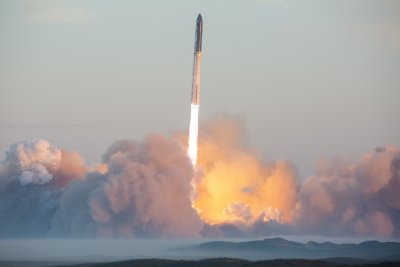
By the end of 2025 SpaceX had flown 11 Starship prototypes, making significant modifications and upgrades from one flight to another. There were some spectacular successes as well as failures. Five times the upper stage made successful soft landings in the Indian Ocean. And 3 times the boosters returned to the launch pad after separation from the upper stages and were successfully captured by the “chopstick” arms on the launch tower.
A Starship launches on Nov.18, 2023 for the second orbital test flight mission. Credits: SpaceX
In early 2026, SpaceX plans to start test flying the third major iteration of the Starship design. While current tests only aim to reach just short of orbital velocity, the goal for 2026 is for the Starship to reach orbit and return to the launch site. If testing goes well, the Starship system could become operational by the end of the year.
Blue Origin has been flying the fully reusable suborbital New Shepard vehicle for several years. It routinely flies up to 6 people and scientific projects to 100+ kilometers. The comapny entered the reusable orbital rocket business in 2025 with two flights of the New Glenn rocket, which has a reusable first stage booster. The booster made a successful landing on just the second launch. On Nov.13, 2025, Blue Origin launched a New Glenn rocket for the second time. It successfully deployed NASA’s ESCAPADE spacecraft into orbit. The rocket booster returned after separation from the upper stage and safely landed on a floatingplatform in the Atlantic.
Weekly summary videos reporting on developments with Starship and other reusable rocket programscan be found on the What about it! and Marcus House Youtube channels.
Cosmic Perspective relases beautifully made high-res videos with terrific soundtracks that hightlight particular events at Starbase. For example,
Below is a collection of news and updates on reusable rocket powered vehicles in operation and in development. See also these previous roundups: Mar.27.2024 Feb.26.2024 Nov.17.2023 Such technology should eventually lead to space transports with aircraft-like operation. That is, orbital flight and return followed by rapid reflight with minimal preparation. Vehicles should fly thousands of … Continue reading Roundup: Reusable rocket vehicles – May.8.2024→
I’ve gathered here recent news and updates on reusable rocket powered vehicles in operation and in development. Check out previous roundups: Feb.26.2024 Nov.17.2023 Rocket reusability will lead to space transports with aircraft-like operation. That is, orbital flight and return followed by rapid reflight with minimal preparation. Vehicles should fly thousands of times with only occasional … Continue reading Roundup: Reusable Rocket Vehicles – March.2024→
Find here the latest news and updates on reusable rocket powered vehicles in operation and in development. (See also the previous Roundup from November 2023.) Such technology should eventually lead to space transports with aircraft-like operation. That is, orbital flight and return followed by rapid reflight with minimal preparation. Vehicles should fly thousands of times … Continue reading Roundup: Reusable rocket vehicles – February.2024→
Significant progress is being made towards space transportation systems that operate repeatedly rather than just fly once and then discarded. Reusable rocket powered vehicles will eventually lower the cost of access to space by orders of magnitude from expendables when the vehicles can fly hundreds of times with only brief refurbishment between flights. While the … Continue reading Roundup: Reusable rocket vehicles→
Here is a sampling of videos about SpaceX and the Starship project. ** Public presentations about SpaceX are usually provided by Elon Musk or Gwynne Shotwell. However, here is an excellent overview of the company given by Kiko Dontchev, Vice President of Launch, at the Summit At Sea event last May. Curious how SpaceX went … Continue reading Videos: A SpaceX overview + Starship reports→
Space in Miniature, led by Michael Mackowski, has released a new digital reference book for space model builders. Mike Mackowski describes the US Space Missiles SIM report: The sixth installment in the Space In Miniature (SIM) digital-only “Tech Reports” series of reference booklets for spacecraft modelers is now available. This publication is a detailed review … Continue reading Space in Miniature releases new “U.S. Space Missiles” ref book for modelers→
Chris McLeod, instructor for the rocket engineering program at Brazoswood High School in Clute, Texas near Houston, sent me the news that the 2022 senior “Goddard Rocket Team” designed and built an SRAD [student researched and designed] hybrid rocket which launched to a verified 45,482′ AGL (49,523′ MSL). This came within 1% of the 50,000′ … Continue reading Hybrid rocket built by Texas students sets an altitude record for high school launches→
An announcement from Virgin Orbit: Virgin Orbit to Launch First Welsh Satellite From UK Spaceport Summer 2022 Cardiff-based Space Forge secure slot on first launch from UK soil with Virgin Orbit Space Forge have developed a fully returnable and reusable satellite platform to enable in-space manufacturing This mission, launched from Spaceport Cornwall this summer, will … Continue reading Virgin Orbit to launch “ForgeStar” returnable, reusable space platform from Spaceport Cornwall→
This sort of announcement seems particularly following this week’s news of a Russian anti-satellite demonstration creating thousands of new space debris objects in low earth orbit: Responsive satellite servicing and sustainable space launches get a boost through Astroscale, Virgin Orbit Partnership ASCEND Conference, Las Vegas, Nevada, Nov. 17, 2021 – Astroscale Holdings Inc. (“Astroscale”), the … Continue reading Astroscale and Virgin Orbit partnering on satellite servicing initiatives→
This roundup provides a sampling of recent articles, videos, and images dealing with space transport (find previous roundups here). The roundup is split into three postings: Part 1: Orbital launches Part 2: Light orbital lift development, suborbital, space transport articles, news, videos, etc. Part 3: SpaceX Falcon 9, Dragon, and Starship Falcon 9 and Dragon … Continue reading Space transport roundup: Part 3 – SpaceX – Oct.27.2021→
A sampling of articles, videos, and images dealing with space transport from late July till today (find previous roundups here). The roundup is split into three postings: Part 1: Orbital launches Part 2: Light orbital lift development, suborbital, space transport articles, news, videos, etc. Part 3: SpaceX Falcon 9, Dragon, and Starship ** USA – Oct.13: … Continue reading Space transport roundup: Part 2 – Light orbital lift, Suborbital, News, etc. – Oct.27.2021→
A sampling of articles, videos, and images dealing with space transport from late July till today (find previous roundups here). The roundup is split into three postings: Part 1 Orbital launches Part 2: Light orbital lift development, suborbital, space transport articles, news, videos, etc. Part 3 SpaceX Falcon 9, Dragon, and Starship Note: My link … Continue reading Space transport roundup: Part 1 – Orbital Launches – Oct.27.2021→
An update from Immortal Data on the partnership with students at the New Mexico Institute of Mining and Technology on a sub-orbital rocket project: Geared Up for Launch: Four Years of Space Engineering Takes Flight August, 30, 2021 (New Mexico) – Innovation works hard behind the scenes, often for years, before its accomplishments see the … Continue reading Geared Up for Launch – Immortal Data & NM Tech→
This roundup provides a sampling of recent articles, videos, and images dealing with space transport (find previous roundups here). Part 2 here focuses on SpaceX while Part 1 reports on activities and news of other space transportation companies and organizations around the world. There were no Starship prototype flights since the last roundup on May … Continue reading Space transport roundup: Part 2 – SpaceX – July.28.2021→
A sampling of recent articles, videos, and images dealing with space transport (find previous roundups here). Part 1 focuses on news from companies and organizations around the world. Part 2 Roundup focuses on SpaceX. ** July 20: Blue Origin flies New Shepard with people for first time. On the 52nd anniversary of the first human … Continue reading Space transport roundup: Part 1 – General – July.28.2021→
Here is a sampling of recent articles, videos, and images dealing with space transport (find previous roundups here). Today’s Part 1 Roundup focused on SpaceX. Part 2 here reports on other companies and organizations. ** Rocket Lab Electron second stage fails in launch attempt; First stage recovered from sea. Two BlackSky earth observation satellites were … Continue reading Space transport roundup – Part 2: Everybody Else – May.18.2021→
Here is a sampling of recent articles, videos, and images dealing with space transport (find previous roundups here). Here Part 1 focuses on SpaceX. Part 2 reports on news from other space transportation companies and organizations around the world. ** Multiple developments across the board at SpaceX since the last roundup on April 8th. Here … Continue reading Space transport roundup – Part 1: SpaceX – May.18.2021→
Mike Mackowski of Space In Miniature sent me the following announcement: Space In Miniature 3.1 – Space Shuttle is Released A complete revision of the third installment of the Space In Miniature (SIM) series of reference books for spacecraft modelers is now available. This book has all the information a modeler will need to build … Continue reading “Space in Miniature 3.1 – Space Shuttle” : Updated reference book for modelers now available→
A sampling of recent articles, videos, and images dealing with space transport (find previous roundups here): ** Apr.8: The Starship prototype SN15 moved to launch site. The vehicle has many upgrades according to Elon Musk. A test flight could happen within a week or two. I certainly hope it achieves the first successful landing of … Continue reading Space transport roundup – April.8.2021→