For many decades, students in university programs have designed and built small satellites and operated them in orbit. With the arrival of standardized Cubesat designs and hardware, high school and even grade school students have joined in the smallsat fun. Such endeavors grew out of the AMSAT initiative of the amateur radio community, which launched the first non-government satellites in 1961. (For more smallsat history, see Satellite Building in the HS archives.) Note that the term Amateur Satellites refers to the use of amateur radio bands for communications, not the quality of the satellites.
Here is a brief sampling of recent student smallsat projects and programs:
**LionCub CubeSat built by the students of the Columbia Space Initiative waits aboard ISS for deployment into orbit: Columbia Space Initiative’s ‘Lion Cub’ satellite reaches International Space Station | Columbia Spectator – June.11.2026
On April 11, student-built satellite Lion Cub arrived at the International Space Station aboard a SpaceX rocket. The nanosatellite is scheduled to remain docked at the ISS until June 29, when it will be deployed into low Earth orbit in what Smith described as “very ceremoniously for us, kind of unceremoniously in video, it just sort of gets ejected out of a launch rail.” At that point, Lion Cub will attempt its central mission: releasing a small stuffed Roaree and photographing it against the backdrop of space.
The CubeSat team first formed in 2022, when a group of students set out to build a satellite without fully knowing how they would get it to space. In 2023, the team proposed Lioness, CSI’s larger scientific satellite mission, and secured a NASA launch contract. The team later joined a multi-university collaboration led by California State Polytechnic University, Pomona, to build Lion Cub, a smaller proof-of-concept satellite that Archer Ankrum, SEAS ’29, a member of the structures team, described as “a test to prepare ourselves” for the full process before the stakes were higher.
** Qatar grade school students learn about the design, construction, and applications of smallsats: Students explore space tech through CubeSat challenge | Qatar Tribune – June.18.2026
More than 180 Grade-8 students at Qatar Academy Doha (QAD), a member of Qatar Foundation (QF), took part in the CubeSat Explorer Challenge- a hands-on learning experience organised by Boeing, INJAZ Qatar and Pure Minds Academy to spark early interest in space, satellite technology and other STEM-related careers.
“This programme didn’t just introduce students to space – it brought space to them. It’s no longer a distant concept, but an accessible, exciting career path they can pursue and build here in Qatar,” said Wael Zaoud, Boeing managing director for the Middle East and North Africa. “Qatar is steadily expanding its space capabilities and creating opportunities for the next generation of engineers and researchers. As a company that helped put the first human on the Moon, Boeing is proud to support young talent who will shape Qatar’s aerospace industry.”
The CubeSat Explorer Challenge introduced school students to the role satellites play in modern economies. Working in teams, students designed and built miniature satellite prototypes equipped with environmental sensors, programmed microcontrollers, collected live data and presented their findings. Through the experience, students gained insight into how satellite technologies support decision-making in areas such as air quality monitoring and climate research.
** MARMOTSat CubeSat built by University of Victoria student team reaches orbit to study ionosphere: MARMOTSat takes flight: University of Victoria CubeSat launched into space | Canadian Space Agency – July.8.2026
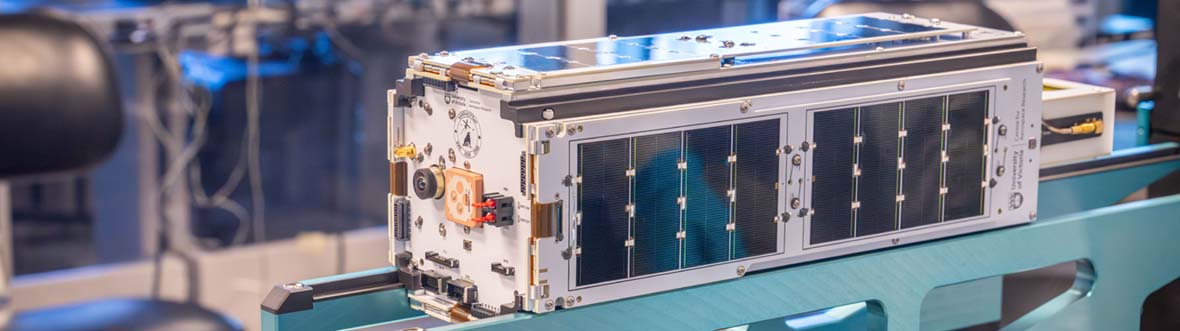
More about MARMOSat:
MARMOTSat, the second CubeSat from UVic’s Centre for Aerospace Research (CfAR) and the UVic Satellite Design Team (UVSD) is set to launch in July aboard a SpaceX Falcon 9 from the Vandenberg Space Force Base in California. The satellite has already been integrated into its deployment canister at the Canadian Space Agency, and the team expects it to reach orbit and deploy within hours of liftoff.
Once in orbit, MARMOTSat will collect data on the structure and composition of the ionosphere, the charged layer of the Earth’s atmosphere that plays a role in everything from radio propagation to satellite navigation. Researchers are particularly interested in how the ionosphere is shifting in response to human-caused climate change, which is a connection that is still not well understood.
- “MarmotSat: Student-Built Canadian CubeSat Brings Open-Source Amateur Experiments to VHF and 10 Meters” – ANS-186 AMSAT News Service Weekly Bulletins – ANS – mailman.amsat.org – July.5.2026 – “For amateurs, the interesting part of MarmotSat is its payload, which marks the debut of the Modular CubeSat Radio (MCR), an open-source, GNU Radio-compatible software-defined radio platform developed by the team. Built around a low-power HF SDR derived from the Hermes Lite 2, the MCR for this mission includes the SDR, an onboard computer, a camera, HF and VHF RF front ends, and simple wire antennas: a base-loaded half-wave tape-measure whip for HF and a half-wave tape-measure dipole for VHF.”
- CfAR shows off satellites, drone outside of B.C. Legislature | Martlet – May.16.2026
- UVic students will send a miniature satellite into earth’s orbit this summer | VIctoriaBuzz – May.8.2026
- MARMOTSat — UPDATES
** SNAPPY, the Solar Neutrino Astro-Particle PhYsics CubeSat. was developed by students and researchers at Wichita State University. The NASA funded spacecraft reached orbit on May 3, 2026 aboard a SpaceX Falcon 9 rocket launched from Vandenberg AFB in California.
- NASA-Supported Small Spacecraft Launches to Study Solar Particles | NASA – May.7/2026
- This student-built satellite is set to help us understand ghost particles better—here’s how | Starlust – May.3.2026
- Wichita State’s CubeSat ready for NASA launch into low Earth orbit | Wichita State News | Apr.30.2026
- The Solar Neutrino and Astro-Particle PhYsics (SNAPPY) CubeSat Development | arxiv.org
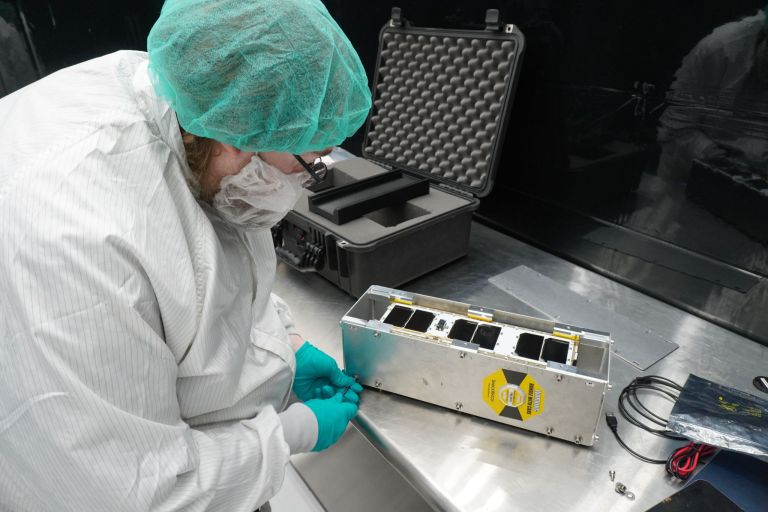
** College of Charleston students built an imaging payload for a CubeSat that reached space in July: College of Charleston Small-Satellite Payload Launches to Space | Today at CofC- July.7.2026
Two College of Charleston students built ultraviolet imaging systems, one of which went to the ISS in April of 2026 and another was integrated into a Cubesat that reached orbit on July 7th:
- CofC Students Contribute to International Space Station Mission | Today at CofC – Apr.2.2026
- Student Gael Gonzalez Shoots for the Stars With NASA | College of Charleston Magazine – Winter 2025
** SPARCS ( Star-Planet Activity Research CubeSat) at Arizona State University
The Star-Planet Activity Research CubeSat (SPARCS) is a small space telescope about the size and shape of a family-size cereal box, launched on SpaceX rocket into low-earth orbit on January 11, 2026.
The science mission which SPARCS will undertake is monitoring the flares and sunspot activity of low-mass stars of M and K spectral type, in the far- and near-ultraviolet to assess how habitable the space environment is for planets orbiting these kinds of stars.
See also the interview with Danny Jacobs , Professor at Arizona State’s School of Earth and Space Exploration and Josh Sink, a student working on SPARCS: ASU students are using a toaster-size satellite to search the galaxy for habitable planets | KJZZ.org – June.15.2026
BRODIE: What have you learned by doing this? Not necessarily just about sort of the data and what it is telling you, but maybe what have you learned about things that might interest you or about yourself or about sort of the universe more broadly?
SINK: Yeah, there’s there’s so many things that I’ve learned from this project. I think the realm of satellites in general, I really didn’t understand and the potential for science. So if our little toaster that’s out in space with a telescope is able to contribute to something as big as like looking for habitable planets and things like that, I think it really put in perspective like how cool science really is and how cool space is.
And on the technical side of things, I’ve learned a whole lot of data this, satellite that, right? But I think the absolute coolest thing is just the potential for what we can actually do out there.
** CUonOrbit is Carleton University’s CubeSat Team, which is developing a satellite to detect wildfires: Inside CUonOrbit: Carleton’s Student Team Reaches New Heights | Carleton Faculty of Engineering and Design – May.19.2026
The club brings together more than 50 students passionate about aerospace, astrophysics and space technology. Through technical projects, outreach initiatives and industry engagement, the team has built a growing presence within Canada’s space sector while giving students direct experience in mission design, systems engineering and research collaboration.
Today, the team is working on one of its most ambitious initiatives yet: the development of Carleton’s first student-led 3U CubeSat focused on wildfire detection. Alongside the CubeSat mission, CUonOrbit has also completed three high-altitude balloon launches, with a fourth mission planned for summer 2026.
** PHAT-Sat (Precision Hyperspectral Agricultural Tracking Satellite) in development by the Wildcat Space Program at Kansas State University: Oberlin student part of Wildcat Space Program satellite design at K-State | Hays Post – May.24.2026
By 2030, the PHAT-Sat project plans to launch a three-unit CubeSat equipped with advanced, hyperspectral cameras that can point toward Kansas and the surrounding region and help detect crop health anomalies. Farmers and drought managers could then analyze that satellite imagery to implement precision agriculture techniques for better irrigation, resource management and sustainability.
In the meantime, the class decided to formulate a “pathfinder” mission to PHAT-Sat by spinning off what had previously been a smaller, secondary payload into NuKAT, a two-unit satellite tentatively set to launch in 2027.
NuKAT will help validate the Microstructured Semiconductor Neutron Detector — produced by the K-State-affiliated Radiation Detection Technologies Inc. — as a viable sensor for use in the various radiation environments found in space, said Colby Johnston, principal investigator for the NuKAT mission.
** SAL-E becomes 13th smallsat from the PolySat Lab at Cal State Polytechnic University in San Luis Obispo to reach orbit: Student researchers loft 13th satellite from Vandenberg in latest orbital win | Mustang News – May.24.2026
Students at Cal Poly’s hands-on aerospace lab watched months of design and late-night fabrication reach orbit when their latest CubeSat rode a launch vehicle out of Vandenberg late last month. The mission not only puts a small satellite into space — it also underlines how undergraduate labs are training the next generation of engineers in real flight operations. …
… Cal Poly’s PolySat Lab — a multidisciplinary, student-run workshop that builds compact research satellites — confirmed the CubeSat reached orbit after a launch from Vandenberg Space Force Base at about 4 a.m. on March 30. Ground teams have established two-way contact and continue to track and receive data from the spacecraft.
The SAL-E mission
is named after Astronaut Dr. Sally Ride, the first American woman in Space and an inspiration for women and the LGBTQ+ community. The objectives of this mission are to evaluate CPCL’s capability of designing, manufacturing, and testing a CubeSat while simultaneously providing a project management basis for future CPCL flight missions. SAL-E launched successfully on SpaceX’s Transporter 16 rideshare mission and first contact was made soon after.
The CubeSat concept was actually first developed by a collaboration between teams at Cal Poly and Stanford.
A live CubeSat tracking demonstration and outreach sessions on space technology, healthcare and defence applications drew school students’ attention on the second day of the 5th IEEE Wireless, Antenna and Microwave Symposium (WAMS-2026) at a college in Narsapur.
** LEOPARDSat-1 Cubesat built by the CubeCats student group at the University of Cincinnati will soon be deployed from the ISS: Satellite built by local students set for deployment after months at space station | Local12 – July.1.2026
[CubeCats President Everett Metzler] said leaks on the International Space Station pushed back the deployment and that he only learned a few days ago it was going ahead. The deployment is the final step in a 10-year plan to deliver LeopardSat-1 from the maker space into the hands of a NASA astronaut.
“An astronaut is going put it inside of an airlock, and then put the deployer outside, and it’s going to launch into space. So, at first, it’s going to start tumbling, then it’s slowly going to detumble over time, and then after a few hours, it’s going to start and – hopefully – transmit back to us,” Metzler said.
Metzler said the satellite carries different carbon-based materials to test how they hold up against radiation in space. He said finding the right material could help make longer missions to the moon and even Mars possible.
The CubeCats’ work will continue after deployment. The group still has to record the data and is already planning its next satellite.
See also,
- UC CubeCats satellite makes hiss-tory at NASA | UC News – Apr.2.2026
- UC to launch first student-led satellite with NASA – CubeCats make history blasting into space | UC News – July.4.2026
** KENSAT is a one person run project that will send a CubeSat
carrying an LLM into low earth orbit — designed, owned, and operated by a single individual rather than a state or a corporation. It performs inference in space, and beams the answer back to anyone listening.
The spacecraft’s owner Ken Chan has made the project open source: KENSAT, Edge-AI Compute in Orbit | GitHub. The spacecrat will run
… a large language model on-orbit. A power-gated NVIDIA Jetson Orin Nano executes neural-network inference in space, and the results are downlinked over a custom UHF radio link to amateur ground stations.
The KENSAT spacecrate will go into
… a 520 km sun-synchronous orbit and circle the planet about sixteen times a day.
On board: a tiny always-on flight computer that keeps the satellite alive, a GPU that runs the language model, a UHF radio for talking to the ground, and a small lithium battery topped up by body-mounted solar panels.
The radio antenna is a pair of tape-measure strips that spring open the moment the satellite is ejected from its deployer. No motors, no actuators, no moving parts that can fail.
This article says KENSAT could reach orbit this fall: This Home-Built CubeSat Is Launching an LLM Into Orbit | Hackster.io – July.1.2026
Getting a complex electronics project off the ground is never easy, but Ken Chan’s latest creation presents some unique challenges. That’s because Chan’s project is designed to literally get off the ground — way off. It is called KENSAT, and it is a 2U CubeSat that is scheduled to go into orbit around the Earth this fall. Perhaps the coolest thing about KENSAT is that it’s not being built in a NASA clean room, but in Chan’s home lab.
Resources:
- AMSAT
- Getting Started with Amateur Satellites – “a complete guide to working amateur satellites, covering tracking, antennas, radio selection, and step-by-step operation for FM, SSB, and digital modes.”
- What are SmallSats and CubeSats? | NASA
- Cal Poly’s CubeSat Laboratory (CPCL) – “where the CubeSat standard originated, and where the CubeSat Design Specification is maintained and published. In addition to providing the CDS, CPCL hosts the annual CubeSat Developer’s Workshop in San Luis Obispo, and provides a central point for CubeSat community resources.”
- CubeSatSim Lite Fully Assembled – AMSAT – This “low-cost, fully assembled satellite simulator” is designed to help users learn about satellite communications by transmitting simulated telemetry signals that can be received with common amateur radio equipment.Operating on the 70 cm amateur band at 434.900 MHz, the CubeSatSim Lite allows users to receive and decode signals using a wide range of radios and software-defined radio (SDR) setups. Digital telemetry and images can be decoded using software such as FoxTelem, APRS decoders, or SSTV applications.”
- Small Satellite Conference | SmallSat – Aug.23-26, 2026 – Salt Lake City, Utah.
- Small Spacecraft: State-of-the-Art Report | Leonard David – May.17.2026
==== Amazon Text Ads ====
Let’s Go To Space:
Building a CubeSat Team through BLUE-SKY Learning
by
**