Here is a new selection of videos, articles, and news items about space habitats (govt and commercial), living in space, and space settlement.
=== Current space inhabitants
ISS – Crew of 7:
- US : Jessica Meir, Jack Hathaway, Anil Menon
- Russia: Andrei Fedyaev, Pyotr Dubrov, Anna Kikina
- Europe: Sophie Adenot
China Tiangong station – Crew of 3:
- Zhu Yangzhu
- Zhang Zhiyuan
- Lai Ka-ying
On July 14th a Russian Soyuz delivered Anil Menon of NASA and Roscosmos cosmonauts Pyotr Dubrov and Anna Kikina to the station.
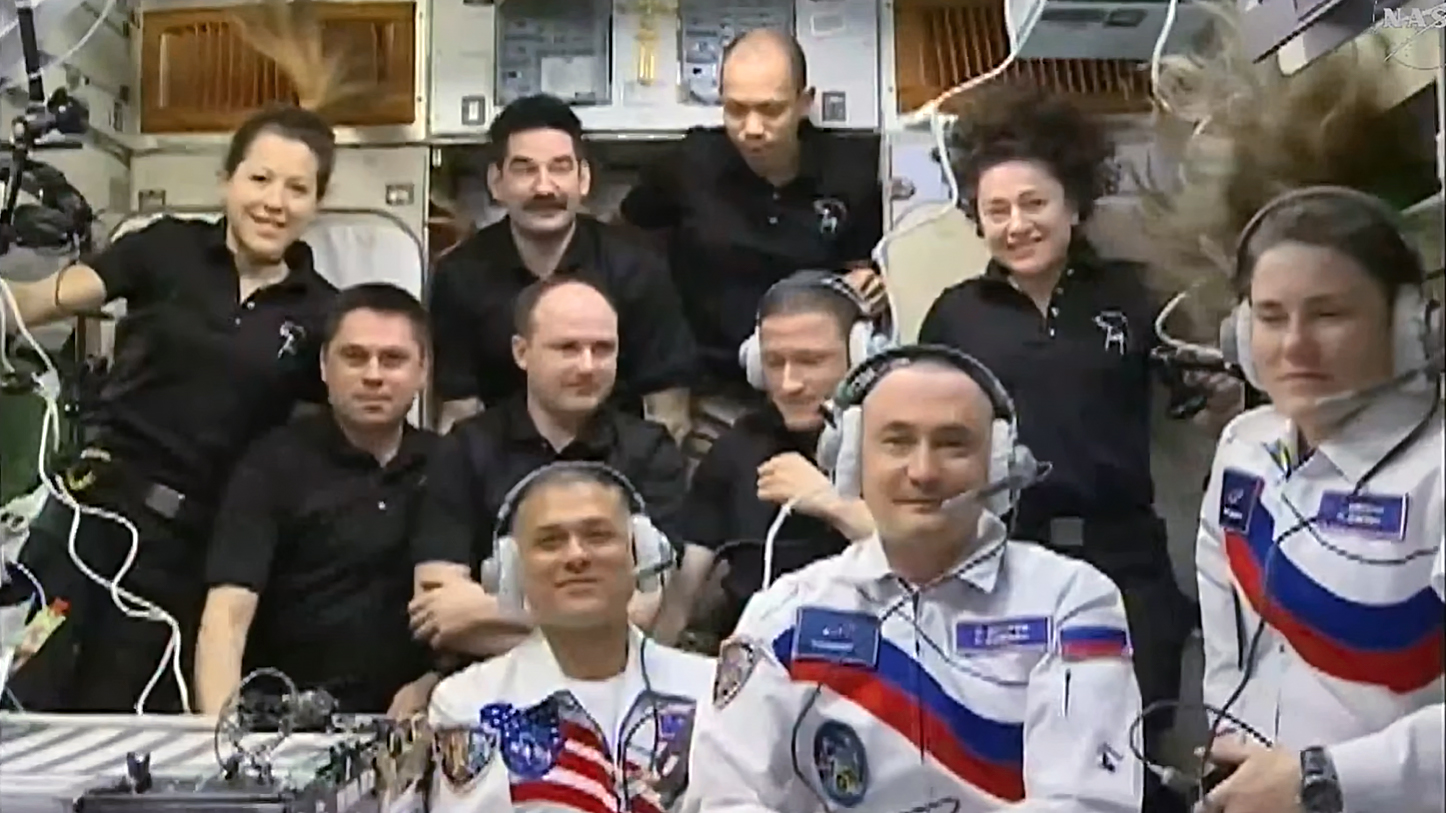
Until the departure on July 26 of NASA astronaut Chris Williams and Roscosmos cosmonauts Sergey Kud-Sverchkov and Sergei Mikaev, there were 10 people on the ISS, making for a total of 13 in orbit, counting the 3 Tiangong residents.
** Soyuz MS-28 undocking and departure | SciNews
The Soyuz MS-28 spacecraft undocked from the Rassvet module of the International Space Station (ISS) on 26 July 2026, at 07:03 UTC (03:03 EDT). Roscosmos cosmonauts Sergey Kud-Sverchkov (Сергей Кудь-Сверчков), Sergei Mikaev (Сергей Микаев) and NASA astronaut Chris Williams are scheduled to land in Kazakhstan on 26 July 2026, at 10:25 UTC (06:25 EDT).
=== International Space Station & NASA
** NASA Astronaut Discusses Life in Space with Naval Academy Alumni Magazine – Tuesday, July 28, 2026 | NASA Video
Aboard the International Space Station, NASA astronaut Jack Hathaway discussed life and work aboard the orbital outpost during an in-flight interview July 28 with U.S. Naval Academy’s “Shipmate” alumni magazine. Hathaway, a graduate of the U.S. Naval Academy, is in the midst of a long-duration mission aboard the microgravity laboratory to advance scientific knowledge and demonstrate new technologies for future human and robotic exploration flights as part of NASA’s Moon and Mars exploration approach, including lunar missions through NASA’s Artemis program.
** Sophie Adenot’s mid-mission highlights | European Space Agency, ESA
Sophie is halfway through the εpsilon mission onboard the ISS, and she has already accomplished so much. Between hundreds of hours of scientific research and thousands of photographs taken from space, she has taken the time to share many unforgettable moments with us — inspiring millions along the way on social media.
“Many thanks to all of you following along on social media, and to all the incredible teams behind εpsilon! It’s been an amazing adventure so far, and I couldn’t be more grateful for your support. Looking forward to sharing the second half of the journey with you all!”, says Sophie.
** Sophie activates ESA’s new space exercise device | European Space Agency, ESA
Following its arrival on board the International Space Station, Sophie completed the checkout and activation of the European Enhanced Exploration Exercise Device (E4D), marking the start of a two-year technology demonstration led by ESA in Columbus. During this period, astronauts will evaluate the device’s design, operational performance and effectiveness in counteracting the physical deconditioning caused by life in microgravity.
** ESA News:
- ESA Astronaut Completes Third Test of EuroSuit Prototype Aboard ISS | European Spaceflight – Aug.4.2026
- Checkout and activation of E4D | ESA – July.7.2026
** Why Can’t Russia Fix The Leaks In Their Space Station Modules? | Scott Manley
We’ve been hearing stories about the ongoing leaks on the ISS for years now, but a recent story highlighted NASA’s concerns with a plan that might have been far more risky.
I wanted to go back and explain the nature of the problem, and how the repairs are more than just slapping flex seal tape over the cracks. An accepted way to fix cracks in thin sheets is to drill a clean hole to distribute the stress over a larger area, stopping the crack from propagating further.
…
0:00 Intro
2:07 AI
3:54 Finding The Leaks
6:27 Cracks
7:42 Stop Drilling
9:19 The Repairs
11:29 Going Deeper
12:58 Old Hardware
15:33 Toppings
=== Commercial space habitats
** Axiom Space
— Building Axiom Station, a Next-Gen Commercial Space Station | Exclusive Interview | Australia in Space TV
What does it take to build the next generation space station that will replace the International Space Station?
In this exclusive interview from Axiom Space headquarters in Houston, Aaron Tullos, Vice President of Station Engineering, gives Australia in Space TV an inside look at the engineering behind the Axiom Station, a commercial space station designed to operate in low Earth orbit.
Aaron explains how Axiom Space is building on decades of lessons learned from the International Space Station, while introducing new technologies and design approaches to support future space research, manufacturing, and human exploration.
Standing in front of a full-scale wooden mock-up of the Habitation Module (Hab1), Aaron walks us through how engineers test designs, reduce costs, optimise mass and power, and prepare the station modules for assembly and launch.
..
— Axiom raises more funds: Axiom Space Closed Oversubscribed Financing at $525M+ | Axiom – June.4.2026
On June 4th, Axiom announced
the final close of its previously reported financing at more than $525 million, oversubscribed amid growing investor demand.
The upsize reflected an opportunistic extension driven by continued institutional and strategic interest in Axiom Space’s leadership of the commercial low-Earth orbit transition and the United States’ return to the Moon.
The close brought new capital onto Axiom Space’s cap table alongside the investors who anchored the round earlier this year. This positions the company to accelerate execution against its core programs: human spaceflight, spacesuits, and Axiom Station – the commercial successor to the International Space Station.
** Gravitics
— BSV Podcast 0129: Gravitics | Balerion Space Ventures on Youtube
Balerion Senior Associate Aidan Daoussis sits down with Colin Doughan, Co-Founder & CEO of Gravitics, to discuss space infrastructure.
— Orbital Carrier Pathfinder under construction:
Machining is officially underway on our first primary structures panel for our Orbital Carrier “Pathfinder” spacecraft.
Known internally as the -X panel, this is the spacecraft’s most complex panel, serving as the critical interface between the launch adapter and the propulsion… pic.twitter.com/BkM2xYTrmW
— Gravitics (@GraviticsInc) June 9, 2026
** Starlab – Voyager Technologies
— Inside Starlab, The Biggest Commercial Space Station! | Everyday Astronaut on Youtube – Aug.14.2026
Have you ever wondered what will replace the International Space Station once it’s de-orbited? Well, I sure have, and I’ve wondered what will replace it. So today I get to go inside Starlab by Voyager Technologies with their CEO Dylan Taylor to see what it’s all about!
— Several organizations have reserved space on Starlab:
The future of research in low Earth orbit is already taking shape.
Before Starlab launches, organizations across biotechnology, pharmaceuticals, advanced materials and semiconductor manufacturing have already reserved space aboard the station.
From protein-based retinal… pic.twitter.com/N1trII4FNW
— Starlab (@Starlab_Space) August 12, 2026
— Starlab picks SES for station communications system: Starlab selects SES Space & Defence for always-on space station connectivity | SatellitePro M – July.27.2026
SES Space & Defence, a wholly owned subsidiary of SES, has signed an agreement with Starlab to develop a communications architecture that will provide continuous, resilient and low-latency connectivity for the commercial space station throughout its operational lifecycle.
…
The partnership will utilise SES Space & Defense’s Low Earth Orbit Relay Services (LRS), powered by the company’s next-generation O3b mPOWER medium Earth orbit (MEO) constellation. The system is designed to overcome the intermittent connectivity typically experienced by low Earth orbit (LEO) spacecraft by relaying data through MEO satellites to ground networks in near real time.
— Starlab announces new agreements with customers reserving station access for research activities and payloads:
- Ecuador Space Society and Starlab to Open Commercial Microgravity Access | Starlab – July.28.2026 – “The agreement creates opportunities for Ecuadorian researchers, universities and businesses to access low Earth orbit research and commercial development aboard Starlab’s space station.“
- Starlab Space Receives Reservation from the Center for Space and Aviation Switzerland and Liechtenstein | Starlab – July.21.2026 – “Reservation agreement connects Switzerland and Liechtenstein’s end-to-end space research ecosystem with U.S. orbital infrastructure, enabling streamlined pathways from laboratory to space aboard Starlab“
- Space Scotland Reserves Payload Space with Starlab Space | Starlab – July.14.2026 – “Reservation creates a pathway for Scottish companies, universities and research organizations to access microgravity research and technology development aboard Starlab’s commercial space station.”
- Space LiinTech Reserves Payload Space Aboard Starlab | Starlab – July.8.2026 – “Agreement will support the integration of artificial intelligence technologies into microgravity-based pharmaceutical and life sciences research aboard Starlab’s commercial space station.“
— Partnership with Voyager allows DigitalBlast of Japan to provide gateway services for companies seeking to use Starlab station for R&D: DigitalBlast Signs Starlab Space Station Reservation Agreement | APOC Wire – July.25.2026
DigitalBlast, Inc. (Chiyoda-ku, Tokyo; President and CEO: Shingo Horiguchi), a company that supports the growth of the space industry and the creation of new businesses, today announced that it has signed a Reservation Agreement for the use of the commercial space station “Starlab” with Starlab Space LLC (headquartered in Houston, Texas, U.S.), the developer and operator of Starlab, and recently held a signing ceremony….
… As interest in the commercial use of low Earth orbit (LEO) grows toward the post-ISS era, DigitalBlast will serve as a user-integration partner for R&D that puts the space environment to practical use, and will work to build itself into one of the gateways through which companies and research institutions in Japan and the wider Asia region can access orbit.
** VAST
— Haven-1 fluid systems:
Our space stations and satellites use fluid systems to transport oxygen, water, coolant, and fuel. We manufacture, test, and integrate these systems in-house with the speed, precision, and scale required to build next-generation space infrastructure, starting with Haven-1. pic.twitter.com/7Ze90uNCyG
— Vast (@vast) August 12, 2026
— Waste handling on Haven-1
Our wet trash system is one of several life-support systems aboard Haven-1. The system manages wet waste containment with integrated odor control and vacuum venting. It’s part of a comprehensive support system designed to keep crews safe in space. pic.twitter.com/MVv0PSecFI
— Vast (@vast) August 5, 2026
— Vast on Fox News:
Vast was featured on @FoxNews’ primetime show @myviewfnc. CEO @MaxHaot and Founder @jedmccaleb hosted @laraleatrump at our Long Beach HQ, sharing a look at how we’re building Haven-1, scheduled to be the world’s first commercial space station and America’s next space station. pic.twitter.com/tUEnDTN907
— Vast (@vast) July 23, 2026
— This New Space Station Is Full Of Modern Touches | Core Memory
The International Space Station is 25 years old, cost $155 billion, and leaks. A startup called Vast thinks it can build the replacement for about a billion dollars, and it plans to launch the first piece in 2027. In this episode, Ashlee Vance heads to Vast’s headquarters in Long Beach, California for a full tour of Haven-1, the spacecraft the company expects to be the world’s first commercial space station. Vast is the wildcard in the race to replace the ISS, moving faster than rivals like Axiom, Blue Origin and Starlab, and it’s doing it the SpaceX way: everything designed, built and tested in house, from the hatch to the micrometeorite shielding to the actual flight hull sitting next to the cafeteria.
The money comes from Jed McCaleb, the crypto billionaire who believes humanity needs a frontier and is willing to spend a fortune to open one. The building falls to CEO Max Haot, who walks Ashlee through mission control, the hull welding operation, and the numbers that make competitors nervous. Vast builds pressure vessels in six months for under $5 million while others pay 55 million euros and wait four years. NASA showed up in 2023 expecting a science fair. They’ve been coming back every quarter since.
Then NASA astronaut Drew Feustel, who spent 225 days on the ISS, takes over for the fun part: a space food taste test featuring freeze dried tiramisu and tales of trading for duck confit in orbit, the largest window ever flown to space, a zero gravity sleep pod that hugs you, and a walkthrough of Haven-1’s surprisingly roomy interior. Four people will live aboard for two week missions, with a SpaceX Dragon serving as taxi, lifeboat and bathroom. Ashlee walked in skeptical after 15 years of covering commercial space delays. He walked out believing this thing is actually going to fly.
…
Chapters
00:00 Intro
01:31 Who’s Paying a Billion Dollars for This?
05:14 Why Vast Builds Everything Itself
07:43 Touching the Real Haven-1
10:12 Space Food Taste Test with an Astronaut
12:49 The Biggest Window to Ever Fly
14:10 How Do You Sleep in Space?
15:59 Is This Really Big Enough for Four People?
20:07 Is Vast Actually Going to Pull This Off?
— Other Vast news:
- Vast’s Haven-1 continues to advance through milestones ahead of planned 2027 launch |- NASASpaceFlight.com – July.4.2026
- Private Astronaut Mission to the International Space Station in Partnership with NASA | Vast/BusinessWird – June.8.2026
** Commercial space station news, articles, etc:
- NASA and commercial space stations:
- NSS Urges Greater Commercial Flexibility and Independence in NASA’s CLD Draft RFP | NSS – July.20.2026
- NASA sure seems to be asking an awful lot of private space stations | Ars Technica – July.10.2026
- Wanted! Commercial Successor for the International Space Station | Leonard David – July.9.2026
- NASA Seeks Industry Input on Second Phase of Commercial Space Stations | NASA – July.6.2026
- Low Earth Orbit (LEO) Destination Request for Information | SAM.gov
- A Japanese company reserves space on the Starlab space station | Behind The Black/Robert Zimmerman – July.26.2026
- The next space station will be private. Its geopolitics will not be: | Aakrith Harikumar/Space Jam – July.17.2026
- The Future of Low Earth Orbit: Sustaining Innovation After the ISS | ISS National Lab – June.16.2026
- US Commercial Space Stations Expand to Europe | Payload – June.5.2026
- NSS Commends NASA for Recommitting to a True Commercial Future in Low Earth Orbit | NSS – June.2.2026
- NASA Agrees with Industry, Keep CLD Program As Is | SpacePolicyOnline.com – June.1.2026
=== Chinese space habitats
** Shenzhou-23 Crew Advances Space Science Experiments, Interacts with Robot Assistant | CCTV Video News Agency
The three astronauts on China’s Shenzhou-23 mission performed a haul of experiments and interacted with a robotic assistant on the Tiangong space station over the past week as they were pressing ahead with scientific research and routine maintenance in orbit.
** Articles, news, etc:
- China Space Station Crew: Brain-function Research | Leonard David – July.14.2026
- China Set to Debut New Cargo Spacecraft for Space Station Operations | Leonard David – July.5.2026
- China plans to double the size of its Tiangong space station while the ISS nears its end | Space.com – June.26.2026
- China’s Space Station Set to Expand | Leonard David – June.24.2026
- China Space Station Crew Returns to Earth | Leonard David – May.29.2026
- New China Crew Onboard Tiangong Space Station | Leonard David – May.25.2026
=== Lunar habitation
** NASA Moon Base development plan:
- Moon Base: About – NASA
- Do we need a lunar building code to build moon bases safely? | Space.com – June.20.2.206
- NASA Provides Update on Moon Base Rovers, Landers, Missions | NASA – May.26.2026
- NASA takes steps toward building Moon Base, including discussing a “perimeter” | Ars Technica – May.26.2025
- Rovers and Drones laying the foundations for NASA Moon Base | NASASpaceFlight.com – May.27.2026
** Interlune and Vermeer collaborating on development of groundwork equipment for the Moon: Interlune builds on partnership with equipment company to lay the groundwork for moon infrastructure | GeekWire – July.30.2026
Seattle-based Interlune is expanding its partnership with Vermeer, an Iowa-based industrial equipment manufacturer, to develop construction tools for use on the moon.
The two companies forged their initial strategic partnership to further Interlune’s plans to extract helium-3 from tons of moon dirt and rocks, also known as regolith. Their full-scale prototype of a lunar excavator was unveiled a little more than a year ago.
At the time, Interlune was focused on mining helium-3 and bringing it back to Earth for applications ranging from quantum computing to medical imaging and nuclear fusion. But a major shift came in March when NASA announced a 10-year, $30 billion initiative to build the infrastructure for a moon base.
In this video, Jacob Keeley of Vermeer describes the Interlune x Vermeer space harvester:
See also: Moon Machinery Partnership for Lunar Base Work | Leonard David – July.31.2026
** Vermeer also partnering with Astrosport Space on lunar construction equipment: Astroport and Vermeer Collaborate to Pioneer “Lunar Iron” for Lunar Base Infrastructure | Businesswire/Vermeer – Apr.15.2026
Astroport Space Technologies, Inc., a leader in lunar construction, today announced at the 20th International Conference on Engineering, Science, Construction and Operations in Challenging Environments (ASCE Earth & Space 2026), a collaboration with global agricultural and industrial equipment manufacturer Vermeer Corporation to help in the development of autonomous construction machinery to aid in building a permanent human presence on the Moon.
The collaboration contributes Vermeer’s surface mining expertise to Astroport’s specialized work in robotic autonomy and lunar soil (regolith). The primary focus of this collaboration is on “lunarization” of Vermeer surface mining machinery using Astroport’s Universal Tool Implement Payload Adapter (UTIPA) technology, a modular adapter system of interchangeable tools designed for robotic construction in the Moon’s extreme environment. Beginning with a surface miner application, the teams will utilize UTIPA technology to adjust heavy equipment’s traditional reliance on mass and weight, in order to operate in the Moon’s low gravity environment and survive massive temperature swings and harsh lunar surface conditions.
** Lunar settlement articles, news, etc
- How to Find Lunar Ice? Moonquakes to the Rescue! | Universe Today – Aug.11.2026
- NASA Delivers Navigation System for Commercial Lunar Relay | NASA – Aug.3.2026
- Water Ice on Moon: Looking for Good Vibrations | Leonard David – Aug.1.2026
- Interlune produces helium-3 using a process meant for the moon | GeekWire – July.22.2026
- Mass Drivers on the Moon: Report Salutes Military Implications | Leonard David – May,28.2026
- Italy’s Lunar Habitat Clears NASA System Requirements Review | European Spaceflight – May.26.2026
- New Material Could Help NASA Melt Moon Rocks, Harness Lunar Resources | NASA – May.22.2026
=== Mars habitation
** In partnership with South Seattle College, the Mars Society will develop a third Moon-Mars analog research station:
- Mars Society & South Seattle College Sign 10-Year Agreement to Build Moon-Mars Analog Research Station in Pacific NW | The Mars Society – July.21.2026
- Mars Society and South Seattle College team up on space habitat | GeekWire – July.21.2026
According to the Society announcement:
The Mars Society, through its Seattle Chapter, and South Seattle College (SSC) have signed a 10-year Memorandum of Agreement (MOA) establishing a multi-program partnership to build a Moon and Mars analog research station on the South Seattle College campus in West Seattle and create a regional education and workforce pathway for the next generation of aerospace researchers, technicians and engineers.
The agreement, signed by SSC President Dr. Monica Brown and Mars Society Executive Director James L. Burk, covers four interconnected efforts: a Moon and Mars analog research station on the SSC campus, a joint space studies curriculum and stackable certificate pathway, a student capstone project and internship program tied to industry partners, and a regional workforce pipeline and community engagement effort.
The Society
… currently operates research stations in Utah and Canada, where crews live and work under simulated Mars mission conditions. This work includes human factors studies, equipment testing, biology and geology field research, medical testing and safety drills. A research station on SSC’s campus would extend the hands-on side of this research, which aligns naturally with the strengths of a skilled trades-focused institution.
** Mars settlement articles, news, etc
- Mars dust is toxic. How will future astronauts deal with it? | Space.com – Aug.5.2026
- Red Planet Logistics: How to Power Mars Mining & Resource Extraction | Mars Society – July.19.2026
=== Large In-Space Habitats
** Space Habitats: The Megastructures We’ll Call Home | Isaac Arthur
Explore the future of space habitats, from rotating cylinders and torus colonies to orbital cities, asteroid homes, and the megastructures humanity may one day live inside.
…
0:00 Intro
4:37 The Sunflower
14:07 The O’Neill Cylinder
49:00 Lewis One
57:40 Stanford Torus
1:22:19 Kalpana One
1:28:14 Nebula
1:29:27 Bernal Sphere
1:54:13 Bishop Ring
2:03:23 Topopolis
2:27:36 McKendree Cylinder
2:33:57 Hammer Habs
2:59:01 Rungworlds
3:04:35 Conglomerations
3:38:45 Epilogue
** Jerry Stone – Island Zero, A Study of A First Space Settlement – NSS Space Ambassadors Presentation | National Space Society
Jerry Stone from the British Interplanetary Society joins the NSS Space Ambassadors and gives his first presentation on the topic of “Island Zero,” a large space station providing artificial gravity. In mid-1969, Professor Gerard K. O’Neill put a question to a study group at Princeton University: “Is a planetary surface the right place for an expanding technological civilization?”
The unexpected result from their studies was that the answer was “No.” A much better place, it seemed, would be in vast habitats constructed in high orbit, at a special location known as the Lagrange points L4 and L5.
It is now almost 40 years since the original studies were conducted, and many advancement shave been made since the 1970s. There have been improvements in materials science, engineering, computing and robotics, and other areas that can make this program more efficient.
The aims of Island Zero will include:
Living under simulated gravity
Construction from modular units and space -produced components
Growing a large percentage of food in space
Development of a space manufacturing facility
Island Zero units could be used to house the construction force for Island One, the first large space settlement. Overall, Island Zero presents a relatively low-cost means of providing a logical progressive approach towards the construction of large settlements in space.
** National Space Society initiates design of a large in-space habitat : National Space Society announces Rotating Space Settlement Design Project | Space Settlement Progress – July.29.2026
In a presentation at this year’s International Space Development Conference, which took place in McLean, Virginia, June 4th through June 7th, National Space Society (NSS) COO/SVP Dale Skran announced the kickoff of an open-source Rotating Space Settlement Design (RSSD) Project. The initiative has been under active development for over a year within the NSS Space Settlement Advocacy Committee (SSAC) and the NSS Board of Scientific and Technical Advisors (BSTA). Full disclosure: Yours truly is a member of the SSAC. It was officially approved as an NSS Project last March. The content of this post is based on Skran’s presentation, supplemented with subsequent material presented to the SSAC, with permission.
The current RSSD project Study Group core team consists of Dale Skran, Frederick (Rick) Jenet, PhD, and Bryce Meyer, with all BSTA and SSAC members actively involved in review and discussion. Work is currently focused on establishing a foundational set of design inputs in the form of “Questions” (see below). A dedicated workshop to refine these questions will be held at the NSS Space Settlement Summit taking place at the University of Central Florida, October 25th and 26th. This will be followed by a public announcement and formal request for comment from the broader community. In addition, the “RSSD Terms of Reference” (TOR) will be published in the NSS Space Settlement Journal.
…
What is the Objective of the RSSD Project?
The core goal is to produce the first complete buildable engineering design for a rotating space settlement. The project is primarily an engineering and systems-design effort, not a policy activity, although legal and economic aspects are necessarily included because they affect feasibility.
See also: Orbital Space Settlement Design Project – NSS.
=== Technologies and strategies for space settlement
** Additive Manufacturing in Microgravity | Isaac Arthur
The most expensive part of space travel isn’t the fuel. It’s the cargo. Additive manufacturing isn’t a sci-fi magic trick; it’s the key to building shipyards and telescopes at scales rockets were never meant to handle. We aren’t just launching ships anymore; we’re moving the factory to the void.
…
Chapters
0:00 Intro
2:10 Additive Manufacturing Is Not a Printer
8:04 The Physics of Printing in Freefall
12:23 Low Gravity, Regolith, and the “Messy Middle”
17:01 CT Scan
17:59 Printing at Scales Rockets Can’t Touch
=== Other space habitat and settlement news, articles, reports, etc.
- Calendar:
- Blueprints for Off-World Living: Scaling Human Settlements in Space – Tue Aug 18, 2026 1:00 PM – 2:00 PM EDT, Online Zoom, Beyond Earth Institute webinar series.
- Space Visions Symposium #3: First Steps to Settlement in Space – Canaveral Council of Technical Societies (CCTS) – September 11, 2026, Space Coast Health Foundation, Rockledge, FL.
- NSS Space Settlement Summit 2026 – From the Moon to Markets: Building the Cis-Lunar Economy, Orlando, FL. – October 25-26, 2026.
- ISS:
- NASA Shares Station Research Today Supporting Moon, Mars Tomorrow | NASA – Aug.11.2026
- Space Station Crew Wraps Busy Week, Plans New Date for US Spacewalk 97 | NASA – Aug.7.2026
- Astronauts Complete Spacewalk for Solar Array Modifications | NASA – Aug.6.2026
- Preserving the legacy of the ISS | The Space Review – July.27.2026
- Spacewalk Preps, Bioprinting, and Exercise Research Top Station Schedule | NASA – July.30.2026
- Expedition 74 Trio Returns to Earth Inside Soyuz | NASA – July.26.2026
- Science and Spacesuit Work Before Crew Changes Commanders | NASA – July.23.2026
- Soyuz MS-29 crew arrives at ISS, U.S. EVA completes Canadarm2 repairs -| NASASpaceFlight.com – July.22.2026
- Expedition 74 Turns Attention to Departing Crewmates | NASA – July.20.2026
- Week Wraps with New Crew Adjustments and Human Research Studies | NASA – Jjuly.17.2026
- Station’s Newest Trio Adjusts to Mission Life Before Next Crew Departure | NASA – July.15.2026
- A most improbable astronaut just went to space | Ars Technica – July.15.2026
- Anil Menon of NASA and Roscosmos cosmonauts Pyotr Dubrov and Anna Kikina | NASA – July.14.2026
- Should the ISS be extended beyond 2030? | Aerospace America – July.1.2026
- Crew Splits Day Between Relaxing, Spacesuit Work, and Cardiac Research | NASA – July.1.2026
- Astronauts Repair Canadarm2 Robotic Arm and Complete Spacewalk | NASA – June.30.2026
- Crew Starts Week with Bioengineering, Space Manufacturing, and Spacewalk Preps | NASA – June.22.2026
- Report: De-orbiting the International Space Station – What are the Implications? | Leonard David – June.21.2026
- Canadarm2 repairs planned as CRS-34 departs ISS | NASASpaceFlight.com – June.18.2026
- Advanced Tech on Station Informing Space-Designed Health Treatments | NASA – June.18.2026
- Advanced Health Research on Station Using Augmented, Virtual Reality Tools | NASA – June.17.2026
- Physics, Eye Checks, and Workout Maintenance Fill Day After Spacewalk | NASA – May.28.2026
- Cancer Treatment, Cartilage Repair, and Spacesuit Checks Wrap Up Week | NASA – May.22.2026
- ISS access:
- Air leaks:
- Russia appears set to finally address long-term, serious space station cracks | Ars Technica – June.15.2026
- Russia’s Ongoing Hissy Fit: Zvezda Module on the International Space Station | Leonard David – June.7.2026
- NASA Provides Update on Space Station Leak | NASA – June.5.2026
- The saga of the International Space Station air leak took a worrying turn Friday | Ars Technica – June.5.2026
- Uh-oh, the International Space Station is leaking again | Ars Technica – May.21.2026
- Resources:
- ISS in Real Time – “Explore 25 years onboard the International Space Station. This multimedia project replays every day of the past 25 years onboard and consists entirely of historical mission material.”
- ISS Archaeology | Boldly Going Where No Archaeologists Have Gone Before
- Amateur Radio on ISS (ARISS)
- NASA Lunar Base program:
- NASA announces new lander contracts for Moon Base Phase One | NASASpaceFlight.com – July.1.2026
- NASA considers sending a spare Mars rover to the moon | GeekWire – June.30.2026
- NASA Awards More Moon Base Science, Previews New Opportunities | NASA – June.30.2026
- NASA backs dozens of projects on the space frontier | GeekWire – June.26.2026
- NASA asks Northrop Grumman to stop working on lunar HALO module | Ars Technica – June.19.2026
- NASA assigns crew for Artemis III, sets aggressive timeline for flying it | Ars Technica – June.9.2026
- China:
- Europe:
- Russia:
- Habitat technologies:
- Lunar settlement technologies:
- NASA Opens Call on Moon Base Health Research | Payload Space – Aug.14.2026
- NASA Data Helps Commercial Space Plan Living Off Our Moon | NASA – Aug.12.2026
- Scientists Map Moon Regolith to Aid Lunar Bases | Universe Today – July.30.2026
- Drawn by helium-3, lunar mining companies prepare for initial missions | Aerospace America – July.29.2206
- Can nuclear heaters keep astronauts warm? NASA wants to know | GeekWire – July.27.2026
- Scientists are Teaching Shrimp to Eat in Microgravity for Future Moon Bases | Universe Today – July.17.2026
- Rice is Nice…on the Moon! | Leonard David – July.1.2026
- Exclusive: Lunar Forge Unveils Plans to Build Lunar Infrastructure Out of Dust | Payload Space – July.1.2026
- NASA Testing Wastewater Treatment Facility for Future Moon Base | NASA – June.2.2026
- Other settlement technologies:
- General settlement topics:
- How to design a space habitat that supports its residents’ mental health | EurekAlert! – Aug.12.2026
- The Future At Stake: We live in perilous times, and the decisions we make now could echo down the millennia | Peter Hague – Planetocracy – July.16.2026
- SpaceX’s IPO sets the stage for the colonization of the solar system — by private enterprise | Behind The Black/Robert Zimmerman – June.13.2026
- Human colonies floating in the clouds of Venus | Selenian Boondocks Kirk Sorensen
- Colonies on Mars require more than engineering | Selenian Boondocks – June.2.2026
- Homing in on the Gravity Prescription | Space Settlement Progress – May.19.2026
- OPINION: Why the moon may matter before it pays | Aerospace America – Apr.30.2026
- Resources:
=== Earth views from ISS
** Observing Blue Jets from ISS:
Blue jets above Earth: a rare atmospheric phenomenon captured from the ISS.
One of the rarest atmospheric light phenomena—a so-called “blue jet”—was captured from the space station orbiting approximately 400 km above Earth’s surface. The event was observed above a storm front… pic.twitter.com/zra9gq4VVv
— Black Hole (@konstructivizm) August 13, 2026
** Night side as seen by ISS:
Timelapse of the ISS flying over the night side of Earth 🛰 pic.twitter.com/WVnW2PkwVY
— Black Hole (@konstructivizm) August 13, 2026
** Live Video from the International Space Station (Official NASA Stream) | NASA
Watch live video from the International Space Station, including inside views when the crew aboard the space station is on duty. Views of Earth are also streamed from an external camera located outside of the space station. During periods of signal loss due to handover between communications satellites, a blue screen is displayed.
The space station orbits Earth about 250 miles (425 kilometers) above the surface. An international partnership of five space agencies from 15 countries operates the station, and it has been continuously occupied since November 2000. It’s a microgravity laboratory where science, research, and human innovation make way for new technologies and research breakthroughs not possible on Earth. More: https://go.nasa.gov/3CkVtC8
Did you know you can spot the station without a telescope? It looks like a fast-moving star, but you have to know when to look up. Sign up for text messages or email alerts to let you know when (and where) to spot the station and wave to the crew: https://spotthestation.nasa.gov
(Optional High Definition feed.)
====

=== Amazon Associate Ads ===
====