1. Monday, July 13, 2020; 7 pm PDT (9 pm CDT, 10 pm EDT: No special programming.
2. Tuesday, July 14, 2020; 7 pm PDT (9 pm CDT, 10 pm EDT): We welcome back Dr. James Schwartz to discuss his new book, The Value of Science in Space Exploration [Amazon commission link], plus his ongoing essay series on space development.
3. Wednesday, July 15, 2020: Hotel Mars TBA pre-recorded. See upcoming show menu on the home page for program details.
4. Thursday, July 16, 2020; 7-8:30 pm PDT (9-10:30 pm CDT, 10-11:30 pm EDT): No special program today.
5. Friday, July 17, 2020; 9:30-11 am PDT (11:30 am-1 pm CDT, 12:30-2 pm EDT): We welcome back John Strickland on multiple topics and plans for space settlement and more.
6. Sunday, July 19, 2020; 12-1:30 pm PDT (3-4:30 pm EDT, 2-3:30 pm CDT): OPEN LINES. Come one com all. We want to hear from you.
A sampling of links to recent space policy, politics, and government (US and international) related space news and resource items that I found of interest (find previous space policy roundups here):
Dr. Bhavya Lal joins the show to discuss the size of the space economy, where it’s going, and how the term itself can mean many different things to many different people. In a world filled with breathless claims about trillion-dollar economies, we dive down into the fundamental assumptions about space commerce, its potential for growth, and the pitfalls of motivated thinking in the hyper-optimistic space community.
Luc Riesbeck is a space policy research analyst at Astroscale U.S., and wants to make our orbits a safer place.
Riesbeck started their career with an undergraduate degree in international relations, then interned at NASA, and quickly realized their interest in space policy. Now with a masters degree and a space policy internship under their belt, Riesbeck is eager to work alongside other industries to put space on the map for the “green” environmental movement.
In this episode, Riesbeck talks about the importance of space sustainability, keeping our orbits clean, and what space policy could look like in the years to come.
Night Sky Network members enjoyed a webinar on June 16, 2020 hosted by Bruce Pittman from NASA’s Space Portal Office, who shared the present, and future of commercial ventures in space. A quiet revolution has been taking place in the development of space over the last 20 years. Sparked by the space ambitions of men such as Jeff Bezos and Elon Musk, these efforts will come into full display over the next 42 months starting with the launch of the NASA Commercial Crew Demo 2 mission by SpaceX now scheduled for May 27th and hopefully ending with Americans returning to the lunar surface for the first time in 50 years by December 2024. But this story is about more than just getting to space. We will also talk about the start of a space manufacturing revolution that is now beginning on the International Space Station. It has been said that the first trillionaire will be made in space, it may be one of the people that we will talk about.
About Bruce Pittman Bruce Pittman is the Director of Commercial Space Development at OffWorld Inc. and is currently working as a contractor in the Space Portal Office at the NASA Ames Research Center in Silicon Valley where he works as the Chief System Engineer. Bruce is a co-founder and Chief Space Officer for the not for profit Future Frontiers Institute. He is also the Senior Operating Officer and Senior Vice President of another non profit, the National Space Society.
Space law expert Ranjana Kaul and space entrepreneur Narayan Prasad discuss space reforms and the recent Indian IN-SPACe announcement with host Pavan Srinath on Episode 144 of The Pragati Podcast.
IGLUNA is aimed at supporting and accelerating the ESA_Lab@ initiative. The Swiss Space Center coordinates IGLUNA project and leads the main systems engineering activities, coaches the students teams, organises the events, and communicates to the general public.
IGLUNA is emulating European students and foster exchange through an international, interdisciplinary, and collaborative platform for demonstration of space technologies.
During the project, university students apply their knowledge to solve a technical challenge, to sustain life in an extreme environment, increasing in parallel the maturity of technologies relevant to the space domain.
During July 10-19, 15 international student teams are presenting their projects that dealt with the goal of developing “A space habitat with remote operations”. The presentations are in a online format called the Virtual Field Campaign:
The objectives of the campaign are to bring together the student projects, test them in an extreme environment, and present them to the other student teams, external experts and the general public.
Due to the Covid-19 crisis, the initially planned Field Campaign with an exhibition and control room at Verkehrshaus – Swiss Museum of Transport and a test bed on the top of Mount Pilatus in Lucerne will not be able to take place physically this summer. In spite of the current restrictions and as real space missions that have limited resources, we aim to do the best we can to ensure a proper project closure together with all involved partners.
Keeping the same dates 10-19 July, the Field Campaign will take place virtually, where all the student teams will connect from their countries to present their projects and hard work to the rest of the world. The project shows and additional space experts presentations will be live-streamed and publicly available.
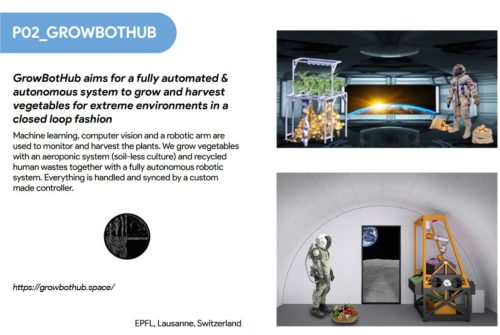
aims to do a fully automated system of growth and harvest of vegetables. To do so, a machine learning algorithm determines when the vegetables are ready to be collected, then a carousel brings the vegetables in front of a robot that picks-up the vegetables and replace them with a new seed so they can start growing again. All these actions and messages are controlled by a top-level controller. The vegetables are grown using an aeroponic system which allows to reduce water and energy consumption compared to other techniques.
IGLUNA team PO2-GrowBotHub designed a fully automated system of growth and harvest of vegetables
The GrowBotHub presentation is the second in this group of three given on July 10th:
P01 MELiSSA 11:56 Complete recycling system for space missions through the biological conversion of human urine for food and bio-based oxygen production thanks to a hydroponic growing unit and a photobioreactor. Melissa Foundation, Belgium
P02 GrowBotHub 1:27:03 Automated and autonomous structure to grow and harvest vegetables in a closed loop fashion in space. EPFL, Switzerland
P06 HYDRATION II 2:41:57 Heated drill system able to extract water from different surfaces such as ice, clay, sand and concrete in order to be used on Lunar ground. Massachussets Institute of Technology (MIT), USA
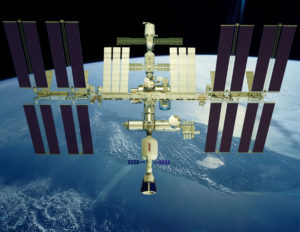
Here is the latest episode in NASA’s Space to Ground weekly report on activities related to the International Space Station:
** Behind the Scenes in Space During Historic SpaceX DM-2 Launch and Docking
You saw history made with the first crewed launch and docking of the SpaceX Crew Dragon, but you didn’t see the flurry of activity on board the International Space Station…until now. Join Expedition 63 Commander Chris Cassidy and his crewmates as they prepare their cameras to document the DM-2 launch, and look over their shoulders to witness the new American spacecraft dock to the station and deliver their new crewmates.
** Independence Day Message from Astronauts in Space
Astronauts Chris Cassidy, Doug Hurley and Bob Behnken commemorate Independence Day in the United States. They explain the history of the American flag that was flown on the first and last space shuttle missions, which Doug and Bob will carry back to Earth when they return home aboard the SpaceX Crew Dragon Endeavour spacecraft. For the latest on the International Space Station: www.nasa.gov/station
** Expedition 63 Inflight with New York Times, Fox News, and USA Today – July 7, 2020
Aboard the International Space Station, Expedition 63 Commander Chris Cassidy of NASA and NASA Flight Engineers Douglas Hurley and Robert Behnken discussed the progress of their mission on the orbital outpost during a series of in-flight interviews July 7 with the New York Times, Fox News and USA Today. Cassidy is in the midst of a six-and-a-half month mission on the station while Hurley and Behnken are in the second month of their mission following their launch May 30 aboard the SpaceX Dragon “Endeavour” spacecraft that resulted in the first commercial crew vehicle docking to the complex the following day.
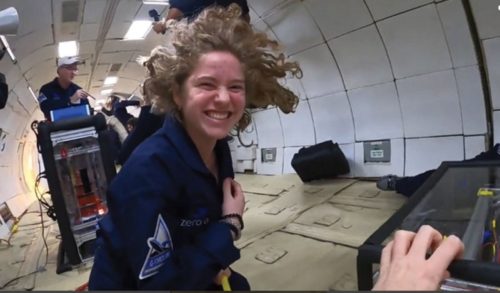
Eleanor Sigrest, a rising senior enrolled in a dual program at Forest Park High School in Woodbridge, Virginia, and the Governor’s School at Innovation Park in Manassas, Virginia, won the competition with her experiment, Improving Fluid Management Through A Novel Microgravity Slosh Mitigation Technique, which will be the first AIAA-sponsored payload to go into flight.
“Ever since I can remember,” she said, “I’ve looked at the stars and known I want to go to space. I want to be the first person on Mars. Through research, I feel I better my personal knowledge and contribute to a community, all sharing the same goal of exploring beyond our Earth and developing the technologies necessary to get to Mars – technologies that will also benefit all humankind.”
In her quest to be the first person on Mars, Eleanor has been conducting independent research on rockets since middle school. She has won a host of science competitions, beginning with the grand prize, regional level, in her first science fair when she was in fourth grade, and including the Broadcom MASTERS Samueli Foundation prize at the national level with her experiment, “Rockets and Nozzles and Thrust, OH MY!”
“Design/Build/Launch is the perfect next step to complement my research of a novel microgravity slosh technique that could simplify spacecraft systems, increase payload capacity and save the space industry billions of dollars,” she said. “This opportunity provides me the chance to further this research and prepare for my own launch to Mars.”
AIAA Executive Director Dan Dumbacher said,
“If aerospace is to continue pushing boundaries to create a better world for us all, we need students like Eleanor Sigrest to be inspired to take up the challenge. Congratulations, Eleanor, on being the first winner of Design/Build/Launch! You inspire us!”
[ Dr. Erika Wagner, Payload Sales Director at Blue Origin, said,]
“Pushing the boundaries of technology are essential to charting our future course in space,” … “Eleanor’s passion to explore the unexplored and determination to bring clarity to science we don’t yet understand are unmatched, and we can’t wait to see how her experiment performs in space. We’re humbled to inspire students to pursue careers in STEM through payloads on our reusable New Shepard vehicle and our non-profit, Club for the Future.”
Eleanor has made presentations at the 2016 Broadcom MASTERS Science and Engineering Project Showcase in Washington, DC, and the 2017 World Science Festival in New York, NY. She leads workshops for middle-school girls, advocating for greater representation by women in STEM fields. She has been featured on NBC’s TODAY program in a “Girls Changing the World” segment and is a lifetime fellow of the American Junior Academy of Science. In May, Eleanor received the first-place AIAA “Look Up!” Award presented at the 2020 Regeneron International Science and Engineering Fair (Intel ISEF).
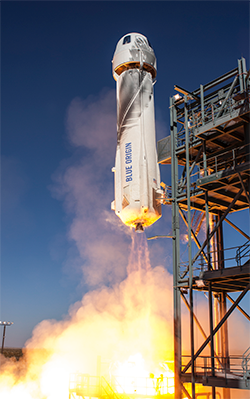
A fully reusable New Shepard rocket lifts off for a suborbital trip to space. Credits: Blue Origin
Design/Build/Launch (DBL) Competition
The DBL competition is open to high school students and designed to promote student engagement in microgravity and/or space technology research. Each proposal is composed of two parts: each entrant designed an experimental payload to be launched on Blue Origin’s New Shepard rocket and described outreach plans to engage the public with the promise and excitement of space.
Eleanor’s DBL proposal was selected from among entries received from students from across the United States.
Eleanor will receive a $1,000 grant to prepare her work to fly on a future New Shepard flight. She will report on the results of her experiment at 2021 ASCEND, AIAA’s event dedicated to the space ecosystem.
About Blue Origin: For information on Blue Origin, visit www.blueorigin.com and follow @BlueOrigin on Twitter and Instagram. To learn more about Club for the Future and our space mail program, visit clubforfuture.org and follow @ClubForFuture on Twitter and Instagram.
About AIAA: The American Institute of Aeronautics and Astronautics (AIAA) is the world’s largest aerospace technical society. With nearly 30,000 individual members from 91 countries, and 100 corporate members, AIAA brings together industry, academia, and government to advance engineering and science in aviation, space, and defense. For more information, visit www.aiaa.org, or follow AIAA on Twitter, Facebook, or LinkedIn.
About ASCEND: ASCEND stands for Accelerating Space Commerce, Exploration and New Discovery and is designed to bring together technical and business leaders to solve problems that affect the entire planet and beyond. Powered by AIAA, the ASCEND event will happen online 16–18 November 2020. For more information, please visit www.ascend.events, or follow ASCEND on Twitter, Facebook or LinkedIn.