A sampling of recent articles, videos, and images dealing with space transport (find previous roundups here):
** Northrup Grumman Minotaur IV launches 4 NRO classified satellites from Virginia spaceport Wednesday morning. The modified Peacekeeper missile used four solid-fueled stages to put the satellites into low earth orbit.
More at:
- Northrop Grumman Successfully Launches Minotaur IV Rocket Carrying Satellite for the National Reconnaissance Office | Northrop Grumman
- US launches 4 secret spy satellites to orbit | Space.com
- Northrop Grumman successfully launches NROL-129 from MARS – NASASpaceFlight.com
- NROL-129 Launch Press Kit (pdf)
** Launch of the UAE Hope Mars mission on a Japanese H-2A rocket was scrubbed on Tuesday due to bad weather at the Tanegashima Space Center in southern Japan. The new target liftoff time is Thursday, July 16, 2020 at 8:43 pm GMT (4:43 pm EDT).
** China launched a broadband Internet satellite on Long March 3B on July 9th: Long March 3B launches APStar-6D – NASASpaceFlight.com
The satellite is part of a multi-beam high-throughput broadband satellite communication system based on the Ku and Ka frequency bands that will form a space-wide Internet communication network covering the whole world, build an integrated, autonomous, controllable, efficient and safe satellite broadband communication network and service platform that provide the ability to match global communications needs to provide high-quality, efficient, and low-cost satellite broadband communications services for mobile communications, including maritime communications, aviation airborne communications, land vehicle communications and fixed satellite broadband Internet access.
** Chinese Kuaizhou-11 rocket launch failed on July 10th. Two commercial satellites were lost. First launch of Chinese Kuaizhou-11 rocket ends in failure – SpaceNews
The three-stage rocket uses solid fueled motors and has been derived from Chinese military missile technology by ExPace Technology Corp., a subsidiary of the government-run China Aerospace Science and Industry Corporation (CASIC).
SpaceNews:
The mission was China’s 19th launch of 2020, following the successful launch of the APSTAR-6D communications satellite to geosynchronous transfer orbit Thursday.
China has suffered three failures this year. These were the debut launch of the Long March 7A in March, a new launcher which may replace the aging, hypergolic Long March 3B. The latter launcher failed in April resulting in the loss of the Indonesian Palapa-N1 communications satellite.
** More about the recent Israeli Shavit rocket launch from Scott Manley:
The Shavit first launched in 1988 carrying Israeli designed and built surveillance satellites, since then it’s launched more than 10 time, with the latest being the first weekend of July 2020 carrying the Ofeq 16 satellite. Shavit is unique among launch vehicles in that it’s designed to launch retrograde to avoid dropping spend stages on Israels neighbours.
** Skyrora opens new engine test facility in Scotland: Skyrora opens rocket engine test complex expected to create over 170 jobs – Skyrora
Skyrora has established an engine test complex in Scotland, where it already has successfully tested its 3.5kN engine and three-tonne engine for its sub-orbital and orbital rockets. Skyrora expects the newly established Engine Test Complex to help the company create over 170 new jobs in the area by 2030.
Skyrora’s engine test complex layout is fairly minimal, mainly consisting of a fuel and oxidiser loading system to put fuel into both tanks and a pressure supply system to feed the fuel to the engine in the test stand. Skyrora also built the actual test stand, the road to access the test site and the concrete slab for the test site to sit on. It took the team only a few weeks to build it, at a fraction of the estimated time and cost while making sure all measures followed health and safety guidelines.
Skyrora’s vision is to test all three engines used on its rocket suite in the one location: the seven-tonne engine for the first and second stage of the orbital Skyrora XL launch vehicle, the 3.5Kn engine for the third stage, and the three-tonne engine for the sub-orbital Skylark L launch vehicle.
The test site is estimated to help Skyrora create over 170 mainly technical jobs in manufacturing and operations ranging from mechanical engineering to electronics for avionics systems.
Skyrora are excited to announce that we have established a rocket engine test facility in Scotland, with the aim of supporting 170 jobs by 2030. This engine test complex has already seen the successful testing of two of our engines!
For the full story: https://t.co/ruL8qtStaW pic.twitter.com/pn8BHtqDOi
— Skyrora (@Skyrora_Ltd) July 14, 2020
** Taiwanese TiSpace develops mobile launch system for Hapath V rocket:
花2個月打造出來的機動式發射系統,已經完成全系統功能測試及發射模擬驗證。
It took us 2 months to build a mobile launch system that had completed the system testing with launch operation sequence simulation verified. pic.twitter.com/pDP4AAGVID
— TiSPACE (@LaunchService) July 13, 2020
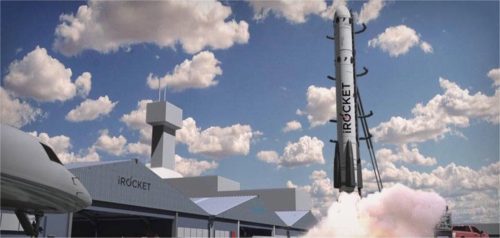
** Startup iRocket signs contract with USAF: Fully Reusable, Autonomous, Small Rockets, Flight-Ready in Under 24 Hours – iRocket
On July 7, 2020 iRocket announced that the company signed a Phase II RAPID Other Transaction Agreement contract with the U.S. Air Force. The award was created just three months after the phase I contract when iRocket partnered with Space and Missile Systems Center (SMC) in Albuquerque, N.M., and Air Force Research Lab at Wright-Patterson Air Force Base, Ohio.
iRocket is a privately funded New York startup building autonomous small reusable rockets to cargo micro, nano, cube, and constellations to LEO on its Shockwave launch vehicle. The company develops cost-effective small launch vehicles that can support 300kg and 1500 kg payloads for space research and exploration. After the recent successful launch of two American astronauts into orbit by the SpaceX/NASA partnership, there has been tremendous media interest in private companies innovating, reducing costs, and increasing access to space exploration – all of which are iRocket’s specialties. iRocket plans to disrupt the small satellite market and will offer on-orbit satellite servicing capabilities by 2025.
…
iRocket’s Shockwave will be a fully autonomous launch vehicle and the only fully reusable small launcher in the market. It will consist of two stages to orbit, the first and second stage landing back on the launch site. iRocket will prove inland launch capabilities to the Department of Defense and be mission capable of launching within 24 hrs. iRocket plans to launch its rockets from Launch Complex 48 at Kennedy Space Center in Cape Canaveral, Fl.
** Vert Aerospace aims to develop a smallsat launch system with a low carbon footprint. The fully reusable vehicle will accomplish this by
using additive manufacturing, Vert Aerospace will drastically REDUCE part count and material needs.
and
The Gaia Launch Vehicle (GLV) will be fueled using recycled RP-1. Vert Aerospace will use a proprietary CO2 conversion process powered by solar.
** Germany’s DLR sponsoring microlauncher competition (Google Translation):
The microlauncher competition of the DLR Space Administration started on May 15, 2020. The competition supports German start-ups with a total amount of 25 million euros, which Mikrolauncher wants to develop and operate commercially. A maximum of five companies can participate, of which two winners will be selected by an expert jury during the two-year term….
… The Mikrolauncher competition is divided into three phases: In the preliminary round (2020), the maximum of five participating start-ups are selected, each receiving 500,000 euros in funding. In the course of the main round (2021) the winner of the competition will be determined, who will receive funding of eleven million euros. In the third phase (2022), the second place is awarded, which is also endowed with eleven million euros.
Funding is provided through the European Space Agency’s C-STS program . Technical, economic and operational evaluation criteria are decisive for the selection of the teams in all three competition phases.
Three teams – HyImpulse, Isar Aerospace Technologies and Rocket Factory Augsburg – have now been selected from the preliminary round to continue to the next phase of the competition: DLR microlauncher competition: These three teams are one round further – DLR Portal (Google Translate)
The core task of the competition was a proposal for transport services from earth to orbit (“Earth to Orbit”) based on a micro launcher developed by the company itself. A prerequisite was also the willingness to allow free flight of selected non-commercial payloads from universities or research institutions with a maximum total mass of 150 kilograms each on the qualification flights. In the last two rounds of the competition, the winners receive funding for the final qualification phase of their carrier system, including the implementation of two demonstration flights in the period 2022-2023. After the preliminary round has now ended, the first winner of the competition will be determined in the course of the main round (2021), who will receive funding of eleven million euros. In the third phase (2022), the second prize is awarded, which is also endowed with eleven million euros.
The microlaunchers are loosely defined as those launchers that can take a payload of a few hundred kilograms to low earth orbit.
** Spaceflight to fly new Sherpa-FX space tug on a SpaceX Rideshare mission later this year to take multiple smallsats to desired orbits: Spaceflight Inc. Unveils Next-Gen Orbital Transfer Vehicle To Fly Aboard Next SpaceX Rideshare Mission – Spaceflight
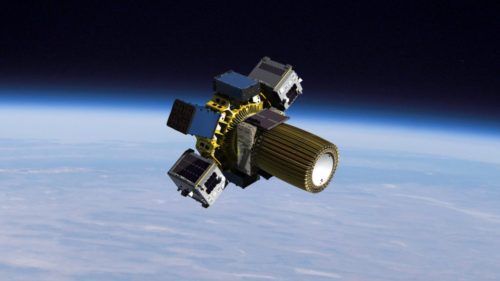
Some hosted payloads will remain attached to the transfer vehicle:
In addition to the customer spacecraft, Sherpa-FX will transport multiple hosted payloads including one for Celestis Inc., as well as several that will demonstrate technologies designed to identify and track spacecraft once deployed. By demonstrating these tracking systems on orbit, Spaceflight customers will have access to flight-proven technologies that can mitigate space congestion and provide the foundation of effective and responsible space traffic management. Technologies onboard Sherpa-FX include payloads by NearSpace Launch, Keplerian Technologies and their hardware partner Tiger Innovations, and Space Domain Awareness Inc. These innovative payloads will provide spacecraft developers an independent capability to identify and track their spacecraft without drawing on the host spacecraft resources.
** First Launch of Europe’s next-gen Ariane 6 rocket slips till late 2021. The all expendable vehicle is intended to replace the Ariane 5 and to offer launch prices competitive with SpaceX Falcon 9. ESA confirms Ariane 6 delay to 2021 – SpaceNews
Europe’s Ariane 6 rocket won’t launch until the second half of 2021 at the earliest, a delay of at least six months, the European Space Agency confirmed July 9.
“While we know that the maiden flight will not take place before the second semester of 2021, we cannot at this moment precisely quantify the delay, and we cannot provide an exact launch date,” Daniel Neuenschwander, ESA’s director of space transportation, said according to an ESA translation of remarks at a July 9 press event provided to SpaceNews. The French Association of Professional Journalists in Aeronautics, organized the event at ArianeGroup’s headquarters in Paris.
** Status of development of seven heavy lift launch systems: Sadly, none of the big rockets we hoped to see fly in 2020 actually will | Ars Technica
- H3 – Mitsubishi Heavy Industries – Likely first launch 2Q 2021
- Omega – Northrop-Grumman – 3Q-4Q 2021
- Ariane 6 – Airbus/Safran/ESA – 4Q 2021
- Vulcan-Centaur – United Launch Alliance – 4Q 2021
- Super Heavy reusable 1st stage – SpaceX – 4Q 2021
- SLS – Boeing/NASA – 1Q-2Q 2022
- New Glenn – Blue Origin – 3Q-4Q 2022
** Briefs:
- Rocket Report: Surprise Israeli launch, Britain decides to bail out OneWeb | Ars Technica
- Independent reviewers offer 80 suggestions to make Starliner safer | Ars Technica
==================
Check out the
The Lurio Report
for news and analysis of key developments in NewSpace
The latest issue:
Riding a Dragon, Rockets Rising, Space Resource Policy
Vol. 15, No. 4, June 14, 2020
Space Frontier Foundation Award for NewSpace Journalism
==================
** SpaceX:
** Two SpaceX Falcons struggling to fly. The third go at launching the Starlink 9 payload with 57 Starlink satellites and 2 BlackSky satellites on Saturday July 11th was scrubbed due to unspecified technical problems. This followed two previous attempts to lift off since late June. A launch of another Falcon 9 set for Tuesday July 14th of the South Korean Anasis 2 military communications satellite was postponed due to an issue with the upper stage. The first stage booster had been successfully test fired last Saturday. The Anasis launch is now set for Sunday, July 19th at 5 pm EDT (2100 GMT).
- SpaceX hit by back to back Falcon 9 and Starship rocket delays – Teslarati
- SpaceX stands down from Starlink launch for the third time – Ars Technica
- Falcon 9 launch of South Korean military satellite postponed – Spaceflight Now
- SpaceX test-fires Falcon 9 rocket launch next week with Korean military satellite – Spaceflight Now
** SpaceX – Lift, Load and Go – GPS III – www.USLaunchReport.com
From the sea to the highway. Incredible how SpaceX has shortened the Port processing time. With the new Octagrabber, they are able to load directly from JRTI to the transporter. Pushing for that 24hr turnaround. All in 4K.
It appears that the Raptor engine on the Starship prototype SN5 will be test fired in the next few days. If that goes well, a brief hop flight up to 150 meters could take place soon after: Starship SN5 set for a static fire followed shortly by a 150-meter hop attempt – NASASpaceFlight.com
Starship SN5 is finally set to begin Raptor engine testing this weekend after a successful cryogenic proof test on July 1. If the static fire test is successful, it will clear the way for a 150-meter hop test as early as next week. The 150-meter hop will be the first test flight of a full-scale Starship tank section.
A successful cryogenic proof test on July 1 verified that Starship SN5 can withstand the forces associated with engine testing. These forces include the pressure created by the cryogenic propellants and the thrust from the Raptor engine.
Ahead of the static fire test, the hydraulic thrust simulator – used for the proof testing – was removed to make way for a Raptor engine. Raptor SN27 is the engine chosen for use on SN5.
….
Whatever the case, SpaceX teams are understood to be eager to get Starship SN8 completed. The vehicle will feature major upgrades over previous Starship prototypes. SN8 will be built out of 304L stainless steel versus 301, receive a fairing, aerosurfaces, and three Raptor engines to allow for a higher altitude test flight.
****** Boca Chica Beach facilities have developed and expanded rapidly has seen in the before and after imagery provided in this article from RGVAerialPhotography and other sources: New images show SpaceX’s Starship factory, launch site grow over time – Business Insider
Space X Boca Chica Build Site Year 2018 to 2020 overlayed images.
Space X Boca Chica Build Site Year 2018 to 2020 overlaid images. Cessna 172 🛩️and give you monthly (🤔 biweekly)updates of the Space X Boca ChicaSites.Thanks! https://t.co/HM7wP3RQV9 #RGV #SpaceX @elonmusk pic.twitter.com/Y4NiU8Wcb7
— RGVAerialPhotography (@RGVaerialphotos) June 16, 2020
First ever aerial photo showing the SpaceX Boca Chica Launch and Build Site in the same shot!!!
.@elonmusk #SpaceX #RGV #Bocachica
visit https://t.co/dGpvgoDEmt for the full 40+photo online gallery. 07/06 Flyover🛩️📷🚀 pic.twitter.com/RNX6SyMRhL— RGVAerialPhotography (@RGVaerialphotos) July 7, 2020
A new fly over video from RGV:
******More videos of Boca Chica:
****** July 11: SpaceX Boca Chica – Additional facility expansion – NASASpaceflight – YouTube
SpaceX Boca Chica continues to grow as a spaceport with the impressive High Bay continuing assembly while extra land is cleared for further expansion. Video and Pictures from Mary (@BocaChicaGal). Edited by Brady Kenniston (@TheFavoritist)
****** July 12: SpaceX Boca Chica – Gearing up for Starship SN5’s Static Fire testing – NASASpaceflight – YouTube
While there is activity all across SpaceX Boca Chica, the focus of attention will be on Starship SN5 this coming week ahead of her Static Fire test campaign. Footage includes Production Facility section preps and the drive past of the facilities that have new additions each week. Video and Pictures from Mary (@BocaChicaGal). Edited by Jack Beyer (@thejackbeyer).
****** July 14: SpaceX Boca Chica – Nosecone Ready To Stack – Work On New Lot – NASASpaceflight – YouTube
In today’s Boca Chica update, Nosecone stacking appears imminent (but doesn’t happen), another new nosecone (yes another one) is spotted in the fabrication tents, Earth work begins at a new lot that SpaceX has apparently purchased, future starship parts line up and SN5 test campaign preparations continue. Video and Pictures from Mary (@BocaChicaGal). Edited by Jack Beyer (@TheJackBeyer)
****** July 15: SpaceX Boca Chica – A New Nosecone Is Born – New Lots Readied For Expansion – NASASpaceflight – YouTube
In this Starship update; a new Nosecone is born in Boca Chica, a scrap ring stack is moved out of the fabrication area, earth work on both sides of the build site continued, and work at the launch site and on SN5 continued ahead of engine testing. Video and Pictures from Mary (@BocaChicaGal). Edited by Jack Beyer (@TheJackBeyer)
****** Webcast Starship reports:
**** SpaceX Starship news as SN5 heads towards 150m flight, OneWeb, RocketLab & Starliner updates – Marcus House
****** What’s Missing In SpaceX’s Boca Chica? – What about it!?
****** Will the Starship Facility Survive Hurricanes? – What about it!?
****** SpaceX Boca Chica – Weekly Update – First Week of July, 2020 – NASASpaceflight – YouTube
NSF’s first weekly update video showing the highlights of work ongoing at SpaceX Boca Chica. Featuring videos and photos from Mary (@bocachicagal) for NSF. Edited and hosted by Jack Beyer (@thejackbeyer).
=====
=== The Art of C. Sergent Lindsey ===



 [Amazon commission link], plus his ongoing essay series on space development.