A sampling of links to recent space policy, politics, and government (US and international) related space news and resource items that I found of interest (find previous space policy roundups here):
** NASA Administrator Discusses Collaboration with US Space Force – NASA
The Mitchell Institute hosted the Space Power Forum with NASA Administrator Jim Bridenstine and Chief of Space Operations General Jay Raymond on Tuesday, September 22. The space domain is as vitally important to U.S. defense as it is to its scientific and commercial interests, and the establishment of the U.S. Space Force (USSF) raises big questions with implications for all. This conversation with the leaders of NASA and the USSF explored how they intend to collaboratively tackle shared challenges in space, their respective mission requirements, and opportunities to leverage commercial capabilities and innovation.
In this exclusive interview with 7investing, Dr. Magnus shares her thoughts about the new “space economy”. She also discusses what technologies will be most-needed for off-world colonization and describes several things that people interested in this space should have on their radar.
LEO Commercialization:
The Pathway to Earth’s Trillion Dollar Space Economy
Today’s global $350 billion space economy will soon bloom into a trillion-dollar economy. Join the National Space Society for the virtual webinar LEO Commercialization: The Pathway to Earth’s Trillion Dollar Space Economy on September 30 at 1:00 p.m. Eastern Time (10 a.m. Pacific), as we present a group of thought leaders who will engage in a 90-minute discussion of what it will take to get us to that first trillion dollars in low Earth orbit.
Panelists include:
Lynn Harper, Lead, Integrative Studies, Space Portal at NASA Ames Research Center,
Moderated by Bruce Pittman, Chief System Engineer at NASA Space Portal and NSS Senior Vice President.
Topics include government policy and funding to support emerging space industries, near-term profitable space manufacturing, medical and technological products, and much more.
Research and development platforms, both government and commercial, are needed in space. Some will be attached to the International Space Station, while others will be free flyers in various orbits around the Earth. The space ecosystem will soon be full of multiple providers and a world-wide customer base, resulting in an economically thriving low Earth orbit marketplace, eventually extending into cislunar space and beyond. But this bright future will require intelligent legislation and strong financial support to succeed—and this discussion will outline the path ahead.
Join us on September 30 at 1:00 p.m. Eastern Time (10 a.m. Pacific) for a presentation about our exciting future in space and the steps we need to make it a reality. This extraordinary event will be simulcast by e360tv.com over Facebook, YouTube, Roku, Amazon Fire, and other streaming media. Be sure to mark your calendars—you don’t want to miss this!
Here is the latest episode in NASA’s Space to Ground weekly report on activities related to the International Space Station:
** ISS National Lab Mission Overview: Northrop Grumman CRS-14 – ISS National Lab
Northrop Grumman’s 14th commercial resupply mission (CRS-14) to the International Space Station (ISS)is slated for launch no earlier than September 29 at 10:26 p.m. ET from Wallops Flight Facility in Virginia. The ISS U.S. National Laboratory is sponsoring more than 20 payloads on this mission that will bring value to our nation, and further enable a sustainable market in low Earth orbit. These payloads represent a diverse mix of research and technology development seeking to leverage the unique space-based environment of the orbiting laboratory to push the limits of fundamental and applied science.
** Northrop Grumman’s CRS-14 Mission to the International Space Station: What’s on Board – NASA
A Northrop Grumman Cygnus resupply spacecraft soon heading to the International Space Station carries thousands of pounds of scientific investigations, technology demonstrations, commercial products, and cargo. The company’s 14th commercial resupply mission is scheduled to launch no earlier than Sept. 29 from NASA’s Wallops Flight Facility in Virginia. The craft’s cargo includes critical materials that support research ranging from cancer therapies to vegetable growth and a commercial product as part of NASA’s goal to achieve a sustainable economy in low-Earth orbit. Learn more here: 14th Cygnus Carries Toilet, Cancer Research, VR Camera to ISS | NASA
** Expedition 64 Crew Final Qualification Training September 23, 2020 – NASA
Expedition 64 Soyuz Commander Sergey Ryzhikov of Roscosmos, Flight Engineers Sergey Kud-Sverchkov of Roscosmos and Kate Rubins of NASA and their backups, Oleg Novitskiy and Petr Dubrov of Roscosmos and Mark Vande Hei of NASA, conducted final qualification training for their upcoming International Space Station mission at the Gagarin Cosmonaut Training Center in Star City, Russia Sept. 22 and 23. Ryzhikov, Kud-Sverchkov and Rubins are scheduled to launch on Oct. 14 from the Baikonur Cosmodrome in Kazakhstan in the Soyuz MS-17 spacecraft for a six-month mission on the International Space Station.
** Expedition 64 GCTC Crew News Conference – NASA
** 2020 Tissue Engineering and Regenerative Medicine Workshop: Biofabrication – ISS National Lab
A sampling of recent articles, press releases, etc. related to student and amateur CubeSat / SmallSat projects and programs (find previous smallsat roundups here):
** Western University (Canada) and Arizona State teams to collaborate on CubeSat project:
[On Sept. 23rd] …Western signed a game-changing memorandum of understanding (MoU) with the MILO Institute, a non-profit research collaboration led by Arizona State University and supported by Lockheed Martin and its subsidiary GEOshare.
As part of the agreement, [Electrical and computer engineering professor Jayshri] Sabarinathan and her Western Space collaborators will contribute a one-unit CubeSat (a square-shaped miniature satellite roughly the size of a Rubik’s cube) to a MILO Institute and University of Texas at El Paso flight mission planned for June 2021 – an aggressive timeline, she admits, but that just adds to the excitement.
The project will contribute to development of technology for lunar and other deep space exploration.
For the past two years, Sabarinathan and her team have been designing, developing and constructing a CubeSat with research partners at Nunavut Arctic College and Canadensys Aerospace Corporation, scheduled for launch in 2022. Ukpik-1, a two-unit CubeSat project outfitted with 360-degree imaging VR cameras and funded by the Canadian Space Agency, will fly to the International Space Station in two years. Next summer’s ‘bonus’ launch provides the team with an unexpected – but most-opportune – test run for its endeavour.
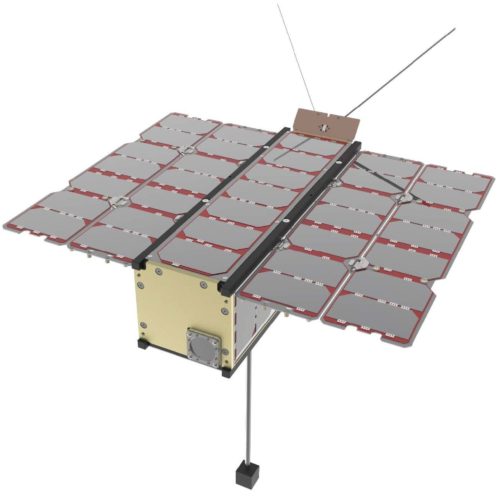
The RadCube mission is designed to test new technologies for monitoring space weather – the variations in the solar wind coming from the Sun, which can disrupt and damage satellites and infrastructure on Earth.
RadCube is a ‘cubesat’ mission, which are designed to use smaller, cheaper and lower-power components than traditional space missions. The technologies in RadCube, if proven to work well in space, could be used in a range of future missions, such as constellations of multiple cubesats working together to measure the solar wind. CubeSat spacecraft are typically constructed upon multiples of 10 × 10 × 10 cm cubes, and RadCube is made up of three of these base units.
Imperial academics and technicians from the Department of Physics this week delivered a miniature magnetometer to the project in Hungary – an instrument that measures the interactions between the Earth’s magnetic field and that carried by the solar wind, which is a major component of space weather monitoring.
Rendering of the RadCube satellite. The MAGIC instrument sits on the end of the boom at the bottom. Credits: Imperial College
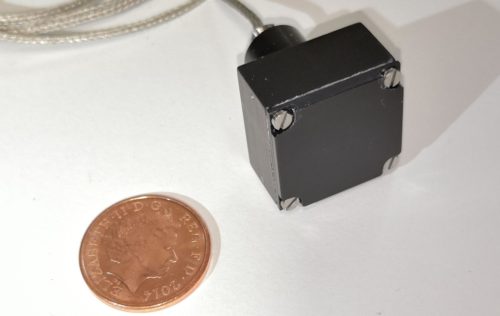
The individual detectors on their instrument – called MAGIC (MAGnetometer from Imperial College) – are less than a millimetre in size, and the total instrument sensor is only four centimetres cubed. This is in comparison to the sophisticated magnetometers the lab builds for large and expensive space missions, such as the recent Solar Orbiter mission and the upcoming JUICE mission, which are much larger and weigh a couple of kilograms.
The MAGIC instrument also uses less than a watt of power, compared to up to 20 watts for the larger instruments. While MAGIC is not as sensitive as these larger instruments, as it is much cheaper to build and uses far less power, the technology could be carried on several spacecraft working in tandem. In this way, the lower-quality data is compensated by a much larger volume of data.
The MAGIC (MAGnetometer from Imperial College) for the RadCube spacecraft. Credits: Imperial College
A miniature satellite developed by university students in the UAE to observe the country’s climate will launch later this month.
MeznSat was funded by the UAE Space Agency and built by engineering and science students at the Khalifa University and American University of Ras Al Khaimah (Aurak).
MeznSat’s initial lift-off was scheduled for the end of 2019, however it was delayed twice and will now blast into the skies on a Soyuz-2b rocket from Russia on September 28.
It is the third miniature satellite – known as a CubeSat – constructed in the Emirates.
See previous postings about the MeznSat project here, here, and here.
** AMSAT news on student and amateur CubeSat/smallsat projects:
** Sierra Foothills ARC August 2020: Cubesats! The story of the ASU Phoenix Cubesat project
The Sierra Foothills ARC was privileged to have Devon KM6MDG and Trevor KM6MDH talk about their work on the Phoenix Cubesat, AzTechSat-1. The two are graduate students at Arizona State University, and were involved with the program from shortly after conception, through deployment from the International Space Station, to operation afterward. In their talk, they review the objectives of the satellite, talk about its construction and their roles and challenges, and detail its current status.
The Space and Satellite Systems Club at UC Davis is the premiere space-based engineering club on campus. Our efforts are focused towards developing the skills and technical know-how necessary to design spacecraft by developing, manufacturing, and launching a CubeSat mission to Low-Earth Orbit (LEO). The club focuses on technologies for smaller spacecraft and cube satellites and covers a wide range of research areas from controls and dynamics to sensors, electronics and software. We are currently set to launch our first CubeSat (REALOP) later in 2021. This mission will be a technical demonstration of our in-house developed bus and technological components, the payload on the will serve as an earth sciences mission that will utilize IR and RGB cameras to study the thermal activity of the Earth’s atmosphere from LEO.