I recently posted about Joe Barnard adding thrust vector control and other advanced features to model rockets. The goal is to model not just the appearance of large rockets but how they take off and fly as well. This weekend, he successfully flew for the first time a model he built of the SpaceX Falcon Heavy, which involved separation of the two side cores and the in-flight firing start-up of the center core.
The side boosters executed a 20 degree roll program with a rate of 30dps, beginning at T+0.9. Initial pitch-over of the vehicle at launch was due to thrust inconsistencies between booster motors. Because of a low level coordinate transformation error in its flight software, the center core flew with poor stability, correcting roughly 20 degrees off axis for both pitch and yaw. Photos from the flight can be found here: https://bps.space/gallery/
Find out more about Barnard’s projects and rocket hardware at BPS.space.
The company Rocket Lab plans to launch an Electron rocket from the Mahia Peninsula on the east coast of New Zealand’s North Island during a two week long launch window that opens on June 23rd. This will be the company’s third launch and, they hope, the second one to successfully put payloads into orbit. Here is a NZ TV news report on the company:
New Zealand has entered the space race. In just a few days, the Kiwis will launch their first commercial rocket, taking satellites into orbit. @MarkWBurrows#9Newspic.twitter.com/n1jB05fuuG
JPL Science System Engineer Kim Steadman joins us to talk about some past, present and future missions that JPL has sent to Mars and beyond. We touch on Spirit, Opportunity, Curiosity, the upcoming Mars 2020 and the different personalities each rover has. We sprinkle a little Juno and Cassini in there for good measure as well.
Space News: Opportunity LOS SpaceX is planning even more facilities at KSC Axiom Space Announces Private Astronaut Expeditions
TMRO is viewer supported:
TMRO shows are crowd funded. If you like this episode consider contributing to help us to continue to improve. Head over to http://www.patreon.com/tmro for funding levels, goals and all of our different rewards!
December 21st of this year will mark the 50th anniversary of the launch of the Apollo 8 mission to the Moon. Astronauts Frank Borman, James Lovell, and William Anders became the first humans to leave Earth and orbit another celestial body. The mission was extremely risky. The Saturn V rocket had only launched twice before and never with a crew and on the previous launch there were engine shutdowns on the second stage (longer firing of the remaining engines saved the mission). Although there was no lunar lander on Apollo 8 , many key technologies and operations needed for a successful lunar landing mission were demonstrated for the first time such as translunar injection, command module navigation, communications, and midcourse corrections.
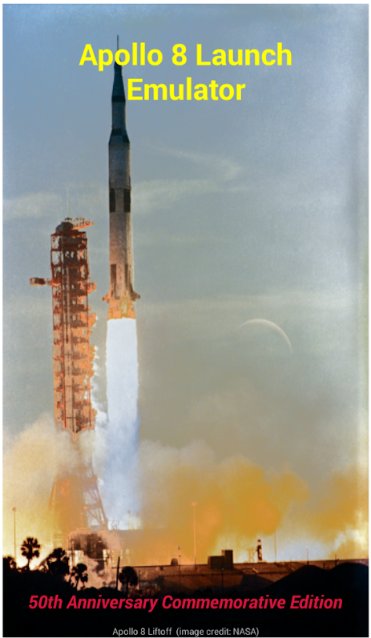
And all these tasks were performed with computer technology that was far less powerful than what runs a $10 wristwatch today. To get an appreciation for the state of the art in advanced compact computers in 1968, check out the free Apollo 8 Launch Emulator for Android created by astronomer Rick Boozer.
operate a realistic replica of the Apollo 8 spacecraft’s guidance computer”.
This app is not a traditional game (no winning or losing involved). It is also not an entire mission simulation. So, if you are looking for either of those, then don’t download this app.
Instead, it is a commemoration of the launch of humankind’s first trip to another world by way of an emulation of a realistic Apollo Guidance Computer (or AGC) and DiSplay KeYboard interface (called DSKY).
You can re-enact the launch of the powerful Saturn V rocket that sent the Apollo 8 spacecraft with its crew on the way to the Moon on December 21, 1968. The animation you will see will not be of a flying rocket, but the mission critical true-to-life data displayed as it would have been shown in real-time to the astronauts as they ascended from the launch pad to Earth parking orbit.
To add to the enjoyment of the experience, the app supplies optional English explanations of the data shown. Not only that, you will be continually informed of major events that occur at each mission critical point between launch and Earth orbit at the appropriate time.
As a bonus, you will be able to type in a small subset of the actual commands that the astronauts entered into the AGC via the DSKY and see relevant results.
If, as in my case, you don’t have an Android device, you can run the app on a PC or Mac computer by downloading the free NOX virtual Android device creator at www.bignox.com.