Here is the Planetary Society‘s latest Planetary Post video with Robert Picardo:
From the caption:
William Shatner sends a message to Voyager 1, Cassini crashes into Saturn, asteroid-seeking OSIRIS-REx gets a gravity assist, and The Planetary Society’s citizen-funded solar sailing spacecraft LightSail® 2 is making news again. Robert Picardo is here to tell you all about it in this month’s Planetary Post. Get space updates delivered straight to your inbox: http://planet.ly/TI0Pf
===
Here is the full video mentioned by Picardo that shows an animation of the LightSail 2 spacecraft development and launch.
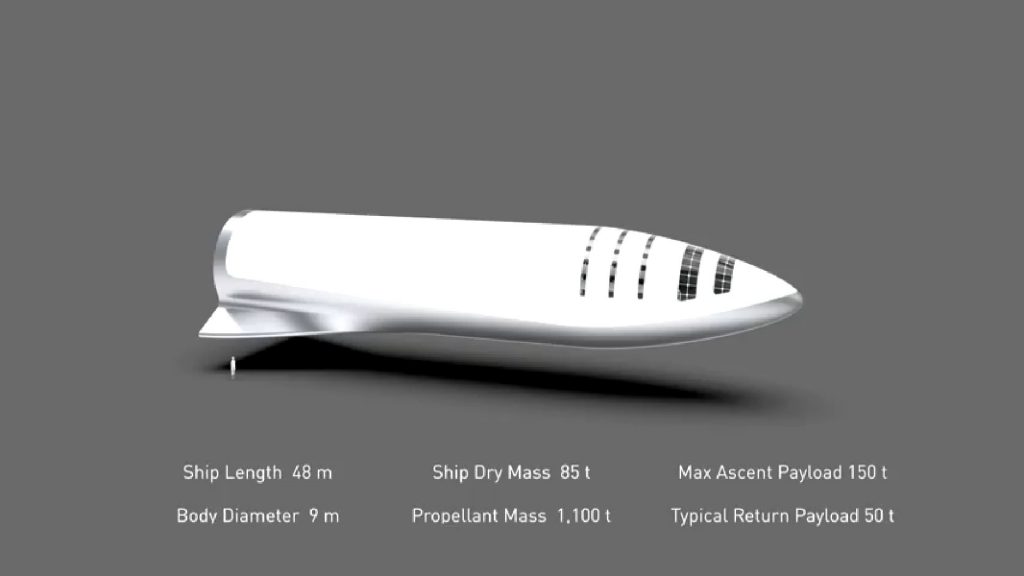
Elon Musk gave a talk today at the International Astronautical Congress (IAC 2017) in Adelaide, Australia in which he described the design of a new SpaceX rocket system, informally called the BFR (e.g. “Big Freaking Rocket”). The company will soon start building the BFR with the goal of uncrewed flights to Mars by 2022 and crewed flights in 2024. The system can also be used to launch satellites, take crews and cargo to the International Space Station, and carry out missions to the lunar surface. He even talked about using it for 30 minute passenger flights between any two points on earth.
Here is Elon’s talk, which he titled, “Making Life Multiplanetary“:
An artist’s view of a BFR spaceship module on the Moon:
Here is a video showing how the vehicle could be used for point-to-point commercial transport on earth.
“Fly to most places on Earth in under 30 mins and anywhere in under 60. Cost per seat should be about the same as full fare economy in an aircraft. Forgot to mention that.” – Elon Musk
A brief clip showing a Mars base enabled by the BFR growing into a city:
SpaceX has credibility for such aspirations because the company has proven it can do things that were not considered feasible by many in the space industry even just a few years ago. Here, for example, is a compilation of clips showing the 16 successful landings so far of the SpaceX Falcon 9 first stage boosters:
NASA’s Commercial Crew Program is partnering with private companies to develop new spacecraft to fly astronauts on NASA missions to the International Space Station, and we want kids to have a fun way to learn more about this program while being creative!
The Commercial Crew Program is holding an artwork contest from Oct. 2 to Nov. 2 for children ages four to 12 years old. The winning artwork will be used to create a 2018 calendar, which has a different space-related theme for each month. The themes educate students about the International Space Station, astronauts, growing food in space and more! Unique and original artwork will be selected for each month. Once the calendar is complete, it will be transmitted to astronauts aboard the space station. The calendar also will include supplemental education materials for kids here on Earth to learn more about the space-related themes.
Go to https://go.nasa.gov/2xBWNj4 for more information about the competition’s themes, rules and deadlines plus the entry form. Get your parent’s permission, of course!
We’re calling on all inventors and doers to make human flight a reality by building the world’s first personal flying device for anyone, anywhere. Over the next two years, teams will compete to win $2,000,000 in prizes, creating revolutionary technology and accessing the top minds in aerospace.