A sampling of recent articles, videos, and images dealing with space transport (find previous roundups here):
** Two launches from Cape Canaveral this weekend: Back-to-back launches scheduled from Cape Canaveral this weekend – Spaceflight Now
**** Saturday, May 16th, a ULA Atlas V rocket will take a X-37B spaceplane into orbit for the 6th mission of the program. (See previous ST Roundup for info on the X-37B mission.) The window for the launch is between 8:24-10:53 am EDT (1224-1453 GMT).
- Atlas V USSF-7- United Launch Alliance (ULA) Rocket Launch – ULA
- Live coverage: Atlas 5 rolls to launch pad at Cape Canaveral – Spaceflight Now
- X-37B Space Plane: Ready for New Mission – Leonard David
**** Sunday, May 17th, a SpaceX Falcon 9 will put 60 more Starlink satellites into orbit. Over 400 Starlink satellite are already in space. Liftoff is set for 0753 GMT (3:53 a.m. EDT). A storm brewing in the Atlantic, however, may cause a postponement since it could prevent the recovery of the booster, which will be on its 5th flight. To maintain the desired high flight rate for the Starlink program, the boosters need to be reused multiple times. A test firing of the booster engines was successfully carried out yesterday.
- SpaceX readies rocket for final Falcon 9 launch before crew flight – Spaceflight Now
- SpaceX Falcon 9 booster set for record-breaking landing after lessons learned from engine failure – Teslarati
Find more SpaceX items below
** China launches Kuaizhou-1A solid fueled rocket with two smallsats (93 kg each )for the Xingyun communications and data relay constellation. The constellation will eventually reach 80 satellites.
- First two smallsats launched for Chinese data relay constellation – Spaceflight Now
- Kuhaizhou-1A launches two satellites, one named in tribute to Wuhan – NASASpaceFlight.com
** China’s new crew capsule lands successfully a few days after launch on the new Long March 5B:
- Return capsule of China’s experimental manned spaceship comes back successfully – Xinhua
- Re-entry module of prototype spacecraft makes landing – Chinadaily.com.cn
- China’s New Spaceship: Space Station and Human Moon Exploration Plans – Leonard David
- New Chinese crew capsule completes test flight, returns to Earth – NASASpaceFlight.com
The core stage made an uncontrolled reentry a week after the launch:
- An out-of-control Chinese rocket may have dumped debris in Africa after falling from space – The Verge
- Large chunks of a Chinese rocket missed New York City by about 15 minutes | Ars Technica
- U.S. military tracking unguided re-entry of large Chinese rocket – Spaceflight Now
**** Recovery operations for China’s new crewed spacecraft – SciNews/CCTV/CNSA
China’s new-generation crewed spacecraft successfully landed at the Dongfeng landing site, Inner Mongolia Autonomous Region, China, on 8 May 2020, at 05:49 UTC (13:49 local time). During the two days and 19 hours in orbit, the uncrewed spacecraft carried out a series of space science and technology experiments. The spacecraft was transported to the Jiuquan Satellite Launch Center for inspection and verification work. Credit:China Central Television (CCTV)/China National Space Administration (CNSA)
**** Spacecraft Return Capsule Structure Intact as Designed after Return to Earth: Designer – CCTV
The structure of the return capsule of the trial version of China’s new-generation manned spaceship was intact as designed after it landed on the Earth on Friday, a designer of the spaceship said on Saturday.
** History of Chinese spaceplane designs and projects:
- Part 1: A Historical Perspective on Chinese Spaceplanes – The China Aerospace Blog
- Part 2: China’s Spaceplane Projects: Past, Present and Future – The China Aerospace Blog
** Rocket Lab updates:
Another set of 3D printed Rutherford engines rolling off the line in Long Beach. We’re fast approaching our 200th engine! pic.twitter.com/DsLdk9L93B
— Rocket Lab (@RocketLab) May 13, 2020
The 3rd pad (LC-1B) is coming along nicely. pic.twitter.com/wHkzeWI2Vw
— Peter Beck (@Peter_J_Beck) May 12, 2020
A rocket at LC-2 USA and at LC-1 NZ. One day I would love to launch both at the same time and we can have a race to orbit. pic.twitter.com/nLbvPqZfJb
— Peter Beck (@Peter_J_Beck) May 7, 2020
** Firefly updates:
Firefly Aerospace is preparing Reaver engines for integration with Alpha Flight 1. Engines are acceptance tested on our horizontal test stand. This video shows the startup sequence of an engine, filmed at 1,000 frames per second. pic.twitter.com/GBsAJnYPc6
— Firefly Aerospace (@Firefly_Space) May 8, 2020
Firefly is currently acceptance testing all of the elements and systems for Alpha Flight 1. Today, the Stage 1 liquid oxygen (LOx) tank successfully passed acceptance testing! Alpha uses the world’s largest all-composite LOx tank, which allows Firefly to create the lightest, pic.twitter.com/m8fS62ShTL
— Firefly Aerospace (@Firefly_Space) May 12, 2020
** Briefs:
- Cygnus departs space station, beginning extended experimental mission – Spaceflight Now – After departing the ISS, Cygnus will remain in orbit till May 29th. It will deploy some smallsats and do various experiments including combustion and fire tests.
- Defence deal sends Gilmour Space soaring – InnovationAus – See also Gilmour Space Technologies
- Pryer Aerospace Signs Long-Term Agreement with Blue Origin to Support New Glenn Heavy-Lift Launch Vehicle – Pryer Aero
- SPACESHIPMANIA – YouTube – Models
** SpaceX:
** Counting down to launch of astronauts to the ISS on SpaceX Crew Dragon. Preparations are speeding up for the Commercial Crew Program (CCP) demonstration launch for crew transport to the Station. Liftoff is set for May 27th at
- Astronauts Robert Behnken and Douglas Hurley entered quarantine on May 13th:
- NASA’s role in monitoring development of the crew system:
- A Tesla Model X will take the astronauts to the launch pad:
- Solar array performance will determine how long the Dragon remains at the ISS:
Here’s some @Tesla news that everyone should love. Check out the Model X that will carry @AstroBehnken and @Astro_Doug to the launchpad for the Demo-2 mission! #LaunchAmerica pic.twitter.com/6GCQYDFXiv
— Jim Bridenstine (@JimBridenstine) May 13, 2020
**** Try docking the Crew Dragon to the ISS with the SPACEX – ISS Docking Simulator. Scott Manley gives a tutorial on the simulator:
How To Dock With ISS in SpaceX’s Free Dragon Docking Simulator
In advance of the DM-2 Flight carrying crew to the ISS using the first privately designed and built spacecraft SpaceX have released a cut down version of the Dragon simulator which allows you to fly the docking sequence with the ISS. While this is only a cut down version of a full Dragon 2 simulation, it does give you a chance to see how the user interface design is radically different from existing space vehicles. It also gives you a chance to fly recklessly around a simulated ISS, since they won’t let you do that in real life.
The astronauts in flight-suits practice docking in the full scale hardware simulator: Crew Dragon Displays and Crew Spacesuits Ready for Mission to Space Station – Commercial Crew Program
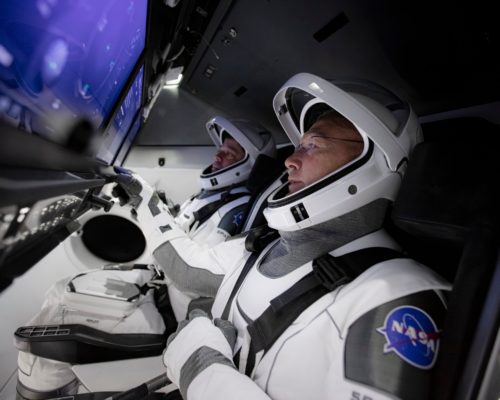
**** Promotional video from NASA on the upcoming commercial crew mission: NASA and SpaceX prepare to #LaunchAmerica – NASA
Together with SpaceX, NASA will return human spaceflight to American soil after nearly a decade. SpaceX will launch people into space for the first time ever with astronauts Bob Behnken and Doug Hurley on board Crew Dragon, which will dock to the International Space Station.
Prepare to #LaunchAmerica on May 27: www.nasa.gov/launchamerica
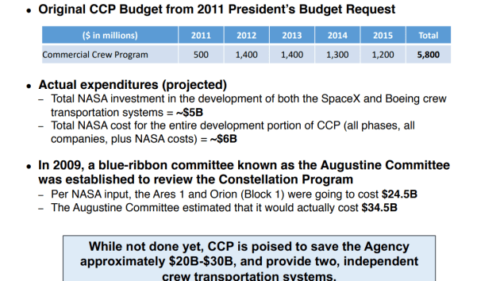
**** Commercial Crew was a huge bargain and Orion/SLS a boondoggle of historic proportions: NASA: SpaceX, Boeing building spacecraft for astronauts saved up to $30 billion – CNBC
**** Planet Labs takes advantage of Rideshare on Starlink launches: SkySats 16-21 to Launch on SpaceX Falcon 9 Rideshare Missions – Planet Lab
Planet is set to launch six more SkySat satellites (SkySats 16-21) into Low Earth Orbit this summer, rounding out the fleet of 15 SkySats already in operation.
SkySats 1-15 operate in Sun Synchronous Orbits, a specific type of Low Earth Orbit that results in the Earth’s surface always being illuminated by the Sun at the same angle when the satellite is capturing imagery. About half of the SkySats currently pass overhead in a morning crossing plane, while the other half moves in an afternoon crossing plane, so together they provide twice-daily coverage of select areas on a global scale. SkySats 16-21 will operate at a “mid-inclination” orbit of 53 degrees, complimenting the Sun Synchronous fleet, and will offer more targeted coverage and raw image capacity in key geographic regions.
The six SkySats will be evenly split across two launches on SpaceX’s Falcon 9, a two-stage reusable rocket that has successfully flown satellites and cargo over 80 times to orbit. They will do so as rideshare payloads on launches of SpaceX’s Starlink satellites.
SkySats 16-18 will launch on SpaceX’s ninth Starlink mission, targeted for launch in the next month, and SkySats 19-21 will launch later this summer. Both missions will launch from Cape Canaveral Air Force Base in Florida.
The launch of SkySats 16-21, as well as the development of our enhanced 50 cm imagery (to be made available to customers this year)—are just some examples of Planet’s continuously evolving industry-leading geospatial offerings. Stay tuned to the Pulse blog for more launch and product updates in the coming months.
See also:
- SpaceX Starlink launches to debut rideshare capabilities next month – Teslarati
- Planet Labs SkySats to rideshare with SpaceX Starlink launches – NASASpaceFlight.com
**** Each generation of SpaceX rockets pushes the technology to the next level: Technology Progress = Iterations Times Progress Between Iterations – NextBigFuture.com
Elon Musk has noted that progress in any given technology is simply # of iterations * progress between iterations. SpaceX has successfully completed six major iterations and is on its seventh rocket version iteration. SpaceX has existed for eighteen years and has shortened its development time from six years to about two years.
This is why SpaceX is crushing all of its competitors like United Launch Alliance, China, Russia, Ariane and Blue Origin.
**** Starship
****** SpaceX continues to maintain a very high level of activity at Boca Chica Beach. The Raptor engine used during test firings last week was removed from the SN4 Starship prototype. A subsequent pressure test on the SN4 using cryogenic propellants successfully reached 7.5 atmospheres, which should provide sufficient margin for uncrewed test flights. (8.5 atm will need to be reached to provide the safety margin desired for crew flights.) A different Raptor engine was then installed on SN4. Test firings are expected to start within a day or two. If these go well, there could be a 150 meter hop a few days after that.
This diagram for the cryogenic tank tests shows the liquid methane fuel in green and the liquid oxygen in blue:
Let’s clear some misconceptions:
chilly exterior: cold(er than air) gas inside
chilly with condensation on bottom: very little cryo liquid inside (common before static fires)
frosty walls: filled with cryo liquid (up to the frost lines. happens during cryo proof and actual WDRs) pic.twitter.com/Fz3seKp3mW— Rafael Adamy (@fael097) May 9, 2020
Meanwhile, the SN5 is nearly fully stacked. It’s expected that it will get a nosecone on top and the reentry fins on the side. Assuming it passes tank pressure and engine test firing tests with three engines installed, the SN5 might launch to as high as 20 km. SpaceX’s first high-flying, triple-Raptor Starship is almost finished – Teslarati.
Oh and SN5’s tanks section is finally fully stacked🚀Although saying “fully” is kinda dicey now since it’s supposed to have a nosecone, eventually🤔Good thing they’re not in a hurry with all the SN4 testing ahead😅
📸 by @BocaChicaGal for @NASASpaceflight https://t.co/5qC0eR4RpF pic.twitter.com/Ah3zwzJnHd— Rafael Adamy (@fael097) May 13, 2020
Components for SN6 are also in production. Each prototype is expected to have improvements and enhancements over the previous one. Eventually, a SN# will go to orbit and then attempt a reentry and landing.
SN6 gets a pointy end🚀 …maybe? Well we can’t know for sure which nosecone each SN will get, but I’ll assign the latest nose to the latest SN until we know better. This is Nosecone #4 by the way.
📸 by @BocaChicaGal for @NASASpaceflight https://t.co/5qC0eR4RpF pic.twitter.com/ex9oGFjCT4— Rafael Adamy (@fael097) May 12, 2020
Here are Elon’s goals for transport costs once operational Starships are flying:
Starship + Super Heavy propellant mass is 4800 tons (78% O2 & 22% CH4). I think we can get propellant cost down to ~$100/ton in volume, so ~$500k/flight. With high flight rate, probably below $1.5M fully burdened cost for 150 tons to orbit or ~$10/kg.
— Elon Musk (@elonmusk) May 8, 2020
Would be about 10 times that cost for payload to surface of Mars
— Elon Musk (@elonmusk) May 8, 2020
***** Views of Boca Chica activities:
****** May 7: Starship SN-4 Slow Motion 4K Static Fire [May 7, 2020] – Everyday Astronaut on Youtube
SpaceX successfully static fired their Starship SN-4 prototype using fuel from the header tank (secondary smaller tank inside the main tank). Everything looked good and SpaceX will continue to push to prepare for the 150m hop of this vehicle. Thanks to Rachel and Gene from @SPadre [@ spacepadreisle on twitter] for shooting this for us!
****** May 8: SpaceX Releases Massive LN2 Possible Cryo Test Abort – LabPadre – YouTube
05.09.2020 After an initial possible ambient test. SpaceX unexpectedly released a massive amount of LN2 from the tank farm. Some are speculating that a valve may have ruptured. Waiting on Elon’s response. All images are explicitly owned by LabPadre Media.
****** May 9: SpaceX Boca Chica – Full Drive-Past Entire Facility – NASASpaceflight – YouTube
Mary takes you on an updated drive past the growing facility at SpaceX Boca Chica, from the launch site to the production facility. Very useful to get one’s bearings. No fancy editing or timelapse, just a fateful of Boca Chica, which most of you will appreciate! Video from Mary (@BocaChicaGal)
****** May 10: 4K SpaceX Starship SN4 Passes Cryo Test! – LabPadre – YouTube
05.09.2020 A 4K segment of SpaceX Boca Chica crossing another milestone with Starship SN4 passing a cryogenic pressure test at 7.5 Bar according to Elon Musk on Twitter. At this point in the test the top starts to frost rather quickly. All images are explicitly owned by LabPadre Media.
****** May 11: SpaceX Boca Chica – Raptor delivery for Starship SN4 ahead of 150 meter hop – NASASpaceflight – YouTube
A new Raptor engine for Starship SN4 has arrived at SpaceX’s Boca Chica launch site ahead of the final static fire test, set for no earlier than Tuesday. If all goes well with the static fire, SN4 is expected to hop to 150 meters. Video and Photos from Mary (@BocaChicaGal). Edited by Jack Beyer (@thejackbeyer).
****** May 11: SpaceX Boca Chica – Starship SN4, 5, 6 and Nosecones Everywhere – NASASpaceflight – YouTube
As Starship SN4 prepares for another Static Fire test, SN5 is in the VAB and SN6 sections wait their turn at SpaceX Boca Chica. Meanwhile, yet another new nosecone has been spotted. Video and Photos from Mary (@BocaChicaGal).
****** May 12: SpaceX Boca Chica – Starship SN5 Stacked – NASASpaceflight – YouTube
Another Starship is born at SpaceX Boca Chica as SN5 is stacked inside the High Bay. Meanwhile, SN4 is in final preparations for a Static Fire test with the SN20 Raptor on Wednesday. Video and Photos from Mary (@BocaChicaGal). Edited by Jack Beyer (@thejackbeyer).
** May 14: SpaceX Boca Chica – Final preps underway ahead of Starship SN4’s third static fire – NASASpaceflight – YouTube
Final preparations were underway at SpaceX’s Boca Chica launch site on Wednesday ahead of the third Raptor static fire on Starship SN4. The static fire is slated to occur on Thursday afternoon. Video and Photos from Mary (@BocaChicaGal). Edited by Jack Beyer (@thejackbeyer).
** Webcast rocket reports:
**** SpaceX Starship SN4 Prepares for flight, Crew Dragon Demo 2 & Crew-1 updates, Chinese Long March 5B – Marcus House
Starship completed its static fires with the SN4 Starship and we are looking onwards now to the potential 150 metre flight test. The SN5 and SN6 Starship continues construction as well so loads going on again in BocaChica Texas. More news, talks, and footage related to the first crewed flight for SpaceX coming up in a few weeks with the Crew Dragon Demo 2 mission including a great talk from Gwynne Shotwell. This week also saw the first successful flight of the Chinese Long March 5B heavy-lift rocket. Then a few other great little snippets of news as well.
**** SpaceX Starship Updates – A History Of Starship Evolution – What about it!?
**** SpaceX Starship Updates – NASA Perseverance Rover Getting Ready For Mars – What about it!?
== Amazon Ad ==