A sampling of recent articles, videos, and images dealing with space transport (find previous roundups here):
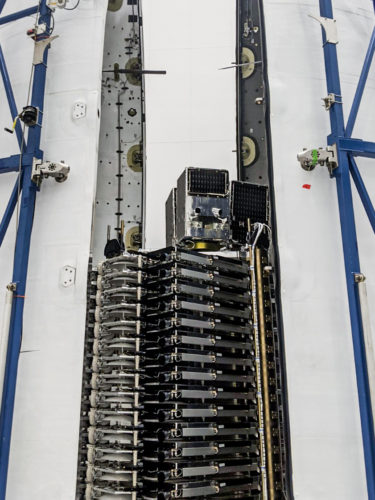
** SpaceX launches Starlink and Planet SkyNet satellites. Early Saturday morning, SpaceX launched a Falcon 9 from Cape Canaveral for the second time in June with a batch of satellites for the Starlink broadband Internet constellation. Rather than the usual 60 satellites, however, this flight carried 58 Starlinks, leaving out two to provide room for three SkyNet earth observation satellites from Planet Labs and their deployment mechanism. Not long after the upper stage reached orbit, the three SkySats could be seen drifting away during the live webcast. The subsequent deployment of the Starlinks took place during a communications gap. The Starlinks will use their onboard propulsion systems to reach their final operating orbits.
- SkySats 16-18 Successfully Launch Aboard the SpaceX Falcon 9 – Planet
- SpaceX launches first Starlink rideshare mission with Planet Labs – NASASpaceFlight.com
- SpaceX’s predawn Starlink satellite launch looks simply spectacular in these Twitter photos | Space.com
A view of the Starlink and SkySat satellites before being enclosed in the nosecone fairings:
A view of the launch from outside of the Cape: SpaceX-Starlink 8 Launch-Landing Burn 06-13-2020 – USLaunchReport:
The booster returned to Port Canveral this morning:
Spacex 3x recycled booster arriving @PortCanaveral @jettypark this morning 7am from starlink launch Jun 13 pic.twitter.com/4naAr9EMF3
— Ken Kremer (@ken_kremer) June 16, 2020
Time lapse: SpaceX’s “Of Course I Still Love You” droneship docks at Port Canaveral today following Saturday’s Falcon 9 launch of 58 Starlink satellites and three Planet Labs earth observation satellites.
Lots of cool stuff to observe in this video!
🎥: Me for @SuperclusterHQ pic.twitter.com/f6hHKyxLHG
— John Kraus 🚀 (@johnkrausphotos) June 16, 2020
The nosecone fairings on this launch had flown previously. They were recovered intact from the ocean and could conceivably fly on third launch: SpaceX’s next rocket fairing reuse milestone within reach after latest recovery – Telsarati.
Both fairings seem to be in good shape. Let’s see how they look once the tarps are lifted. #SpaceX pic.twitter.com/7NTTXAcRgX
— Matt (@Booster_Buddies) June 14, 2020
[ Update: Elon Musk comments on the fairings:
Fairing reuse is looking good
— Elon Musk (@elonmusk) June 16, 2020
]
Find more about other SpaceX activities below.
** Rocket Lab sent five smallsats to orbit on the 12th Electron launch from New Zealand just past midnight on Saturday morning US Eastern time. The payload included three test smallsats for NRO, the auroral plasma science ANDESITE 6U CubeSat built by students at Boston University , and the M2 Pathfinder communications test satellite from University of New South Wales campus at Canberra in Australia.
- SpaceX launches first Starlink rideshare mission with Planet Labs – NASASpaceFlight.com
- University-built CubeSat launched with swarm of auroral science nodes – Spaceflight Now
** Rocket Lab sets July 3rd for next Electron launch, three weeks after the mission described above: Rocket Lab to Demonstrate Fastest Launch Turnaround to Date | Rocket Lab
The mission, ‘Pics Or It Didn’t Happen,’ is scheduled to launch from Rocket Lab Launch Complex 1 Pad A on New Zealand’s Māhia Peninsula no earlier than 3 July, 2020 UTC— just days after the successful launch of Rocket Lab’s most recent mission, ‘Don’t Stop Me Now,’ on 13 June, 2020 UTC. The back-to-back missions will represent Rocket Lab’s fastest turnaround between missions to date.
‘Pics Or It Didn’t Happen’ will deploy seven small satellites to a 500km circular low Earth orbit for a range of customers, including Spaceflight Inc.’s customer Canon Electronics, as well as Planet and In-Space Missions.
The primary payload aboard this mission, Canon Electronics Inc.’s CE-SAT-IB, was procured by satellite rideshare and mission management provider Spaceflight Inc. The mission objective for the CE-SAT-IB satellite is to demonstrate Canon Electronics Inc.’s Earth-imaging technology with high-resolution and wide-angle cameras, as well as test the microsatellite for mass production.
The next five spacecrafts manifested for this mission are the latest generation of SuperDove satellites manufactured by Planet, operator of the world’s largest constellation of Earth-observation satellites. Planet’s satellites are capable of imaging the Earth’s entire landmass on a near-daily basis. This unprecedented dataset helps researchers, students, businesses and governments discover patterns, detect early signals of change, and make timely, informed decisions. These five SuperDoves, Flock 4v, are equipped with new sensors to enable higher image quality with sharper, more vibrant colors and accurate surface reflectance values for advanced algorithms and time-series analysis.
The final spacecraft aboard Electron for this mission has been supplied by British small mission prime, In-Space Missions. The Faraday-1 6U CubeSat is a hosted payload mission providing a low-cost route to orbit for start-ups, institutions, and large corporate R&D groups. In addition, it provides a first flight demonstration of In-Space’s own software-defined payload that will enable uploadable payload capabilities on future missions. Faraday-1 is the first flight of the Faraday service with four future satellites already under contract.
** China sends an ocean observation satellite into orbit on a Long March 2C rocket: China successfully launches new ocean observation satellite – Xinhua
China successfully sent an ocean observation satellite into orbit from the Taiyuan Satellite Launch Center in north China’s Shanxi Province on Thursday.
A Long March-2C rocket, carrying the satellite HY-1D, lifted off at 2:31 a.m. (Beijing Time), according to the China National Space Administration (CNSA).
The new satellite will form China’s first satellite constellation for marine civil service together with HY-1C, which was launched in September 2018, and double the current ocean observation data, according to CNSA and the Ministry of Natural Resources.
See also Long March 2C lofts Haiyang-1D – NASASpaceFlight.com.
** Interstellar Technologies of Japan tried to reach suborbital space (100km) last Saturday with a MOMO sounding rocket. The MOMO-5 rocket lifted off and for 30 seconds or so the flight appeared to go well but then there was then a flash and spark-like debris was seen in the plume. The nozzle came apart. Nevertheless, the vehicle continued upward for another 40 seconds and then began to tumble. The engine was shut off remotely and the vehicle fell into the sea about 4 miles offshore from the launch pad.
The rocket reached an altitude of about 11.5 kilometers. Surprisingly low considering how long the engine fired before the fault occurred. Other than the nozzle failure, all the other systems performed well. According to posts on the company’s Twitter account, another vehicle is already under construction.
More info at:
As its name suggests, Momo-F5 is the fifth sounding rocket built by Interstellar Technologies, which aims to build affordable rockets to “make space more accessible,” according to a statement. It stands 32 feet (10 meters) tall and weighs about 1 metric ton. The company has launched one successful mission, the Momo-F3 rocket flight of May 2019, out of its five to date.
Interstellar Technologies used the Campfire crowdfunding site to raise $391,000 (42 million yen) for the Momo-F5 launch, well above the mission’s goal of nearly $84,000 (9 million yen). The mission was named for the book “Poupelle of Chimney Town” by Akihiro Nishino.
- Launch results of “Pupel MOMO Unit 5 in Entotsu Town” – CAMPFIRE – Crowdfunding site for the company.
- Japanese startup’s rocket launch fails | NHK WORLD-JAPAN News
- Japanese startup’s rocket launch fails over engine problem – Xinhua | English.news.cn
- Interstellar Technologies’ privately-developed MOMO-5 rocket falls short of reaching space – TechCrunch.com
Early shutdown.⁰MOMO-F5 was shut down earlier than planned by the abort command.
The vehicle had safely splashdowned to ocean.
Detailed announcements will be given after further investigation.#PoupelleOfChimneyTownMOMOF5#InterstellarTechnologies— インターステラテクノロジズ/なつのロケット団 (@natsuroke) June 13, 2020
MOMO5号機 打ち上げ後に緊急停止https://t.co/IlJcRH6MUf pic.twitter.com/vFV55tk5k9
— 十勝毎日新聞電子版 (@kachimai_denshi) June 13, 2020
** Astra will try again this July to launch a rocket to orbit from the Alaskan launch facility on Kodiak Island. San Francisco startup Astra is going for its first orbital rocket launch in July – CNBC.
Mark your calendars! @Astra is planning their next orbital attempt for July 20th from Pacific Spaceport Complex – Alaska!
Hopefully this time it’s slightly warmer than in February for the sake of the launch team. Godspeed Rocket 3.0! pic.twitter.com/GFkevZbBoH
— Brady Kenniston (@TheFavoritist) June 16, 2020
Astra has announced the opening of their next launch window from Kodiak, Alaska: July 20th!
I’m happy to share I’ll be back to photograph the company’s first orbital launch attempt.
Let’s look at some previously-unreleased images I captured for Astra earlier this year: pic.twitter.com/JfIf47q1xX
— John Kraus 🚀 (@johnkrausphotos) June 16, 2020
— Astra (@Astra) June 16, 2020
** Briefs:
- The US military is getting serious about nuclear thermal propulsion | Ars Technica
- Rocket Report: Brazil opens equatorial launch site, Kerbal launch slips | Ars Technica
- China’s experimental manned spaceship’s return capsule shown to public – CGTN
- Space news: Manned space travel from Britain in two years says UKSpace chief – Express.co.uk
- First launch of Russia’s upgraded Rokot-M carrier rocket planned for 2022 – Science & Space – TASS
- Rosatom considers inappropriate purchase of Sea Launch – RIA Novosti, 06.16.2020 (Google translation)
- Review: Chasing the Dream – The Space Review
==================
Check out the
The Lurio Report
for news and analysis of key developments in NewSpace
The latest issue:
Riding a Dragon, Rockets Rising, Space Resource Policy
Vol. 15, No. 4, June 14, 2020
Space Frontier Foundation Award for NewSpace Journalism
==================
** SpaceX:
**** The Director General of Roscosmos not thrilled with SpaceX success in launching crew to the ISS and taking commercial satellites to GEO:
This English translation of Dmitry Rogozin’s comments on Crew Dragon is something. My favorite part is his comparison of Soyuz to Renaissance artists. “In the same manner the paintings by Leonardo da Vinci, Michelangelo, and Titian are priceless…”https://t.co/B48S4zIzYA
— Eric Berger (@SciGuySpace) June 10, 2020
Responses to Rogozin plus comments on the Raptor engine:
- Elon Musk: “Quite a piece! I should credit Soviet/Russian engine work in the 80’s as being a factor in deciding to switch from H2 to CH4. They demonstrated excellent performance on test stands, with Isp up to 380 secs.”
- Elon Musk “Combined with SpaceX deep subcooling of propellants to near liquefaction temp of N2, use of common dome (CH4 & O2 liquid at similar temps) & higher T/W of engines enables de facto higher delta-V than an H2/O2 stage”.
- Just a Tinker: “Folks don’t realize the mass penalty using hydrogen as rocket fuel. The Space Shuttle’s External Tank carried about four time the volume of liquid hydrogen than its liquid oxygen. Hydrogen is light but takes room that equates to larger tanks. Liquid methane takes much less room.“
- Elon Musk: “Also, insulation of a deep cryogen ( which I’d call anything that liquifies nitrogen aka 78% of air) is heavy & prone to heat leaks. H2 is hell.“
- Everyday Astronaut: “I know you’d never add unecessary complexity in the manufacturing line, but I’m still surprised you never made a closed cycle Merlin Vacuum to get closer to that 380 mark. Especially with SpaceX’s experience with ox rich preburners now with Raptor Rocket“.
- Elon Musk: “We could never reach 380 Isp with RP/kerosene. CH4 has higher Isp potential on paper, but even better in practice. With CH4, you can reach >99% of max theoretical combustion efficiency, but RP is ~97% on a good day & requires desooting of turbines between flights.”
- Elon Musk: “Important technical note: due to higher O/F of CH4 vs RP1 (oxygen is dense) & significant density increase of subcooled CH4 (plus no common dome insulation needed), plus cryo strength bump of CH4, tank mass of CH4/O2 stage is almost same as RP1/O2.“
- Everyday Astronaut: “So now that Raptor’s been pushed through its paces and more and more in actual production, how’s it looking? Manage any full duration tests yet? Re-firing / re-using looking better than Merlin yet?“
- Nick Wijngaards: “I’m curious to see new test footage or specs improvements of the raptor engine. SN1 vs SN20 Rocket“
- Elon Musk: “Hundreds of improvements in manufacturability primarily (this is by far the hardest problem), mass down, thrust up, Isp up. Current improvement list continues past SN50. As the saying goes, it’s 1% inspiration & 99% perspiration …”
- James Tyrrell: “We’re on SN5/6/7 and there are plans continuing past SN50!! well.. holy shit.“
- Elon Musk: “Actually, we’re on SN30 for Raptor.“
- Everyday Astronaut: “Some day can we get a video compilation, “How not to run a full flow staged combustion engine” like the booster landing montage. Face with tears of joy I’ll bet there’s some speculat failures when pushing Raptor, that would be an amazing video“
- Elon Musk: “Sure. That’s long montage.“
**** Amazing Camera Views From Inside SpaceX Rocket Fairings – Scott Manley
On Tuesday a great video was posted from the fairing of a SpaceX rocket carrying a payload of Starlink Satellites. It was one of the best looks at the interior of the fairings which are practically independent spacecraft able to control their entry & descent to steer their way to a rendezvous with the recovery vessels.
**** Major upgrades planned for the McGregor test facility: SpaceX pursues local funding for $10 million upgrade to McGregor plant – wacotrib.com
The rocket company launched by billionaire Elon Musk will spend $10 million on infrastructure improvements at its rocket-testing facility in McGregor. The upgrades will include “noise suppressors,” which should prove welcome to those within earshot of SpaceX’s rumbling, window-rattling rehearsals.
Waco City Council and McLennan County Commissioners Court will vote Tuesday on sending SpaceX $2 million from the Waco-McLennan County Economic Development Corp. fund, with each entity allocating $1 million.
**A cool view of the separation of the booster from the upper stage and of the booster using its thrusters to reorient itself for its return for landing:
Falcon 9 MECO and first stage boost back burn (CRS-19) pic.twitter.com/91Mxqta9IX
— TJ Cooney 🚀 (@TJ_Cooney) June 16, 2020
****** Labeled SN7 by observers, a shortened version of a Starship tank was moved to the launch area at Boca Chica Beach last week. (A similar shortened tank named SN2 was pressure tested back in March to check wielding techniques.) On Monday the tank was pressured tested until it failed. A rupture was much less dramatic than previous failures in which parts and metal were hurled about.
Elon said the test results were positive:
Tank didn’t burst, but leaked at 7.6 bar. This is a good result & supports idea of 304L stainless being better than 301. We’re developing our own alloy to take this even further. Leak before burst is highly desirable.
— Elon Musk (@elonmusk) June 15, 2020
****** The full scale Starship prototype SN5 is expected to roll out to the pad area in a few days. It will mount on a new stand that’s nearly complete. The previous stand was destroyed by a fiery explosion when methane fuel ignited after leaking from a failed disconnect mechanism at the base of the SN4 vehicle. A ram mechanism has been installed in the stand for pushing on the bottom of the tank. This presumably simulates the stresses on the tanks during a launch to orbit. Arocket’s tank must deal not only with the internal pressure of the propellant but also the increase in the propellant’s effective “weight” as the rocket accelerates.
The original plan was for SN4 to do a low altitude hop powered by its single Raptor engine. SN5 would then do higher altitude flights using 3 Raptors. The presumption of observers is that SN5 will still get 3 Raptors despite SN4’s destruction before it had a chance to fly.
Assembly of prototype Starships SN6 is also nearly complete. See videos below for views of the construction of the Starship prototypes.
****** Elon Musk has indicated that launches of the huge Starship/Super Heavy booster combo will most likely require an offshore facility due to safety issues and loudness. It appears the preparations for development of such a facility are underway:
SpaceX is hiring for Offshore Operations Engineers in Brownsville.
From the post: “Work as part of a team of engineers and technicians to design and build an operational offshore rocket launch facility”
With thanks to @CowboyDanPaasch for the scoop.https://t.co/S0i8BM04KL
— Gavin – SpaceXFleet.com (@SpaceXFleet) June 16, 2020
****** June 11: SpaceX Boca Chica – 304L Starship Sections Appear as Roll Lift Rides In – NASASpaceflight – YouTube
Lots of pre-rollout preps ongoing at SpaceX Boca Chica for SN5 and SN7 test tank as more Starship Sections – made from the new 304L Steel rings – appear at the production facility. Video and Pictures from the awesome Mary (@bocachicagal).
June 12: Starship SN7 Tank Rollout – SPadre – YouTube
June 14: SpaceX Boca Chica – Starship SN6 Stacking as SN5 heads outside. – NASASpaceflight – YouTube
With SN7 Test Tank at the launch site, Two “Grown Up” Starships – SN5 (now outside of the High Bay) and SN6 – (into final stacking) are preparing for the test campaigns. Video and Photos from Mary (@BocaChicaGal) – Edited by Jack Beyer (@thejackbeyer)
June 16: SpaceX Boca Chica – SN7 test tank reaches 7.6 bar during pressure test. – NASASpaceflight – YouTube
The SN7 test tank reached 7.6 bar during pressure testing to failure, per SpaceX CEO Elon Musk. With some improvements, Musk expects the next test tank to be able to achieve even higher pressures. Video and Pictures from Mary (@bocachicagal). Edited by (@thejackbeyer)
** Webcast rocket reports:
**** SpaceX Starship is now the top priority, Crew Dragon updates, Starlink launch with Planet rideshare – Marcus House
** SpaceX Starship Updates – Super Heavy Preparations – What about it!?
Today we will take a first look at SpaceX’s preparations for the largest booster Rocket ever built. Super Heavy. We will recap everything, that’s happened since the last Episode, look at the latest Starship Prototype progress, look into what Elon Musk had to say and last but not least, take a look at possibly the first efforts of getting infrastructure in place to support Super Heavy.
=====
=== Space Art from C. Sergent Lindsey ===