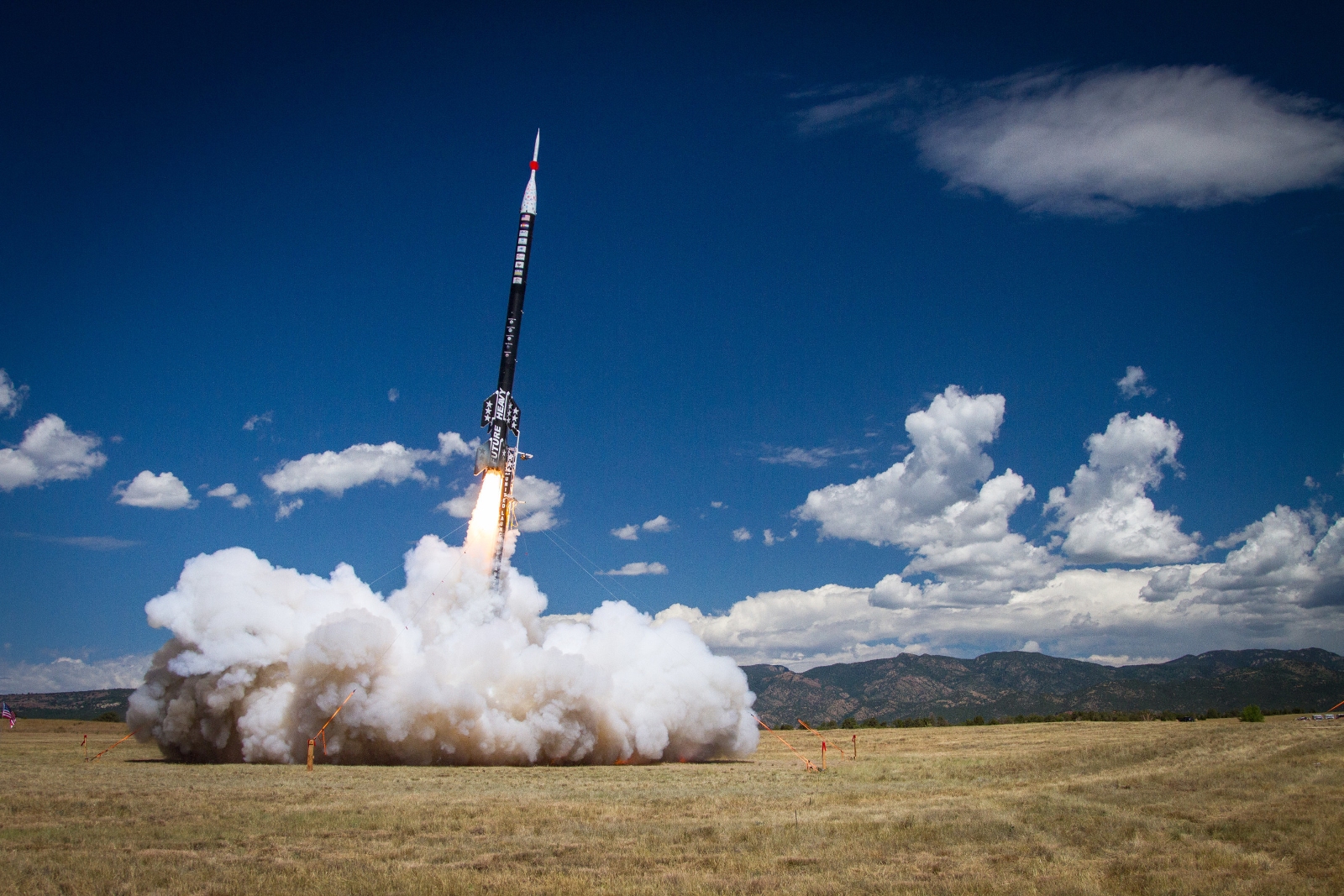
On Sunday, interns at United Launch Alliance (ULA) and Ball Aerospace in Colorado flew a 50 foot (15.24 m) rocket that they built this summer. The “Future Heavy” rocket carried 16 payloads developed by interns and students as well.
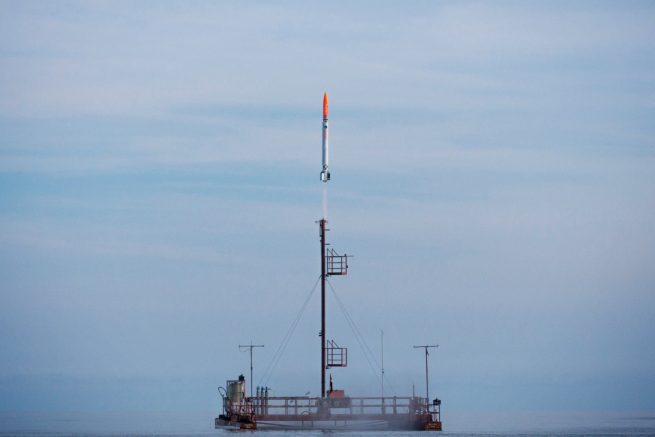
Yesterday Copenhagen Suborbitals launched their rocket Nexø I, their most advanced vehicle yet, from a floating platform in the Baltic Sea. (See earlier posting). The good news is that the rocket lifted off successfully with its liquid-fueled engine (Ethanol and Liquid Oxygen) and active guidance system and was successfully recovered. The bad news is that it failed to reach its planned altitude and the parachute system failed to open: The Nexø I rocket launched – Copenhagen Suborbitals –
It was a beautiful launch with a not so great landing. The rocket flew to about 1514 meters before a catastrophic failure occurred.
Even though it didn’t go completely as planed we still see it as a partially success. A lot of sub systems actually work as they should.
We managed to recover the rocket. We will therefore have a good chance of finding the root cause of the failure.
We will post more about the launch and crash after we have had a closer look at the rocket and telemetry data.
Here is a video of the webcast. The countdown to liftoff starts at the 3 hr 20 min 8 sec mark:
We have not yet had opportunity to examine data, parts or footage.
A tentative speculation on root cause would be simple LOX [Liquid Oxygen] overload. In other words a problem with measuring the correct amount of LOX in the tank, which we have encountered previously, and worked on solving via several methods. We will look into this.
Too much LOX will result in a too small gas pocket in the tank – which equals too little gas propellant energy and a premature loss of tank pressure in the LOX tank, again resulting in an increasing O/F-ratio mismatch. The engine subsequently extinguished.
The GNC didn’t detect acceleration below minimum, as this detection was removed from the algorithm prior to the mission, based on the fact that the acceleration, through the use of pressure blow-down at relatively low altitude, would be very low before the occurrence of MECO.
The GNC instead used the chamber pressure. This was low at an unusually early time. The GNC treated this as a sensor failure, and instead an estimated pressure, based on a table generated from earlier tests, was used.
Thus the GNC didn’t signal the deployment of the parachute, as it was under the (false) impression that the engine was still operating as expected.
SpaceX successfully launched a Dragon Cargo vehicle on a Falcon 9 rocket late Sunday night. The Dragon reached the Int. Space Station this morning and berthed to it. The first stage of the Falcon 9 returned for a landing a few minutes after liftoff. Below are videos of the F9 launch, the booster landing, and the Dragon rendezvous and berthing.
And two videos of the first stage booster landing:
The Dragon approaches the ISS:
And astronauts on the station reach out and grab the Dragon with the station’s robotic arm and bring it in for attachment to a port:
This Saturday Copenhagen Suborbitals will attempt to launch its most ambitious rocket. The Nexø I uses a liquid propellant engine and an active guidance system. Find updates and webcast info at The Nexø I Mission.
Here is the press release:
Danish amateur rocket builders launch their most advanced rocket yet.
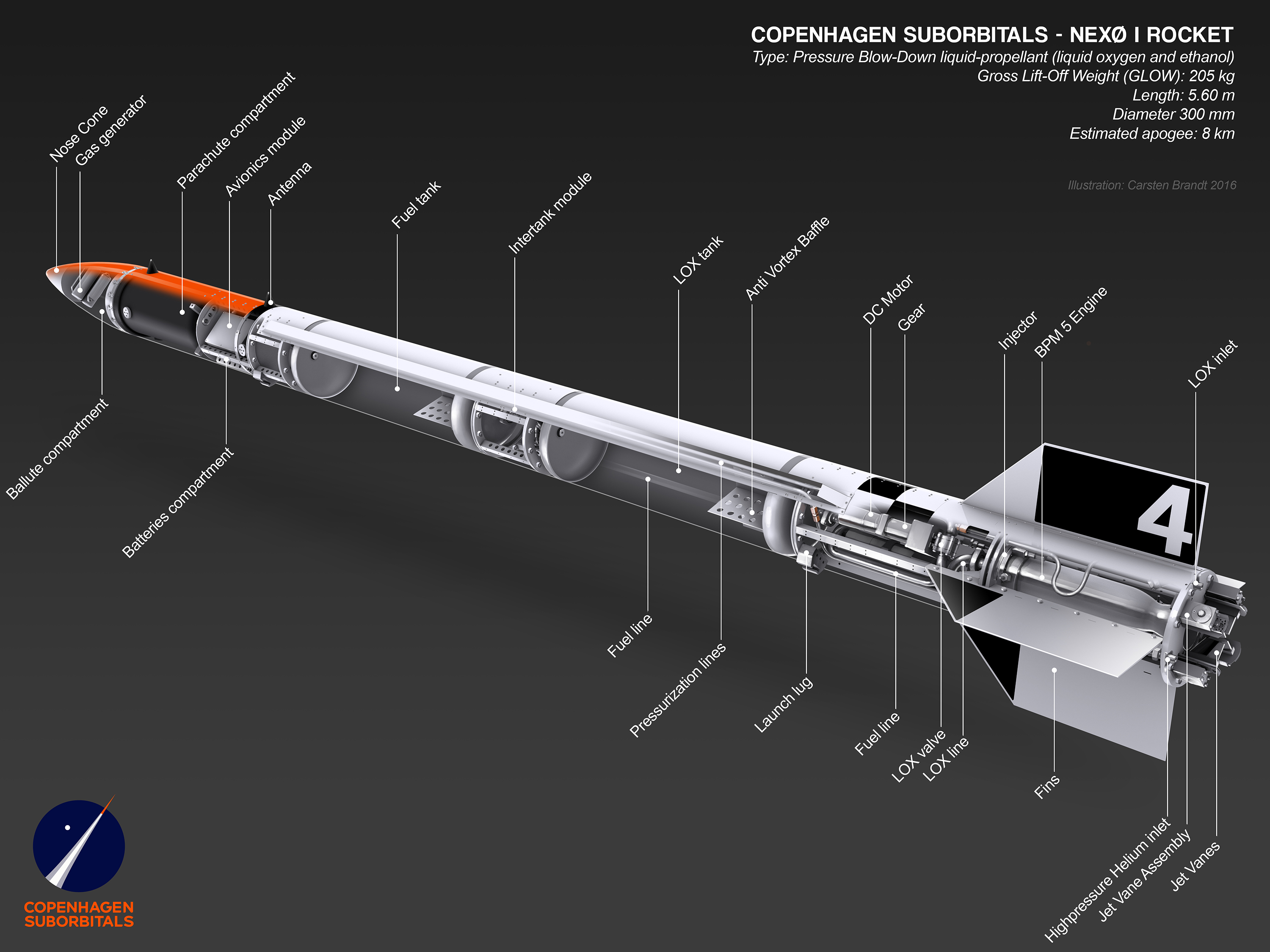
Nexø I on it’s launch rail onboard MLP Sputnik, seen at the Sea Acceptance Test (SAT) recently in the Copenhagen harbour. Click to enlarge.This summer, Copenhagen Suborbitals are launching the Nexø I rocket, as the next step towards their goal of flying an amateur astronaut into space. The rocket is the first of the Nexø Class to fly, named after the city of Nexø on the Bornholm island that hosts the Danish spaceport. Standing 5,6 m tall, Nexø I is the first, fully guided and liquid fuelled rocket built by the group. Launched from the Mobile launch platform Sputnik on the Baltic Sea east of Denmark, it can fly up to 6-10 km before landing back in the ocean by parachute.
“These days everyone is working around the clock to make the mission happen” says Kristian Elof Sørensen, Chairman of Copenhagen Suborbitals. “Nexø I is the most advanced rocket we have ever built, and a successful mission this year is important for our effort to build a rocket big enough to put a man in space.”
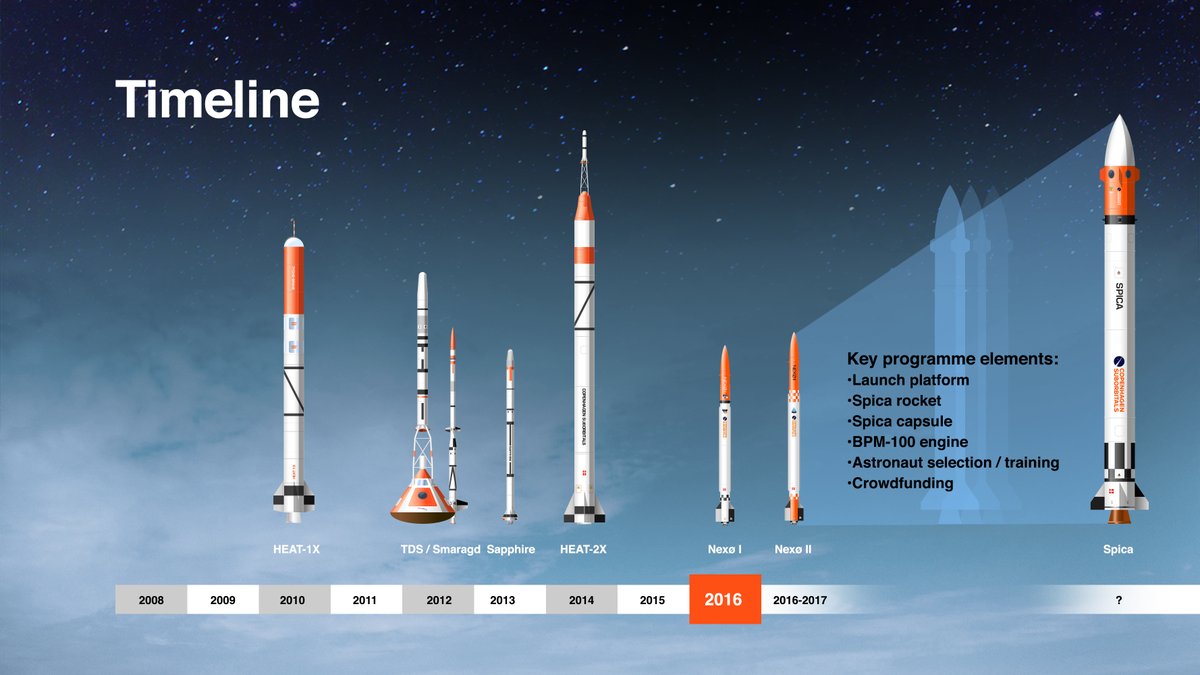
Copenhagen Suborbitals have built and launched rockets from Denmark since 2011, when their HEAT-1X made headlines as the biggest, amateur rocket ever flown. The group is the world’s only manned, amateur space programme, with 55 volunteers building rockets and space capsules in a central copenhagen workshop, all completely crowdfunded.
“Nexø I will not fly into space, but the technologies we are testing are the same needed to build our manned rocket, Spica” says Kristian Elof Sørensen. “The Spica rocket is so big that it makes sense to build smaller rockets first to test the subsystems on a smaller scale.”
Infographic showing Spaceport Nexø on the island of Bornholm, the launch site EDS139, and some of the mission ships. Click to enlargeThe flight will happen between July 23rd and September 1st, with the actual date depending on weather conditions. The first possible launch window is Saturday july 23rd. “The rocket is ready, so we are now following the weather forecasts very closely. We need a calm day and waves under 0.5 meters in the Baltic sea for the launch” says Kristian Elof Sørensen
Read more – and see the launch live at: copsub.com
Timeline of past, present, and future Copenhagen Suborbitals rockets. Click for larger image.
For the first time Blue Origin will be webcasting one of their experimental vehicle launches. This got us to thinking, what have they been working on in the past and what does that mean for the future of Blue Origin? Will they be heading to the Moon? Mars? Or just playing catchup to SpaceX? To be clear, this is all speculation and guesses. What do you think?
Space news topics discussed:
* China launches another Beidou Navigation Satellite * SpaceX launches, but fails to land * Gravitational Waves Detected from Second Pair of Coalescing Black Holes * Blue Origin to Webcast New Shepard Flight on Sunday Morning * The Return of Antares has slipped to August * Soyuz TMA-19M lands
TMRO is viewer supported:
TMRO Live is a crowd funded show. If you like this episode consider contributing to help us to continue to improve. Head over to http://www.patreon.com/tmro for information, goals and reward levels. Don’t forget to check out our SpacePod campaign as well over at http://www.patreon.com/spacepod
Here is a video of today’s flight of the Blue Origin New Shepard rocket vehicle:
And the full webcast video (broadcast starts at around 27 minutes into the video and liftoff firing starts at 1:03:10):
![0-3[1]](http://hobbyspace.com/Blog/wp-content/uploads/2016/07/0-31.jpeg)
![DSC06426[1]](http://hobbyspace.com/Blog/wp-content/uploads/2016/07/DSC064261.jpg)
![nexøflightevents[1]](http://copenhagensuborbitals.com//wp_blog/wp_content/uploads/2016/07/nex%C3%B8flightevents.jpg)