All posts by TopSpacer

ESO: Exquisite views of a star cluster with new camera on the Very Large Telescope

A new report from ESO (European Southern Observatory
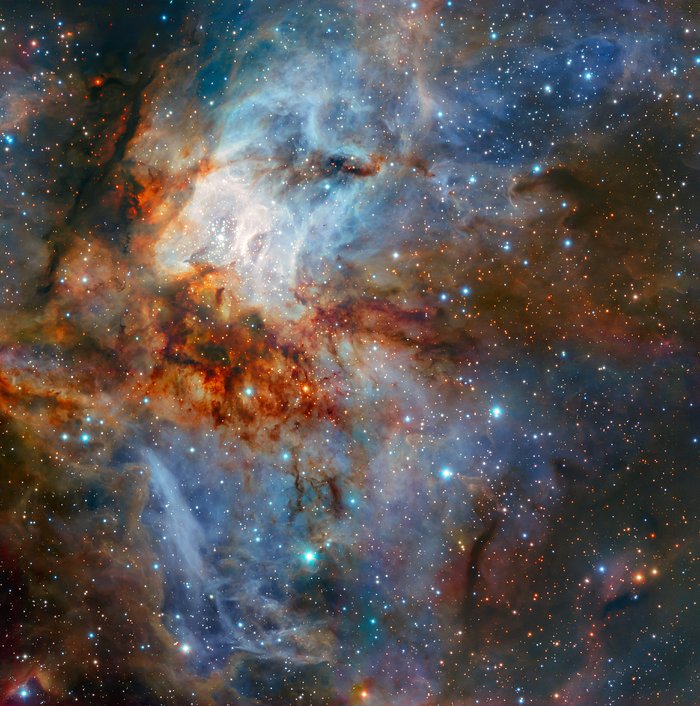
Colourful Celestial Landscape 

New observations with ESO’s Very Large Telescope show the star cluster RCW 38 in all its glory. This image was taken during testing of the HAWK-I camera with the GRAAL adaptive optics system. It shows the cluster and its surrounding clouds of brightly glowing gas in exquisite detail, with dark tendrils of dust threading through the bright core of this young gathering of stars. [Higher res images]
New observations with ESO’s Very Large Telescope show the star cluster RCW 38 in all its glory. This image was taken during testing of the HAWK-I camera with the GRAAL adaptive optics system. It shows RCW 38 and its surrounding clouds of brightly glowing gas in exquisite detail, with dark tendrils of dust threading through the bright core of this young gathering of stars.

This image shows the star cluster RCW 38, as captured by the HAWK-I infrared imager mounted on ESO’s Very Large Telescope (VLT) in Chile. By gazing into infrared wavelengths, HAWK-I can examine dust-shrouded star clusters like RCW 38, providing an unparalleled view of the stars forming within. This cluster contains hundreds of young, hot, massive stars, and lies some 5500 light-years away in the constellation of Vela (The Sails).

The central area of RCW 38 is visible here as a bright, blue-tinted region, an area inhabited by numerous very young stars and protostars that are still in the process of forming. The intense radiation pouring out from these newly born stars causes the surrounding gas to glow brightly. This is in stark contrast to the streams of cooler cosmic dust winding through the region, which glow gently in dark shades of red and orange. The contrast creates this spectacular scene — a piece of celestial artwork.
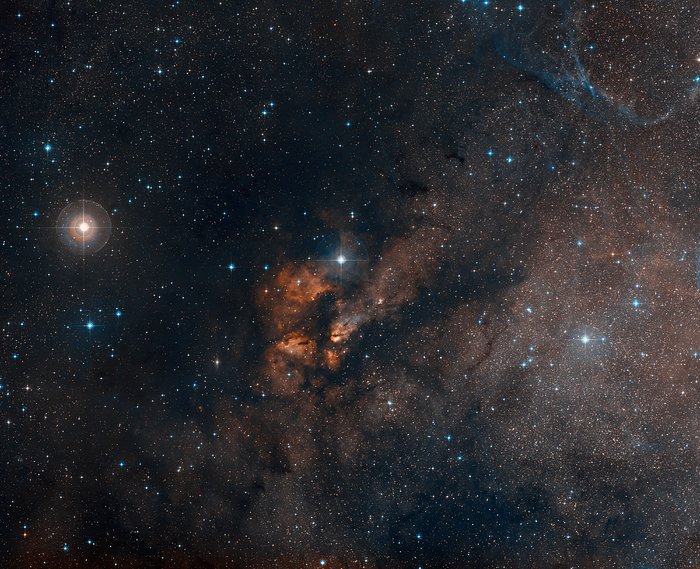
This image is a colour composite made from exposures from the Digitized Sky Survey 2 (DSS2). The field of view is approximatelly 2.4 x 2.0 degrees. [Higher-res images]
Previous images of this region taken in optical wavelengths are strikingly different — optical images appear emptier of stars due to dust and gas blocking our view of the cluster. Observations in the infrared, however, allow us to peer through the dust that obscures the view in the optical and delve into the heart of this star cluster.

HAWK-I is installed on Unit Telescope 4 (Yepun) of the VLT, and operates at near-infrared wavelengths. It has many scientific roles, including obtaining images of nearby galaxies or large nebulae as well as individual stars and exoplanets. GRAAL is an adaptive optics module which helps HAWK-I to produce these spectacular images. It makes use of four laser beams projected into the night sky, which act as artificial reference stars, used to correct for the effects of atmospheric turbulence — providing a sharper image.

This image was captured as part of a series of test observations — a process known as science verification — for HAWK-I and GRAAL. These tests are an integral part of the commissioning of a new instrument on the VLT, and include a set of typical scientific observations that verify and demonstrate the capabilities of the new instrument.

====
 

Video: Robert Picardo talks with Amy Mainzer about protecting earth from asteroids & comets

Robert Picardo of The Planetary Post and Dr. Amy Mainzer from NASA JPL and deputy manager for the NEOWISE Project

discuss our efforts to look for asteroids and comets near Earth and how we plan to deflect the dangerous ones that could come our way.

====


The Space Show this week – July.9.2018

The guests and topics of discussion on The Space Show this week:

1. SPECIAL TIME: Monday, July 9, 2018; 7-8:30 pm PDT; 9-10:30 pm CDT; 10-11:30 pm EDT: We welcome Dr. Steven Abood of Florida International University (FIU) regarding his work on sex on Mars and reproduction. See his paper [Futures-Mars.pdf] on our blog.

2. Tuesday, July 10, 2018: 7-8:30 pm PDT; 9-10:30 pm CDT; 10-11:30 pm EDT: We welcome back Dr. Doug Plata  for news and updates.

3. Wednesday, July 11, 2018: Hotel Mars. See Upcoming Show Menu and the website newsletter for details. Hotel Mars is pre-recorded by John Batchelor. It is archived on The Space Show site after John posts it on his website.

4. Friday, July 13, 2018; 9:30 am – 11 pm PDT, (12:30 – 2 am EDT; 11:30 am -1 pm CDT): We welcome back Laura Montgomery, Atty. to discuss new space property rights ideas and more.

5. Sunday, July 15, 2018: 12-1:30 pm PDT; 2-3:30 pm CDT; 3-4:30 pm EDT. We welcome Dr. Julian Nott from UCSB regarding Titan.

See also:
* The Space Show on Vimeo – webinar videos
* The Space Show’s Blog – summaries of interviews.
* The Space Show Classroom Blog – tutorial programs

The Space Show is a project of the One Giant Leap Foundation.

The Space Show - David Livingston
David Livingston

====


Video: TMRO Orbit 11.27 – “Creating a Starship Culture with Gateway Foundation”

The latest episode of TMRO.tv Space program is now available on line: Creating a Starship Culture with Gateway Foundation – Orbit 11.27 – TMRO

John Blincow and Dr. Tom Spilker join us to talk about the Gateway Foundation and their plans to design, test and build the Gateway Spaceport. If you’re interested in helping volunteer your time and talents to making the Gateway real, head over to https://gatewayspaceport.com for more information

The Space News topics presented:

An Eruptive Enigma Solved on Mars
Kepler In Safe Mode
A Generic Headline Concerning A Study Confirming Uranus’ Formation But The Headline Is Devoid Of The Obvious Joke
More Hope for Life on Other Worlds

====


Audio: Hear the radio emissions of Saturn and its moon Enceladus

Check out the exotic sounds of Saturn as derived from the radio transmissions generated by waves in the plasma (ionized particles) between Saturn and the rings and the satellite Enceladus:

Listen: Electromagnetic Energy of Saturn, Enceladus

New research from NASA’s Cassini spacecraft’s up-close Grand Finale orbits shows a surprisingly powerful and dynamic interaction of plasma waves moving from Saturn to its rings and its moon Enceladus. The observations show for the first time that the waves travel on magnetic field lines connecting Saturn directly to Enceladus. The field lines are like an electrical circuit between the two bodies, with energy flowing back and forth.

Researchers converted the recording of plasma waves into a “whooshing” audio file that we can hear — in the same way a radio translates electromagnetic waves into music. In other words, Cassini detected electromagnetic waves in the audio frequency range — and on the ground, we can amplify and play those signals through a speaker. The recording time was compressed from 16 minutes to 28.5 seconds.

Much like air or water, plasma (the fourth state of matter) generates waves to carry energy. The Radio Plasma Wave Science (RPWS) instrument on board NASA’s Cassini spacecraft recorded intense plasma waves during one of its closest encounters to Saturn.

“Enceladus is this little generator going around Saturn, and we know it is a continuous source of energy,” said Ali Sulaiman, planetary scientist at the University of Iowa, Iowa City, and a member of the RPWS team. “Now we find that Saturn responds by launching signals in the form of plasma waves, through the circuit of magnetic field lines connecting it to Enceladus hundreds of thousands of miles away.”

Sulaiman is lead author of a pair of papers describing the findings, published recently in Geophysical Research Letters.

The interaction of Saturn and Enceladus is different from the relationship of Earth and its Moon. Enceladus is immersed in Saturn’s magnetic field and is geologically active, emitting plumes of water vapor that become ionized and fill the environment around Saturn. Our own Moon does not interact in the same way with Earth. Similar interactions take place between Saturn and its rings, as they are also very dynamic.

The recording was captured Sept. 2, 2017, two weeks before Cassini was deliberately plunged into the atmosphere of Saturn. The recording was converted by the RPWS team at the University of Iowa, led by physicist and RPWS Principal Investigator Bill Kurth.

The GRL research is available on the American Geophysical Union’s website:

The Cassini-Huygens mission is a cooperative project of NASA, ESA (European Space Agency) and the Italian Space Agency. NASA’s Jet Propulsion Laboratory, a division of Caltech in Pasadena, manages the mission for NASA’s Science Mission Directorate, Washington. JPL designed, developed and assembled the Cassini orbiter. The RPWS instrument was built by the University of Iowa, working with team members from the U.S. and several European countries.

Gretchen McCartney
Jet Propulsion Laboratory, Pasadena, California
818-393-6215
Gretchen.P.McCartney@jpl.nasa.gov

Dwayne Brown / JoAnna Wendel
NASA Headquarters, Washington
202-358-1726 / 202-358-1003
dwayne.c.brown@nasa.gov / joanna.r.wendel@nasa.gov

=====