1. Monday, July 20, 2020; 7 pm PDT (9 pm CDT, 10 pm EDT: We welcome Rand Simberg back for Evoloterra and Apollo 11 on the 51st anniversary of going to the Moon.
2. Tuesday, July 21, 2020; 7 pm PDT (9 pm CDT, 10 pm EDT): We welcome back Dr. Pat Patterson to tell us about the all virtual SmallSat Conference this year. Don’t miss it.
3. Wednesday, July 22, 2020: Hotel Mars TBA pre-recorded. See upcoming show menu on the home page for program details.
4. Thursday, July 23, 2020; 7-8:30 pm PDT (9-10:30 pm CDT, 10-11:30 pm EDT): No special program today.
5. Friday, July 24, 2020; 9:30-11 am PDT (11:30 am-1 pm CDT, 12:30-2 pm EDT): We welcome back Steven Wolfe regarding the Beyond Earth Institute and space settlement important news.
**Sun. July.19.202 – Open lines program hosted a “discussion on a wide variety of topics with your phone calls. Robert Jacobson was back on and has set up another ebook give away program.”
A sampling of links to recent space policy, politics, and government (US and international) related space news and resource items that I found of interest (find previous space policy roundups here):
We speak with Daniel Ceperley, CEO and Co-Founder of LeoLabs Space about the growing issue of space debris. Orbital debris is a serious issue that will only get worse, but dealing with it is as much an opportunity as a challenge. Daniel explains his goal to track the 12,000 known debris objects low earth orbit by building set of advanced radars and we discuss the possibility of long-term solutions to collision avoidance. Is there a future where satellites use radar to detect other objects and avoid collision? Listen to this episode of Constellations to learn how today’s visionaries, such as Daniel Ceperley of LeoLabs, are making space safer for the rest of us.
In this week’s Space Cafè WebTalk, Jenni Tapio, Chief Specialist in the Ministry of Economic Affairs and Employment of Finland talked about the implementation of national space laws on the example of Finland and beyond.
She discussed the example of the Finnish Act on Space Activities. What does a national space law mean for business opportunities? She also answered relevant questions from the audience.
7:58 pm EDT: The upper stage firing went as planned and the probe was successfully deployed. Communications with the vehicle have been established and the solar panels were deployed. The spacecraft’s next job is to use its attitude thrusters to orient itself so as to maximize power generation from the sun. The probe will reach Mars next February. After going into orbit, the spacecraft’s instruments will study the atmosphere and weather on the Red Planet.
6:31 pm EDT: The launch has succeeded so far in reaching low earth orbit. The upper stage with the probe is now in a coast period before the stage will fire its engine for 4 minutes to send the Hope probe on its route to Mars. The stage will then separate from the probe soon after the engine boost ends. The firing should start at around 6:54 pm EDT (22:54 UTC).
Here is the latest episode in NASA’s Space to Ground weekly report on activities related to the International Space Station:
** Down to Earth – Reach for the Stars – NASA Johnson
In celebration of the upcoming #SpaceStation20th anniversary, Spaceflight Participant Hazzaa Ali Almansoori from the United Arab Emirates, who recently flew in space with other International Astronauts, shares his thoughts on his journey to reach the stars and his perspective on the power of us all working together in space in this episode of Down to Earth – Reach for the Stars.
The two NASA astronauts completed all the work to replace batteries that provide power for the International Space Station’s solar arrays on the starboard truss of the complex. The new batteries provide an improved and more efficient power capacity for operations.
The spacewalkers removed six aging nickel-hydrogen batteries for the second of two power channels for the starboard 6 (S6) truss, installed three new lithium-ion batteries, and installed the three associated adapter plates that are used to complete the power circuit to the new batteries. Mission control reports that all three new batteries are working.
Behnken and Cassidy are scheduled to conduct one more spacewalk Tuesday, July 21, during which they will remove two lifting fixtures used for ground processing of the station’s solar arrays prior to their launch. They’ll also begin preparing the Tranquility module for the installation of a commercial airlock provided by NanoRacks and scheduled to arrive on a SpaceX cargo flight later this year. The airlock will be used to deploy commercial and government-sponsored experiments into space.
** Expedition 63 Inflight with US Ambassador to Russia on Apollo Soyuz 45th Anniversary – July 17, 2020 – NASA
Aboard the International Space Station, Expedition 63 Commander Chris Cassidy of NASA and Russian Flight Engineers Anatoly Ivanishin and Ivan Vagner of Roscosmos marked the 45th anniversary of the historic docking of an Apollo command module and a Soyuz spacecraft during an in-flight conversation July 17 with the U.S. Ambassador to Russia, John J. Sullivan and Vasily Boryak, the Deputy Director of the North American Division of the Russian Ministry of Foreign Affairs. The Apollo command module, with Tom Stafford, Vance Brand and Deke Slayton aboard and the Soyuz spacecraft with Alexey Leonov and Valery Kubasov, linked up on July 17, 1975, two days after their respective launches from the Kennedy Space Center, Florida and the Baikonur Cosmodrome in Kazakhstan to mark the beginning of the international cooperation between the United States and Russia that has been recognized as the springboard for the development and assembly of the International Space Station.
A sampling of recent articles, press releases, etc. related to student and amateur CubeSat / SmallSat projects and programs (find previous smallsat roundups here):
A pair of microsatellites were deployed into Earth orbit today outside Japan’s Kibo laboratory module. The Deformable Mirror CubeSat will demonstrate the performance of a tiny but powerful exo-planet telescope. The TechEdSat-10 CubeSat will test returning small payloads safely into Earth’s atmosphere.
The CubeSats were launched to the ISS on a Northrop-Grumman Antares rocket in a Cygnus cargo vehicle on February 15th of this year.
TechEdSat-10 is the latest CubeSat sponsored by the NASA Ames Technology Education Satellite (TechEdSat) program. This spacecraft was developed in collaboration with student teams at San Jose State University and the University of Idaho. The primary goal of the mission is to test technologies for low cost return of small payloads from orbit. The CubeSat will deploy a Exo-Brake, which is
a tension-based, flexible braking device resembling a cross-parachute that deploys from the rear of a satellite to increase the drag. It is a de-orbit device that replaces the more complicated rocket-based systems that would normally be employed during the de-orbit phase of re-entry.
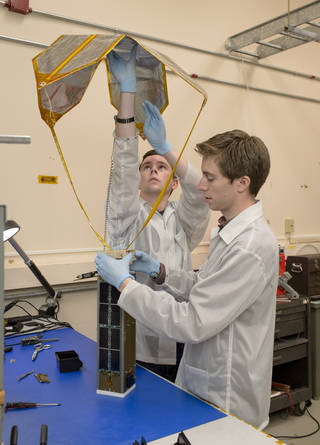
An Exo-Brake is a parachute-like apparatus deployed from a spacecraft to increase drag in the very thin atmosphere of low earth orbit. The increased drag will hasten the satellite’s reentry. This photo shows an Exo-Brake being packed into TechEdSat-5. Credits: ASA Ames/Dominic Hart
The TecEdSat-10 mission will
… further develop the tension-based drag device (an ‘Exo-Brake’) and demonstrate frequent uplink/downlink control capability. In addition, the Exo-Brake is modulated in order to change the drag profile and then permit, for the first time, a targeting experiment. TechEdSat-10 is sized at a scale of 3 m, which permits re-entry within 4 weeks at a ßof ~5 kg/m2. Understanding the thermophysics of such a device permits it to be scaled for larger payloads and re-entry within 1.5 days.
Targeting would allow the brake to return a payload to a specific area for ease of recovery.
The Deformable Mirror CubeSat (DeMi) project is an MIT project sponsored by DARPA. Deformable mirrors are used in ground-based telescopes to cancel out distortions in stellar images caused by variations in atmospheric density, temperature, etc. For observatories in orbit, there is no atmosphere to deal with but there are various structural and optical flaws, small strains from temperature changes, etc. The goal for this mission is to demonstrate that such imperfections can be compensated for with a deformable mirror in a space telescope.
In order to image an Earth-like planet, an exoplanet direct imaging system needs to achieve a contrast ratio of 1 × 10E−10. Even with adaptive optics on a large ground-based telescope, it is currently not possible to overcome the effects from atmospheric turbulence to achieve the high contrast needed to obtain high-resolution spectra of an Earth-like exoplanet. While a space telescope does not have to overcome the effects of atmospheric turbulence, achieving a clear image usually comes at the expense of smaller aperture size (e.g., due to launch cost and launch vehicle limitations). The performance of a space telescope will still suffer from optical imperfections, thermal distortions, and diffraction that will corrupt the wavefront, create speckles, and ruin the contrast. High actuator-count deformable mirrors have the authority to correct high spatial frequency aberrations that would otherwise degrade the contrast in these conditions.
Deformable Mirror CubeSat (DeMi) serves as an on-orbit testbed for a MEMS deformable mirror. The baseline deformable mirror payload architecture incorporates a Shack-Hartmann wavefront sensor for mirror characterization as well as a focal plane sensor for correcting an image of an external object. DeMi characterizes the on-orbit performance of a 140 actuator MEMS deformable mirror with 5.5 μm maximum stroke. The goal is to measure individual actuator wavefront displacement contributions to a precision of 12 nm. …
The ultimate goal is to enable space telescopes to image exoplanets directly:
Current space telescopes have limited ability to detect and distinguish small, dim objects such as exoplanets that are next to large, bright objects such as stars. MEMS deformable mirror technology can improve the imaging capabilities of future space telescopes.
Aurora Flight Sciences is managing the project and Blue Canyon Technologies built the spacecraft.
AMSAT-DL Proposes LunART – Luna Amateur Radio Transponder
Buffalo Soldiers Special Event on the Satellites
Hamfests, Conventions, Maker Faires, and Other Events
Upcoming Satellite Operations
Upcoming ARISS Contacts
Satellite Shorts from All Over
** AMSAT arose from the HAM radio community and many educational and science related smallsats use amateur radio bands for communications. This article doesn’t include anything on AMSAT or amateur radio via satellites but it does give a good overview of the state of amateur radio globally: The Uncertain Future of Ham Radio – IEEE Spectrum.
** Building a CubeSat for less than $1000 — Part 3 — Avionics Schematic – Third episode in a series from RG SAT on how to build a low cost CubeSat.
Today I cover the schematic I created for the Avionics board of the Cubesat. The Avionics board essentially serves as the main computer for the Cubesat, including control of the Attitude Control System, and radio communications.
A World CanSat/Rocketry Championship (hereinafter: WCRC) is generally an international competition open to elite competitors from around the world, representing their nations (as university student Teams or as independent student Teams), and winning this event will be considered the highest or near highest achievement in this field. The WCRC was formulated and negotiated among the Organizations from 6 countries: Serbia, India, Italy, Tunisia, Canada, and Peru (hereinafter: Founders) from October.
CubeSats are miniature satellites typically deployed into low earth orbit. A standard 1U CubeSat is a cube ten centimeters on a side. Here, I tracked three different CubeSats on the night of 6/17 at our dark site observatory. Tracking is performed blind, meaning there is no optical assist to help the telescope point to the target. These videos are shot using a Celestron RASA 11 telescope and the ZWO ASI 6200 mono camera, operated in 8 bit video mode, quarter frame size, 100ms exposure. That video is further cropped here to make it easier to find the satellite.
** Dove Satellite – Observing Earth With A Cubesat –
I paid a visit to Planet, they’re one of my ‘neighbours’ in San Francisco’s SOMA district. Their business is planetary imaging and they’ve launched over 100 Dove Cubesats which are built around the largest possible camera you can fit in a cubesat.
The challenge: Build and launch a pair of cube satellites on a tight budget and even tighter timeline. Here is how Aerospace engineers designed the Aerospace Rogue Alpha/Beta CubeSats as pathfinders for studying rapid reconstitution.