** What’s Up: August 2020 Skywatching Tips from NASA
What are some skywatching highlights in August 2020? See the Moon posing with various planets throughout the month, plus catch the peak of the annual Perseid meteor shower. Additional information about topics covered in this episode of What’s Up, along with still images from the video, and the video transcript, are available at https://solarsystem.nasa.gov/whats-up….
In August, a flock of star-studded figures soars overhead. Look for the Vega and Lyra constellations, which point to Epsilon Lyrae and the Ring Nebula. You can also spot three bright summer stars: Vega, Deneb, and Altair, which form the Summer Triangle. Keep watching for space-based views of these and other stars and nebulas.
** What’s in the Night Sky August 2020 #WITNS Comet NEOWISE | Perseid Meteor Shower – Alyn Wallace
** What to see in the night sky, August 2020
What can you see in the night sky? Astronomers Pete Lawrence and Paul Abel reveal their stargazing tips for August 2020. In 2020 we’re celebrating 15 years of our Virtual Planetarium. Discover more here: https://www.skyatnightmagazine.com/sp...
1. Monday, August 3, 2020; 7 pm PDT (9 pm CDT, 10 pm EDT: No special programming.
2. Tuesday, August 4, 2020; 7 pm PDT (9 pm CDT, 10 pm EDT): We welcome back John Strickland for space settlement and new commercial space project ideas.
3. Wednesday, August 5, 2020: Hotel Mars TBA pre-recorded. See upcoming show menu on the home page for program details.
4. Thursday, August 6, 2020; 7-8:30 pm PDT (9-10:30 pm CDT, 10-11:30 pm EDT): No special programming.
5. Friday, August 7, 2020; 9:30-11 am PDT (11:30 am-1 pm CDT, 12:30-2 pm EDT): We welcome back Mark Bray to discuss SLS and more.
6. Sunday, August 9, 2020; 12-1:30 pm PDT (3-4:30 pm EDT, 2-3:30 pm CDT): Welcome to OPEN LINES. All calls on space, technology, science and STEM welcome. We want to hear from you.
** Fri. July 31, 2020 – Scott Herman discussed the BlackSky Global earth satellite imaging company and “Geospatial intelligence and global monitoring, dusk-to-dawn capabilities, LEO Constellation, commercial value, market growth, national security and much more”.
A sampling of links to recent space policy, politics, and government (US and international) related space news and resource items that I found of interest (find previous space policy roundups here):
** Unleashing the Power of Geospatial Intelligence, Lessons Learned from the Government and Turning… – Constellations Podcast
On this episode of the Constellations podcast we will discuss harnessing the power of geospatial intelligence (GEOINT) by moving beyond data silos and integrating, fusing and analyzing data horizontally to deliver new insights. The podcast reviews GEOINTs historical roots, the evolution today across industries and looks to the future. With more remote sensing satellites, more rapid revisits and global coverage – an enormous volume of data is being created today. There is a daunting challenge in terms of archiving, processing and analyzing all that data and turning it into insights.
As the founder and early adopter of the concept of GEOINT, the government has been on the front lines for over a decade. What lessons can be learned from the government’s efforts that can be applied to today’s new technologies and providers in the commercial sector to maximize the full value of geospatial intelligence? Keith Masback, a leading international authority on geospatial intelligence with over 30 years of experience will shed some light on this topic. Keith is the Owner and Principal Consultant at Plum Run and provides advisory and consulting services to leading-edge companies working in geospatial intelligence and related fields. Prior to founding Plum Run, he spent over a decade as the President / Chief Executive Officer of the United States Geospatial Intelligence Foundation.
** Ralph Dinsley – Moving Space Situational Awareness To Civilian Management – Cold Star Project S02E53
Following a three-and-a-half decade UK defense career culminating in managing RAF Fylingdales and in the role of Aerospace Battle Manager, Ralph “Dinz” Dinsley founded Northern Space and Security (NORSS). In this discussion with Cold Star Project host Jason Kanigan, Dinz lays out the case for moving space situational awareness from military to civilian management. Dinz answers:
– What is “Peace and Development”, the postgraduate studies subject you applied yourself to for your Masters degree? – What exactly is “Aerospace Battle Manager”, the role you held for a dozen years? – What would you describe as the main reason behind the establishment of NORSS? What problems do you solve, and for what organizations? – Is the military dominance coverage of the orbital environment still fit for purpose? Under what domain should space traffic management be? – What is the Space Law Games, which you co-initiated? What do you hope to discover from the exercise? – Where do you find yourself getting pulled into discussions as a well-known individual in the UK defense sector?
** The Space Show – Fri. July 31, 2020 – Scott Herman discussed the BlackSky Global earth satellite imaging company and “Geospatial intelligence and global monitoring, dusk-to-dawn capabilities, LEO Constellation, commercial value, market growth, national security and much more”.
A sampling of recent articles, press releases, etc. related to student and amateur CubeSat / SmallSat projects and programs (find previous smallsat roundups here):
** The annual Smallsat Conference hosted at Utah State University is on line this year due to the Covid-19 virus situation. Registration is free. Though the event is nominally August 1-6, there are dozens of videos of workshop and technical session presentations already on line.
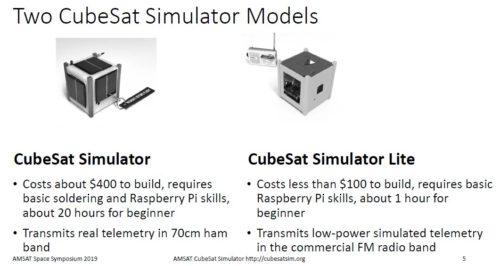
** Villanova University has a new student CubeSat Club. The group is starting out by running a locally developed CubeSat simulator, receiving signals from CubeSats in orbit, designing a test project for a high-altitude balloon flight, and more.
The club’s long-term goal involves a bigger leap: to design, build and launch an actual CubeSat—a 10-by-10-by-10-centimeter, lightweight nanosatellite that can be launched from a rocket, or put into orbit by astronauts on the ISS. But with design, equipment, programming, testing, and launch, CubeSat development can take several years and cost up to $100,000.
For now, club members are taking smaller steps towards their ultimate mission as they gain hands-on experience with satellite technology through a CubeSat simulator developed by faculty adviser Alan Johnston, PhD, associate teaching professor of Electrical and Computer Engineering. The low-cost simulator functions like a real CubeSat, with working solar panels and the capability to send telemetry to an antenna, making it an ideal learning tool.
Monitoring its Lindenblad antenna will keep Villanova’s CubeSat Club busy. First, they will design a payload to be launched into the stratosphere via a high-altitude balloon. If all goes well, the balloon’s telemetry will be detectable from the roof of Tolentine as it sails above Villanova. Also on tap is working with a project called AmbaSat-1: to program, launch and track a credit card-sized “sprite” satellite into low earth orbit.
** Student CubeSat project at the MIT Beaver Works Summer Institute. There are several CubeSat project videos available online. Here is a brief overview of the project that involved designing an system for imaging and tracking ocean plastic debris:
And here is an overview of the design that the students developed:
** AMSAT news on student and amateur CubeSat/smallsat projects:
Welcome to Week 2 of PLIX CubeSats Online! 🛰️ For the second session, we’ll be covering the Satellite Testing & Payload Integration workshop, which covers both satellite testing strategies and the incorporation of a data-collecting tool. Read more about the CubeSats activity on our PLIX Activity Repository: http://bit.ly/PLIX-CubeSats
Here is the latest episode in NASA’s Space to Ground weekly report on activities related to the International Space Station:
** Expedition 63 Demo 2 In flight Crew News Conference – July 31, 2020 – NASA Johnson
Aboard the International Space Station, Expedition 63 Commander Chris Cassidy of NASA and Flight Engineers Doug Hurley and Robert Behnken of NASA discussed the progress of their mission and preparations for the homecoming of the SpaceX Crew Dragon spacecraft during a crew news conference from orbit July 31. Hurley and Behnken are scheduled to return to Earth Aug. 2 aboard the Crew Dragon vehicle to wrap up an historic nine-week mission which was the first crewed flight on a privately owned spacecraft, while Cassidy is in the midst of a six-and-a-half month mission on the orbital complex.
** Expedition 63 In flight with EAA Young Eagles NASA ARMD – July 14, 2020
Aboard the International Space Station, Expedition 63 Flight Engineers Doug Hurley and Robert Behnken of NASA discussed life and work aboard the orbital laboratory July 14 as they answered pre-recorded questions from students involved with the Experimental Aircraft Association Young Eagles program. The group is associated with NASA’s Aeronautics Research Mission Directorate. Hurley and Behnken launched May 30 on the SpaceX Crew Dragon spacecraft to the station, inaugurating the era of commercial crew launch capability from U.S. soil on an American space vehicle. Hurley and Behnken plan to return to Earth in August on the Crew Dragon craft for the first parachute-assisted splashdown of U.S. astronauts since the Apollo-Soyuz mission 45 years ago.
** SpaceCast Weekly – July 31, 2020
SpaceCast Weekly is a NASA Television broadcast from the Johnson Space Center in Houston featuring stories about NASA’s work in human spaceflight, including the International Space Station and its crews and scientific research activities, and the development of Orion and the Space Launch System, the next generation American spacecraft being built to take humans farther into space than they’ve ever gone before.