A sampling of recent articles, videos, and images from space-related science news items (find previous roundups here):
Mars
** Monitor NASA’s Perseverance rover as it travels to Mars: Follow NASA’s Perseverance Rover in Real Time on Its Way to Mars
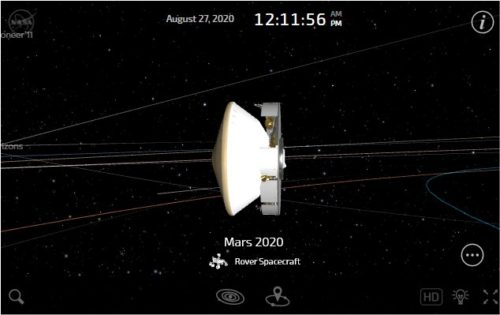
The last time we saw NASA’s Mars 2020 Perseverance rover mission was on July 30, 2020, as it disappeared into the black of deep space on a trajectory for Mars. But with NASA’s Eyes on the Solar System, you can follow in real time as humanity’s most sophisticated rover – and the Ingenuity Mars Helicopter traveling with it – treks millions of miles over the next six months to Jezero Crater.
“Eyes on the Solar System visualizes the same trajectory data that the navigation team uses to plot Perseverance’s course to Mars,” said Fernando Abilleira, the Mars 2020 mission design and navigation manager at NASA’s Jet Propulsion Laboratory in Southern California. “If you want to follow along with us on our journey, that’s the place to be.”
Eyes doesn’t just let you see the distance between the Red Planet and the spacecraft at this very moment. You can also fly formation with Mars 2020 or check the relative velocity between Mars and Earth or, say, the dwarf planet Pluto
** The UAE Hope mission takes a photo of Mars, where it will go into orbit in February: Mars ahead! UAE’s Hope spacecraft spots Red Planet for 1st time | Space.com
The Hope probe is officially 100 million km into its journey to the Red Planet. Mars, as demonstrated in the image captured by the probe’s Star Tracker, is ahead of us, leaving Saturn and Jupiter behind. The Hope probe is expected to arrive to Mars on February 2021. pic.twitter.com/Eg2pMerc78
— HH Sheikh Mohammed (@HHShkMohd) August 24, 2020
On August 17th, the first course correction for Hope was carried out successfully:
The #HopeProbe has successfully completed its first trajectory correction manoeuvre – a major milestone in its journey to #Mars. This marks the first firing of the probe’s six Delta-V thrusters, for course correction that will see the probe directly targeting Mars’ capture orbit. pic.twitter.com/fYRWunYFbM
— Hope Mars Mission (@HopeMarsMission) August 17, 2020
** A preview of where Perseverance will land and explore: Perseverance’s planned journey in Jezero Crater | Behind The Black
Getting to [its farthest goal] however is optimism in the extreme. The distance to it from the break in the canyon is actually longer than the distance from the landing ellipse to the rim. It will likely take most of the decade of the 2030s to reach this spot, which means Perseverance will have persevered on Mars for almost twenty years if it gets this far.
Let us hope that this rover is well named. Let us also hope that before it dies human beings will have also arrived on Mars, and will be able to come by to check on it. And if Perseverance is then still operational, scientists on Earth will finally be able to use it to snap a picture of life on Mars, even if that life came from Earth.
** Previewing Perseverance science by a panel at the SETI Institute:
The Mars 2020 Perseverance Rover successfully launched on July 30, 2020, is now en route toward Mars. The mission will pave the way for future human expeditions to Mars and demonstrates technologies that could be used by future Mars explorers.
** Much of the Mars landscape may have been carved by ice rather than flowing water: Early Mars was covered in ice sheets, not flowing rivers, new research shows | ASU Now
A large number of the valley networks scarring the surface of Mars were carved by water melting beneath glacial ice, not by free-flowing rivers as previously thought, according to new research published in Nature Geoscience. The findings effectively throw cold water on the dominant “warm and wet ancient Mars” hypothesis, which postulates that rivers, rainfall and oceans once existed on the red planet.
….
“Climate modelling predicts that Mars’ ancient climate was much cooler during the time of valley network formation,” said Grau Galofre. “We tried to put everything together and bring up a hypothesis that hadn’t really been considered: that channels and valleys networks can form under ice sheets, as part of the drainage system that forms naturally under an ice sheet when there’s water accumulated at the base.”
These environments would also support better survival conditions for possible ancient life on Mars. A sheet of ice would lend more protection and stability of underlying water, as well as provide shelter from solar radiation in the absence of a magnetic field — something Mars once had, but which disappeared billions of years ago.
** A tribute to spunky Opportunity: What the Martian surface looked like to Oppy – humanity’s most resilient rover | Aeon Videos
Using raw rover imagery and the sound of actual wind on Mars, I painted this little portrait of Opportunity, our faithful little martian rover friend that was lost earlier this year. Losing a rover feels a little like losing a pet. But for all that it accomplished, and for our ability to revel in all the awesome images it collected over its lifetime, its end is bittersweet. Oppy traveled 28 miles on Mars over a span of 14 years – an amazing feat of engineering and human ambition.
After sifting through thousands of raw Mars images for hours and hours, I have developed a strange sense of Mars as a real place I have been, riding alongside this little rover that could, making laps across rocky martian plains. My hope is this little portrait gives you a glimpse of that same feeling. Still can’t believe we put a vehicle on mars that lasted almost 15 years. I don’t even expect my car to run that long. Humans are pretty rad sometimes.
Created by John D. Boswell who posts videos under the name melodysheep.
** Mars avalanche – Capturing an Avalanche on Mars – NASA Image of the Day

** Update on the “Mars Mole” on the Insight lander and its attempts to dig deeper and reach the target depth to measure the ground temperature: Troubled Mars “Mole” – Going Underground – Leonard David
That troubled “Mole” heat probe on NASA’s InSight Mars mission is presently fully covered with Martian sand. The plan now calls for the Mole to be pushed a little deeper into the ground with the continued help of the spacecraft’s robotic scoop.
The save the Mole script calls for not pressing the Mole with the robotic arm’s blade, but with the shovel at an angle of 20 to 30 degrees with respect to the surface.
Lots more about the status of the from the German team that built and operates the Mole: Mars InSight mission: The Mole is ‘in’ and the ‘finishing touches’ are ‘in sight’ – DLR Blog- Aug.10.2020
As a supporting indication, I note that a recent measurement of the thermal conductance from the Mole to the regolith shows increased values over earlier measurements. This suggests that both the thermal and mechanical contact have improved. So we’re feeling optimistic!
** Leonard David also describes the Curiosity rover‘s roving:
- Curiosity Mars Rover: “We are ‘go’ for Drilling”
- Curiosity Mars Rover: Eying “Mary Anning 2” drill target
- Curiosity Mars Rover’s Wish List
- Curiosity Mars Rover: Weekend Plan
- Curiosity Mars Rover’s Bake-off!
- Curiosity Mars Rover: Drill Campaign
- Curiosity Mars Rover: Drill Results
- Curiosity Mars Rover: New Drilling Activities
** Curiosity spots a dust devil: Sols 2864-2866: Spot the Difference! – NASA’s Mars Exploration Program

** Tour more marvelous sites on the Martian surface with Bob Zimmerman
- The longest lava tube in the solar system?
- Collapsed Martian crater in glacier?
- Revisiting Mars’ glacier country
- Cracks and scallops on the lowland plains of Mars
- More glaciers and eroding gullies on Mars
- Wormlike glacier on Mars
- The colors of Mars
- Mars: On the floor of Valles Marineris
- Mars: A small volcano at the base of a big volcano
- Bottom edge of Martian glacier?
- Corroded Martian southern highlands
- Martian sand traps and elongated dunes
- The edge of Mars’ south polar layered cap
- Ascraeus Mons, Mars’ second highest mountain
- Slushy floor of southern Martian crater?
- The dry barren plains of Tyrrhena Terra
- Glacier country on Mars
- Martian eroding ridges amid brain terrain
Solar system
** Venus beckons for attention while Mars hogs funding for missions.
*** Venus: Earth’s Evil Twin or Just Misunderstood? A talk about Venus by NASA JPL geoscientist Sue Smrekar:
Venus is becoming more attractive to scientists as technology improves for sending spacecraft to survive orbit and even descend to the surface. From orbiters to balloons, we will talk about the great science that can be done, how we can do it and what we hope to learn. Host: Brian White
Co-Host: Lindsay McLaurin
*** Hotel Mars /The John Batchelor Show/The Space Show – John Batchelor and Dr. David Livingston talked with Dr. David Grinspoon about the discovery of 37 recently active volcanoes on Venus.
*** Rocket Lab is pursuing a privately funded project to send a small probe to Venus: Rocket Lab aims to launch private Venus mission in 2023 | Space.com
“I’m madly in love with Venus,” Rocket Lab founder and CEO Peter Beck said on Aug. 5 during a company update and Q&A session livestreamed on YouTube. “I’m working very hard to put together a private mission to go to Venus in 2023.”
** Latest on Pluto: Wed. Aug. 19, 2020 – Hotel Mars – John Batchelor Show/The Space Show – John Batchelor and David Livingston talked with Dr. Alan Stern about “the dark side of Pluto and what we know from the New Horizons spacecraft flyby of Pluto several years ago”.
** Jupiter: The Juno mission continues to study the biggest planet in the Solar System. Here is a recent posting from the Juno team with a dramatic visualization of a “simulated journey into one of Jupiter’s exotic high-altitude electrical storms”: ‘Shallow Lightning’ on Jupiter (NASA Visualization, ft. Music by Vangelis) | Mission Juno
This animation takes the viewer on a simulated journey into Jupiter’s exotic high-altitude electrical storms. Get an up-close view of Mission Juno’s newly discovered “shallow lighting” flashes and dive into the violent atmospheric jet of the Nautilus cloud. The smallest white “pop-up” clouds on top of the Nautilus are about 100 km across. The ride navigates through Jupiter’s towering thunderstorms, dodging the spray of ammonia-water rain, and shallow lighting flashes. At these altitudes — too cold for pure liquid water to exit – ammonia gas acts like an antifreeze that melts the water ice crystals flung up to these heights by Jupiter’s powerful storms – giving Jupiter an unexpected ammonia-water cloud that can electrify the sky. The animation was created by combining an image of high-altitude clouds from the JunoCam imager on NASA’s Juno spacecraft with a computer-generated animation.
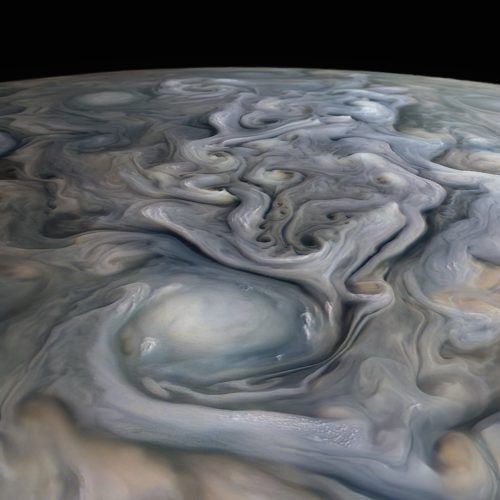
*** JunoCam : Processing | Mission Juno offers Juno images processed by citizen scientists into gorgeous works of art. For example, here is Jupiter, Perijove 26, Artificial Vertical Relief – Kevin M. McGill.
Sun
** The next solar cycle is beginning to show itself: Sunspot update: Hints of the next maximum | Behind The Black
[The SILSO sunspot number graph] shows the one weak sunspot at the beginning of the month and the two stronger sunspots late in the month. The first sunspot had a polarity linking it to the previous fading solar cycle, while the last two had polarities assigning them to the new solar cycle. This continues the trend of the past few months, where more and more new sunspots belong to the new cycle as the old cycle fades away.
** The Carrington Event was no ordinary coronal burst, but a similar gigantic solar storm could hit Earth at any time and should serve as a warning to prepare our electrical systems to withstand its effects: Carrington Event still provides warning of Sun’s potential 161 years later – NASASpaceFlight.com
When the CME arrived, the Kew Observatory’s magnetometer recorded the event as a magnetic crochet in the ionosphere. This observation, coupled with the solar flare, allowed Carrington to correctly draw the link — for the first time — between geomagnetic storms observed on Earth and the Sun’s activity.
Upon impact, telegraph systems across Europe and North America, which took the brunt of the impact, failed. In some cases, telegraphs provided electric shocks to operators; in other cases, their lines sparked in populated areas and — in places — started fires.
The event produced some of the brightest auroras ever recorded in history. People in New England were able to read the newspaper in the middle of the night without any additional light. Meanwhile, in Colorado, miners believed it was daybreak and began their morning routine.
The auroras were so strong they were clearly observed throughout the Caribbean, Mexico, Hawaii, southern Japan, southern China, and as far south as Colombia near the equator in South America and as far north as Queensland, Australia near the equator in the Southern Hemisphere.
Moon
** China’s Chang’e-4 lander and Yutu-2 rover just completed their 21st lunar day of activities on the Moon’s far side: Chinese lunar probe’s 600 days on Moon’s far side – ecns.cn
Last Tuesday was the 600th day of Chang’e-4 on the moon and the rover had traveled 519.29 meters.
The rover Yutu-2, or Jade Rabbit-2, has far exceeded its three-month design lifespan, becoming the longest-working lunar rover on the moon.
With the help of data transmitted to Earth, Chinese researchers have made progress in vital research such as the moon’s geological evolution, radiation and low-frequency radio environment.
** China aims to launch the Chang’e-5 lunar sample return mission by end of this year: China Farside Moon Mission; Next Up, Return Samples – Leonard David
… This ambitious venture is focused on collecting and returning lunar specimens back to Earth by robotic means – a task last done in 1976 by the former Soviet Union.
…
The former Soviet Union successfully executed three robotic sample return missions: Luna 16 returned a small sample (101 grams) from Mare Fecunditatis in September of 1970; February 1972, Luna 20 returned 55 grams of soil from the Apollonius highlands region; Luna 24 retrieved 170.1 grams of lunar samples from the Moon’s Mare Crisium (Sea of Crisis) for return to Earth in August 1976.
…
Reportedly, the Chinese mission will retrieve and return to Earth up to 4.4 pounds (2 kilograms) of lunar surface and subsurface samples.
The Chang’e-5 mission is comprised of four parts: the orbiter, lander, ascender, and Earth reentry module containing the lunar collectibles.
** Some lunar polar water ice could be affected by exhaust from landers: Cautionary Warning: Moon Landers and Contamination of Lunar Polar Ice – Leonard David
Follow-up work should include measuring the amount of exhaust that’s around the Moon during and after future landings, Prem said, which would help narrow in on an answer to how much these exhaust gases “stick” to the surface. “But I would also suggest that modeling and monitoring the fate of exhaust gases should be a routine part of lunar mission development and planning.”
“Whether we intend to or not, we’re going to do this experiment of bringing exhaust gases with us,” Prem said.
It’s now a matter of deciding how we deal with them.
** Asteroids and Comets
** OSIRIS-REx probe nearly ready for a sample retrieval from the surface of the asteroid Bennu after two practice runs:
- Second Rehearsal Puts OSIRIS-REx on a Path to Sample Collection | NASA
- OSIRIS-REx is One Rehearsal Away from Touching Asteroid Bennu | NASA
During the final practice run, the spacecraft reached
an approximate altitude of 131 feet (40 meters) over sample site Nightingale before executing a back-away burn. Nightingale, OSIRIS-REx’s primary sample collection site, is located within a crater in Bennu’s northern hemisphere.
The approximately four-hour “Matchpoint” rehearsal took the spacecraft through the first three of the sampling sequence’s four maneuvers: the orbit departure burn, the “Checkpoint” burn and the Matchpoint burn. Checkpoint is the point where the spacecraft autonomously checks its position and velocity before adjusting its trajectory down toward the event’s third maneuver. Matchpoint is the moment when the spacecraft matches Bennu’s rotation in order to fly in tandem with the asteroid surface, directly above the sample site, before touching down on the targeted spot.
Four hours after departing its 0.6-mile (1-km) safe-home orbit, OSIRIS-REx performed the Checkpoint maneuver at an approximate altitude of 410 feet (125 meters) above Bennu’s surface. From there, the spacecraft continued to descend for another eight minutes to perform the Matchpoint burn. After descending on this new trajectory for another three minutes, the spacecraft reached an altitude of approximately 131 ft (40 m) – the closest the spacecraft has ever been to Bennu – and then performed a back-away burn to complete the rehearsal.
During the rehearsal, the spacecraft successfully deployed its sampling arm, the Touch-And-Go Sample Acquisition Mechanism (TAGSAM), from its folded, parked position out to the sample collection configuration. Additionally, some of the spacecraft’s instruments collected science and navigation images and made spectrometry observations of the sample site, as will occur during the sample collection event. These images and science data were downlinked to Earth after the event’s conclusion.
The following video shows a time lapse of images over a 13.5-minute period during the practice run on August 11th:
The imaging sequence begins at approximately 420 feet (128 meters) above the surface – before the spacecraft executes the “Checkpoint” maneuver – and runs through to the “Matchpoint” maneuver, with the last image taken approximately 144 feet (44 meters) above the surface of Bennu. The spacecraft’s sampling arm – called the Touch-And-Go Sample Acquisition Mechanism (TAGSAM) – is visible in the lower part of the frame. Credits: NASA/Goddard/University of Arizona
The first actual collection attempt is currently scheduled for October 20th
During this event, OSIRIS-REx’s sampling mechanism will touch Bennu’s surface for several seconds, fire a charge of pressurized nitrogen to disturb the surface and collect a sample before the spacecraft backs away. The spacecraft is scheduled to return the sample to Earth on Sept. 24, 2023.
** Update on the Lucy Mission, “The First Mission to Jupiter’s Trojan Asteroids”– Lucy One Step Closer to Exploring the Trojan Asteroids – NASA
… The Discovery Program’s Lucy mission passed a critical milestone and is officially authorized to transition to its next phase.
This major decision was made after a series of independent reviews of the status of the spacecraft, instruments, schedule and budget. The milestone, known as Key Decision Point-D (KDP-D), represents the official transition from the mission’s development stage to delivery of components, testing, assembly and integration leading to launch. During this part of the mission’s life cycle, known as Phase D, the spacecraft bus (the structure that will carry the science instruments) is completed, the instruments are integrated into the spacecraft and tested, and the spacecraft is shipped to NASA’s Kennedy Space Center in Florida for integration with the launch vehicle.
“Each phase of the mission is more exciting than the last,” says Lucy Principal Investigator Hal Levison of Southwest Research Institute in Boulder, CO. “While, of course, Lucy still has several years and a few billion miles to go before we reach our real goal – exploring the never-before-seen Trojan asteroids – seeing this spacecraft come together is just incredible.”
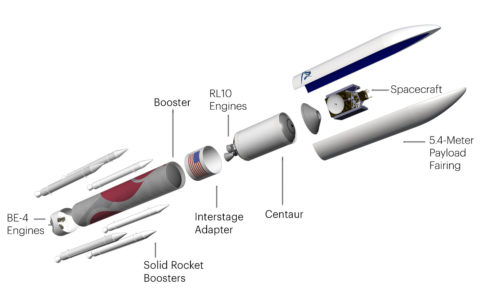
A ULA Atlas V rocket is scheduled to launch the Lucy spacecraft in late October 2021. Here is an overview of the mission:
Launching in late 2021, Lucy will be the first space mission to explore the Trojan asteroids. These are a population of small bodies that are left over from the formation of the solar system. They lead or follow Jupiter in their orbit around the Sun, and may tell us about the origins of organic materials on Earth. Lucy will fly by and carry out remote sensing on six different Trojan asteroids and will study surface geology, surface color and composition, asteroid interiors/bulk properties, and will look at the satellites and rings of the Trojans.
** Antarctic meteorite offers clues to origin of key chemical components of life: Pristine Space Rock Offers Scientists Peek at Early Solar System | NASA
During a 2012 expedition to Antarctica, a team of Japanese and Belgian researchers picked up a small rock that appeared coal black against the snow white. Now known as meteorite Asuka 12236, it was roughly the size of a golf ball.
Despite its modest size, this rock from space was a colossal find. As it turns out, Asuka 12236 is one of the best-preserved meteorites of its kind ever discovered. And now, NASA scientists have shown that it contains microscopic clues that could help them solve a universal mystery: How did the building blocks of life flourish on Earth?
So, when astrobiologists at NASA’s Goddard Space Flight Center in Greenbelt, Maryland, got their (carefully gloved) hands on a teeny sliver of this primitive meteorite, they quickly took to decoding the information inside. Under the glare of the fluorescent lights and accompanied by the whir of analytical tools running in the background, the NASA Goddard team first crushed a 50-milligram pinch of Asuka 12236 in their lab with a mortar and pestle. Then they suspended the amino acids from the ancient dust in a water solution and sent the liquid through a powerful analytical machine that separated the molecules inside by mass and identified each kind.

=====
=== The Art of C. Sergent Lindsey ===


 (Amazon commission link)], doing business with the Russians and the Chinese, plus his thoughts on Mars, returning to the Moon, the commercial players today, settlement and more”.