A sampling of links to recent space policy, politics, and government (US and international) related space news and resource items that I found of interest (find previous space policy roundups here):
Yogi Berra would have gotten it wrong when it comes to the space surrounding Earth. It’s gotten so popular people are still flocking there. It raises serious questions: Which federal agency should take charge of space traffic management? Congress couldn’t figure that one out. So it hired the National Academy of Public Administration. For what NAPA concluded, Federal Drive with Tom Temin turned to study fellow and former NASA Administrator Sean O’Keefe.
** The Space Show – Tues. Sept.1.2020 – An open lines program included discussion of multiple topics “and there were two callers, Marshall and Ft. Worth John. Marshall reviewed the book “Space Is Open For Business” and more. John talked about physics, an online Cal Tech class he completed that might interest listeners plus he commented on the Mufon report of UFO sightings and why the US has so many sightings compared to the rest of the world.”
** Defending Earth! A Planetary Society Live Event – Planetary Society
Saving our planet from an asteroid strike is the only preventable major disaster. The Planetary Society reviews its work to help humankind prepare for and avoid this otherwise inevitable calamity. Planetary Radio host Mat Kaplan welcomes Chief Scientist Bruce Betts, Chief Advocate and Senior Space Policy Adviser Casey Dreier, and our special guest, Professor Amy Mainzer of the University of Arizona, Principal Investigator for the NEOWISE mission. This event was presented live on September 3, 2020.
3. Wednesday, Sept. 9, 2020: Hotel Mars TBA pre-recorded. See upcoming show menu on the home page for program details.
4. Thursday, Sept. 10, 2020; 7-8:30 pm PDT (9-10:30 pm CDT, 10-11:30 pm EDT): We welcome Dr. Lena De Winne of Asgardia Space.
5. Friday, Sept.11, 2020; 9:30-11 am PDT (11:30 am-1 pm CDT, 12:30-2 pm EDT): We welcome back Dr. John Brandenburg. DR. B has new supernova info plus he is now with a new aerospace company that he will tell us about. In addition, he has yet another new book in the works.
6. Sunday, Sept.13, 2020; 12-1:30 pm PDT (3-4:30 pm EDT, 2-3:30 pm CDT): Our Sunday Open Lines program is back. All callers are welcome, first time callers should call us. All science, space, STEM and STEAM topics welcome. We want to hear from you.
Some recent shows:
** Friday Sept.4.2020 – Dr. Matthew Caplan talked “about theories on how the universe will end. Other topics included extra terrestrial life, New Physics, alternative universes, stars and plans, super novas and much more”.
** Open Lines Tuesday – Sept.1.2020 – David Livingston led a discussion with listeners on a range of topics including “Marshall & Ft. Worth John called to review “Space Is Open For Business” & talk about online physics classes & Senate hearings on new UFO classified material, plus Space Show matters”.
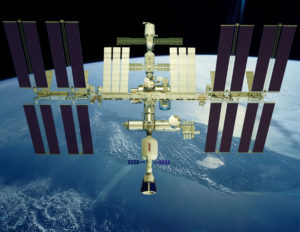
Here is the latest episode in NASA’s Space to Ground weekly report on activities related to the International Space Station:
** Students Use Ham Radio to Call an Astronaut in Space – NASA Johnson
On May 15, 2020, Canadian students used ham radio to talk with NASA astronaut Chris Cassidy, currently aboard the International Space Station. Thanks to ham radio operators and the International Space Station program, the students were able to participate from their homes. Learn more about ham radio aboard the space station: https://go.nasa.gov/2DRPAeK Learn more about the research being conducted on station: https://www.nasa.gov/iss-science
** Tropical Storm Laura Viewed From International Space Station – NASA Johnson
External cameras on the International Space Station captured views of Tropical Storm Laura from approximately 250 miles above. The station passed directly over the tropical system on Sunday, August 23 prior to the storm making landfall on Cuba. The National Hurricane Center is projecting Laura to strengthen into a hurricane once in the Gulf of Mexico with landfall expected on the Gulf coast later this week.
** Every Spacecraft Which Has Visited The Space Station – Scott Manley
Over the last 2 decades there have been over 200 spacecraft which have visited the space station, built by many nations and organizations, with different designs. So I thought it might be nice to make a summary of every spacecraft for comparison since we’re getting close to the 20th anniversary and 100th crew to visit the ISS.
Solid, liquid, gas, plasma… did you know there’s also a fifth state of matter? Since 2018, NASA’s Cold Atom Lab has been using the microgravity environment on the International Space Station to help chill atoms to almost absolute zero – the coldest temperature matter can reach. At these low temperatures, Cold Atom Lab produces the fifth state of matter, called a Bose-Einstein condensate.
Experiments with this fifth state of matter could lend deeper insight into how our world works on a fundamental level. For example, scientists will be able to measure the very faint tug of gravity that is still present aboard the station, and put Albert Einstein’s theory about this fundamental force to the test. Studies of Bose-Einstein condensates aboard the station could also lead to new technologies, like better tools for navigation and more precise clocks. For more information, visit https://coldatomlab.jpl.nasa.gov
A sampling of recent articles, videos, and images dealing with space transport (find previous roundups here):
** SpaceX flies the prototype Starship SN6 on a low altitude hop: The SN6 flew today following a postponement on Sunday believed due to high winds, which continued until today. In what looked like a duplicate of the hop by SN5 on August 4th, the vehicle flew up and over and down to a pad while leaning from vertical due to the offset position of the single Raptor engine from the center of the base. It may have gone a bit higher than the SN5’s 150 meters. Elon Musk has spoken of eventually seeing test flights of Starship prototypes happening multiple times a week.
** SpaceX launches two Falcon 9 rockets within four days. On Sunday, August 30th, a F9 put the Argentine SAOCOM-1B radar satellite and two American smallsats into orbit. The unusual southern trajectory took the rocket along the Florida coast and the upper stage over Cuba. The first stage booster returned for a landing on a pad back at Cape Canaveral. The fairing halves were recovered from the sea.
Here is a view of the F9 continuously from liftoff to the booster landing: From Launch To Landing – SpaceX Falcon 9 w/ SAOCOM 1B – YouTube
On Thursday morning, September 3rd, another batch of 60 Starlink satellites were launched from Pad 39B. The booster landed safely on a platform at sea and the satellites were deployed successfully.
** An Arianespace Vega rocket put over 50 smallsats into orbit Thursday morning as well. This was the first flight of the Vega since a launch failure on July 10, 2019. The flight also marked the start of a smallsat rideshare program in which satellites from different organizations split the cost of flying to space. The four-stage Vega is all solid-fueled except for the small fourth stage, which uses UDMH and nitrogen tetroxide.
The satellite, named ‘First Light’, is the first spacecraft from Rocket Lab’s family of configurable Photon satellites to be deployed to orbit. Launched as a technology demonstration, ‘First Light’ builds upon the existing capabilities of the Electron launch vehicle’s Kick Stage with additional subsystems to enable long duration satellite operations. This pathfinding mission is an initial demonstration of the new power management, thermal control and attitude control subsystem capabilities. By testing these systems for an extended period on orbit, Rocket Lab is building up flight heritage for future Photon satellite missions planned to low Earth orbit, the Moon, and Venus.
‘First Light’ was deployed to orbit on Rocket Lab’s 14th Electron mission, ‘I Can’t Believe It’s Not Optical’, which lifted-off from Rocket Lab Launch Complex 1 in New Zealand on August 31, 2020. Approximately 60 minutes after lift-off, Electron deployed a 100 kg microsatellite for Capella Space, an action that would typically signal the successful completion of a standard Rocket Lab mission. However, shortly after deploying the customer payload, Rocket Lab conducted an entirely new operation for the first time: Rocket Lab engineers sent a command to transition the Kick Stage into Photon satellite mode. This action marked the first on-orbit demonstration of Rocket Lab’s Photon satellite as a two-in-one spacecraft, first using it to complete its conventional launch vehicle function to deploy customer satellites, then transitioning into a satellite to continue a standalone mission
Rocket Lab will offer the Photon to users who want to send a payload to space but don’t want to build a whole satellite. By taking advantage of the Photon’s built-in capabilities, a payload owner can focus just on the payload’s operations and not those of the carrier spacecraft.
Rocket Lab has been granted a Launch Operator License by @FAANews for Electron missions from LC-2! This is a major step toward the first Electron launches from U.S. soil. pic.twitter.com/ETe7lcF3Tw
The license allows “allows for multiple launches from LC-2 for the next 5 years without needing a new launch-specific license for every mission“.
Among our first Electron missions from LC-2 will be a mission to the Moon for @NASA in support of the agency’s Artemis program. Learn more about this exciting mission here: https://t.co/W8mopvOjptpic.twitter.com/j0bYds906D
** A ULA Delta IV Heavy aborted after ignition of one of its engines and just 3 seconds before the planned liftoff on August 29th. According to ULA, there will be a postponement of at least seven days before the next launch attempt. The launch had been postponed several times, most recently due to a ground equipment problem. No new launch date has been announced yet. The NROL-44 mission involves a classified spysat of some sort.
Note that the flames are standard for DIV launches due to the deliberate ignition of hydrogen gas that can build up around the base of the rocket.
Rocket Factory currently is developing a launcher system called RFA One for small satellites with a payload performance of up to 300kg to low earth orbit (LEO). The first launch is scheduled for 2022.
** Interesting account of the history of RLV development in the US: Jess Sponable – Reusable Launch, Pete Conrad, and DARPA – Cold Star Project S02E58
2X past DARPA Program Manager Jess Sponable is on the Cold Star Project to share his experiences and aspirations in the space industry. With host Jason Kanigan, our topics cover the development of reusable launch technology, a colorful character (#3 to walk on the Moon) named Pete Conrad and Jess’ interactions with him, and DARPA. Our conversation was submitted to and approved for public release by the USAF.
The general consensus is that only 2 to 3 companies can survive the coming shakeout. However, I will note that many countries will support at least one or two national smallsat launch service ventures. For example, Spain is likely to steer government funded smallsats to a company like PLD Space, UK will send government payloads to companies like Skyrora and Orbex, Germany will back ventures such as HyImpulse and OHB’s Rocket Factory (see above), China and India are each going to support their multiple launcher companies, etc.
So while 2 or 3 small launch system companies will get the bulk of competitively selected payloads, globally there could easily be a dozen or more small companies around the world that survive indefinitely on government smallsats and subsidies. They may not generate high profits but they can remain in business with a modest number of launches per year.
** Briefs:
Made In Space Europe and Momentus plan robotic spacecraft – SpaceNews – “Under the memorandum of understanding, the companies will mount a Made In Space robotic arm on a Momentus Vigoride transfer vehicle. With the robotic arm, Vigoride could grab onto a satellite in space to move it to a new orbit.”
As noted at the top of this posting, SpaceX has launched Falcon 9 rockets twice since the previous roundup. According to this schedule, there could be up to three more flights in September, including two Starlink missions
**** Starship
See the SN6 flight video at top. A pressure test to destruction of the SN7.1 propellant tank prototype is said by many to be the next major action at Boca Chica. The goal is to confirm the improvements in welding techniques and the performance of a new steel alloy.
Meanwhile, construction of the High Bay building for stacking of the Super Heavy has reached its full height greater than 81 meters. It just needs a roof and side panels to complete the external structure. Elon has said that construction of the first Super Heavy prototype should start this week.
Work continues also on the launch platform for the Super Heavy. This involves the building of massive tilted pillars to hold up the base where the SH will stand.
See the videos below for visuals of these activities and projects.
****** Elon Musk talked about Starship, Raptor engines, and building a colony on Mars in a phone interview for the Humans to Mars conference.
Some highlights of his remarks:
Making good progress on the production line for Starship.
Need eventually to make a thousand or more Starships to make it feasible and affordable to put a city on Mars.
Assembly of the first prototype Super Heavy booster to start this week at Boca Chica.
The target number of Raptor engines on the SH has decreased from 31 to 28.
Raptor thrust to weight ratio could reach 200.
First orbital mission could take place next year.
Initial missions could be failures due to the difficult challenges of developing a fully reusable system.
Will do hundreds of satellite launch missions before taking people to orbit on a Starship.
This short video shows a virtual flight over the Starship Facility in Boca Chica, TX on August 28th, 2020. It is kept as simple as possible with major focus on BUILDINGS, JIGS and STARSHIP-Parts. For other design projects, please visit my webpage: http://www.alexrex.de/
While Starship SN6 aborted it hop attempts on Sunday due to very windy conditions in Boca Chica, Test Tank SN7.1 continued assembly ahead of its expected test to failure after SN6’s completed hop. Video and Pictures from Mary (@BocaChicaGal). Edited by Nicholas Gautschi (@NGautschi).
****** Sept.1:
A sign of future intent as a huge amount of steel that will make up future Starships – and possibly allocated to the prototype Super Heavy – was on show at Boca Chica. Includes checking in with SN7.1 and the soon-to-hop SN6, the latter view a drive past. Video and Pictures from Mary (@BocaChicaGal). Edited by Nicholas Gautschi (@NGautschi).
****** Sept.3: SpaceX Boca Chica – Starship SN10 parts arriving as SN6 looks forward to hop – NASASpaceflight – YouTube
Multiple current/future Boca Chica efforts in work as Starship SN6 prepare to hop. SN10 parts have now started to arrive, while work on the Super Heavy mount continues. Video and Pictures from Mary (@BocaChicaGal). Edited by Theo Ripper (@TheoRipper).
**** Other Starship and space transport reports:
**** Aug.29: SpaceX Starship Super Heavy Booster to start soon, SN6 flight shortly and Delta IV Heavy Abort – Marcus House
Around a few frustrating delays, we have a lot to talk about. Starship Super Heavy Booster build to start soon according to Elon’s recent tweets. We had the Delta IV Heavy Abort just hours ago and hopefully an SN6 flight shortly This week we have lots to share yet again on SpaceX’s starship development from Boca Chica Texas. Much more information on the super-heavy launch pad and we are of course gearing up for the launch of Starship serial number 6. We had an interesting abort just hours ago with the attempted flight of the Delta IV Heavy from Cape Canaveral Air Force Station. Some updates on the James Webb Space Telescope. And SpaceX may very well be flying back to back Falcon 9’s on the next Starlink mission and SAOCOM1B mission on Sunday depending on range approval (although Delta IV heavy may cause issues with this plan).
**** Aug.28: How to finance a fleet of SpaceX Starships? – What about it!?
Today amongst other thing’s I’ll explain to you, what SpaceX’s Starship has to do with the number 553 and how it will be financed.
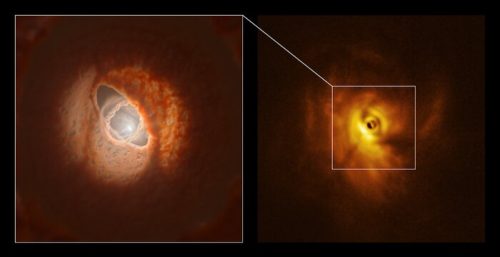
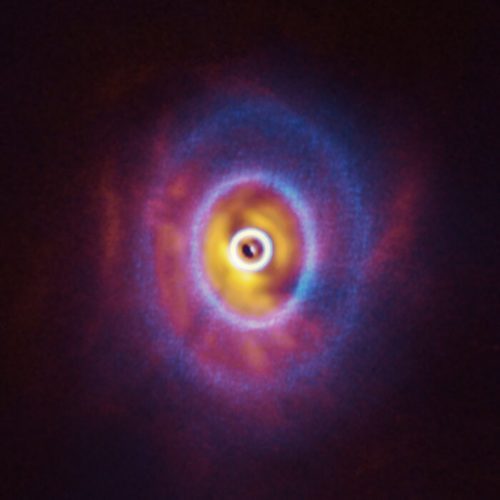
ALMA, in which ESO is a partner, and the SPHERE instrument on ESO’s Very Large Telescope have imaged GW Orionis, a triple star system with a peculiar inner region. The new observations revealed that this object has a warped planet-forming disc with a misaligned ring. In particular, the SPHERE image (right panel) allowed astronomers to see, for the first time, the shadow that this ring casts on the rest of the disc. This helped them figure out the 3D shape of the ring and the overall disc. The left panel shows an artistic impression of the inner region of the disc, including the ring, which is based on the 3D shape reconstructed by the team.
A team of astronomers have identified the first direct evidence that groups of stars can tear apart their planet-forming disc, leaving it warped and with tilted rings. This new research suggests exotic planets, not unlike Tatooine in Star Wars, may form in inclined rings in bent discs around multiple stars. The results were made possible thanks to observations with the European Southern Observatory’s Very Large Telescope (ESO’s VLT) and the Atacama Large Millimeter/submillimeter Array (ALMA).
Our Solar System is remarkably flat, with the planets all orbiting in the same plane. But this is not always the case, especially for planet-forming discs around multiple stars, like the object of the new study: GW Orionis. This system, located just over 1300 light-years away in the constellation of Orion, has three stars and a deformed, broken-apart disc surrounding them.
“Our images reveal an extreme case where the disc is not flat at all, but is warped and has a misaligned ring that has broken away from the disc,”
says Stefan Kraus, a professor of astrophysics at the University of Exeter in the UK who led the research published today in the journal Science. The misaligned ring is located in the inner part of the disc, close to the three stars.
The new research also reveals that this inner ring contains 30 Earth-masses of dust, which could be enough to form planets.
“Any planets formed within the misaligned ring will orbit the star on highly oblique orbits and we predict that many planets on oblique, wide-separation orbits will be discovered in future planet imaging campaigns, for instance with the ELT,”
says team member Alexander Kreplin of the University of Exeter, referring to ESO’s Extremely Large Telescope, which is planned to start operating later this decade. Since more than half the stars in the sky are born with one or more companions, this raises an exciting prospect: there could be an unknown population of exoplanets that orbit their stars on very inclined and distant orbits.
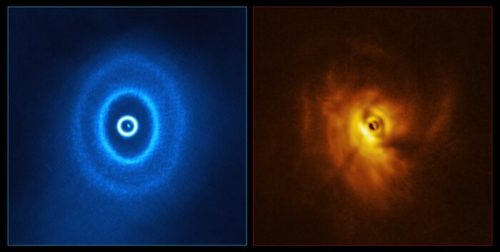
ALMA, in which ESO is a partner, and the SPHERE instrument on ESO’s Very Large Telescope have imaged GW Orionis, a triple star system with a peculiar inner region. Unlike the flat planet-forming discs we see around many stars, GW Orionis features a warped disc, deformed by the movements of the three stars at its centre. The ALMA image (left) shows the disc’s ringed structure, with the innermost ring separated from the rest of the disc. The SPHERE observations (right) allowed astronomers to see for the first time the shadow of this innermost ring on the rest of the disc, which made it possible for them to reconstruct its warped shape.
“We found that the three stars do not orbit in the same plane, but their orbits are misaligned with respect to each other and with respect to the disc,”
says Alison Young of the Universities of Exeter and Leicester and a member of the team.
They also observed the system with the SPHERE instrument on ESO’s VLT and with ALMA, in which ESO is a partner, and were able to image the inner ring and confirm its misalignment. ESO’s SPHERE also allowed them to see, for the first time, the shadow that this ring casts on the rest of the disc. This helped them figure out the 3D shape of the ring and the overall disc.
The international team, which includes researchers from the UK, Belgium, Chile, France and the US, then combined their exhaustive observations with computer simulations to understand what had happened to the system. For the first time, they were able to clearly link the observed misalignments to the theoretical “disc-tearing effect”, which suggests that the conflicting gravitational pull of stars in different planes can warp and break their discs.
Their simulations showed that the misalignment in the orbits of the three stars could cause the disc around them to break into distinct rings, which is exactly what they see in their observations. The observed shape of the inner ring also matches predictions from numerical simulations on how the disc would tear.
ALMA, in which ESO is a partner, and the SPHERE instrument on ESO’s Very Large Telescope have imaged GW Orionis, a triple star system with a peculiar inner region. Unlike the flat planet-forming discs we see around many stars, GW Orionis features a warped disc, deformed by the movements of the three stars at its centre. This composite image shows both the ALMA and SPHERE observations of the disc. The ALMA image shows the disc’s ringed structure, with the innermost ring (part of which is visible as an oblong dot at the very centre of the image) separated from the rest of the disc. The SPHERE observations allowed astronomers to see for the first time the shadow of this innermost ring on the rest of the disc, which made it possible for them to reconstruct its warped shape.
Interestingly, another team who studied the same system using ALMA believe another ingredient is needed to understand the system.
“We think that the presence of a planet between these rings is needed to explain why the disc tore apart,”
says Jiaqing Bi of the University of Victoria in Canada who led a study of GW Orionis published in The Astrophysical Journal Letters in May this year. His team identified three dust rings in the ALMA observations, with the outermost ring being the largest ever observed in planet-forming discs.
Future observations with ESO’s ELT and other telescopes may help astronomers fully unravel the nature of GW Orionis and reveal young planets forming around its three stars.