A sampling of recent articles, videos, and images dealing with space transport (find previous roundups here):
** Blue Origin plans a New Shepard flight on Sept. 24th:
Blue Origin’s next New Shepard mission (NS-13) is currently targeting liftoff for Thursday, September 24, at 10:00 am CDT / 15:00 UTC. Current weather conditions are favorable. This will be the 13th New Shepard mission and the 7th consecutive flight for this particular vehicle (a record), demonstrating its operational reusability.
New Shepard will fly 12 commercial payloads to space and back on this mission, including the Deorbit, Descent, and Landing Sensor Demonstration with NASA’s Space Technology Mission Directorate under a Tipping Point partnership. This is the first payload to fly mounted on the exterior of a New Shepard booster rather than inside the capsule, opening the door to a wide range of future high-altitude sensing, sampling, and exposure payloads.

The lunar landing sensor demo will test precision landing technologies for future missions to the Moon in support of the Artemis program. The experiment will verify how these technologies (sensors, computers, and algorithms) work together to determine a spacecraft’s location and speed as it approaches the Moon, enabling a vehicle to land autonomously on the lunar surface within 100 meters of a designated point. The technologies could allow future missions—both crewed and robotic—to target landing sites that weren’t possible during the Apollo missions, such as regions with varied terrain near craters. Achieving high accuracy landing will enable long-term lunar exploration and future Mars missions.
This is the first of two flights to test these lunar landing technologies, increasing confidence for successful missions in the Artemis program. NS-13 is part of the risk reduction process to test these types of sensors for future missions.
As a part of NASA’s Artemis Human Landing System program, Blue Origin is also leading the National Team, comprised of Lockheed Martin, Northrop Grumman, and Draper, to develop a Human Landing System to return Americans to the lunar surface. The technology for the Blue Origin Descent Element that takes astronauts to the lunar surface is derived from the autonomous landing capabilities developed for the New Shepard program.
New Shepard has flown more than 100 payloads to space across 10 sequential flights. Payloads on board NS-13 include experiments from Johns Hopkins University Applied Physics Laboratory, Southwest Research Institute, NASA Flight Opportunities, Space Lab Technologies, University of Florida, Space Environment Technologies, and mu Space Corp. A selection of the manifested payloads can be found below.
Also on board will be tens of thousands of postcards from Blue Origin’s nonprofit, Club for the Future, some of which will include a special NASA Artemis stamp.
All mission crew supporting this launch are exercising strict social distancing and safety measures to mitigate COVID-19 risks to personnel, customers, and surrounding communities.
You can watch the launch live at BlueOrigin.com. The pre-show begins at T-30 minutes and will provide mission details, including a special update from NASA Administrator Jim Bridenstine.
** Blue Origin facilities at Cape Canaveral continue to expand:
Some real nice shots taken of the @blueorigin facilities at Exploration Park in July 2020 from an environmental report https://t.co/Z7ngY4V4gv pic.twitter.com/wZjJhyX4qd
— Harry Stranger (@HarryStrangerPG) September 22, 2020
** Blue Origin planning development of near earth orbit destinations for the company’s future crew vehicles:
It looks like Blue Origin is planning to build an orbital habitat. Company is hiring an “Orbital Habitat Formulation Lead” to “establish viable LEO destination systems in the 2020s.”https://t.co/1OMEwLiA80
— Eric Berger (@SciGuySpace) September 21, 2020
The job description begins with:
To develop Blue Origin’s vision of millions of people living and working in space, humanity will require places for them to live and work: space destination systems in which value-creating economic activity can occur. LEO (low Earth orbit) habitable stations, learning from but going beyond the ISS (International Space Station), are a first step. Such stations, supporting a robust LEO economy, will be fundamentally different from “exploration” habitats designed for small, professionally trained crews in deep space.
More at Blue Origin considers entering commercial space station business – SpaceNews
** ULA sets launch of Delta IV Heavy for Sept. 26th at 12:14am EDT ( 0414 GMT) from Cape Canaveral. The NROL-44 mission will launch at a classified spy satellite for the National Reconnaissance Office (NRO). A launch on August 29th was abort just 3 seconds before liftoff due a ground systems failure.
** Northrop Grumman is set to launch a Cygnus vessel on an Antares rocket on Sept 29th. The Cygnus will deliver cargo to the ISS. Liftoff from Wallops Island, Virginia is targeted for 10:26 am EDT (0226 GMT on 30th)
** China launches Long March 4B rocket with Haiyang-2C ocean observation satellite from the Jiuquan Satellite Launch Center on Monday:
- China launches new satellite to monitor ocean environment – ecns.cn
- Long March 4B launches new ocean observation satellite – NASASpaceFlight.com
** Nuclear-powered space tug in advanced development by Russia’s KB Arsenal Design Bureau .
Anatoly Zak reports on the project: Russia reveals a formidable nuclear-powered space tug – RussianSpaceWeb.com
After years of near silence, a prominent developer of Russian military spacecraft suddenly publicly floated the first pictures of a massive nuclear-powered space transport undergoing assembly at the company’s facility in St. Petersburg. The KB Arsenal design bureau, which serves as the prime contractor in the project, is known for its Soviet-era nuclear-powered satellites, one of which infamously crashed in the Arctic region of Canada in 1977.
A series of photos and computer-generated imagery, which surfaced on the Internet in 2020 and originated from KB Arsenal clearly revealed the latest version and the planned operation of a very large space tug propelled by electric engines and powered by a nuclear source.
The project officially known as the Transport and Energy Module, TEM, has been well known to the watchers of the Russian space program for more than a decade.
Tracing its roots to the dawn of the Space Age, the TEM concept is attempting to marry a nuclear reactor with an electric rocket engine. The electric propulsion systems heat up and accelerate ionized gas to create a thrust-generating jet and, therefore, are alternatively known as ion or plasma engines. When measured per unit of spent propellant mass, electric engines are more efficient than traditional liquid or solid-propellant rockets, but their thrust is relatively low at any given time and they require a great deal of electric power to operate. Because of this, until recently, the practical use of electric propulsion in space flight was mostly limited to orbit adjustment systems aboard satellites or to deep-space missions, in which spacecraft could take advantage of low thrust over very long periods of time.
The nuclear reactor would not be activated until the tug was in a high orbit. It would use solar panels for power during the preparatory period. The fuel would not become highly radioactive until after the reactor was turned on.
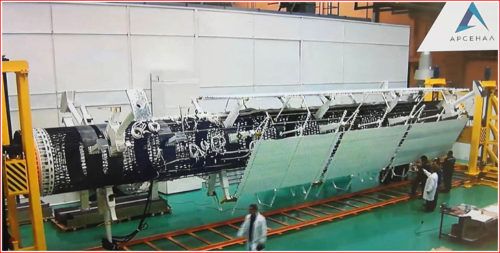
The photos of a vehicle in construction are new but the existence of TEM and other nuclear powered spacecraft projects had been generally known for awhil: Ekipazh: Russia’s top-secret nuclear-powered satellite – The Space Review – Oct.7.2019.
On February 2, 1998, the Russian government adopted a decree aimed at reviving the dormant Russian space nuclear program. It called for resuming research and development in the field with the goal of producing nuclear reactors with a capacity of up to 100 kilowatts and an operational lifetime of five to seven years after 2010. A key short-term goal was to use nuclear reactors as part of so-called “transport and energy modules” (TEM), a Russian term for electric space tugs. The nuclear reactor would power an electric propulsion system to boost spacecraft to their operational orbits (“transport”) and subsequently provide power to their on-board systems (“energy”). This would make it possible to increase the mass of payloads delivered to high orbits by two to three times and supply them with 10 to 20 times more power than before.[4]
A video of a video shown at an exhibition shows a possible crewed system powered by a TEM:
As with many such Russian projects, the design and ambition are admirable but the execution will be slow (due to low funding, bureaucratic management, etc) and take many years before reaching space. Find occasional updates posted at Russian nuclear propulsion – NASASpaceflight Forum.
** Rocket Lab announces target date for next Electron mission, which will deliver a total of 10 satellites to orbit: Rocket Lab To Launch Commercial Earth-Imaging Rideshare Mission For Planet, Canon Electronics – Rocket Lab
This rideshare mission will be Electron’s 15th launch overall and fifth in 2020, making Electron the second most-frequently launched U.S. rocket this year.
Long Beach, California. 21 September, 2020 – Leading space systems company, Rocket Lab, has today announced its next Electron launch will be a rideshare mission to low Earth orbit for Planet and Spaceflight Inc.’s customer Canon Electronics.
The mission – named ‘In Focus’ in a nod to the Earth-imaging satellites onboard – will lift-off in October from Rocket Lab’s private orbital launch site, Launch Complex 1, in New Zealand. The mission will deploy a total of 10 satellites to precise and individual orbits. The mission will be Rocket Lab’s 15th launch overall and fifth mission of 2020, making Electron the second most-frequently launched United States orbital rocket this year.
Earth-imaging company Planet has nine of their latest generation SuperDove satellites booked on the mission for deployment to a 500km morning-crossing Sun Synchronous Orbit (SSO). Each of the nine SuperDoves will be integrated with and deployed from Rocket Lab’s Maxwell dispensers, the industry’s lightest CubeSat dispenser in its class. Planet’s Flock 4e’ of SuperDoves will join the company’s constellation of Earth-observation satellites already on orbit providing medium-resolution global coverage and near-daily revisit.
The 10th and final payload aboard this mission, Canon Electronics Inc.’s CE-SAT-IIB, was arranged by satellite rideshare and mission management provider Spaceflight Inc. CE-SAT-IIB is a technical demonstration microsatellite developed by Canon Electronics Inc. It has a middle-size telescope equipped with an ultra-high sensitivity camera to take night images of the Earth and small size telescopes which are suitable for CubeSat use.
In a mission later this year, the company will attempt to recover the first stage of the Electron for the first time:
Rocket Lab has multiple missions scheduled for the remainder of 2020, including an upcoming launch in Q4 earmarked for the company’s first Electron first stage recovery attempt. The Electron’s first stage will be equipped with new hardware, including a reaction control system and an in-house designed parachute system, to orient the booster during its re-entry descent and slow down the first stage before a soft landing in the ocean where it will be collected by a ship.
** Firefly test fires Alpha rocket in preparation for first flight:
Another view of tonight’s test! pic.twitter.com/LY2g4BsdR8
— Firefly Aerospace (@Firefly_Space) September 20, 2020
Here is an extended profile of Max Polyakov, the Ukrainian mogul who rescued Firefly from oblivion: Firefly Aerospace and Max Polyakov Want to Build Smaller Rockets Than SpaceX – Bloomberg
This fish-out-of-water routine is fun, but Polyakov is someone the emerging commercial spaceflight industry needs to take seriously. To date, he’s put $150 million of his own money into rocketry, more than anyone besides Elon Musk, with SpaceX, and Jeff Bezos, with Blue Origin. Polyakov’s company, Firefly Aerospace Inc., runs a vast engine test site about a half-mile from the beer barn. From offices in nearby Cedar Park, Firefly executives have put the company in the mix for a series of contracts to launch satellites into orbit for NASA, the U.S. Department of Defense, and a string of commercial satellite companies.
** Southern Launch in Australia tests sounding rocket:
We have lift off 🚀 Congratulations to the team at @SouthernLaunch for successfully launching a rocket to the edge of space from Koonibba, #SouthAustralia. It’s the latest example of how SA is at the forefront of this emerging sector and is creating #SAJobs of the future. pic.twitter.com/NHvYo5DATf
— Steven Marshall, MP (@marshall_steven) September 19, 2020
** HyImpulse Technologies in Germany tests hybrid rocket motor:
Successfully kicked off the first series of tests of our 75kN #hybridpropulsion motor. It is the largest one in Europe and one of the largest LOX/paraffin motors worldwide. It will propel SL1 in 2022. Tests are funded through participation in the HyTec project of EU SME Phase II. pic.twitter.com/uninkWlaEJ
— HyImpulse Technologies (@HyImpulseTech) September 14, 2020
We were able to verify the integrity of the hybrid motor and the proper operation of the oxidizer feed system with this #coldflow test, in combination with the test bench.
All data is looking great and we are now ready for the first #hotfire test of our large #hybridmotor! pic.twitter.com/VlOsXa3AOp
— HyImpulse Technologies (@HyImpulseTech) September 17, 2020
Test firing of our 75kN hybrid rocket motor at @DLR_de Lampoldshausen confirms that our proprietary Paraffin/LOX formulation for rocket propellants achieve the same high performance as liquid hydrocarbon-based fuels with simplified #propulsion system & at a fraction of the cost. pic.twitter.com/qKgpot7aGE
— HyImpulse Technologies (@HyImpulseTech) September 18, 2020
** PLD Space of Spain shows off an 180 sec test of the b-prop (Kerosene/LOX) TEPREL-B engine, which will power the reusable MIURA-1 suborbital rocket:
MIURA 1 Qualification Campaign of the flight engine version (TEPREL-B). PLD Space successfully achieved a 180 seconds test of the MIURA 1 liquid rocket engine. This test is an increased duration test (x1.5 MIURA 1 powered flight time) of the TEPREL-B engine, developed by the company, focused on demonstrating the engine´s endurance and reliability. This test is a key milestone for the engine qualification process. About the company: PLD Space, founded in 2011, and based in Elche, is a Spanish company developing reusable rockets. Currently, PLD Space is working on two launchers, the suborbital MIURA 1 and the orbital MIURA 5.
** Launch system startup Isar Aerospace of Germany aims for the European smallsat constellation market: A German rocket startup seeks to disrupt the European launch industry | Ars Technica
Founded in 2018 by a group of recent engineering graduates who had participated in a rocket research group, plus a few students still in school, Isar chose to focus first on developing an engine. Named Aquila, the engine is fueled by propane and liquid oxygen, and nine of these engines will power the first stage of the company’s “Spectrum” rocket.
With this booster, Isar intends to launch up to 1,000kg to low-Earth orbit. It has not set a price per launch, but it is targeting a competitive price point of 10,000 Euros ($11,700) per kg.
…
The company concluded a round of seed funding in August 2018—raising in the low millions of Euros, Metzler said—that allowed Isar to build its first test site near Munich, finalize the design of the vehicle, and begin to work on its propulsion system. Isar ramped up its fundraising in December 2019, bringing in 17 million Euros in series A funding. This allowed the company to grow from 25 to 100 employees and build out a 4,500 sq. meter production facility. There, it seeks to build Aquila engines in weeks, rather than months, at the lowest possible cost.
First launch is targeted for 2022. A launch site has not yet been chosen.
** SNC update focuses on the Dream Chaser wings via a profile of a engineer working on them: Employee Spotlight: Meet Dream Chaser Structural Engineer, Gracie P – Sierra Nevada
Our Dream Chaser® spaceplane is a lifting body, but, according to structural engineer, Gracie P., that doesn’t mean you can count the wings out! In this Employee Spotlight, she explains why they’re so crucial to the Dream Chaser design & her role at SNC. https://t.co/piGi0GWa94 pic.twitter.com/7ZCmHBuUwf
— Sierra Nevada Corporation (@SierraNevCorp) September 22, 2020
Dream Chaser is a lifting body which means that the actual body of the vehicle provides much of the required lift, whereas on a standard aircraft, you would expect the wings to do the lifting. That does not, however, mean that you can count the Dream Chaser wings out. The design and analysis of the wings proved to be a decisively complex technical problem. Developing the loading criteria for the wings resulted in many iterations in the analysis to prove the wings could withstand the extreme conditions from orbital re-entry. As a result, the wings have some of the thickest composite on Dream Chaser. The wing skins are optimized for weight and each section was sized based off of analysis that I performed, with the thickest sections being at the root of the wing, while the tip is relatively thin. All of the analysis that I completed culminated in the completion of the composite co-bonded wings being delivered to our production facilities in Louisville, CO.
** Briefs:
- National Team Completes System Requirements Review to Define its Integrated Human Landing System Design – Blue Origin
- China Space Plane Deployed Payload – Leonard David
- Seaborne rocket launches key to future of China’s space programme, experts say | South China Morning Post
- Rocket Report: Chinese rocket fails, Starship may make a leap in October | Ars Technica
- Gilmour Space to launch Space Machines Company on first Eris rocket – Gilmour Space – Australia
- Virgin Orbit Seeking Over $100 Million As ‘Jaw Dropping’ Costs Mount And Small Satellite Market Narrows – Forbes
- PLD Space closes €7M investment in tie-up with Arcano Partners – PLD Space – Spain
- General Atomics Delivers Nuclear Thermal Propulsion Concept to NASA | General Atomics
- Equatorial Space Systems Partners With Commercial Space Technologies For Smallsat Launch Services – SatNews
- Atomic Aggies at Spaceport America
- Station Boosts Orbit to Avoid Space Debris – Space Station
==================
Check out the
The Lurio Report
for news and analysis of key developments in NewSpace
The latest issue:
Strides and Views, Rocket Lab, Bernard Kutter, RIP
Vol. 15, No. 6, September 18, 2020
Space Frontier Foundation Award for NewSpace Journalism
==================
** SpaceX:


 [Amazon commission link], which features stories and speculation from the best of the best around the world.


