Curiosity rover images the Martian haze during global dust storm

The dust storm on Mars that had has cut off the Opportunity rover’s access to the power of the Sun has now engulfed the whole planet:

Martian Dust Storm Grows Global
Curiosity Captures Photos of Thickening Haze 

A storm of tiny dust particles has engulfed much of Mars over the last two weeks and prompted NASA’s Opportunity rover to suspend science operations. But across the planet, NASA’s Curiosity rover, which has been studying Martian soil at Gale Crater, is expected to remain largely unaffected by the dust. While Opportunity is powered by sunlight, which is blotted out by dust at its current location, Curiosity has a nuclear-powered battery that runs day and night.

A self-portrait taken by NASA’s Curiosity rover taken on Sol 2082 (June 15, 2018). A Martian dust storm has reduced sunlight and visibility at the rover’s location in Gale Crater. Image Credit: NASA/JPL-Caltech/MSSS > Larger view

The Martian dust storm has grown in size and is now officially a “planet-encircling” (or “global”) dust event.

Though Curiosity is on the other side of Mars from Opportunity, dust has steadily increased over it, more than doubling over the weekend. The sunlight-blocking haze, called “tau,” is now above 8.0 at Gale Crater — the highest tau the mission has ever recorded. Tau was last measured near 11 over Opportunity, thick enough that accurate measurements are no longer possible for Mars’ oldest active rover.

For NASA’s human scientists watching from the ground, Curiosity offers an unprecedented window to answer some questions. One of the biggest is: why do some Martian dust storms last for months and grow massive, while others stay small and last only a week?

“We don’t have any good idea,”

says Scott D. Guzewich, an atmospheric scientist at NASA Goddard Space Flight Center in Greenbelt, Maryland, leading Curiosity’s dust storm investigation.

Curiosity, he points out, plus a fleet of spacecraft in the orbit of Mars, will allow scientists for the first time to collect a wealth of dust information both from the surface and from space. The last storm of global magnitude that enveloped Mars was in 2007, five years before Curiosity landed there.

Two images from the Mast Camera (Mastcam) on NASA’s Curiosity rover depicting the change in the color of light illuminating the Martian surface since a dust storm engulfed Gale Crater. The left image shows the “Duluth” drill site on Sol 2058 (May 21); the right image is from Sol 2084 (June 17). The cherry red color is largely due to red dust grains in the atmosphere letting red light through to the surface, but not green or blue light. Image Credit: NASA/JPL-Caltech/MSSS › Larger view

In the animation above, Curiosity is facing the crater rim, about 18.6 miles (30 kilometers) away from where it stands inside the crater. Daily photos captured by its Mast Camera, or Mastcam, show the sky getting hazier. This sun-obstructing wall of haze isabout six to eight times thicker than normal for this time of season.

Curiosity’s engineers at NASA’s Jet Propulsion Laboratory in Pasadena, California, have studied the potential for the growing dust storm to affect the rover’s instruments, and say it poses little risk. The largest impact is to the rover’s cameras, which require extra exposure time due to the low lighting. The rover already routinely points its Mastcam down at the ground after each use to reduce the amount of dust blowing at its optics. JPL leads the Mars Science Laboratory/Curiosity mission.

Martian dust storms are common, especially during southern hemisphere spring and summer, when the planet is closest to the Sun. As the atmosphere warms, winds generated by larger contrasts in surface temperature at different locations mobilize dust particles the size of individual talcum powder grains. Carbon dioxide frozen on the winter polar cap evaporates, thickening the atmosphere and increasing the surface pressure. This enhances the process by helping suspend the dust particles in the air. In some cases, the dust clouds reach up to 40 miles (60 kilometers) or more in elevation.

Though they are common, Martian dust storms typically stay contained to a local area. By contrast, the current storm, if it were happening on Earth, is bigger than North America and Russia combined, says Guzewich.

The dust storm may seem exotic to some Earthlings, but it’s not unique to Mars. Earth has dust storms, too, in desert regions such as NorthAfrica, the Middle East, and the southwest United States.

But conditions here prevent them from spreading globally, said Ralph A. Kahn, a Goddard senior research scientist who studies the atmospheres of Earth and Mars. These include the structure of our thicker atmosphere and stronger gravity that helps settle dust. Earth also has vegetation cover on land that binds the soil with its roots and helps block the wind and rain that wash the particles out of the atmosphere.

In June 2018 NASA’s Curiosity Rover used its Mast Camera, or Mastcam, to snap photos of the intensifying haziness the surface of Mars, caused by a massive dust storm. The rover is standing inside Gale Crater looking out to the crater rim. The photos span about a couple of weeks, starting with a shot of the area before the storm appeared. > Larger image

===

Update on Opportunity: Opportunity Hunkers Down During Dust Storm | NASA


====

 

Videos: Big rockets look even bigger when put in “everyday places”

Here are two new videos that can give one a much better sense of just how big the big rockets that are launching, and in some cases landing, today really are:

Bonus: Enjoy more of The Everyday Astronaut‘s soundtrack to the video at top:

====


Video: PlanetVac tested on Masten Space’s Xodiac rocket

I’ve previously posted about the PlanetVac system for gathering a sample of the surface of celestial bodies. It was developed by Honeybee Robotics and supported financially by the Planetary Society. Here is a video report on a recent test using Masten Space Systems‘s Xodiac vertical takeoff and landing reusable rocket.

From the caption:

Taking samples of other worlds is an important step towards discovery, but it is an expensive and complex process. Honeybee Robotics and The Planetary Society
teamed up to solve this problem. This is PlanetVac.

Learn more: http://www.planetary.org/planetvac/

After a few prototypes, PlanetVac is ready to be tested in Mojave, CA on a Xodiac rocket made by Masten Space Systems. NASA selected PlanetVac to fly on a Xodiac rocket as part of its Flight Opportunities program. If this PlanetVac Xodiac test is successful, it will significantly increase its chance of being selected on a real space mission.

PlanetVac Xodiac was supported by Planetary Society members. Over 800 people joined the team by donating. Thank you to the 887 donors from 35 countries who supported PlanetVac Xodiac in 2018. Special thanks to Pendleton Ward and Dustin Roberts who provided generous matching funds to inspire the community in support of the project.

====

Voyager mission posters and infographics

The two Voyager spacecraft were launched in 1977 and successfully visited the gas giant planets of our solar system before heading out into interstellar space. The nuclear powered vehicles are still operating and sending data back to earth.

Check out these posters and infographics from NASA JPL in celebration of the Voyager missions.

The Grand Tour – JPL Travel Poster: NASA’s Voyager mission took advantage of a once-every-175-year alignment of the outer planets for a grand tour of the solar system. The twin spacecraft revealed details about Jupiter, Saturn, Uranus and Neptune – using each planet’s gravity to send them on to the next destination. Voyager set the stage for such ambitious orbiter missions as Galileo to Jupiter and Cassini to Saturn. Today both Voyager spacecraft continue to return valuable science from the far reaches of our solar system.
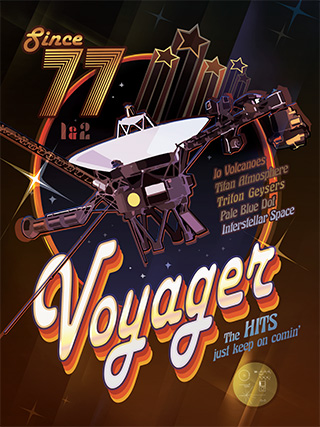
The Voyagers Rock On: Thanks to the twin Voyager spacecraft, music is truly universal: Each carries a Golden Record with sights, sounds and songs from Earth as it sails on through the Milky Way. Recalling the classic rock era of the late 1970s when the Voyagers launched, this poster is an homage to the mission’s greatest hits. Some of the most extraordinary discoveries of the probes’ first 40 years include the volcanoes on Jupiter’s moon Io, the hazy nitrogen atmosphere of Saturn’s moon Titan and the cold geysers on Neptune’s moon Triton. Voyager 1 is also the first spacecraft to deliver a portrait of our planets from beyond Neptune, depicting Earth as a ‘pale blue dot,’ and, as of Aug. 25, 2012, to enter interstellar space. Voyager 2 is expected to enter interstellar space in the coming years. Even after 40 years, the Voyagers’ hits just keep on coming.
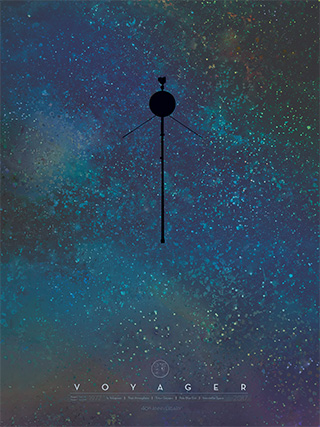
The Voyagers: Reaching for the Stars: The twin Voyager spacecraft, which launched in 1977, are our ambassadors to the rest of the Milky Way, destined to continue orbiting the center of our galaxy for billions of years after they stop communicating with Earth. On Aug. 25, 2012, Voyager 1 became the first human-made object to enter interstellar space, and Voyager 2 is expected to cross over in the next few years. At age 40, the Voyagers are the farthest and longest-operating spacecraft and still have plenty more to discover. This poster captures the spirit of exploration, the vastness of space and the wonder that has fueled this ambitious journey to the outer planets and beyond.

Infographics:

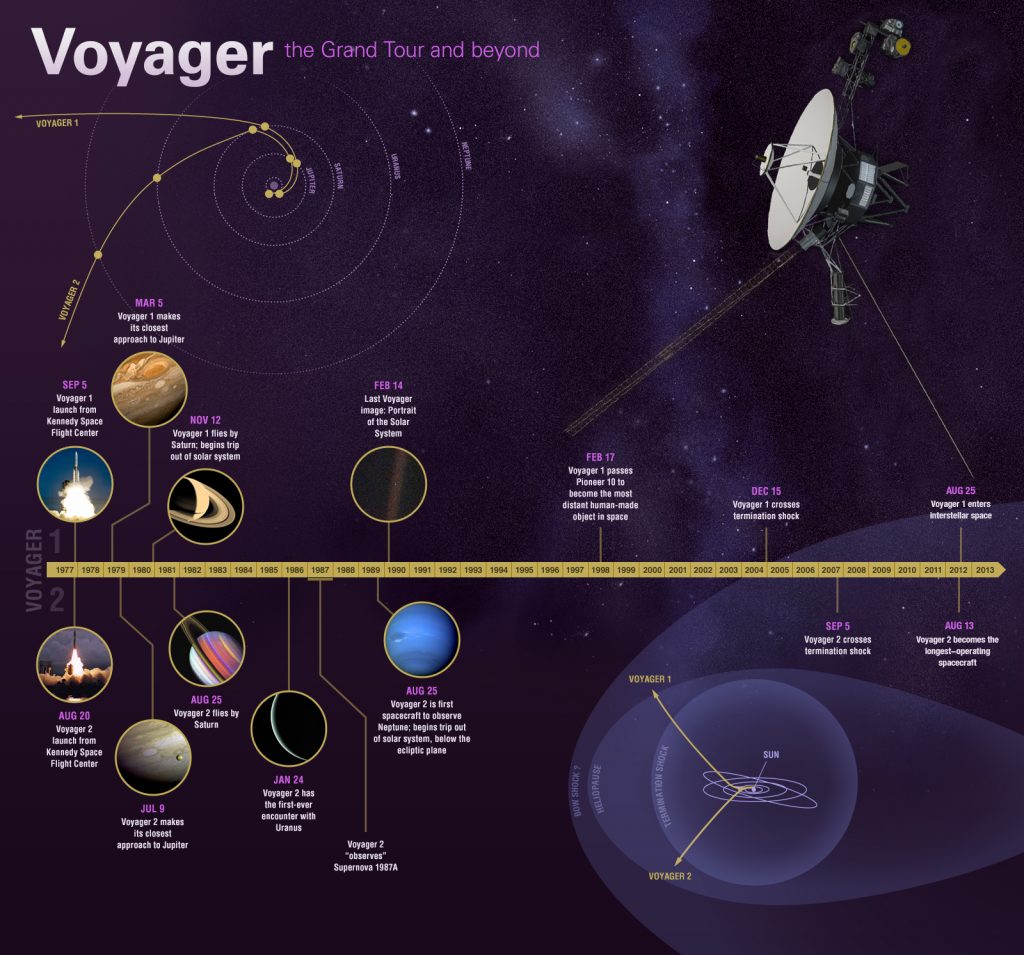
Voyager Mission Timeline

a

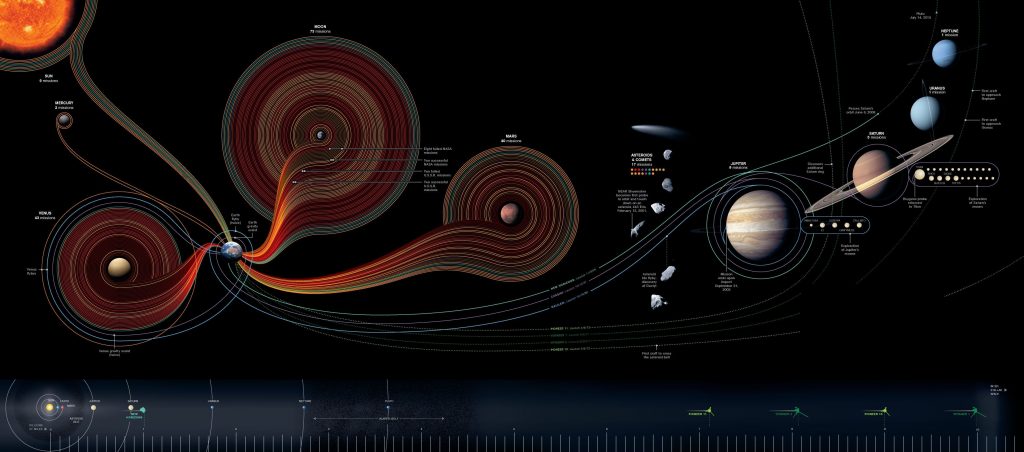
JPL Mission Paths: See how many NASA/JPL past & present missions flew around the universe.

====


The Space Show this week – June.18.2018

The guests and topics of discussion on The Space Show this week:

1. Monday, June 18, 2018; 2-3:30 pm PDT (4-5:30 pm CDT, 5-6:30 pm EDT): Mark Sundahl, Atty, returns to discuss commercial space law, property rights, etc.

2. Wednesday, June 13, 2018: Hotel Mars. See Upcoming Show Menu and the website newsletter for details. Hotel Mars is pre-recorded by John Batchelor. It is archived on The Space Show site after John posts it on his website.

3. Thursday, June 21, 2018: 7-8:30 pm PDT; 9-10:30 pm CDT; 10-11:30 pm EDT: We welcome back Dr. Haym Benarova for this special program.

4. Friday, June 22 2018; 9:30 am -11 am PDT, (12:30 -2 pm EDT; 11:30 am -1 pm CDT): We welcome back Dr. John Brandenburg for his latest science fiction book, Morningstar Rising UFO Armageddon.

5. Sunday, June 24, 2018: 12-1:30 pm PDT; 2-3:30 pm CDT; 3-4:30 pm EDT. Dennis Wingo returns to do a special interview with me about commercial and NewSpace history.

See also:
* The Space Show on Vimeo – webinar videos
* The Space Show’s Blog – summaries of interviews.
* The Space Show Classroom Blog – tutorial programs

The Space Show is a project of the One Giant Leap Foundation.

The Space Show - David Livingston
David Livingston

Everyone can participate in space