A reader responds to the earlier posting about robot assistants in space with a link to this documentary about Robby the Robot, a metallic character first seen in the marvelous 1956 movie Forbidden Planet:
A reader responds to the earlier posting about robot assistants in space with a link to this documentary about Robby the Robot, a metallic character first seen in the marvelous 1956 movie Forbidden Planet:
Filmmaker David Ruck has created a documentary titled, I Want To Be An Astronaut – “The dream of one boy. The fate of one nation. A documentary about our future in space”
“I Want To Be An Astronaut” is a documentary about a young man who has aspired to be an astronaut since he was 3 and the path he now faces to become one. Aside from being a film, we hope to carry a message of inspiration to young people across America by igniting imaginations and fostering the next generation of explorers. While we are not affiliated with NASA or any other organization, we believe in the power of the space program to inspire and engage students. It is by focusing on the raw power of space exploration that we aim to educate young people and give em a little kick in the butt to move ahead with their dreams and work hard to be our next generation of heroes – whatever avenue they pursue. “I Want To Be An Astronaut“ asks–and attempts to answer– imperative issues through interviews with leading space experts as well as exclusive footage of the country’s space centers. Above all, though, the compelling film generates a dialogue not simply about science, but the future of our nation.
According to this update on their Indiegogo site, they are finishing up the documentary and it is being submitted to film festivals for this year.
Here is a trailer:
A Kickstarter crowd-funding campaign opened today for the game Space Pioneer, which was created by a team that includes three cosmonauts: Space Pioneer by Space Enigma Studios — Kickstarter
Our team consists of world famous astronauts, engineers, designers, programmers, artists and architects who allow us to construct a game that will be the most accurate virtual representation of our universe to date. Space Pioneer aims to be a game that is uncompromisingly entertaining and educational. Our game chiefly focuses on interstellar exploration; it is based on images and resources from the Hubble telescope, ESA/NASA, and numerous well known observatories. The player will be able to pilot a fully customizable spaceship into the vast regions of our universe and can colonize other planets beyond our solar system. In addition, he or she can research different scientifically accurate theories to upgrade their spaceship, build vast space stations and terra-form inhospitable planets.
The project is described in this video:
A selection of space policy/politics related items:
Recent space policy related spacecasts:
The latest presentation to the Future In-Space Operations (FISO) study group is now posted in the FISO Working Group Presentations Archive. Both slides (pdf) and audio (mp3) are available for the talk, Co-Robots and the Future of Space Activity, Madhu Thangavelu , USC – Jan.8.14
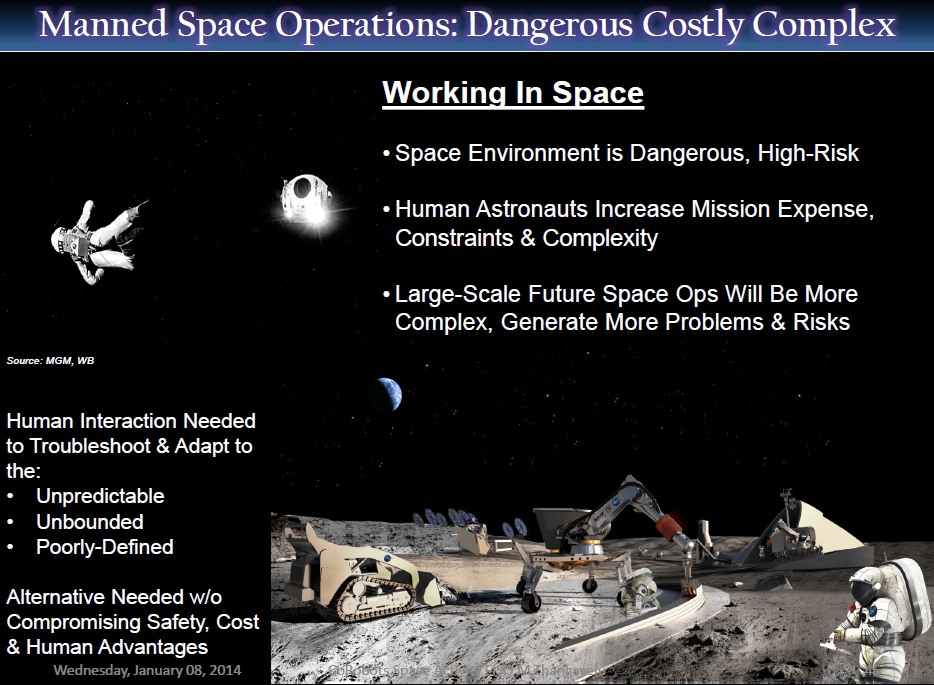
Space exploration and development is often presented as a robot versus manned binary choice but it is really robot versus manned + robot. To accomplish significant development in space, humans will need the productivity multipliers provided by robots, particularly tele-operated ones. Resource extraction and processing, construction, and other tasks in the vacuum and radiation of space, in the dust of the Moon, etc will be controlled by people nearby in safe and cozy habitats.
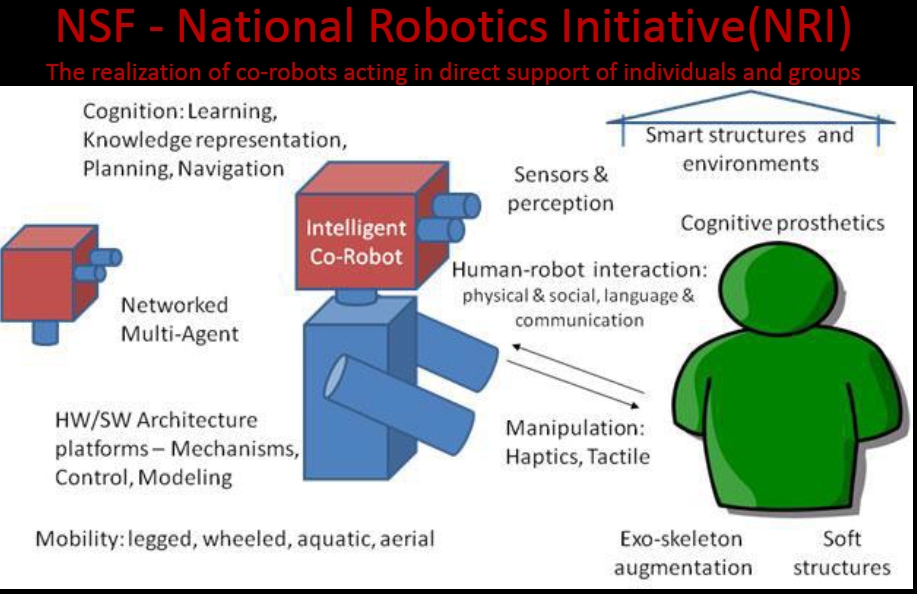
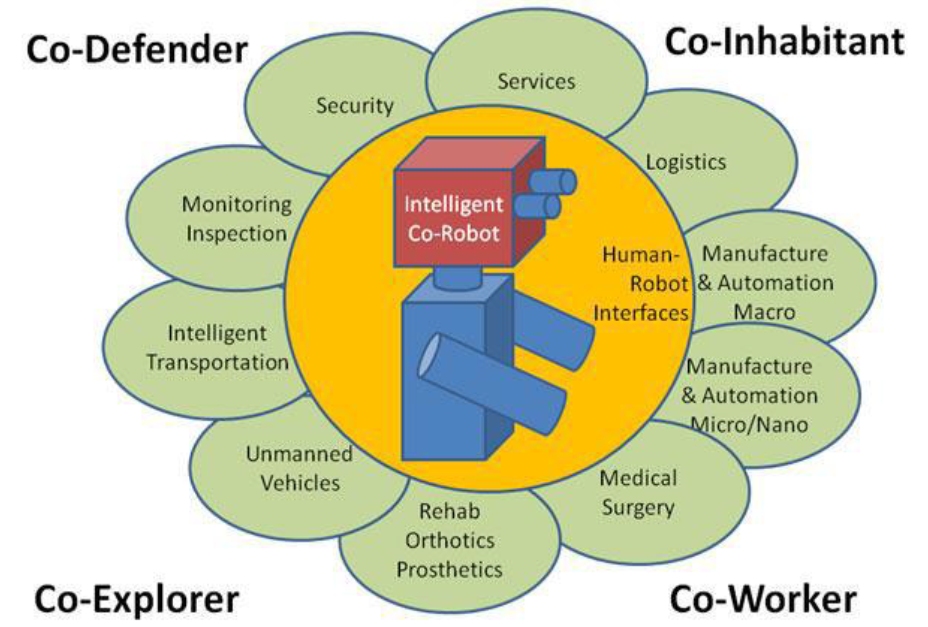
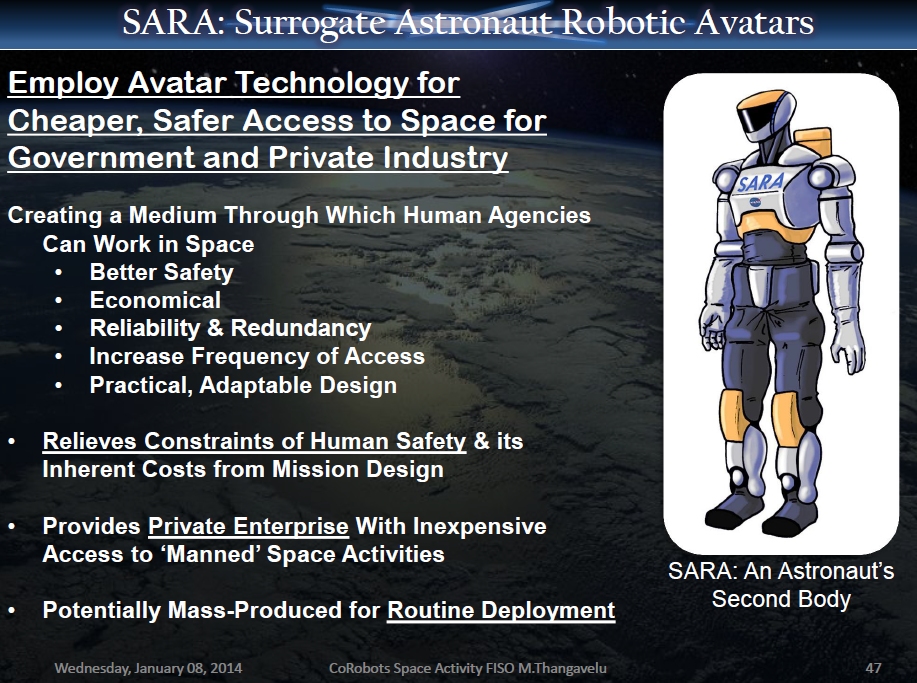
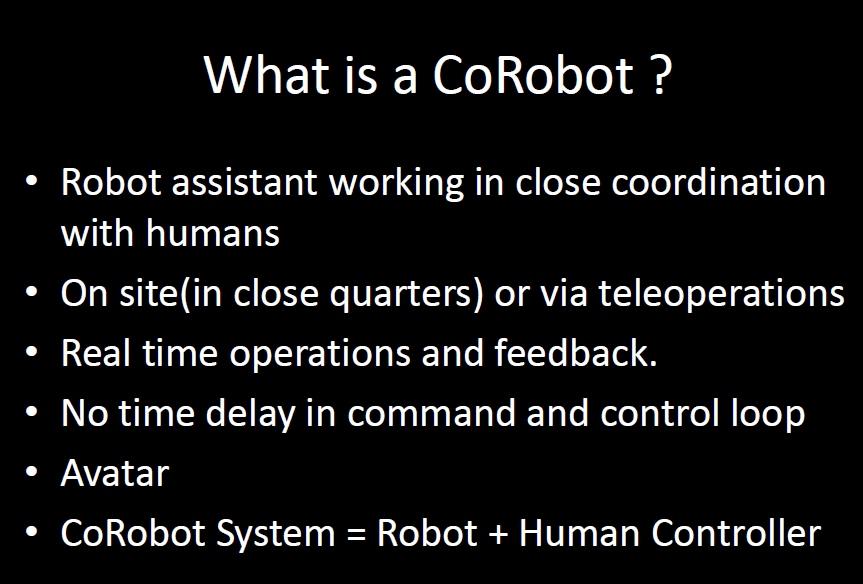
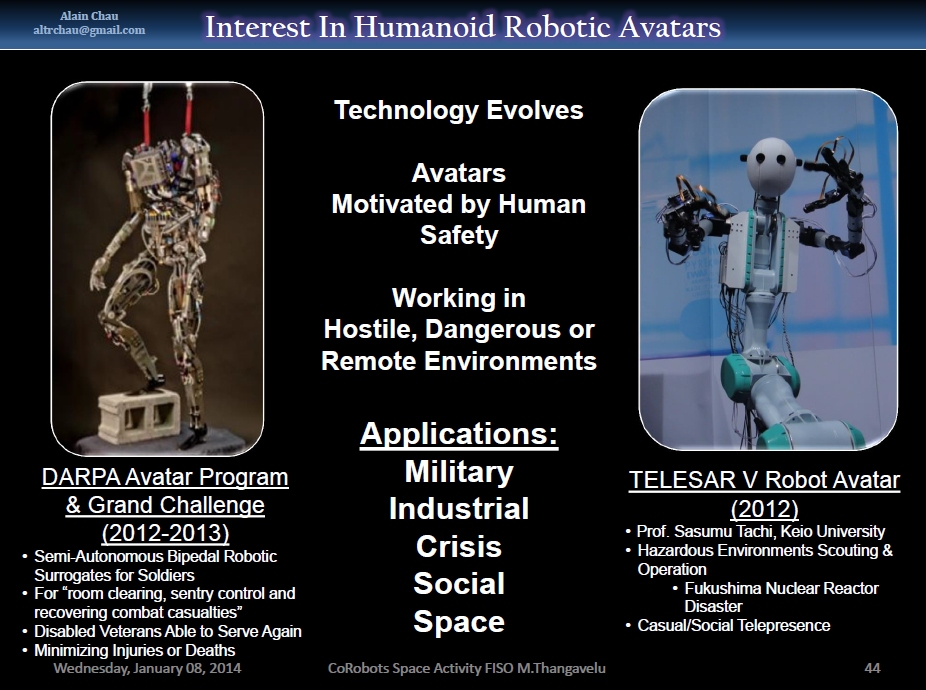
Thangavelu’s presentation discusses many topics related to such scenarios. He starts with the CoRobot concept, in which robots work closely with people to assist them in different ways. He then moves to the SARA (Surrogate Astronaut Robot Avatar) concept in which a person wears an elaborate suit whose movements are mimicked by a robot out, say, on the surface of the Moon. Thangavelu lays out a plan for developing and testing SARA systems starting with a facility on the ISS.
Here is a sampling of his many slides: