After an extended break, Spacevidcast is back for their first show of 2014: The first Spacevidcast of 2014 – Spacevidcast
After an extended break, Spacevidcast is back for their first show of 2014: The first Spacevidcast of 2014 – Spacevidcast
The FUNcube nanosat (now officially designated AO-73) reached orbit last November via a Russian Dnepr rocket. The FUNcube project is led by AMSAT-UK and is intended as
a complete educational single CubeSat project with the goal of enthusing and educating young people about radio, space, physics and electronics.
The project encompasses the FUNcube Dongle, which is a low cost device that plugs into a USB port and turns your computer into
the “ground segment”, or a radio receiver designed to allow anyone to try their hand at reception of satellites like FUNcube anywhere on Earth as part of a global educational collaboration project collecting information from space.
(The Dongle also needs to connect to a simple antenna.)

The satellite has materials on the external surface of the satellite configured with temperature sensors to provide an experiment to study heat radiation and to demonstrate telemetry collection and space research methods. There is now a teachers guide available on how to combine this on-board experiment data with the ground station:
As shown in the above diagram, the telemetry data obtain can be shared at the FUNcube Real Time Data on line warehouse.
====
Find more about FUNcube and other space radio projects in the HobbySpace Radio section.
Science fiction writer and webcaster Doug Turnbull writes about the importance of a cost-effective, sustainable human spaceflight program to maintain support for unmanned space exploration: Will Robots or Astronauts be the Future of Interplanetary Research? – Space.com
The famous line from the movie “The Right Stuff,” which tells the story of America’s early space program, “No bucks, no Buck Rogers,” could easily be reversed to state: “No Buck Rogers, no bucks.” Human spaceflight is sexier than robot missions and thus an easier sell to hard-strapped taxpayers.
Unfortunately, the SLS/Orion boondoggle will only undermine that support:
The causes of the problem are programs like the SLS and the Orion spacecraft, both of which are monumentally expensive projects that will duplicate — granted, in slightly larger form — hardware that has already been created in the private sector. As noted space science and policy writer John Strickland stated in a Nov. 30, 2013, interview on Mars Pirate Radio: “SLS/Orion is a leech on the space program … that takes money away from more deserving and useful projects.”
—
Stewart Money notes the underfunding of and constraints on the commercial crew program in the 2014 budget just passed and wonders what NASA will do with regard to the next step in the program: Commercial Crew Still Under Fire – Innerspace.net
What also is not going to be mentioned apparently, is any similar stipulation that the far more expensive SLS/MPCV programs undergo a cost benefit analysis, or even a cost analysis for that matter. Or even asked to explain what it’s mission is.
Instead, coming in to what should be a definitive year for the Commercial Crew program, culminating in the selection of which company or companies are moving into the final phase, NASA faces a choice; whether to further throttle the entire program as it jumps through the hoops Congress has placed in front of it, or to keep its current schedule with a decision late this year, and necessarily down select to a single winner.
—
More space policy/politics links:
**************************
On Thursday NASA JPL held the Mars Exploration Rover 10-Year Anniversary Event to celebrate the 10 years of exploring Mars with the Opportunity, Spirit, and Curiosity rovers.
During the event Steve Squyres of Cornell showed this intriguing comparison of two images of the same spot near the Opportunity rover : Mystery Rock ‘Appears’ in Front of Mars Rover – Space.com
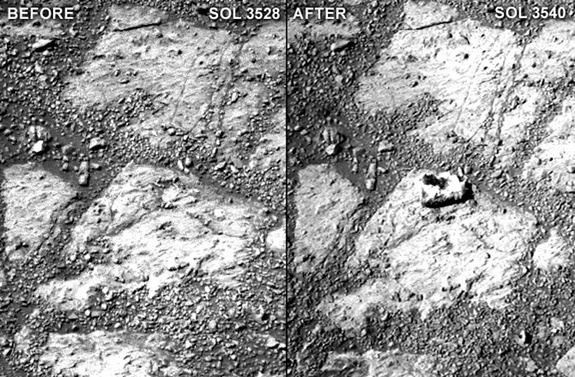 Credit: NASA/JPL-Caltech
Before you start believing in rock throwing Martians, this is most likely a piece of debris kicked up by one of the rover’s wheels.
Commercial communications satellites, weather satellites and other spacecraft are often put into a high equatorial orbit (36000 km high) called the geostationary orbit where the satellite will revolve at the same angular velocity as the earth turns, thus keeping it always above a given spot on the equator. Here is an explanation of geostationary and also of geosynchronous orbits and of how an orbit can be made circular : How to get a satellite to geostationary orbit – The Planetary Society
Putting a spacecraft into geostationary orbit typically starts by a rocket putting it into a highly elliptical orbit with the apogee at 36,000 km. This is called the geostationary transfer orbit. The animation below illustrates how the perigee of a highly elliptical orbit is raised by firing the spacecraft’s own engine at the apogee of the orbit: