The too quiet sun

I’ve posted occasionally  (e.g. see here and here) about the tepid solar activity in what should be a period of awesomely explosive outbursts from our home star. The realization is starting to sink in that this will truly be a very minimal maximum in the solar cycle : Is our Sun falling silent? – BBC (incl. video) 

“I’ve been a solar physicist for 30 years, and I’ve never seen anything quite like this,” says Richard Harrison, head of space physics at the Rutherford Appleton Laboratory in Oxfordshire.

He shows me recent footage captured by spacecraft that have their sights trained on our star. The Sun is revealed in exquisite detail, but its face is strangely featureless.

“If you want to go back to see when the Sun was this inactive… you’ve got to go back about 100 years,” he says.

And

While the full consequences of a quietening Sun are not fully understood, one thing scientists are certain about is that our star is unpredictable, and anything could happen next.

“This feels like a period where it’s very strange… but also it stresses that we don’t really understand the star that we live with.” says Prof Harrison.

“Because it’s complicated – it’s a complex beast.

===

Check the HobbySpace Sun & Space Weather page for daily solar imagery and data.

Video: Neil deGrasse Tyson talks about new Cosmos series with Bill Moyers

Neil deGrasse Tyson was on the Bill Moyers show to talk about his upcoming new miniseries on Fox TV titled Cosmos: A Space-Time Odyssey, which updates Carl Sagan’s famous Cosmos program:

* Neil deGrasse Tyson on the New Cosmos: Part 1 – BillMoyers.com

Neil deGrasse Tyson on the New Cosmos from BillMoyers.com on Vimeo.

* Neil deGrasse Tyson on Science, Religion and the Universe: Part 2 – BillMoyers.com

Neil deGrasse Tyson on Science, Religion and the Universe from BillMoyers.com on Vimeo.

A sampling of citizen science at Zooniverse

I scanned blogs of some of the space related citizen science projects at Zooniverse and turned up this items:

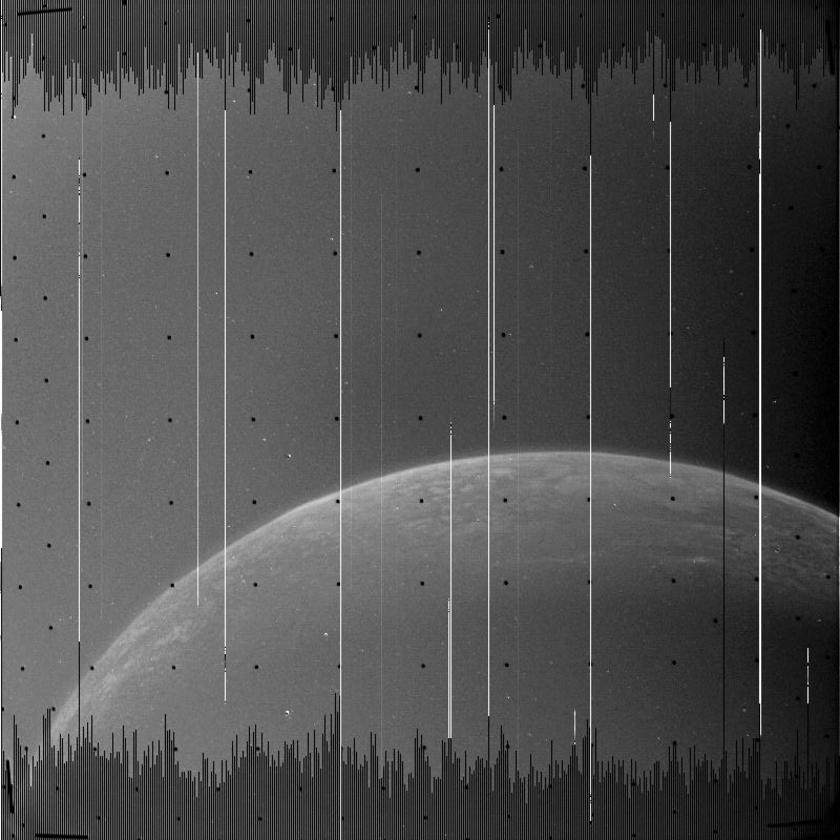
Fans in the Manhattan region of the south pole of Mars


====

This is an old blog post from 2012 but the video looks cool:  See your data analysis like never before! – Solar Stormwatch Blog

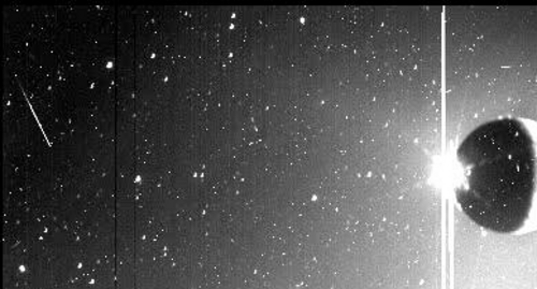
An animation of data scaled from images of the NASA STEREO Heliospheric Imagers by members of the Citizen Science project Solar Stormwatch. For more information, or to participate in the project, visit www.solarstormwatch.com

Raw space imagery – the appeal of imperfection

Raw and flawed space images can sometimes be more compelling than the perfect ones: Through a Glass, Darkly – The Planetary Society

The Machine, at the Edge of ForeverCredits: NASA / JPL
“A raw image sent by Voyager 2 from Neptune’s moon Triton, just 

before the spacecraft slipped away into the darkness beyond the planets,
never to return.”

Sparkling Io
Credits: NASA / JPL
“The Galileo spacecraft catches a peek at Jupiter’s moon Io in

a raw image full of cosmic ray hits and other noise.”

AMSAT & ISS amateur radio news

Go to AMSAT News for the latest headlines about developments in amateur and student satellites and for updates about amateur radio on the ISS.

ANS 019 Weekly AMSAT Bulletin – January 18, 2014:
* ARRL Features Bringing Space into the Classroom
* The Pragmatic Guide for Using the FUNCube Materials Science Experiment in the Classroom
* SA AMSAT Invites Educational Payload Proposals
* PhoneSat 2.4 Ham Radio CubeSat
* UK CubeSat programme in New Electronics
* Peter Portanova W2JV To be Active on Satellites as W1AW/2
* Deorbitsail CubeSat
* 2014 Eastern VHF-UHF-Microwave Conference — April 11-13
* FUNcube-1 in Practical Wireless Magazine
* ARISS News
* Satellite Shorts From All Over

Here is the video discussed in the “Bringing Space into the Classroom” item above. From the caption:

AMSAT Forum at the 2013 Dayton Hamvention and the presentations on education wrapped up with a talk by Mark Spencer, ARRL Education & Technology Program Director. “Spence”, WA8SME, briefly described his classroom experiments for measuring the “wobble” of the Fox satellite, demonstrating a Maximum Power Point Tracker (MPPT) for a solar array, and a lower cost azimuth-elevation rotor system for lightweight satellite antennas

Everyone can participate in space