Space elevator newsletter + Solar sail update + Mars One update

The International Space Elevator Consortium (ISEC) has a new edition of this newsletter out today: ISEC e-Newsletter – May.2014.

In this issue’s President’s Corner, ISEC President Dr. Peter Swan talks about the importance of Involvement – getting active with ISEC and Space Elevator activities.  ISEC has many activities ongoing and we can always use volunteers.  If you are interested, please email Dr. Swan at pete.swan@isec.org.

Also in this issue, we announce the release of the latest ISEC study; this on Design Considerations for Space Elevator Tether Climbers.  The latest in a series of these studies, this one concentrates on how a Tether Climber might operate and is a “must-read” for all those who take an active interest in space elevator technologies.

Dr. Swan also represented ISEC at the recent NSS/ISDC Conference in Los Angeles – more details are shown elsewhere in this eNewsletter.

===

Here’s a status report on solar sail projects such as the Sunjammer Mission (to launch in 2015) : Are Solar Sails the Future of Space Travel? – Space.com

===

And here is the latest Mars One newsletter: Mars One Astronaut Selection Process: The Next Steps

Sci-Tech: Suspended animation for medical apps and space travel

We don’t yet have self-aware robots or low cost transportation to orbit but we do have iPhones and Google search. The latter two are just as sci-fi as the former two technologies for someone who grew up in the 1960s. The future really is hard to predict.  Some tech that seemed almost in hand keeps getting pushed further into the future while occasionally something that seemed extremely far-fetched turns out to be well within reach.

For example, suspended animation, also referred to as induced hibernation or extended torpor (see post here), has been a common plot device in science fiction for ages. It played a prominent role, for example, in the movie 2001: A Space Odyssey where several members of a crew going to Jupiter were put into hibernation to reduce the amount of food, oxygen, etc, needed for the trip. Until recently, I thought this was no closer to reality than Hal but  it looks like it might nearly be in hand  : Suspended Animation Human Trials About to Begin – IFLScience.

It shouldn’t in fact be too surprising. Maintaining patients in unconscious states for days is done routinely in hospitals. Coma patients can be kept alive for months, even years. Occasionally there are reports of someone awakening from a long term coma and continuing with a normal life. So the mechanics of maintaining the vital systems appears to be well understood.

The induced torpor research is aiming to go the next step and lower body temperature to slow metabolic processes even further than in a comatose state. As mentioned in the above article, doctors are using Therapeutic Hypothermia (TH) already to deal with some traumatic injuries.

In the video below (starting at 55:30)  from the NASA Innovative Advanced Concepts (NIAC) Symposium held back in February (see post here), John Bradford of SpaceWorks Engineering and his collaborator Douglas Talk discussed such issues in a presentation about their proposed Torpor Inducing Transfer Habitat For Human Stasis To Mars. Here are their slides (pdf) and see also this infographic (pdf).

As with Discovery-1 expedition, they are proposing to place a crew

in inactive, low-metabolic Torpor state for mission transfer phases by leveraging evolving medical advances in Therapeutic Hypothermia  and Total Parenteral Nutrition.

The benefits of this include:

– Reduction in mission consumables due to inactive crew
– Reduced pressurized volume required for living quarters
– Eliminate many ancillary crew accommodations (food galley, eating  supplies, cooking, exercise equipment, entertainment, etc.)
– Minimize psychological challenges for crew

Watch live streaming video from niac2014 at livestream.com

John Bradford is posting updates on progress with their study at the blog Space Torpor. In a recent post he showed images of a proposed Artificial-Gravity Inducing Torpor Habitat!

artG-torporHab-cut-away[1]

Animation of an Island 3 space colony

An animation of the Island 3 type in-space cylindrical colony proposed by Gerard K. O’Neill in the 1970s: Island Three – An Animation by Steve Gunn – Project Ion

FISO: On-Orbit Servicing + To Mars via 6 not-so-easy pieces + Solar sails

Catching up with recent presentations to the Future In-Space Operations (FISO) study group. The presentation materials are  posted in the FISO Working Group Presentations Archive for the following 3 talks.

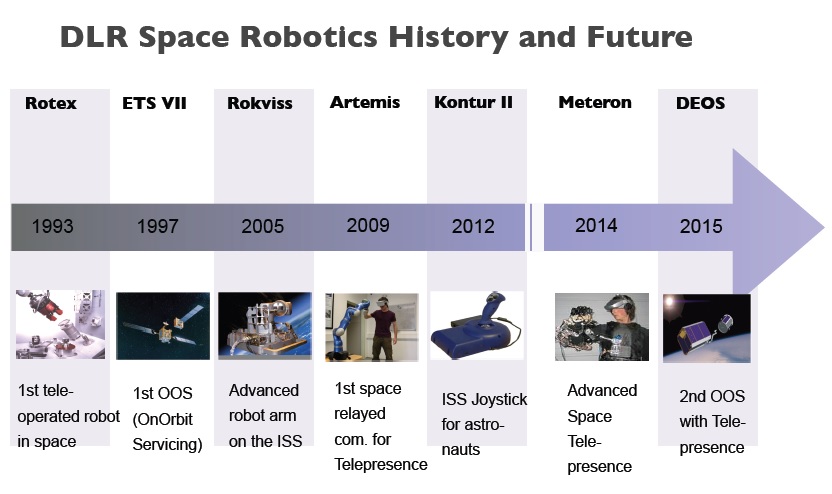
* On-Orbit Servicing: Telepresence and the DEOS Simulator, Jordi Artigas , DLR  – May.7.14

  • An overview of the German space agency (DLR)  in-space robotics projects, past and present. An intro to telepresence
  • Artigas_5-7-14.pdf – slides
  • Artigas.mp3 – audio

A timeline of DLR space robotics projects:

Timeline

====

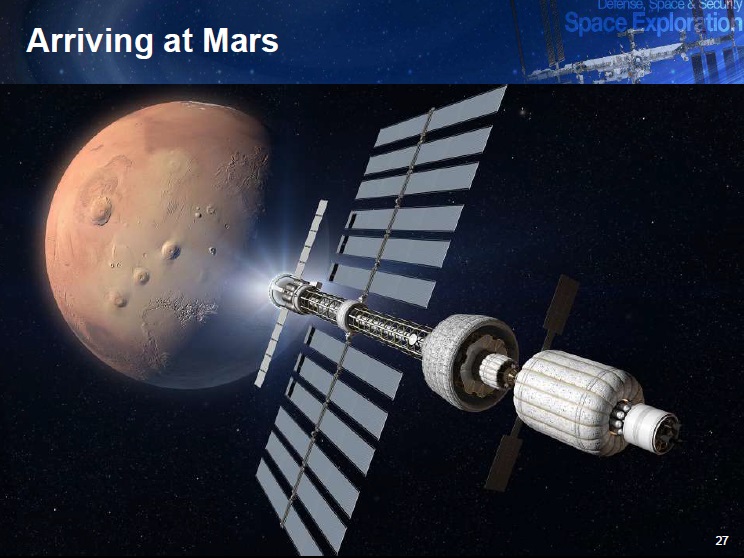
* Mission to Mars Using Six ‘Not So Easy’ Pieces, Mike Raftery, Boeing- May 14, 2014

SEPatMars

====

* Solar Sail Description and Space Weather (and Other) Mission Capabilities, Bruce Campbell , (formally ATK, GSFC) – May 21, 2014

  • An overview of the basics of solar sails, types of solar sails, a review of previous, current and future projects
  • Campbell_5-21-14.pdf – slides
  • Campbell.mp3 – audio

SizeComparisons

Mars Curiosity rover as seen from orbit

Emily Lakdawalla at the Planetary Society processed imagery from ESA’s Mars Express orbiter and NASA’s Mars Reconnaissance Orbiter to produce an amazingly sharp color image of the Curiosity rover and its tracks : New orbital images of Curiosity landing site from Mars Express and HiRISE – The Planetary Society

20140522_ESP_035917_1755_colorized-with_ESP_018854_1755_f840-EmilyLakdawallaHiRISE photo of Curiosity at the Kimberley – March 26, 2014.
Credits: NASA / JPL / UA / Emily Lakdawalla
Click for large version

20140523_color_coverage_curiosity_field_site_20140523_f537_EmilyLakdawallaA map showing the route of Curiosity so far
and where it is going.
Click for large version.

Everyone can participate in space