The Space Walk of Fame Charity Space Memorabilia Auction takes place on Oct. 29. Don’t miss out on this chance to bid on exciting pieces of aerospace history — from photos signed by the Mercury Astronauts to pieces of the Hindenberg to a flown-in-space quilt and SO much more. Over 300 items offered! You can begin bidding NOW at Invaluable.com.
Click HERE to see the auction items and find out how to bid!
Remember that the museum makes a percentage from each sale so you are supporting our STEAM Space education program and helping students and at-risk youth learn about science and technology. Our goal is to move them from away from being passive consumers and TOWARD producing goods, services or digital products.
NO items featured in the memorabilia auction are being sold from the museum collection — these are all consignment pieces or are provided by astronauts or former space workers.
Framed and matted photograph from the Astronaut Scholarship Foundation. Authentically signed by John Glenn, Wally Schirra, Scott Carpenter and Gordon Cooper. A limited edition #261/300. In new condition.
This week we bring on the CTO of Masten Space Systems, Dave Masten. Dave talks about what has been happening with the XS-1 DARPA program as well as his new safer, green Hypergolic fuel.
Space news topics discussed:
* Long March 2F launches Shenzhou 11 * Antares launches Cygnus 0A-5 * Soyuz MS-02 launches * NASA’s Juno Spacecraft Runs Into Problems * Shenzhou 11 Docks with Tiangong-2 * Possible Active Lava Flows Have Been Observed on Venus * TGO orbits Mars, Schiaparelli crash lands
TMRO is viewer supported:
TMRO:Space is a crowd funded show. If you like this episode consider contributing to help us to continue to improve. Head over to http://www.patreon.com/tmro for information, goals and reward levels. Don’t forget to check out our SpacePod campaign as well over at http://www.patreon.com/spacepod
** Urban Aero‘s Cormorant/AirMule vertical-take off and landing (VTOL) ducted fan autonomous vehicle is large enough to transport cargo and one or two persons. I’ve posted here several times over the years about Israeli-based Urban Aero and they appear close to a commercial vehicle. This video starts with an animation but at 1:22 there is footage of a working full-scale prototype flying quickly across the sky:
During the test flight program, the Volocopter demonstrated various dynamic flight maneuvers at higher speeds for the first time.
These test flights did not only serve as a presentation of possible flight dynamics. The actual goal was to gain important knowledge in order to optimize the current developments of the new prototype for serial production. This included determining the VC200’s power requirements during different flight maneuvers and at different speed levels. In order to evaluate the limits of flight behavior, the positioning and height automation, as well as the flight maneuver limits were deactivated during some tests.
A postdoctoral scholarship is available in the Particle and Astroparticle Physics research group ( www.particle.kth.se) at the Department of Physics, KTH Royal Institute of Technology, Stockholm, Sweden.
The position primarily concerns the development of space missions with a focus on X-ray polarimetry. The research group has conducted ballooning campaigns for hard X-ray polarimetry (PoGOLite, PoGO+), participates in the X-ray Imaging Polarimetry Explorer (XIPE) mission proposal for ESA M4, and is developing a national small satellite concept for gamma-ray burst polarimetry. The successful candidate will participate in the further development of X-ray polarisation missons within the group (instrument development and analysis of data from on-going missions).
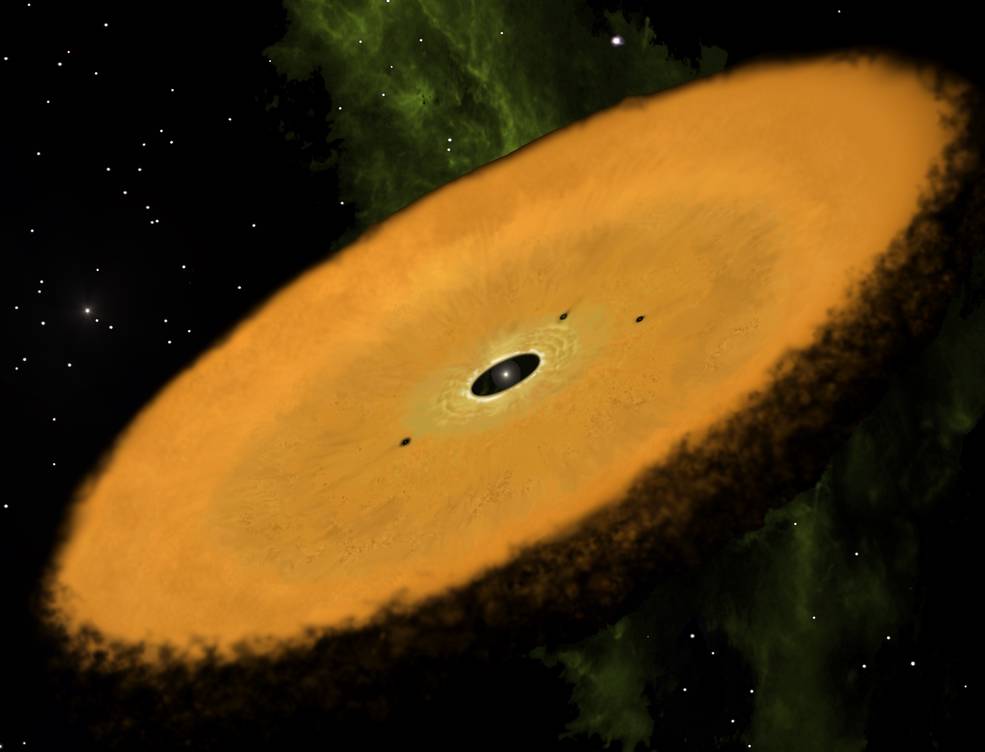
Via a NASA-led citizen science project, eight people with no formal training in astrophysics helped discover what could be a fruitful new place to search for planets outside our solar system – a large disk of gas and dust encircling a star known as a circumstellar disk.
Artist’s concept of the newly discovered disk. Credits: Jonathan Holden
A paper, published in The Astrophysical Journal Letters and coauthored by eight citizen scientists involved in the discovery, describes a newly identified red dwarf star, AWI0005x3s, and its warm circumstellar disk, the kind associated with young planetary systems. Most of the exoplanets, which are planets outside our solar system, that have been imaged to date dwell in disks similar to the one around AWI0005x3s.
The disk and its star are located in what is dubbed the Carina association – a large, loose grouping of similar stars in the Carina Nebula approximately 212 light years from our sun. Its relative proximity to Earth will make it easier to conduct follow-on studies.
“Most disks of this kind fade away in less than 30 million years,” said Steven Silverberg, a graduate student at Oklahoma University and lead author of the paper. “This particular red dwarf is a candidate member of the Carina association, which would make it around 45 million years old. It’s the oldest red dwarf system with a disk we’ve seen in one of these associations.”
Since the launch of NASA’s Disk Detective website in January 2014, approximately 30,000 citizen scientists have performed roughly two million classifications of stellar objects, including those that led to this discovery. Through Disk Detective, citizen scientists study data from NASA’s Wide-field Infrared Survey Explorer mission (WISE), the agency’s Two-Micron All Sky Survey project, and other stellar surveys.
“Without the help of the citizen scientists examining these objects and finding the good ones, we might never have spotted this object,” said Marc Kuchner, an astrophysicist at NASA’s Goddard Space Fight Center in Greenbelt, Maryland, who leads Disk Detective. “The WISE mission alone found 747 million objects, of which we expect a few thousand to be circumstellar disks.”
The eight citizen scientist co-authors, members of an advanced user group, volunteered to help by researching disk candidates. Their data led to the discovery of this new disk.
“I’ve loved astronomy since childhood and wanted to be part of the space program, as did every boy my age,” adds Milton Bosch, a citizen scientist co-author from California. “I feel very fortunate to be part of such a great group of dedicated people, and am thrilled to partake in this adventure of discovery and be a co-author on this paper.”
Disk Detective is a collaboration between NASA, Zooniverse, the University of Oklahoma, University of Córdoba in Argentina, National Astronomical Observatory of Japan, Space Telescope Science Institute, Harvard-Smithsonian Center for Astrophysics, Carnegie Institution of Washington, University of Hawaii and Korea Astronomy and Space Science Institute.
To learn more about opportunities for the public to participate in NASA science and technology projects, visit: www.nasa.gov/solve