ESO: First Giant Planet around White Dwarf Found

The latest news from the European Southern Observatory (ESO):

First Giant Planet around White Dwarf Found
ESO observations indicate the Neptune-like exoplanet is evaporating

This illustration shows the white dwarf WDJ0914+1914 and its Neptune-like exoplanet. Since the icy giant orbits the hot white dwarf at close range, the extreme ultraviolet radiation from the star strips away the planet’s atmosphere. While most of this stripped gas escapes, some of it swirls into a disc, itself accreting onto the white dwarf.

Researchers using ESO’s Very Large Telescope [VLT] have, for the first time, found evidence of a giant planet associated with a white dwarf star. The planet orbits the hot white dwarf, the remnant of a Sun-like star, at close range, causing its atmosphere to be stripped away and form a disc of gas around the star. This unique system hints at what our own Solar System might look like in the distant future.

“It was one of those chance discoveries,”

says researcher Boris Gänsicke, from the University of Warwick in the UK, who led the study, published today in Nature.

The team had inspected around 7000 white dwarfs observed by the Sloan Digital Sky Survey and found one to be unlike any other. By analysing subtle variations in the light from the star, they found traces of chemical elements in amounts that scientists had never before observed at a white dwarf.

“We knew that there had to be something exceptional going on in this system, and speculated that it may be related to some type of planetary remnant.” 

To get a better idea of the properties of this unusual star, named WDJ0914+1914, the team analysed it with the X-shooter instrument on ESO’s Very Large Telescope in the Chilean Atacama Desert. These follow-up observations confirmed the presence of hydrogen, oxygen and sulphur associated with the white dwarf. By studying the fine details in the spectra taken by ESO’s X-shooter, the team discovered that these elements were in a disc of gas swirling into the white dwarf, and not coming from the star itself.

“It took a few weeks of very hard thinking to figure out that the only way to make such a disc is the evaporation of a giant planet,”

says Matthias Schreiber from the University of Valparaiso in Chile, who computed the past and future evolution of this system.

The detected amounts of hydrogen, oxygen and sulphur are similar to those found in the deep atmospheric layers of icy, giant planets like Neptune and Uranus. If such a planet were orbiting close to a hot white dwarf, the extreme ultraviolet radiation from the star would strip away its outer layers and some of this stripped gas would swirl into a disc, itself accreting onto the white dwarf. This is what scientists think they are seeing around WDJ0914+1914: the first evaporating planet orbiting a white dwarf.

Combining observational data with theoretical models, the team of astronomers from the UK, Chile and Germany were able to paint a clearer image of this unique system. The white dwarf is small and, at a blistering 28 000 degrees Celsius (five times the Sun’s temperature), extremely hot. By contrast, the planet is icy and large—at least twice as large as the star. Since it orbits the hot white dwarf at close range, making its way around it in just 10 days, the high-energy photons from the star are gradually blowing away the planet’s atmosphere. Most of the gas escapes, but some is pulled into a disc swirling into the star at a rate of 3000 tonnes per second. It is this disc that makes the otherwise hidden Neptune-like planet visible.

“This is the first time we can measure the amounts of gases like oxygen and sulphur in the disc, which provides clues to the composition of exoplanet atmospheres,”

says Odette Toloza from the University of Warwick, who developed a model for the disc of gas surrounding the white dwarf.

“The discovery also opens up a new window into the final fate of planetary systems,”

adds Gänsicke.

Stars like our Sun burn hydrogen in their cores for most of their lives. Once they run out of this fuel, they puff up into red giants, becoming hundreds of times larger and engulfing nearby planets. In the case of the Solar System, this will include Mercury, Venus, and even Earth, which will all be consumed by the red-giant Sun in about 5 billion years. Eventually, Sun-like stars lose their outer layers, leaving behind only a burnt-out core, a white dwarf. Such stellar remnants can still host planets, and many of these star systems are thought to exist in our galaxy. However, until now, scientists had never found evidence of a surviving giant planet around a white dwarf. The detection of an exoplanet in orbit around WDJ0914+1914, located about 1500 light years away in the constellation of Cancer, may be the first of many orbiting such stars.

According to the researchers, the exoplanet now found with the help of ESO’s X-shooter orbits the white dwarf at a distance of only 10 million kilometres, or 15 times the solar radius, which would have been deep inside the red giant. The unusual position of the planet implies that at some point after the host star became a white dwarf, the planet moved closer to it. The astronomers believe that this new orbit could be the result of gravitational interactions with other planets in the system, meaning that more than one planet may have survived its host star’s violent transition.

“Until recently, very few astronomers paused to ponder the fate of planets orbiting dying stars. This discovery of a planet orbiting closely around a burnt-out stellar core forcefully demonstrates that the Universe is time and again challenging our minds to step beyond our established ideas,”

concludes Gänsicke.
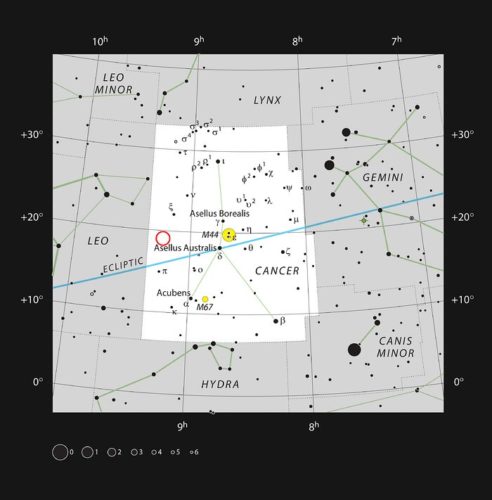
This chart shows the location of WDJ0914+1914 in the constellation of Cancer (The Crab). This map shows most of the stars visible to the unaided eye under good conditions, and WDJ0914+1914 itself is highlighted with a red circle on the image. This white dwarf is orbited by a Neptune-like exoplanet that is evaporating, the first ever giant planet found around a white dwarf.

Links

== Amazon Ad ==

Fire in the Sky:
Cosmic Collisions, Killer Asteroids, and
the Race to Defend Earth

Space transport roundup – Dec.3.2019

A sampling of recent articles, videos, and images dealing with space transport (find previous roundups here):

[ Update Dec.4: Launch postponed due to high winds:

Update: The SpaceX webcast is active for the CRS-19 mission to the ISS (press kit):

And the pre-launch briefing held on Tuesday Dec.3rd:

An explanation was given regarding why the F9 booster is to land on a sea platform rather than return to the pad at Cape Canaveral: SpaceX’s surprise Falcon 9 drone ship landing explained ahead of Cargo Dragon launch – Teslarati.

]

** A SpaceX Falcon 9 is set to launch a Cargo Dragon to the ISS on Wednesday at 12:51 pm EST from Cape Canaveral. SpaceX Targeting Wednesday, Dec. 4, for CRS-19 Launch – SpaceX/NASA. The schedule:

    • 1:30 p.m. Tuesday, Dec. 3 – NASA Social, What’s on Board science briefing highlighting research taking place on CRS-19
    • 4 p.m. Tuesday, Dec. 3 – Prelaunch news conference from Kennedy with representatives from the International Space Station Program Science Office, SpaceX and the U.S. Air Force 45th Space Wing
    • 12:30 p.m. Wednesday, Dec. 4 – Launch countdown coverage begins

The first stage booster will aim to land on a platform at sea rather than return to the Cape landing pad: SpaceX Falcon 9 launch and landing imminent as drone ship heads to sea – Teslarati

In short, the ~350-km-downrange landing plan suggests that this Cargo Dragon launch may have a much smaller propellant margin than essentially every similar mission preceding it. This could be explained in a few ways. Maybe after Falcon 9 B1050’s surprise landing failure, SpaceX decided that all new Falcon 9 boosters will attempt drone ship landings after their first flight, minimizing the risk to Cape Canaveral in the event of a CRS-16 repeat. Another possibility, Crew Dragon capsule C205 – scheduled to support the spacecraft’s In-Flight Abort (IFA) test late this month or early next – may still be close to the Cape’s Landing Zones, another reason to avoid even the slightest chance of a catastrophic Falcon landing failure.

The official weather forecast gives a 90% chance of acceptable conditions at the time of liftoff.

CRS-19 coverage:

SpaceX may fit in four Falcon 9 launches this month counting CRS-19: After a slower launch year—by its standards—SpaceX plans a busy December | Ars Technica

After [CRFS-19], SpaceX should return to the launch pad in the middle of the month for its next launch, which will send the JCSAT 18/Kacific 1 communications satellite into space. This commercial mission is currently slated for no earlier than December 15, also from Space Launch Complex-40 at Cape Canaveral Air Force Station in Florida. If the flight occurs on time, it will require a relatively quick turnaround at the launch pad.

On top of that, there are potentially two more missions before the end of the year—although the schedule for each may slip into January. SpaceX has not yet announced a launch date for the In-Flight Abort test of its Crew Dragon spacecraft, a dramatic test as part of NASA’s Commercial Crew Program that will see the Dragon pull rapidly away from the rocket. SpaceX employees are still working toward a launch by the end of December for the test.

SpaceX also may launch its third batch of 60 Starlink satellites into low-Earth orbit before the end of this month, although the company has not announced an official launch date for this mission either.

More SpaceX items below.

** Uncrewed test flight of Boeing Starliner slips a couple of days: Boeing Uncrewed Flight Test Launch Date Update – Commercial Crew Program/NASA

The launch of Boeing’s uncrewed Orbital Flight Test to the International Space Station, as part of NASA’s Commercial Crew Program, now is targeted for 6:59 a.m. EST Thursday, Dec. 19. NASA, Boeing and United Launch Alliance (ULA) agreed to target the new date to allow ULA sufficient time to resolve an issue with the rocket’s purge air supply. Boeing’s CST-100 Starliner spacecraft will launch atop a ULA Atlas V rocket from Space Launch Complex 41 at Cape Canaveral Air Force Station in Florida.

** Scott Manley reviews Chinese launcher systems:

China is now the number one nation in terms of rocket launches, with most of its launchers tracing their design heritage back to the Dong Feng 5 ICBM. This includes the Long March 2, 3 & 4 – all propelled by YF-20 family Engines burning UDMH & NTO The Newer Long March 5,6 &7 all use new cryogenic propulsion systems. Long March 11 is a solid rocket based system.

China looks to keep up its recent high launch rate: China to continue world-leading launch rate in 2020 – SpaceNews.com.

** Update on the Rocket Lab Electron launch that was postponed from last week:

** Leo Aerospace is developing a high-altitude balloon Launch System: The goal is to offer low cost orbital and suborbital launch services. In addition, the platform can be used for long-loiter high-altitude applications.

Leo Aerospace Regulus high altitude balloon launch system.

Regulus Orbital is Leo Aerospace’s premier high-altitude orbital launch platform.  A fully and rapidly reusable craft, Regulus requires minimal refurbishment over lifetime operations.  Autonomous flight control provides optimized flight capabilities in a range of weather and mission envelopes. Additionally, its on-board, autonomous, command and control infrastructure continuously assesses system health.  Regulus is equipped with a rotational control system, comprised of a series of bipropellant thrusters.  This system is capable of controlling the entire platform’s yaw and roll profiles.  Regulus Orbital is designed for a typical mission of placing 25 kg to 550 km sun-synchronous orbit but can service a range of missions with payload capacity up to 57 kg with no fixed ground infrastructure.

See also : Space Startup Aims to Launch Cubesats on Balloon-Lofted Rockets | Space.com

** Update on construction  of second SpaceShipTwo from Virgin Galactic:

** SpaceX:

[ Update: More about the situation with the Starship assembly operations in Florida:

]

*** A major reduction in Starship assembly activity Florida is underway according to Felix Schlang in his SpaceX news video shown below.

However, Michael Sheetz of CNBC reports that the Florida Starship activities are paused rather than ended:

Some components from the  Florida site are being shipped to Boca Chica:

*** Views of Boca Chica activities:

NASASpaceflight – Dec.3.2019

A check around SpaceX Boca Chica – December 2, 2019
Features: Ongoing site preparation, more deliveries and Big Yellow gets dismantled.
Footage and photos from Mary (@bocachicagal) for NSF.

LabPadre – Dec.3.2019:

It appears that SpaceX is breaking ground for their new launch control center here at Boca Chica, Texas. Fast paced progress ahead for the push of MK-3.  Video Credit: Maria Pointer

== Amazon Ad ==

Moon Rush: The New Space Race

Space policy roundup – Dec.2.2019

A sampling of links to recent space policy, politics, and government (US and international) related space news and resource items that I found of interest (find previous space policy roundups here):

Webcasts:

** Mission Eve: Episode 0112: Harriet Brettle

Harriet Brettle is a business analyst at Astroscale, a commercial space company dedicated to cleaning up orbital debris. Her journey into the Space industry began when, as a young girl, her dad let her down easy: being a witch was not a viable career option. But she could get excited about the planets, sciences and math, which is just what she did. Discover how Harriet went from graduating from university with a degree in mathematics, to a career in finance, to Outreach Coordinator of the Planetary Society, to that fateful day when she landed a major role as part of the Astroscale team. Harriet’s story will make you laugh, feel inspired, and most importantly, remember to never doubt yourself. Space needs Harriet. And space needs you.

** A Recap of the 2019 Canadian Space Summit – SpaceQ

The annual Canadian Space Summit was an opportunity for stakeholders to get together to learn the latest from their colleagues and in the case of this years conference, the public unveiling of a new government conceived SatCom consortium.

In this weeks SpaceQ podcast we’re doing something a little different. In this episode I’m going to fly solo and provide a recap of the conference.

** The Space Show – Mon, 11/25/2019 – Alan Ladwig discussed “space tourism and his new book, See You In Orbit?: Our Dream Of Spaceflight”

** The Space Show – Tue, 11/26/2019 – Dr. David Schrunk discussed Project Moon and developing quality standards for laws, including space laws.

==

== Amazon Ad ==

The Case for Space:
How the Revolution in Spaceflight Opens Up
a Future of Limitless Possibility

The Space Show this week – Dec.2.2019

The guests and topics of discussion on The Space Show this week:

1. Monday, Dec. 2, 2019; 2 pm PST (4 pm CST, 5 pm EST): We welcome back Dr. Sean Casey for new views and perspectives on commercial space and investment.

2. Tuesday, Dec. 3, 2019; 7-8:30 pm PST (9-10:30 pm CST, 10-11:30 pm EST): We welcome Bryce Meyer of CMU for space farming, closed life support and more.

3. Wednesday, Dec. 4, 2019: Pre-recorded Hotel Mars Program with John Batchelor. See Upcoming Show on The Space Show website for details.

4. Thursday, Dec. 5, 2019; 7-8:30 PM PST (9-10:30 pm CST, 10-11:30 pm EST): We welcome back Al Globus for updates regarding his settlement work and low radiation, equatorial orbit space stations.

5. Friday, Dec. 6, 2019; 9:30-11 am PST (1:30 am-1 pm CST, 12:30-2 pm EST): We welcome Dr. Panagiotis (Panos) Tsiotras of IEEE and the Georgia Institute of Technology will discuss AI, robotics, automated systems and more.

6. Sunday, Dec. 18, 2019; 12-1:30 pm PST (3-4:30 pm EST, 2-3:30 pm CST): OPEN LINES. We want your calls. Talk about what is on your mind. All callers welcome on space, science, STEM, STEAM and related subjects.

A message from David Livingston:

Please Help The Space Show Reach Our Campaign Goal
Sunday, Dec. 1, 2019

Dear Space Show Listeners:

The Space Show thanks you for your past and present support. Help us reach our $20K campaign goal for Space Show operating costs & upgrades to digital hybrid phone line equipment for 2020. We are moving toward our goal but we need your help to get there. Please support The Space Show. Use the PayPal banner @ www.thespaceshow.com. Make checks to One Giant Leap Foundation & mail to Box 95, Tiburon, CA 94920. Thank you. Remember your gift is tax deductible as The Space Show with One Giant Leap Foundation is a 501C3 nonprofit

Dr. David Livingston
drspace@thespaceshow.com

Some recent shows:

** Tue, 11/26/2019 – Dr. David Schrunk discussed Project Moon and developing quality standards for laws, including space laws.

** Mon, 11/25/2019 – Alan Ladwig discussed “space tourism and his new book, See You In Orbit?: Our Dream Of Spaceflight”

See also:
* The Space Show Archives
* The Space Show Newsletter
* The Space Show Shop

The Space Show is a project of the One Giant Leap Foundation.

The Space Show - David Livingston
The Space Show – David Livingston

Student and amateur CubeSat news roundup – Dec.2.2019

A sampling of recent articles, press releases, etc. related to student and amateur CubeSat / SmallSat projects and programs (find previous smallsat roundups here):

** The Community Satellite Project aims to crowd-develop CubeSats

The Community Satellite Project is an online group of international space professionals and students, collaborating to launch BATSAT, a crowd-developed cubesat. The group was initially founded in early November 2019 via r/space, following a reputable space company’s offer of a free launch.

Our goals are not only to develop and use BATSAT to conduct cutting edge aerospace research, but to facilitate mentorship between space experts and students.

We are currently in the recruiting and mission defining stages of this process.

If you are interested in becoming part of the team, please get in touch via our Join Us page.

This article profiles one of the project’s founders and describes their plans: Southland teenager on mission to build satellite | Stuff.co.nz

More than 740 people have joined the online group, including aerospace engineers, avionics and payload experts, cloud engineers, satellite ground station engineers and university students from all over the world. 

Of this, 260 supporters with specialist skills have been assigned to various teams to confirm the parameters of the project, with regular conversations held using an online meeting app. 

The collective decision is to build two small satellites, each about the size of a Rubik’s Cube, to test a theory about whether electro-magnetic tether straps can be used to de-orbit a satellite once it has come to the end of its life.

More about the project:

** Freeport, New York high school team building CubeSat funded with NASA grant:  Freeport High School prepares for liftoff | Herald Community Newspapers – www.liherald.com

The students have broken their project into phases, and are now in the construction phase. Once Strong and Johnson finish building the satellite, they will conduct environmental tests to expose it to vibration, vacuum and temperature conditions closely identical to space.

Then the students will work with NASA to prepare to launch it into space. After the launch, the seniors will perform satellite operations and conduct space experiments. Once the space mission is complete, the nanosatellite will fall to Earth, possibly burning up in the atmosphere.

See also District Wins Grant to Build CubeSat – Freeport Public Schools.

** AMSAT news on student and amateur CubeSat/smallsat projects: ANS-335 AMSAT News Service Special Bulletin

  • AMSAT Fox Leaderboard Will Show Monthly Leaders
  • AMSAT Will Be at Superstition Superfest Hamfest
  • Electron Booster on the Pad for Rocket Lab’s 10th Mission
  • FCC Seeks to Clear Radio Amateurs Out of 3.4 GHz
  • WRC-19 Final Report: Small Satellites and the 1240-1300 MHz Band
  • AMSAT Auction Celebrating 45th Birthday of AO-7 Raises $480
  • Upcoming ARISS Contact Schedule
  • Upcoming Satellite Operations
  • Satellite Shorts From All Over

General CubeSat/SmallSat info:

The Juventas radar CubeSat to be deployed by the Hera mission to study the Didymos asteroids. Credits: ESA

== Amazon Ad ==

Introduction to CubeSat Technology and Subsystem:
Orbit Design, Debris Impact, and Orbital Decay Prediction

Everyone can participate in space