1. Monday, March 9, 202: No special programming on this day this week.
2. Tuesday, March 10, 2020: No programming on this day this week.
3. Wednesday, March 11, 2020, Pre-recorded Hotel Mars Program with John Batchelor. See Upcoming Show on The Space Show website for details.
4. Wednesday, March 11, 7-8:30 pm PDT (9-10:30 pm CDT, 10-11:30 pm EDT): We welcome back Professor Madhu Thangavelu of USC for news and updates about his space design class.
5. Thursday, March 12, 2020: No special show today.
This image taken from the Mars Reconnaissance Orbiter (MRO) shows the eastern part of a crater in the East Ius Chasma region. Image Credit: NASA/JPL/UArizona via Universe Today and Carnival of Space.
Here is the latest episode in NASA’s Space to Ground weekly report on activities related to the International Space Station:
** ISS National Lab Mission Overview: SpaceX CRS-20
The International Space Station (ISS) U.S. National Laboratory is sponsoring more than 20 payloads slated to launch onboard SpaceX’s 20th commercial resupply services (SpaceX CRS-20) mission. These payloads represent a diverse mix of research and development seeking to leverage the unique space-based environment of the orbiting laboratory to improve life on Earth. The SpaceX CRS-20 mission is slated for launch no earlier than March 6 at 11:50 p.m. ET from Cape Canaveral Air Force Station in Florida. This video highlights many of the ISS National Lab-sponsored investigations on this mission.
** “What’s on Board” Science Briefing – SpaceX CRS-20 Mission
This is NASA’s “What’s on Board” science briefing at held on Thursday, Feb. 20 at Kennedy Space Center, FL where the science investigations launching on the next SpaceX commercial resupply flight to the International Space Station are presented.]
** Jessica Meir speaks with students in Seattle
Aboard the International Space Station, Expedition 62 Flight Engineer Jessica Meir discussed life and research on the orbital laboratory during an in-flight education event March 2 with middle school students from the greater Seattle, Washington region preparing for a Microsoft Education-hosted design challenge at Seattle’s Museum of Flight. Meir has been in orbit since September and will return to Earth aboard a Russian Soyuz spacecraft in mid-April.
** Expedition 62: Live Interviews Jessica Watkins and Anne Roemer – next astronaut selection.
A sampling of recent articles, press releases, etc. related to student and amateur CubeSat / SmallSat projects and programs (find previous smallsat roundups here):
Since the project was announced in 2018, the team has worked on the conceptual design and definition of the cubesat’s mission. They moved on to the design and building phases in the fall of 2019.
When the cubesat is completed in 2022, it will be launched from the International Space Station – something the team is very excited about.
“We have our very own slot to go into space,” said Mr. Power. “That is very cool and exciting.”
When the satellite is launched into space, it will orbit 400 kilometres above Earth and use global navigation satellite system reflectometry to collect sea ice, waves and wind data.
This involves receiving direct and reflected signals from GPS satellites to measure geophysical features of the ocean such as temperature, salinity and wave height.
Fryeburg Academy is pleased to announce its proposed CubeSat experiment, chosen by the Maine Space Grant Consortium last fall, will launch on the MESAT1 satellite—the very first satellite from the State of Maine. It’s one of 18 small research satellites selected by NASA to carry auxiliary payloads into space between 2021–23, and is part of NASA’s CubeSat Launch Initiative that provides opportunities for nanosatellite science and technology payloads built by universities, schools, and nonprofit organizations to rideshare on space launches.
“We began this venture last year with the formation of our Space Raiders club and working with CubeSat simulators,” says FA’s science teacher Dr. Warren Ziegler. “Since then, we’ve partnered with UMaine Orno and The Wells Estuarine Research Reserve and other partners to leverage their resources and knowledge on our chosen experiment that determines water quality and biological markers through imaging coastal estuaries.”
Ziegler and his club will work with Dr. Ali Abedi from UMaine Orno to assemble the CubeSat satellite experiment— aptly named IMAGER— and Dr. Jason Goldstein who leads the Wells Estuarine Research Reserve in Maine. “Our contributions thus far for the project are the remote sensing and spacecraft attitude control sequences that allow the CubeSat to be controlled inflight,” continues Ziegler. “ The goal is to develop a remote sensing tool by modifying a digital camera to image shallow, coastal waters to distinguish water quality properties such as turbidity and phytoplankton concentration.”
The Aristotle Space & Aeronautics Team (ASAT) is composed of students from the Aristotle University of Thessaloniki. ASAT is developing a 3U CubeSat to conduct a biological experiment that investigates molecular mechanisms that are affected by the space conditions. In particular, they will probe the dynamic regulation of gene expression of eukaryotic cells in Low Earth Orbit, using advances in Synthetic Biology and micro-electro-mechanical systems (MEMS).
In France, the CSUM is the leader in the development of student nanosatellites. We are also a European center of reference devoted to bringing together equipment and skills for the development, production, testing and operation of nanosatellites. These projects involve student interns and encourage regional economic development.
The MTCube underwent vibration and other tests by ExoLaunch before its launch in July 2019. Credtis: CSUM
** Students [sent] homemade satellite into space | Nine News Australia – About the Australis OSCAR 5 amateur satellite built by a group of Melbourne university students and launched into orbit in January 1970.
HOUSTON – Today Axiom Space announced it is planning history’s first fully private human spaceflight mission to the International Space Station.
Axiom has signed a contract with SpaceX for a Crew Dragon flight which will transport a commander professionally trained by Axiom alongside three private astronauts to and from the International Space Station. The mission, set to launch as soon as the second half of 2021, will allow the crew to live aboard the ISS and experience at least eight days of microgravity and views of Earth that can only be fully appreciated in the large, venerable station.
“This history-making flight will represent a watershed moment in the march toward universal and routine access to space,”
Axiom CEO Michael Suffredini said.
“This will be just the first of many missions to ISS to be completely crewed and managed by Axiom Space – a first for a commercial entity. Procuring the transportation marks significant progress toward that goal, and we’re glad to be working with SpaceX in this effort.”
This is the first of Axiom’s proposed “precursor missions” to the ISS envisioned under its Space Act Agreement (SAA) with NASA. Discussions with NASA are underway to establish additional enabling agreements for the private astronaut missions to ISS.
Axiom plans to offer professional and private astronaut flights to ISS at a rate of up to two per year to align with flight opportunities as they are made available by NASA, while simultaneously constructing its own privately funded space station.
“Since 2012, SpaceX has been delivering cargo to the International Space Station in partnership with NASA and later this year, we will fly NASA astronauts for the first time,”
said SpaceX President and Chief Operating Officer Gwynne Shotwell.
“Now, thanks to Axiom and their support from NASA, privately crewed missions will have unprecedented access to the space station, furthering the commercialization of space and helping usher in a new era of human exploration.”
With its team’s vast experience in human spaceflight, Axiom serves as a one-stop shop overseeing all elements of its missions. In addition to contracting with SpaceX for a Crew Dragon vehicle to transport its crew to the ISS, Axiom’s turnkey service for the mission – two days in transit and at least eight days aboard the ISS – includes training, mission planning, hardware development, life support, medical support, crew provisions, hardware and safety certifications, on-orbit operations and overall mission management.
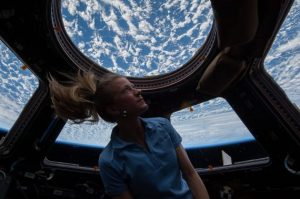
A phenomenal view – the world as seen by NASA astronaut Karen Nyberg from the Cupola of the International Space Station.
NASA recently selected Axiom’s proposal to attach its space station modules to the ISS beginning in the second half of 2024, ultimately creating a new ‘Axiom Segment’ which will expand the station’s usable and habitable volume. When the ISS reaches its retirement date, the Axiom complex will detach and operate as a free-flying commercial space station.
By serving the market for immediate access to space while building the future platform for a global user base, Axiom is leading the development and settlement of low Earth orbit now and into the future.
About Axiom Space: Axiom Space was founded in 2016 with the aim of creating humanity’s home in space to ensure a prosperous future for everyone, everywhere. While building and launching the Axiom Segment of the International Space Station to one day form the world’s first commercial space station, Axiom provides access to the ISS today by conducting crewed missions for professional and private astronauts. More information about Axiom can be found at www.axiomspace.com.
Begin the countdown to the first-ever fully private human spaceflight mission to the International Space Station.