1. Monday, June 22, 2020; 7 pm PDT (9 pm CDT, 10 pm EDT: No special program today.
2. Tuesday, June 23, 2020; 7 pm PDT (9 pm CDT, 10 pm EDT): We welcome back Dr. Jim Logan to discuss the “successful spreading out of humanity into space – PERMANENTLY”, NOT “Exploration” per se – and the most feasible way(s) to establish the first viable toeholds in this “New World” given what we’ve learned (i.e. ‘evidence-based’ not fantasy-based) in almost 60 years of human spaceflight.
3. Wednesday, June 24, 2020: Hotel Mars TBA pre-recorded. See upcoming show menu on the home page for program details.
4. Thursday, June 25, 2020; 7-8:30 pm PDT (9-10:30 pm CDT, 10-11:30 pm EDT): David Livingston and John Batchelor will talk with NASA JPL scientist Dr. Linda Spilker about the Saturn moon Titan and more.
5. Friday, June 26, 2020; 9:30-11 am PDT (11:30 am-1 pm CDT, 12:30-2 pm EDT): We welcome back Jim Lewis from Cape Canaveral to talk about his new space and science fiction work in film. Topics will include SpaceX launches and Jim’s NCOUNTERS TV series getting picked up by Amazon.
6. Sunday, June 28, 2020; 12-1:30 pm PDT (3-4:30 pm EDT, 2-3:30 pm CDT): Welcome to OPEN LINES. All callers and space et al calls welcome. Call and let us know what you want to talk about.
Some recent shows:
** Fri. June/20/2020 – Andrew Chanin of ProcureAM, an exchange traded fund, talked about “space commerce, policy, defense and related investments on a global basis and more”:
** Tues. June.16.2020 – Dr. Harold Sonny White talked aboutt his new non-profit organization, Limitless Space Institute,and their programs. He also “responded to phone calls and emails regarding advanced propulsion, space drives, physics and much more”. Following his 52 minute interview, there was an open lines session with discussions of nuclear propulsion, testing propulsion systems in the lab versus in space, etc.
A sampling of links to recent space policy, politics, and government (US and international) related space news and resource items that I found of interest (find previous space policy roundups here):
Jim Bridenstine on Twitter: “BREAKING: @NASA is developing the process to fly astronauts on commercial suborbital spacecraft. Whether it’s suborbital, orbital, or deep space, NASA will utilize our nation’s innovative commercial capabilities. RFI will be released next week.” – June.19.2020
In this Space Cafe Special, Michelle Hanlon, co-founder of For All Moonkind and Co-Director of the Center for Air and Space Law at the University of Mississippi School of Law, discusses “Race in Space” A Conversation about Equality and Civil Rights. The panel talked about race with diverse perspectives from within and outside the US space community. It was our pleasure to host this incredible panel which included:
Jarard Williams: a recent graduate of the University of Mississippi School of Law who shared his research in a presentation entitled “The Dark Star: Black Representation in Space.”
Yvette Butler: who is joining the law faculty at the University of Mississippi this summer. She discussed recent events, how we got here, and how to engage to both ensure a more equal future and prevent the extension of racism with humans into space.
Kevin Myrick: Co-Founder of Synergy Moon, an official Google Lunar Xprize team, shared how space can help race relations and promote equality and justice.
** 77- Global Intelligence, SAR Satellites and New Insights
On this episode of Constellations, we discuss how Satellite Aperture Radar (SAR) satellites are changing the space industry and how this new technology is impacting markets across the globe. Adam Maher is the CEO of Ursa Space Systems, a start-up company that uses SAR satellite to provide insights into many industries such as energy, oil and gas. Listen as we discuss how Ursa bridges the gap between information-rich data and those companies that are breaking new ground in global intelligence with their vision to “turn data into impact”.
In this week’s Space Cafe Web Talk, Dr. Regina Peldszus and Marc Becker, of DLR Space Administration discussed the concept of ‘dual-use’: how space technologies enable both civilian and military applications. The discussion highlighted key issues at this complex intersection for both domains and addressed policy discourse on the future of applicability for space situational awareness, security, on-orbit servicing, and the possibility of space neutrality.
They provided insight to the post-Cold War space environment and how dual-use has evolved from arms control non-proliferation to an opportunity to cultivate technology for multipurpose systems. It was an encouraging perspective on exploring commonalities and synergies amongst military and non-military stakeholders. The conversation inspires much consideration about how space actors are diversifying use of the same systems and how this is altering the regulatory approach.
Dr. Christopher Newman is Professor of Space Law and Policy at Northumbria University. We’re talking about an important but not oft-seen issue in space, which is a part of many areas such as space situational awareness: environmental protection. The first thing you’re likely to notice is that phrase, like many things in space, does not quite mean what you first thought. It is farther reaching and more broadly applied. Dr. Newman and Cold Star Project host Jason Kanigan discuss:
– Why we should care about environmental protection in space
– What capabilities exist for environmental protection to be included or executed through space law
– The issues with enforcement of any agreements
– Christopher’s experience with implementing environmental protection though space law
– What the good doctor would download directly into his students’ skulls, “Matrix-style”, if he could and more.
SpaceNews talked with the colonel leading AFRL’s effort to keep the U.S. military “one step ahead in space” by fostering key enabling technologies.
The Air Force Research Laboratory’s Space Vehicles Directorate in New Mexico is one of 23 space-related organizations set to transfer to the U.S. Space Force under plans unveiled last month.
As the Department of the Air Force’s “Center of Excellence” for space technology R&D, the Space Vehicles Directorate develops, demonstrates and transitions critical technologies for the entire gamut of military space missions, including communications; positioning, navigation and timing, missile warning, space situational awareness, and defensive space control.
Col. Eric Felt, the Air Force officer who leads the Space Vehicles Directorate and its team of 1,000 military, civilian, and on-site contractors, will talk with SpaceNews Staff Writer Sandra Erwin and Editor-in-Chief Brian Berger about the R&D investments the directorate is making to help the U.S. military maintain a technological advantage in the space domain.
– How can the U.S build more resilient space technology in the face of anti-satellite threats? – What is the role of the private sector in bringing innovation into military programs? – How does the standup of the U.S. Space Force change the thinking about R&D investments?
Also joining the conversation will be Paul Jaffe, a U.S. Naval Research Laboratory engineer and principal investigator for a space-based solar power experiment flying on the X-37B autonomous spaceplane the Space Force launched May 17.
Jaffe will discuss the experiment and what it could mean for future capabilities to harvest power from space.
** Virtual Summit on Geospatial and Earth Observation Industrial Policy for India – Geospatial World
With an intent to have consultation and engagement with larger section of leadership across commercial industry, government institutions, and civil society, Geospatial Media in partnership with World Geospatial Industry Council is organizing a virtual summit on ‘Geospatial and Earth Observation Industrial Development Strategy for India
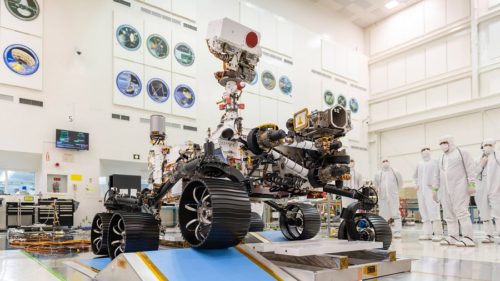
NASA’s Perseverance Mars rover is just over a month from its July 20 targeted launch date. The rover’s astrobiology mission will seek signs of past microscopic life on Mars, explore the geology of the Jezero Crater landing site, and demonstrate key technologies to help prepare for future robotic and human exploration. And the rover will do all that while collecting the first samples of Martian rock and regolith (broken rock and dust) for return to Earth by a set of future missions.
In a clean room at NASA’s Jet Propulsion Laboratory in Pasadena, California, engineers observed the first driving test for NASA’s Mars 2020 [now named Perseverance] rover on Dec. 17, 2019. Credits: NASA JPLThis video describes the efforts to keep the project on track during the coronavirus pandemic:
Getting a Mars rover built, tested and to the launch pad is a feat that requires the dedication of hundreds of team members. The team behind NASA’s Perseverance Mars rover faced one of its biggest challenges when the coronavirus pandemic struck during a crucial time before launch. The safety of the team members became top priority yet they rose to the challenge of completing the rover on time for its launch date, either by working remotely or under new “safe at work” procedures. They developed an increased appreciation for the name of the rover and in May they created the COVID-19 Perseverance Plate, which is now mounted on the side of the rover. The plate commemorates all those impacted by the pandemic and pays special tribute to front line health care workers. Perseverance is targeted to launch from Cape Canaveral, Florida, on July 20, 2020. It will land on Mars on February 18, 2021.
China plans to launch its first Mars exploration mission Tianwen-1 between July and August, Bao Weimin, academician of Chinese Academy of Sciences and director of the Science and Technology Commission at the China Aerospace Science and Technology Corporation, has told CCTV while sharing details about the mission.
According to the plan, the Mars probe will release a rover after a soft landing on the planet and the rover will stay on Mars for 90 Mars sols, or days, on a variety of missions, including reconnaissance and exploration of the Martian landscape.
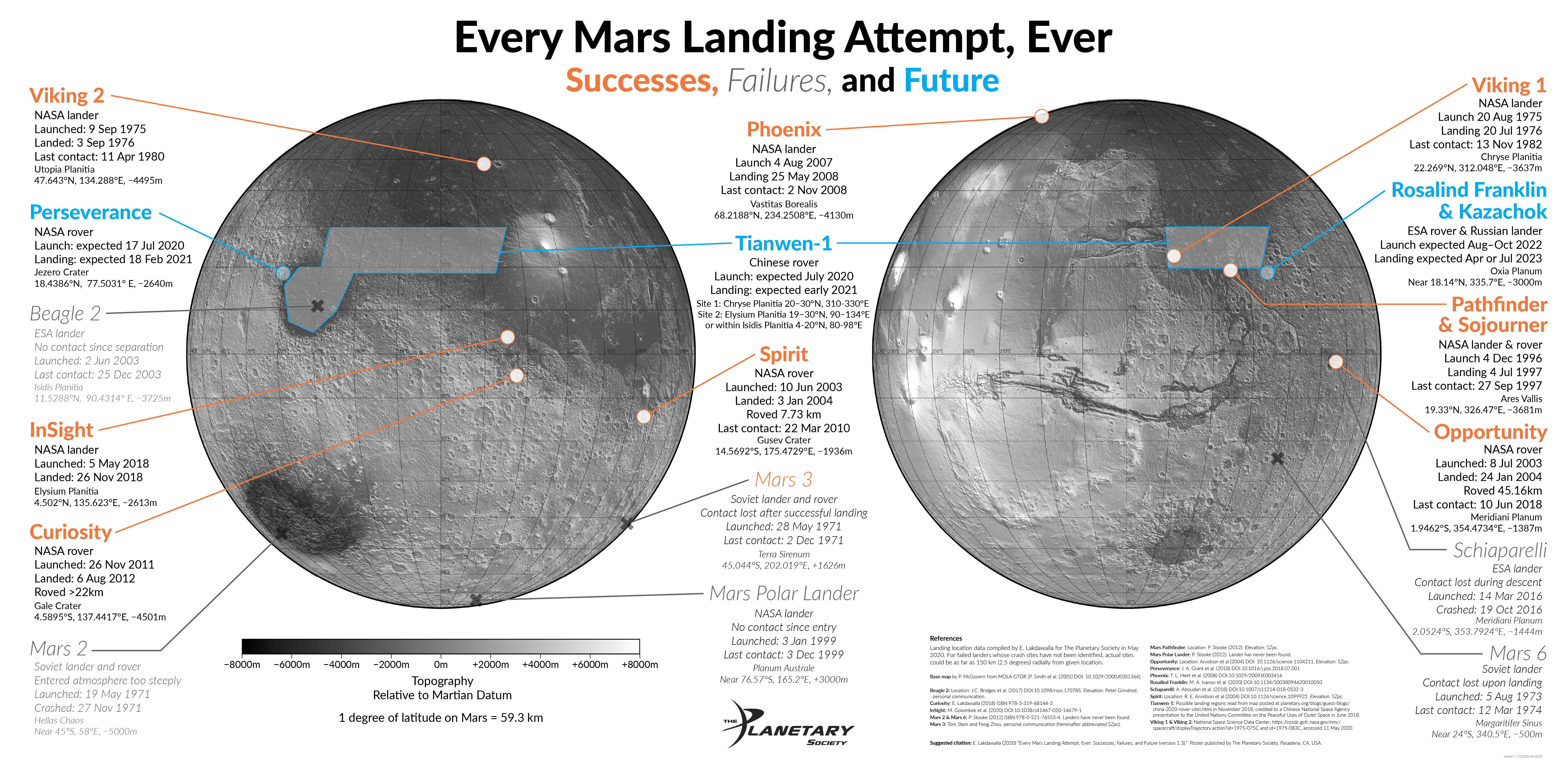
** Check out the Planetary Society’s Mars map showing every landing attempt, including both successes and failures:
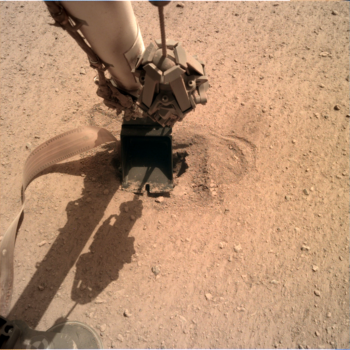
** Latest on efforts to help Insight’s thermometer dig into the Martian surface. The Insight lander set down on the Martian surface on Nov. 26, 2018. A seismometer was set on the ground soon after and has worked well. The HP3 temperature probe was to dig several meters into the ground and measure the temperature. It has not been as successful. The probe’s digging mechanism failed to get a grip in the loose soil in the upper level of the ground and reached less than a meter down The Insight team subsequently came up with a plan to use the lander’s robotic arm to push on the probe until it reached firmer material and could then dig on its own. The
[ Update: Scott Manley describes the parallax experiment:
]
** The relative sizes of the major solar system objects. Here is a cool animation illustrating the relative sizes of the planets, dwarf planets, satellites and asteroids.
In May there was practically no sunspot activity. As the month began, a sunspot faded away, and then, just as the month ended, a sunspot began to appear. Both sunspots had polarities that assign them to the coming solar maximum. Both (as have other new cycle sunspots over the past year) suggest that we will have a solar maximum in the coming five years, not a grand minimum with no sunspots for decades.
The lack of sunspots for the entire month, however, also suggests that the ongoing minimum will be the deepest in centuries. In fact, the number of days where the Sun’s visible hemisphere was blank both last year and this year remains the highest in two centuries. This lack of sunspots also strengthens the possibility that the next maximum will also be the weakest in two centuries.
Xplore Founder and Chief Operating Officer, Lisa Rich said, “We are pleased to announce NOAA has awarded Xplore a study to evaluate the feasibility of a commercial Lagrange point mission with our Xcraft spacecraft. We welcome the potential future opportunity to provide commercial services that can be leveraged to better understand the Sun and provide advanced warning to protect our critical infrastructure.” She continued, “Xplore’s unique, Space as a Service business model provides a cost-effective solution enabling organizations like NOAA to purchase just the data they need via service agreements without having to buy the whole system. Our award further confirms NOAA’s commitment to leverage new commercial services to provide the environmental data needed for understanding the weather here on Earth and in space.”
The Earth-Sun L1 Lagrange point is located approximately a million miles (1.6 million km) from the Earth toward the Sun and three times farther than the Moon – quite the distance when compared to the International Space Station, which is merely 254 miles away. Xplore’s multi-mission ESPA-class space vehicle, the Xcraft™ is designed for missions beyond Earth orbit that include the Moon, Mars, Venus, near-Earth asteroids and Lagrange points, the focus of Xplore’s NOAA mission study.
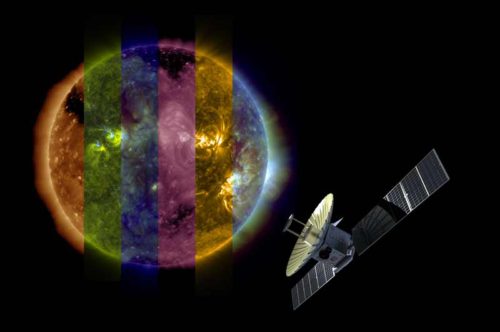
Xplore may develop an observatory to observe the Sun in different spectral bands. Credit: Xplore
ESA’s Sun-exploring mission Solar Orbiter has made its first close approach to the star on June 15, getting as close as 77 million kilometres to its surface, about half the distance between the Sun and Earth.
In the week following this first perihelion, the point in the orbit closest to the Sun, the mission scientists will test the spacecraft’s ten science instruments, including the six telescopes on-board, which will acquire close-up images of the Sun in unison for the first time. According to ESA’s Solar Orbiter Project Scientist Daniel Müller, the images, to be released in mid-July, will be the closest images of the Sun ever captured.
“We have never taken pictures of the Sun from a closer distance than this,” Daniel says. “There have been higher resolution close-ups, e.g. taken by the four-meter Daniel K. Inouye Solar Telescope in Hawaii earlier this year. But from Earth, with the atmosphere between the telescope and the Sun, you can only see a small part of the solar spectrum that you can see from space.”
NASA’s Parker Solar Probe, launched in 2018, makes closer approaches. The spacecraft, however, doesn’t carry telescopes capable of looking directly at the Sun.
“Our ultraviolet imaging telescopes have the same spatial resolution as those of NASA’s Solar Dynamic Observatory (SDO), which takes high-resolution images of the Sun from an orbit close to Earth. Because we are currently at half the distance to the Sun, our images have twice SDO’s resolution during this perihelion,” says Daniel.
Moon
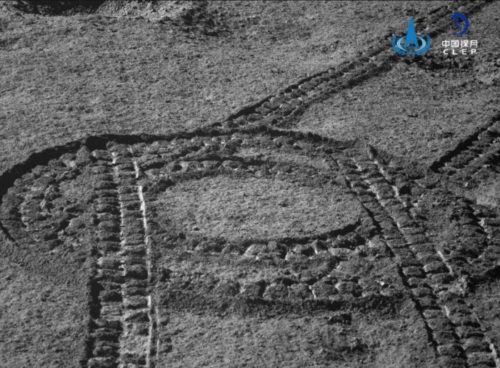
** The Chinese lander Chang’e 4 and the lander Yutu-2 awoke on June 15th after another lunar night and are back at work investigating the Moon’s farside. This is the 19th lunar day since the mission landed on January 3, 2019 in the Von Karman Crater located in the South Pole-Aitken Basin.
After a long hiatus, the China National Space Administration in 2013 finally returned telescopes to the Moon. But this time, no astronauts were required. This first-ever remotely controlled lunar telescope was an add-on instrument that flew with the Chang’e-3 lander.
At just 6 inches in diameter, the Lunar-based Ultraviolet Telescope (LUT) is a far cry from the kinds of instruments astronomers have long dreamed about sending to the Moon. But even at that size, the wavelengths LUT observes can offer unique insights into the cosmos, all without interference from Earth.
Chinese scientists used LUT to collect thousands of hours’ worth of data, tracking stars and even galaxies. And, perhaps more importantly, the telescope’s stable performance also served as a technology demonstration for future missions.
Chinese scientists have since used the telescope to carry out studies of the universe viewed through previously unexplored radio wavelengths. However, due to the modest abilities of the instrument, their observations are limited to the relatively nearby cosmos.
Citizen science pioneers recently made two contributions to a better knowledge of outer space. Backyard astronomers of the SETI Institute and Unistellar network conducted in April citizen science observations, and their discoveries will improve our understanding of asteroids and exoplanets. Thanks to their work, we know precisely the location of the main-belt asteroid 2000 UD52 and have confirmed an exoplanet transit of Qatar-1b.
** Asteroids and Comets
** What are rubble pile asteroids with SETI Institute scientist, Michael Busch. – SETI Institute
Bennu is considered a potentially dangerous asteroid. Its orbit is such at there is a very tiny chance (less than 1 in 2,700) that it will hit the Earth late in the next century. What OSIRIS-REx has shown us, however, is that though the asteroid is 1,600 feet across with a mass of about 85 million tons, if it should cross paths with the Earth a large percentage of it, possibly almost all, will break apart and burn up in the atmosphere before hitting the ground.
At the same time, we know as yet little about the asteroid’s interior. While present data suggests the asteroid is 20 to 40 percent empty space, there still could be buried beneath its gravel pile surface much larger structurally sound pieces that could barrel their way through the atmosphere and smash into the ground.
To find out, we need to learn how to safely and accurately map its interior. Only then will we know if Bennu is truly a threat, or simply a vehicle for providing some future generation on Earth a truly spectacular fireworks show.
** What to do about asteroid threats. A panel discussion at the SETI Institute:
Could an asteroid strike our planet in the future? Astronomers think so since thousands of near-earth asteroids (NEAs) cross our planet’s path. However, the good news is that an asteroid impact is a preventable large-scale disaster. NASA has recently opened a Planetary Defense Coordination Office to manage its ongoing mission of so-called “Planetary Defense.” One of the programs is to find, track, and characterize at least 90 percent of the predicted number of NEAs that are at least 140 meters — bigger than a small football stadium — and characterize a subset of them, so we develop projects to deflect them if needed. How are NEAs found and tracked? What are the expected NEA close approaches?
Researchers from the University of Geneva, have confirmed the existence of the Proxima b extrasolar planet using measurements from the Swiss-built ESPRESSO spectrograph.
The existence of a planet the size of Earth around the closest star in the solar system, Proxima Centauri, has been confirmed by an international team of scientists including researchers from the University of Geneva (UNIGE). The results, which you can read all about in the journal Astronomy & Astrophysics, reveal that the planet in question, Proxima b, has a mass of 1.17 earth masses and is located in the habitable zone of its star, which it orbits in 11.2 days.
This breakthrough has been possible thanks to radial velocity measurements of unprecedented precision using ESPRESSO, the Swiss-manufactured spectrograph – the most accurate currently in operation – which is installed on the Very Large Telescope in Chile. Proxima b was first detected four years ago by means of an older spectrograph, HARPS – also developed by the Geneva-based team – which measured a low disturbance in the star’s speed, suggesting the presence of a companion
The planet, however, appears to offer a very challenging environment for life to arise:
Although Proxima b is about 20 times closer to its star than the Earth is to the Sun, it receives comparable energy, so that its surface temperature could mean that water (if there is any) is in liquid form in places and might, therefore, harbour life.
Having said that, although Proxima b is an ideal candidate for biomarker research, there is still a long way to go before we can suggest that life has been able to develop on its surface. In fact, the Proxima star is an active red dwarf that bombards its planet with X rays, receiving about 400 times more than the Earth.
“Is there an atmosphere that protects the planet from these deadly rays?” asks Christophe Lovis, a researcher in UNIGE’s Astronomy Department and responsible for ESPRESSO’s scientific performance and data processing.
“And if this atmosphere exists, does it contain the chemical elements that promote the development of life (oxygen, for example)? How long have these favourable conditions existed? We’re going to tackle all these questions, especially with the help of future instruments like the RISTRETTO spectrometer, which we’re going to build specially to detect the light emitted by Proxima b, and HIRES, which will be installed on the future ELT 39 m giant telescope that the European Southern Observatory (ESO) is building in Chile.”
There may be a second small planet as well:
In the meantime, the precision of the measurements made by ESPRESSO could result in another surprise. The team has found evidence of a second signal in the data, without being able to establish the definitive cause behind it.
“If the signal was planetary in origin, this potential other planet accompanying Proxima b would have a mass less than one third of the mass of the Earth. It would then be the smallest planet ever measured using the radial velocity method”, adds Professor Pepe.
** CHEOPS (Characterizing Exoplanet Satellite) is a smallsat launched last December to study exoplanets. The mission is part of a EU program to fund science missions at a lower cost that then traditional big . The
CHEOPS has reached its next milestone: Following extensive tests in Earth’s orbit, some of which the mission team was forced to carry out from home due to the coronavirus crisis, the space telescope has been declared ready for science. CHEOPS stands for “CHaracterising ExOPlanet Satellite”, and has the purpose of investigating known exoplanets to determine, among other things, whether they have conditions that are hospitable to life.
CHEOPS is a joint mission by the European Space Agency (ESA) and Switzerland, under the leadership of the University of Bern in collaboration with the University of Geneva (UNIGE). After almost three months of extensive testing, with part of it in the midst of the lockdown to contain the coronavirus, on Wednesday, March 25, 2020, ESA declared the CHEOPS space telescope ready for science. With this achievement, ESA has handed over the responsibility to operate CHEOPS to the mission consortium, which consists of scientists and engineers from approximately 30 institutions in 11 European countries.
For this testing period, the team chose
the planetary system HD 93396 which is in the Sextans constellation, some 320 light years away from Earth. This system consists of a giant exoplanet called KELT-11b, which was discovered in 2016 to orbit this star in 4.7 days. The star is almost three times the size of the sun.
The team chose this particular system because the star is so big that the planet takes a long time to pass in front of it: in fact, almost eight hours. “This gave CHEOPS the opportunity to demonstrate its ability to capture long transit events otherwise difficult to observe from the ground, as the ‘astronomical’ part of the night for ground-based astronomy usually takes less than eight hours,” explains Didier Queloz, professor at the Astronomy Department of the Faculty of Science at the University of Geneva and spokesperson of the CHEOPS Science Team. The first transit light curve of CHEOPS is shown in Figure 3, where the dip due to the planet occurs approximately nine hours after the he beginning of the observation
The transit of KELT-11b measured by CHEOPS enabled determining the size of the exoplanet. It has a diameter of 181,600 km, which CHEOPS is able to measure with an accuracy of 4’290 km. The diameter of the Earth, in comparison, is only approximately 12,700 km, while that of Jupiter – the biggest planet in our solar system – is 139,900 km. Exoplanet KELT-11b is therefore bigger than Jupiter, but its mass is five times lower, which means it has an extremely low density: “It would float on water in a big-enough swimming pool,” says David Ehrenreich, CHEOPS Mission Scientist from the University of Geneva. The limited density is attributed to the close proximity of the planet to its star. Figure 4 shows a drawing of the first transit planet system to be successfully observed by CHEOPS.
Benz explains that the measurements by CHEOPS are five times more accurate than those from Earth. “That gives us a foretaste for what we can achieve with CHEOPS over the months and years to come,” continues Benz.
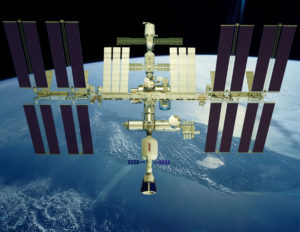
Here is the latest episode in NASA’s Space to Ground weekly report on activities related to the International Space Station:
** Down to Earth – The Fragile Earth – NASA Johnson
In celebration of the upcoming #SpaceStation20th anniversary, European Space Agency Astronaut Luca Parmitano, who has flown two missions, shares his new awareness of how we are changing and influencing our planet in this this episode of “Down to Earth – The Fragile Earth.”
** Expedition 63 Inflight CBS News, Fox Business, CNN Business – June 16,2020 – NASA
Aboard the International Space Station, Expedition 63 Flight Engineers Robert Behnken and Douglas Hurley of NASA discussed the progress of their mission on the orbital outpost during a series of in-flight interviews June 16 with CBS News, CNN Business News and Fox Business News. Behnken and Hurley launched on the SpaceX Crew Dragon spacecraft May 30 and arrived at the station on May 31, marking the first launch of U.S. astronauts on an American spacecraft from American soil to the station since the retirement of the space shuttle in 2011.
** A Recipe for Cooling Atoms to Almost Absolute Zero – NASA JPL
NASA’s Cold Atom Lab aboard the International Space Station cools atoms down to a billionth of a degree above absolute zero, or the temperature at which atoms should stop moving entirely. Nowhere in the universe are there atoms that reach this temperature naturally. But how do scientists accomplish this feat? It’s a three-step process that starts with scientists hitting the atoms with precisely-tuned lasers to slow them down.
The colder atoms are, the slower they move, and the easier they are to study. Ultracold atoms can also form a fifth state of matter, called a Bose-Einstein condensate (BEC). Learning about the fundamental properties of atoms has laid the foundation for technologies that most of us use every day, such as computers. As the first ultracold atom facility in Earth orbit, Cold Atom Lab is opening up new avenues for investigation. You can learn more about Cold Atom Lab here: https://coldatomlab.jpl.nasa.gov/
A sampling of recent articles, press releases, etc. related to student and amateur CubeSat / SmallSat projects and programs (find previous smallsat roundups here):
NASA is inviting additional teams to compete in the Cube Quest Challenge. You can still participate in the in-space phase of the challenge and be eligible to win part of a $4.5 million prize purse.
The Cube Quest Challenge, NASA’s first in-space competition, incentivizes teams to design, build and deliver small satellites capable of advanced operations near and beyond the Moon. To compete, new teams meeting the eligibility criteria must obtain a ride to deep space for their CubeSats – either through commercial launch opportunities or programs like NASA’s CubeSat Launch Initiative.
“We welcome new teams to join us in this challenge in pursuit of advancing space exploration,” said Monsi Roman, program manager for NASA’s Centennial Challenges. “When we established the Cube Quest Challenge in 2015, commercial flight opportunities weren’t as available. Now that technology has advanced and commercial partners are flying payloads, it is a great time to make potential participants aware of the opportunity.”
Fifteen university and private developer teams have already competed for prizes to showcase creative CubeSat technologies through ground-based tournaments, or phase one, of the Cube Quest Challenge, which was completed in 2017.
Three winners received spots as secondary payloads on Artemis I, the first integrated test flight of NASA’s Space Launch System rocket and the Orion spacecraft. These teams have been working on their CubeSats, readying them for launch. Once deployed from the rocket, the teams will begin phase two, the in-space competition.
In-Space Competition
All Cube Quest Challenge competitors, both new and current, will compete in one of two arenas. The Lunar Derby is where CubeSats are to maintain a verifiable lunar orbit. There’s also the Deep Space Derby, in which CubeSats reach approximately 1.8 million miles from Earth.
Once in orbit, the CubeSats must complete various tasks outlined in the competition rules document to be eligible for prize money. To ensure data integrity, each satellite must transmit NASA-provided communications data to be eligible for prize money.
The Next Frontier
“The Cube Quest Challenge opens the lunar and deep space environment, thanks to the mastery of several technologies,” said Elizabeth Hyde, a mechanical engineer at NASA’s Ames Research Center in California’s Silicon Valley and technical advisor for the challenge. “The three technology areas we see as important for jumping from low-Earth orbit to deep space are communications, propulsion and radiation tolerance for CubeSats.”
Initiatives such as the Cube Quest Challenge aim to make deep space exploration more accessible and open up commercial space opportunities beyond low-Earth orbit.
“The next frontier is small satellites. Development efforts are aimed at pushing the boundaries of CubeSat exploration beyond low-Earth orbit,” Hyde said.
The competition is a part Centennial Challenges, based at the NASA’s Marshall Space Flight Center in Huntsville, Alabama. Centennial Challenges is a part of the Prizes and Challenges program within NASA’s Space Technology Mission Directorate. The challenge is managed by NASA’s Ames Research Center in California’s Silicon Valley.
** Code In Space! initiative challenges students to create software to upload and run on a CubeSat in orbit. The 1U CubeSat is named QMR-KWT. Both the satellite and the initiative are sponsored by the Kuwaiti company Orbital Space and developed in partnership with EnduroSat of Bulgaria. The educational program “is open to all students from all schools and universities around the world“.
individual, or team based and should include a mentor (teacher/ university faculty member or scientist affiliated with a school or academic/ research institution)
Software apps will be selected on the basis of how well they provide
a solution for current challenge or limitation in the satellite industry or new concept that could be of value to satellite technology.
The CubeSat will get to orbit in February 2021 on a SpaceX Falcon 9. After deployment from the F9 upper stage, it will get to its target orbit with the help of a Momentus Vigoride transfer vehicle:
… release eight small satellite sensors in space to form a first-of-its-kind free-flying mesh network capable of delivering uniquely comprehensive data mapping of magnetic fields and space weather to our smart phones here on campus.”
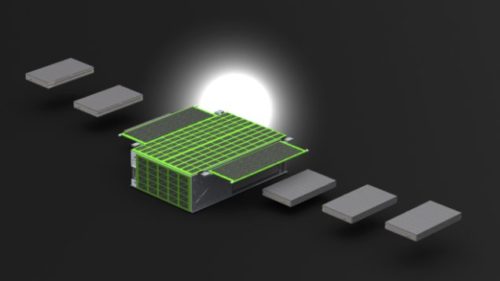
Illustration of the ANDESITE 6U cubesat with picosat deployments. Credits: BUSAT
Funding Aims to Boost Mini-Satellite Program for Space Exploration
SAN LUIS OBISPO – Cal Poly’s partnership with the Air Force Research Laboratory will direct roughly $2.5 million to enhance the university’s Aerospace Engineering Department and boost its mini-satellite program, which was the catalyst for a substantial expansion of space research two decades ago.
The Education Partnership Agreement (EPA) with the Air Force provides a total of $5 million to be split evenly between Cal Poly and California State Polytechnic University in Pomona. Funding for the partnership was secured by three U.S. representatives from California — Salud Carbajal, Norma J. Torres and Grace Napolitano — through the Consolidated Appropriations Act of 2020 (H.R. 1158).
The EPA’s agreements between a defense laboratory and an educational institution allow the labs to provide laboratory equipment and personnel to the schools, plus career and academic advice to students while involving faculty and students in research.
The EPA will help the Air Force Research Lab pioneer transformative aerospace technologies and accelerate its long-term strategic objectives in key areas, such as energy security, energy optimization, reusability, maneuverability and multi-mission mobility.
…
In particular, the funds for Cal Poly will support a thermal vacuum chamber with upgraded facilities to support it. A thermal vacuum chamber can be used for testing spacecraft or spacecraft parts under a simulated space environment.
…
Cal Poly became a major contributor to space research roughly 20 years ago, when former Aerospace Engineering faculty member Jordi Puig-Suari co-created the CubeSat standard with Bob Twiggs of Stanford University. CubeSats are mini-satellites that are affordable and easy to make, allowing governments, schools and private companies worldwide to more easily and affordably explore space and conduct research.
The new vacuum chamber will allow researchers to test and develop propulsion for CubeSats, allowing for greater control of the satellites for space exploration. Currently, most CubeSats cannot be controlled in space, and propulsion and maneuverability are often viewed as the next major step in CubeSat technology.
…
Multiple small satellites will be launched at once on the Vega VV16 mission from Europe’s Spaceport in Kourou, French Guiana. This flight will demonstrate the modular SSMS dispenser resting on its upper stage intended to bring routine affordable launch opportunities for light satellites from 0.2 kg CubeSats up to 400 kg minisatellites. Until now the smallest classes of satellites – all the way down to tiny CubeSats, built from 10 cm modular boxes – have typically ‘piggybacked’ to orbit. They have to make use of any spare capacity as a single large satellite is launched, meaning their overall launch opportunities are limited. The new Vega Small Spacecraft Mission Service switches this into a ‘rideshare’ model, with multiple small satellites being flown together, splitting the launch cost…