Space policy roundup – Oct.12.2020

A sampling of links to recent space policy, politics, and government (US and international) related space news and resource items that I found of interest (find previous space policy roundups here):

International space

Webcasts:

** Discussing Chinese Satcom Constellations with Lan Tianyi – Dongfang Hour – Chinese aerospace and technology

LAN Tianyi is the CEO of Ultimate Blue Nebula and SpaceKey, two Beijing-based firms focusing on satellite/space industry consulting & research. Having spent several years working inside China’s state-owned space apparatus (largely at CAST and its subsidiaries), Tianyi branched off on his own in 2014, and has since been consulting with many of China’s most successful and dynamic commercial space companies. Today, in addition to his two companies, Tianyi is actively involved in the China Satellite Conference, an annual event in Beijing, as well as Satellite World, a Chinese satellite news publication. On today’s episode, we discuss communications constellations. This year has seen a significant acceleration in the rollout of western low Earth orbit (LEO) communications constellations, with the most obvious example being Starlink. Less publicly, Chinese constellation projects have made steady progress throughout the year, and while we are unlikely to see any Chinese constellation with hundreds of satellites in orbit by year-end, there is much to discuss about these projects.

** Jessy Kate Schingler: Civilization on the Moon — and what it means for life on Earth | TED Talk

We could realistically see people starting to live and work on the Moon in the next decade — and how we do it matters, says space policy researcher Jessy Kate Schingler. In this fascinating talk, she discusses the critical issues that arise when we consider civilization in outer space — such as governance, property rights and resource management — and shows how the Moon can be a template for solving our biggest challenges here on Earth.


** E36 – Sanctuary to Contested Domain – National Security Space Policy (with Robin Dickey, Gen Lance Lord, and Robert Bell) – Aerospace Corp – Center for Space Policy & Strategy (CSPS)

** Moriba Jah – What To Improve In Space Situational Awareness – CSP S02E66 – Cold Star Technologies – YouTube

Dr. Moriba Jah, professor at the University of Texas at Austin, past navigator for many missions to Mars, and space situational awareness expert returns to the Cold Star Project. With host Jason Kanigan, Dr. Jah digs deeper into the challenges of space object identification, tracking and orbital prediction, including: – Why is it a problem that satellite orbit pathing predictions assume a spheroid shape? What issues does this create? – What can we do to improve the predictive ability of satellite pathing calculations? Why do we need to improve this accuracy–what’s the rush, what’s driving this need? …

** 85- The Need to Defend Space, Operating from a Position of Strength and the Tyranny of Volume – Constellations Podcast – YouTube

Constellations is grateful that Major General John E. Shaw took the time recently to speak about Space Domain Awareness (SDA) and the Battlespace on the podcast. Listen to Major General Shaw discuss the purpose of the U.S. Space Force and why it was stood up last year (hint… you can’t do modern warfare today without space capabilities). Major General Shaw talks about the need to be able to defend capabilities in space and to prepare for a war that extends into space. Space never sleeps and with the Major General overseeing operations around the world, he has been staying busy ensuring space capabilities are where they are needed at all times. Learn about the value of working hand in hand with allies and commercial partners and how Major General Shaw envisions leveraging commercial capabilities for global space operations.

** October 6, 2020 Zimmerman/Batchelor podcast

** October 9, 2020 Zimmerman/Batchelor podcast

** The Space Show – Sunday – Oct.11.2020 – An open lines discussion among David and callers touched on a wide array of news topics, space policy issues, etc.

** The Space Show – Friday – Oct.9, 2020 – Dr. Geoffrey Landis and David had a “Mars, lunar and commercial exploration discussion covering a wide range of topics including both government and private missions”.

** Monday – Oct.5, 2020 –  James Burk of The Mars Society previewed the virtual Mars Society Conference that will take place October 15-19.

====

=== Amazon Ad ===

Stellaris: People of the Stars


The Space Show this week – Oct.12.2020

The guests and topics of discussion on The Space Show this week:

1. Monday, Oct. 12, 2020; 7 pm PDT (9 pm CDT, 10 pm EDT: No special programming.

2. Tuesday, Oct. 13, 2020; 7 pm PDT (9 pm CDT, 10 pm EDT): We welcome back Gary Oleson to discuss his Space News Op-Ed, “A critical mission for human spaceflight: a quest for value“, published on August 18, 2020.

3. Wednesday, Oct. 14, 2020: Hotel Mars TBA pre-recorded. See upcoming show menu on the home page for program details.

4. Thursday, Oct. 15, 2020; 7-8:30 pm PDT (9-10:30 pm CDT, 10-11:30 pm EDT): No program for this date.

5. Friday, Oct.16, 2020; 9:30-11 am PDT (11:30 am-1 pm CDT, 12:30-2 pm EDT): We welcome back Dr. Deana Weibel to discuss her latest published article, “The Overview Effect and the Ultraview Effect: How Extreme Experiences in/of Outer Space Influence Religious Beliefs in Astronauts“.

6. Sunday, Oct.18, 2020; 12-1:30 pm PDT (3-4:30 pm EDT, 2-3:30 pm CDT): We welcome Dr. Jay Pasachoff who is the chair of the Astronomy Department at Williams College.

Some recent shows:

** Sunday – Oct.11.2020 – An open lines discussion among David and callers touched on a wide array of news topics, space policy issues, etc.

** Friday – Oct.9, 2020 – Dr. Geoffrey Landis and David had a “Mars, lunar and commercial exploration discussion covering a wide range of topics including both government and private missions”.

** Hotel Mars – Wednesday – Oct.7.2020 – Space journalist Eric Berger spoke with John Batchelor and Dr. David Livingston about ” SpaceX Starship testing, steel alloy testing in the tanks, flight tests, upcoming tests, Super Heavy to orbit and more”.

** Tuesday – Oct.6, 2020 – Students Ben Puckett, Shivani Patel, Ishaan Mishra described their  essays for the Limitless Space Institute Contest and also talked about their “future plans, spaceflight, Mars and much more”.

** Monday – Oct.5, 2020 –  James Burk of The Mars Society previewed the virtual Mars Society Conference that will take place October 15-19.

** See also:
* The Space Show Archives
* The Space Show Newsletter
* The Space Show Shop

The Space Show is a project of the One Giant Leap Foundation.

The Space Show - David Livingston
The Space Show – Dr. David Livingston

=== Amazon Ad ===

Space Is Open for Business:
The Industry That Can Transform Humanity

Student and amateur CubeSat news roundup – Oct.12.2020

A sampling of recent articles, press releases, etc. related to student and amateur CubeSat / SmallSat projects and programs (find previous smallsat roundups here):

** University of Hawaiʻi student-built Neutron-1 CubeSat reaches the  International Space Station (ISS): UH satellite to collect neutrons in space – University of Hawaiʻi System News

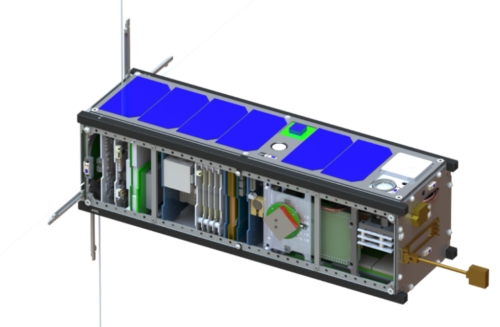
Diagram of the Neutron-1 CubeSat. Credits: Hawaii Space Flight Laboratory (HSFL)

A Northrop Grumman Cygnus cargo vessel berthed to the ISS on October 5th after launching on a Antares rocket from Wallops Island on October 2nd. The Cygnus NG-14 mission carried roughly four tons of cargo, including Neutron-1 and several other smallsats for deployment into orbit from the station. Neutron-1 holds instruments to measure neutrons in space, particularly those coming from the Sun.

Through the 2015 RockSat-X mission, Kauaʻi Community College, Windward Community College, Honolulu Community College and Kapiʻolani Community College were also involved with the development of this mission. The Project IMUA community college collaboration led to the development of a functioning neutron detector, however it was lost during a suborbital test launch from Wallops Flight Facility. This set back the project until Arizona State University (ASU) became a collaborator on this mission by providing the neutron detector in 2018.

“Neutron-1 is a 3U CubeSat [small satellite],” said Amber Imai-Hong, an avionics engineer at HSFL and ground station coordinator for the Neutron-1 mission. “It’s approximately the size of a loaf of bread and the data gathered by the satellite will be used to understand the relationship between the Earth and the Sun by mapping neutrons in the low-earth orbit.”

…

Neutron-1 is launching on a rideshare mission, which includes other satellites, and will be in space for approximately one year. UH delivered the small satellite to NanoRacks, LLC in Houston, Texas on August 20.

** CSFU students developing a satellite to study wildfires: Students Fired Up to Develop Miniature Satellite to Fight Wildfires – Cal State Fullerton Univ. A group of undergraduates at Cal State Fullerton

are designing, manufacturing and building a cube-shaped, miniaturized satellite, known as a CubeSat, to observe Earth from space to predict and detect fires. The data captured is used to detect areas of risk — to put out fires before a blaze even starts.

“This year’s fire season has been particularly harmful. With the onset of climate change, we need to utilize tools such as satellites to study Earth and try to predict and prevent natural disasters,” said senior Patrick Babb, a mechanical engineering major who is leading the team project.

The 10-member student team is developing a prototype, dubbed “TitanSat,” which incorporates infrared cameras and solar power to monitor Earth’s climate and detect hot and dry zones that pose a wildfire risk. 

** Updates on the UAE MeznSat CubeSat recently launched in to orbit on a Russian Soyuz 2.1b rocket along with 18 other smallsats. (See previous posts here, here, here, and here.)

** AMSAT news on student and amateur CubeSat/smallsat projects:

ANS-271 AMSAT News Service Special Bulletin – September 27, 2020

  • 2020 Virtual AMSAT Space Symposium and Annual General Meeting [See also AMSAT 2020 Virtual Symposium schedule announced – Southgate Amateur Radio News]
  • Reminder: Current AMSAT Journal is available on Member Portal
  • AMSAT-DL Online Symposium
  • AMSAT-UK Convention
  • ARRL LOTW new user guide
  • AMSAT Field Day Results for 2020 have been posted
  • ARISS News
  • Upcoming Satellite Operations
  • Hamfests, Conventions, Maker Faires, and Other Events
  • Satellite Shorts From All Over

ANS-278 AMSAT News Service Weekly Bulletin – October 4, 2020

  • Virtual AMSAT Space Symposium and Annual General Meeting – October 17
  • AMSAT-UK Colloquium Online – October 11
  • ARISS Worldwide SSTV Event – October 4-8
  • Happy 27th Birthday, AMRAD-OSCAR 27
  • FCC Deletes 3.4 GHz Amateur Satellite Service Allocation
  • Chinese Amateur Radio Satellite Launches Delayed
  • VUCC Awards-Endorsements for October 2020
  • Message to US Educators: ARISS Contact Opportunity – Call For Proposals
  • Changes to AMSAT TLE Distribution for October 1, 2020
  • Hamfests, Conventions, Maker Faires, and Other Events
  • AMSAT Awards News
  • Upcoming Satellite Operations
  • Satellite Shorts from All Over

ANS-285 – AMSAT News Service Weekly Bulletin – October 11, 2020

  • AMSAT 2020 Virtual Symposium Schedule Announced
  • UH Satellite Successfully Blasts into Space
  • ARISS to Celebrate 20 Years of Ham Radio on the ISS
  • IARU Region 2 Releases 2020 Band Plan Revision
  • Two More Astronauts Earn Amateur Radio Licenses
  • Upcoming Satellite Operations
  • Hamfests, Conventions, Maker Faires, and Other Events
  • ARISS News
  • Satellite Shorts from All Over

General CubeSat/SmallSat info:

** SEDS-Canada x Canadian CubeSat Project Panel – SEDS-Canada

** BWSI Build A CubeSat Final Presentations – MIT Beaver Works Summer Institute

Caution: portions of the audio are difficult to hear
Build a CubeSat – Sierra Nevada Corp. Project Beaver Works Summer Institute will offer students the opportunity to design, build, and test a prototype CubeSat. Students will explore all the major subsystems of a satellite and get hands on experience with mechanical, electrical, and software engineering. The class will use these new skills to demonstrate a real CubeSat science mission in partnership with scientists from Woods Hole Oceanographic Institution.
– Introduction by Jack Fox
– Presentations
Astrobeever
Buzz Lightyear
Team Oddsat
BYJ Cube
Rubble Space Telescope
– Q&A
…

** 84- Microsoft Azure Orbital, Ground Station as a Service, and Dynamic Ground – Constellations Podcast

On this Constellations podcast, the focus will be on Microsoft’s recent announcement of their Ground Station as a Service (GSaaS) offering “Azure Orbital” and what it means for the satellite industry. Azure Orbital is Microsoft’s managed service that is designed to deal with the growing flood of data for Earth Observation and Internet of Things applications. The managed service lets users communicate to, control their satellite, process data and scale operations directly in Microsoft Azure. Microsoft’s GSaaS takes a very different approach compared to traditional ground systems. Azure Orbital leverages key technologies such as virtualization, Software-Defined Networking (SDN), and cloud computing to enable customers to automate and scale operations across the globe. On this podcast Nora Zhan, Product Manager for Microsoft discusses Azure Orbital. She is involved in Azure Space, Satellites and Ground Stations and in bringing this new platform to market to provide satellite connectivity.

** The Open Source Satellite Programme – British Computer Society Open Source Specialists

Presented by Paul Madle Over the last 25 years, the UK has brought positive disruptions to the space industry. The University of Surrey innovated small spacecraft: leveraging Commercial-Off-The-Shelf components that could compete with larger more traditionally designed spacecraft. In the last 7 years, Scottish CubeSats (very small satellites) have grown from academic projects into commercially viable products performing earth observation and other applications. Both of these innovations have brought down costs and made space more accessible to greater numbers of people. KIPSE Space Systems aspires to be a catalyst for the next step-change to the industry by collaboratively designing a new, capable spacecraft platform that is open source, all design being freely accessible through the internet.

=== Amazon Ad ===

Introduction to CubeSat Technology and Subsystem:
Orbit Design, Debris Impact, and Orbital Decay Prediction

ESO: Telescopes observe final moments of a star eaten by a black hole

A new report from the European Southern Observatory (ESO):

Death by Spaghettification:
ESO Telescopes Record Last Moments of Star Devoured by a Black Hole

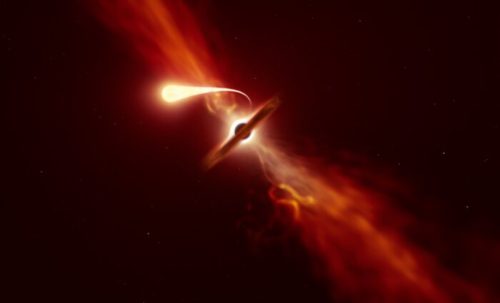
This illustration depicts a star (in the foreground) experiencing spaghettification as it’s sucked in by a supermassive black hole (in the background) during a ‘tidal disruption event’. In a new study, done with the help of ESO’s Very Large Telescope and ESO’s New Technology Telescope, a team of astronomers found that when a black hole devours a star, it can launch a powerful blast of material outwards.Credits ESO

Using telescopes from the European Southern Observatory (ESO) and other organisations around the world, astronomers have spotted a rare blast of light from a star being ripped apart by a supermassive black hole. The phenomenon, known as a tidal disruption event, is the closest such flare recorded to date at just over 215 million light-years from Earth, and has been studied in unprecedented detail. The research is published today in Monthly Notices of the Royal Astronomical Society.

“The idea of a black hole ‘sucking in’ a nearby star sounds like science fiction. But this is exactly what happens in a tidal disruption event,”

says Matt Nicholl, a lecturer and Royal Astronomical Society research fellow at the University of Birmingham, UK, and the lead author of the new study. But these tidal disruption events, where a star experiences what’s known as spaghettification as it’s sucked in by a black hole, are rare and not always easy to study. The team of researchers pointed ESO’s Very Large Telescope (VLT) and ESO’s New Technology Telescope (NTT) at a new flash of light that occurred last year close to a supermassive black hole, to investigate in detail what happens when a star is devoured by such a monster.

Astronomers know what should happen in theory.

“When an unlucky star wanders too close to a supermassive black hole in the centre of a galaxy, the extreme gravitational pull of the black hole shreds the star into thin streams of material,”

explains study author Thomas Wevers, an ESO Fellow in Santiago, Chile, who was at the Institute of Astronomy, University of Cambridge, UK, when he conducted the work. As some of the thin strands of stellar material fall into the black hole during this spaghettification process, a bright flare of energy is released, which astronomers can detect.

Although powerful and bright, up to now astronomers have had trouble investigating this burst of light, which is often obscured by a curtain of dust and debris. Only now have astronomers been able to shed light on the origin of this curtain.

“We found that, when a black hole devours a star, it can launch a powerful blast of material outwards that obstructs our view,” 

explains Samantha Oates, also at the University of Birmingham. This happens because the energy released as the black hole eats up stellar material propels the star’s debris outwards.

The discovery was possible because the tidal disruption event the team studied, AT2019qiz, was found just a short time after the star was ripped apart.

“Because we caught it early, we could actually see the curtain of dust and debris being drawn up as the black hole launched a powerful outflow of material with velocities up to 10 000 km/s,” says Kate Alexander, NASA Einstein Fellow at Northwestern University in the US. “This unique ‘peek behind the curtain’ provided the first opportunity to pinpoint the origin of the obscuring material and follow in real time how it engulfs the black hole.”

The team carried out observations of AT2019qiz, located in a spiral galaxy in the constellation of Eridanus, over a 6-month period as the flare grew in luminosity and then faded away.

“Several sky surveys discovered emission from the new tidal disruption event very quickly after the star was ripped apart,” says Wevers. “We immediately pointed a suite of ground-based and space telescopes in that direction to see how the light was produced.”

Multiple observations of the event were taken over the following months with facilities that included X-shooter and EFOSC2, powerful instruments on ESO’s VLT and ESO’s NTT, which are situated in Chile. The prompt and extensive observations in ultraviolet, optical, X-ray and radio light revealed, for the first time, a direct connection between the material flowing out from the star and the bright flare emitted as it is devoured by the black hole.

“The observations showed that the star had roughly the same mass as our own Sun, and that it lost about half of that to the monster black hole, which is over a million times more massive,”

says Nicholl, who is also a visiting researcher at the University of Edinburgh.

The research helps us better understand supermassive black holes and how matter behaves in the extreme gravity environments around them. The team say AT2019qiz could even act as a ‘Rosetta stone’ for interpreting future observations of tidal disruption events. ESO’s Extremely Large Telescope (ELT), planned to start operating this decade, will enable researchers to detect increasingly fainter and faster evolving tidal disruption events, to solve further mysteries of black hole physics.

Links

=== Amazon Ad ===

Imagined Life: A Speculative Scientific Journey among the Exoplanets
in Search of Intelligent Aliens, Ice Creatures, and Supergravity Animals


Videos: “Space to Ground” + Other ISS reports – Oct.9.2020

Here is the latest episode in NASA’s Space to Ground weekly report on activities related to the International Space Station:

** Rocket Ranch Episode 24: Space Lullaby – NASA’s Kennedy Space Center

Astronaut Chris Hadfield’s cover of David Bowie’s Space Oddity that he recorded while on the International Space Station has over 47 million views. Now retired, the veteran of three spaceflights and first Canadian to walk in space has given a lot of thought to the future of space exploration and what it can mean for all of us. Hear from him now on this episode of the Rocket Ranch.

** NASA Television Video File – Expedition 64 Pre Launch Baikonur Activities – October 8, 2020 – NASA Video

At the Baikonur Cosmodrome in Kazakhstan, the International Space Station’s Expedition 64 crew, Soyuz Commander Sergey Ryzhikov of Roscosmos, Flight Engineers Sergey Kud-Sverchkov of Roscosmos and Kate Rubins of NASA and their backups, Oleg Novitskiy and Petr Dubrov of Roscosmos and Mark Vande Hei of NASA, participated in a variety of activities Sept. 27-Oct. 7 as they prepared for the upcoming mission. Ryzhikov, Kud-Sverchkov and Rubins are set to launch Oct. 14 from Baikonur in the Soyuz MS-17 spacecraft for a six-month mission on the International Space Station. The footage includes the crew’s arrival in Baikonur, their Soyuz fit check in the Cosmodrome’s Integration Facility, the ceremonial Cosmonaut Hotel flag-raising ceremony and other training milestones.

** Expedition 63 Astronaut Chris Cassidy speaks with Time Magazine – October 5, 2020 – NASA Video

Aboard the International Space Station, Expedition 63 Commander Chris Cassidy of NASA discussed his mission and future space exploration during an in-flight event Oct. 6 with TIME Magazine’s “TIME 100 Talks” series. Cassidy is in the final weeks of his six-and-a-half month mission on the station, heading for a return to Earth Oct. 22 aboard a Russian Soyuz spacecraft.

** Northrop Grumman’s Cygnus 14 Rendezvous and Capture – October 5, 2020 – NASA Video

Loaded with almost four tons of supplies and scientific experiments, Northrop Grumman’s unpiloted Cygnus cargo ship arrived at the International Space Station Oct. 5, four days after launching from the Wallops Flight Facility, Virginia atop the company’s Antares rocket. Named the “SS Kalpana Chawla” in honor of the late NASA astronaut who lost her life in the Columbia accident in February 2003, Cygnus was captured by Expedition 63 Commander Chris Cassidy of NASA using the station’s Canadian-built robotic arm. Ground controllers then installed Cygnus to the Earth-facing port of the Unity module where it will reside until mid-December.

** How to use the Bathroom in Space – NASA Johnson

One of the most frequent questions we get about life on Space Station is how to use the toilet…Here’s a quick look at the answer! -Expedition 63 Commander Chris Cassidy

=== Amazon Ads ===

Outpost in Orbit:
A Pictorial & Verbal History of the Space Station

======

LEGO Ideas International Space Station Building Kit,
Adult Set for Display,
Makes a Great Birthday Present
(864 Pieces)

======

Everyone can participate in space