Here is a sampling of videos about SpaceX and the Starship project.
** Public presentations about SpaceX are usually provided by Elon Musk or Gwynne Shotwell. However, here is an excellent overview of the company given by Kiko Dontchev, Vice President of Launch, at the Summit At Sea event last May.
Curious how SpaceX went from 13 launches in 2019 to pacing for 100 in 2023? As VP of Launch at SpaceX, Kiko Dontchev goes into work every day with the simple goal of making space travel as accessible as air travel, and he is well on his way. In this talk, Kiko will dive into SpaceX’s exponential growth approach, Elon’s problem-solving algorithm, and becoming the most prolific launcher of all time.
** Several new media sources have risen in the past couple of years that report extensively on SpaceX Starship related activities. A sampling of these include:
Here, for example, are three reports on recent Starship developments:
** The design, development, and commercial potential of Starship are presented in the SpaceX Starship report, for which I was the primary author. Initially published by NewSpace Global in March 2023, we updated it in May to include coverage of the first flight test.
==================
Check out the The Lurio Report
for news and analysis of key developments in NewSpace
The latest issue: Starships’ Second Flight, Blue HLS, Return Sustainably
Vol. 18, No. 2, July 16, 2023
Space Frontier Foundation Award for NewSpace Journalism
Space in Miniature, led by Michael Mackowski, has released a new digital reference book for space model builders. Mike Mackowski describes the US Space Missiles SIM report:
The sixth installment in the Space In Miniature (SIM) digital-only “Tech Reports” series of reference booklets for spacecraft modelers is now available. This publication is a detailed review of the Atlantis re-issue of the old Monogram “U.S. Space Missiles” kit.
The initial version of this 1/128th scale kit came out in 1958 as the “United States Missile Arsenal” and Monogram updated it with a different mix of 36 missile subjects in 1969. The 1969 release, the 1983 version, and the recent Atlantis edition all use the same molds, with slightly different instructions. With the Atlantis Models release in 2022 making it readily available again, it seemed like a SIM Tech Report treatment would be popular.
The SIM Tech Report is based on a two-part kit review originally published in 1984 in Plastic Novelty Items, a publication of the Chicago Sprue Stretchers IPMS chapter. They included descriptions of most of the 36 missiles and was heavily illustrated with detailed drawings. The review covered the 1983 “Heritage Edition,” with text by Joe Suszynski and drawings by Jim Griffiths. After Joe passed away some years ago, I contacted Jim and made arrangements to use their work at some future time. That time has come. The SIM version adds photos of all the missiles and up-to-date drawings by model rocketry guru Peter Alway. Brian Nicklas, of the National Air and Space Museum and author of his own book on US missiles, also made contributions to this book.
SIM TR-6 US Space Missiles is available in digital (pdf) format only for $10 at spaceinminiature.com. There are 57 pages and 122 illustrations, many in color, resulting in a 178MB file.
This is the sixth in a series of special volumes in the Space In Miniature series called “Tech Reports”.
designed and built an SRAD [student researched and designed] hybrid rocket which launched to a verified 45,482′ AGL (49,523′ MSL). This came within 1% of the 50,000′ ceiling at WSMR [White Sands Missile Range].
The Horizon 1 rocket used nitrous oxide with a solid 3D printed fuel grain.
All information was validated by the U.S. Army at the White Sands Missile Range a few weeks later, “Brazoswood High School set a new world record for altitude achieved by a student-built, hybrid-motor propelled rocket reaching 45,482 feet above ground level, beating Fredericksburg High School’s record of 36,100 feet and earning the the SystemsGo Kepler Award.”
McLeod notes
that this rocket, from research, design, and fabrication, was all completed in just one school year, with just one chance at launch, and that the students themselves learned the machining, composites, and other fabrication required to build the vehicle.
Check out the project website, which includes details of the rocket’s design and construction and also a summary of the flight, which took place on June 26, 2022.
Here are videos of the flight and student activities before and after the launch.
Virgin Orbit to Launch First Welsh Satellite From UK Spaceport Summer 2022
Cardiff-based Space Forge secure slot on first launch from UK soil with Virgin Orbit
Space Forge have developed a fully returnable and reusable satellite platform to enable in-space manufacturing
This mission, launched from Spaceport Cornwall this summer, will test new return capability
LONG BEACH, Calif. & CARDIFF, Wales–(BUSINESS WIRE)–Leading launch company Virgin Orbit (Nasdaq: VORB) and European in-space manufacturing tech start-up Space Forge announce today an agreement to launch the first satellite developed in Wales in summer 2022.
In a historic moment for UK space, the satellite will be launched as part of a broader joint UK-US mission to open the country’s first domestic space port in summer 2022 out of Spaceport Cornwall in Newquay, Cornwall.
Virgin Orbit’s LauncherOne ignites in mid-air for the first time during the company’s Launch Demo. May 25, 2020. Credit: Virgin Orbit/Greg Robinson.
With shared values of democratising space and pioneering responsive and responsible launch technologies, the synergy between Virgin Orbit and Cardiff-based Space Forge’s ethos makes this the ideal marriage for initial launch from the UK. This, coupled with Spaceport Cornwall’s ambitions to become a world leader in responsible launch will offer a real-world example of a global shift in environmental space practice – from sustainable on the ground operations, to horizontal lower impact launch technologies, to in-orbit services minimising the environmental impacts of manufacturing.
Space Forge is on a mission to make space work for humanity – seeking to harness the power of microgravity, offering an on demand service to advance the expansion of the market for premium research and development applications.
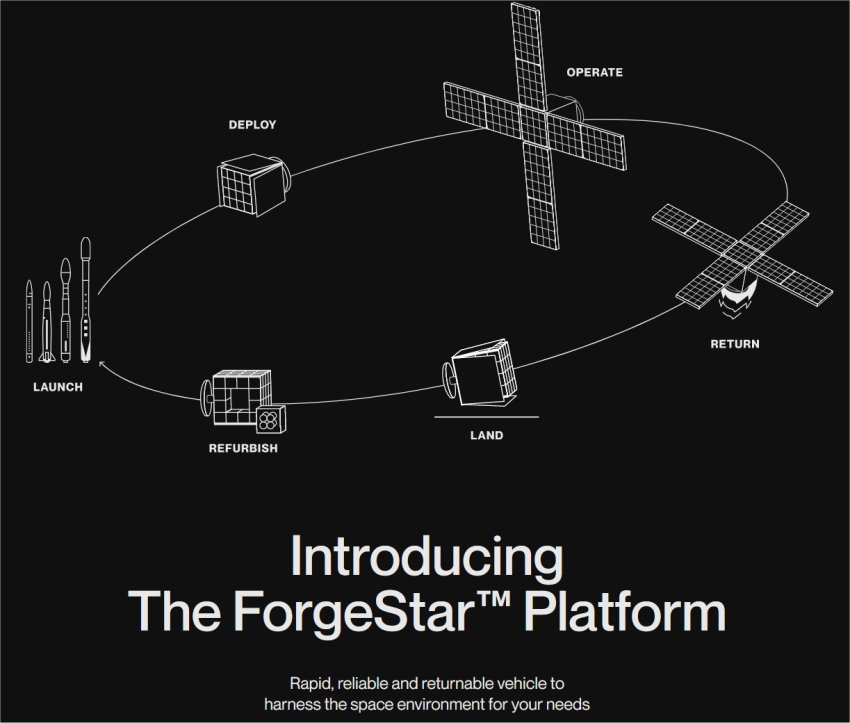
Space Forge recently announced that, along with partners, it is developing a world-first service incorporating both launch and return of a new small class of vehicle – the ForgeStar – that can be deployed from conventional launchers to provide rapid, reliable and reusable in-space infrastructure. This inaugural mission will see Space Forge’s ForgeStar-0 platform launched for the first time and will test future return from space technology.
The Forge Star Platform, “ a fully returnable and reusable satellite platform to enable in-space manufacturing“. Credits: Space Forge
Aiming to unlock the next steps on the path to market expansion, dedicated in-space manufacturing, coupled with proof of reliable return, will allow Space Forge to leverage the benefits of the space environment, namely: microgravity, vacuum, and temperature, to create products impossible to manufacture on Earth.
Their focus is on producing materials and products which offer game-changing levels of performance and efficiency in power hungry infrastructure and systems – reducing the environmental impact of production on earth to unlock new value and innovation. Research suggests that manufacturing certain materials in space could reduce CO2 emissions by 75% – the equivalent to removing all petrol cars from the UK.
“We at Virgin Orbit are delighted to have been chosen to move Space Forge forward in their space journey as we look forward to our inaugural Cornwall launch. Space Forge is joining the growing community of space innovators advancing space technologies for the betterment of our world,” said Virgin Orbit CEO Dan Hart. “Their commitment to sustainability builds a foundation for future growth in the industry that we at Virgin Orbit are proud to be part of.”
Joshua Western, CEO, Space Forge:
“We’re thrilled to be making UK history with our first launch. We will demonstrate the use of space for good through in-space manufacturing and reliable return and it’s brilliant that both Virgin Orbit and Spaceport Cornwall share our ambitions. This is the start of a great collaboration and we are so excited to see where it goes.”
Melissa Thorpe, Head of Spaceport Cornwall:
“Launch from Cornwall is the chance to set the bar for the global space industry. Leading with companies like Space Forge, who are innovating in the responsible use of space, is key to this next iteration of space exploration.
It’s amazing to see our partners Virgin Orbit select customers who share our ambitions in this area and we can’t wait to show the world how this can be done.”
Dr Paul Bate, CEO of the UK Space Agency:
“The UK is set to become the first nation in Europe to offer small satellite launch, as we become one of the most attractive space economies in the world.
“Space Forge is an innovative, fast-growing company and their agreement with Virgin Orbit demonstrates how all regions of the UK are playing a key role in our ambition to create a thriving small satellite launch market. In-space manufacturing harnesses the benefits of the space environment to create materials far superior to those we can produce on Earth, which can be used to speed up electric car charging or improve the lifetime of aircraft engines.
“This is a huge moment for Space Forge to be part of the first satellite launch from the UK and I wish them all the best, along with Spaceport Cornwall and Virgin Orbit.”
About Space Forge: Space Forge Ltd is a UK start-up on a mission to lead the clean industrial revolution by harnessing space. The company is developing fully returnable satellites that are designed for manufacturing next generation super materials in-space. In creating a reliable return, Space Forge will advance the expansion of the microgravity market for premium research and development applications by lowering the barriers to entry. The company is focused on R&D initiatives where dedicated return from the space environment can add a significant benefit, or overcome obstacles found terrestrially, to unlock new value and innovation.
About Virgin Orbit: Virgin Orbit (Nasdaq: VORB) operates one of the most flexible and responsive space launch systems ever built. Founded by Sir Richard Branson in 2017, the company began commercial service in 2021, and has already delivered commercial, civil, national security, and international satellites into orbit. Virgin Orbit’s LauncherOne rockets are designed and manufactured in Long Beach, California, and are air-launched from a modified 747- 400 carrier aircraft that allows Virgin Orbit to operate from locations all over the world in order to best serve each customer’s needs. Learn more at www.virginorbit.com and visit us on LinkedIn, on Twitter @virginorbit, and on Instagram @virgin.orbit.
About Spaceport Cornwall: Spaceport Cornwall is the horizontal space launch site at Cornwall Airport Newquay, in South West England. Spaceport Cornwall is a partnership between Cornwall Council, commercial launch operator Virgin Orbit and Goonhilly Earth Station. The consortium will deliver small satellite launch into lower Earth Orbit, for the first time ever from the UK by 2022. The project is funded by the UK Space Agency, Cornwall Council, Cornwall and the Isles of Scilly Local Enterprise Partnership and Virgin Orbit. For video and media content:www.spaceportcornwall.com/media
This sort of announcement seems particularly following this week’s news of a Russian anti-satellite demonstration creating thousands of new space debris objects in low earth orbit:
ASCEND Conference, Las Vegas, Nevada, Nov. 17, 2021 – Astroscale Holdings Inc. (“Astroscale”), the market leader in satellite servicing and long-term orbital sustainability across all orbits, today announced it has signed a Memorandum of Understanding (“MOU”) with Virgin Orbit, the responsive launch and space solutions company that has announced a planned business combination with NextGen Acquisition Corp. II (“NextGen”) (NASDAQ: NGCA). The MOU establishes a new partnership in which the two companies will seek opportunities to cooperate on a series of space initiatives that will drive the future of space sustainability and on-orbit servicing ecosystem. Astroscale is planning dozens of missions over the next decade and is in discussions with Virgin Orbit to launch as many as 10 of those on Virgin Orbit’s LauncherOne. The two companies are also working toward a future joint mission concept focused on satellite servicing.
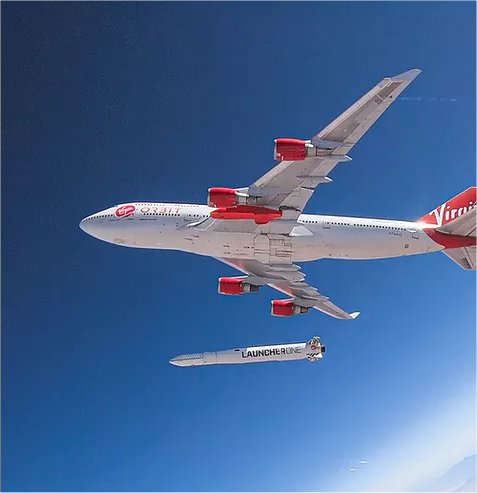
LauncherOne rocket released from carrier aircraft. Credits: Virgin Orbit
Astroscale and Virgin Orbit share a vision of creating a sustainable space environment and will explore areas of cooperation on policy and regulatory efforts in the fields of space sustainability, space debris removal, government partnerships, launch and on-orbit servicing spectrum allocation. The MOU also includes a partnership to study the business potential of a joint Global Responsive Satellite Servicing capability, pre-encapsulating Astroscale payloads and storing them at LauncherOne spaceports, as well as promoting U.S.-Japan and U.S.-UK bilateral cooperation with a responsive launch capability from Virgin Orbit’s launch sites in Oita, Japan, and Spaceport Cornwall, UK. The two companies are also discussing a future mission concept wherein Astroscale would utilize its robotic arms payload and/or docking plate on the LauncherOne system.
“The space industry is on the cusp of a new era, with flexible and responsive launch and satellite servicing an emerging reality,” said Nobu Okada, Founder & CEO of Astroscale. “This partnership with Virgin Orbit will bring value to these rapidly developing sectors, not just for technology development, but for business and regulatory innovations as well. Virgin Orbit is a like-minded company that is revolutionizing the way we launch and access space while maintaining a commitment to space sustainability.”
[Virgin Orbit CEO Dan Hart said, ]
“We at Virgin Orbit are excited to partner with Astroscale to foster the development and promotion of the responsible, sustainable use of space,” […] “Our LauncherOne System already has key features that minimize the impact of space launch on Earth. We’re committed to finding ways to protect the space and Earth environments, and we’re highly motivated to drive forward technologies that will enable orbital debris clean-up.”
In addition to pursuing joint activities, Virgin Orbit recently joined The Consortium for Execution of Rendezvous and Servicing Operations (CONFERS), an international industry group representing the on-orbit servicing ecosystem. Astroscale is already an active member of CONFERS, which is advancing the on-orbit servicing industry by leveraging best practices from government and industry to research, develop, and publish technical and operational standards for OOS and Rendezvous and Proximity Operations.
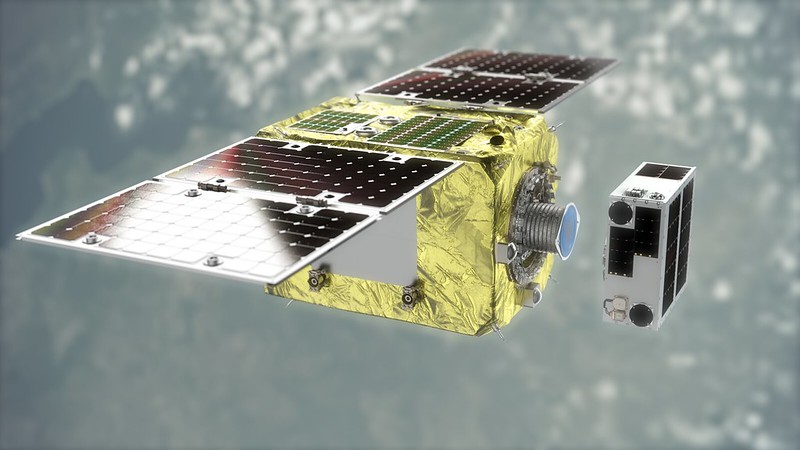
Artist view of the Astroscale ELSA-d spacecraft to demonstrate in-space rendezvous and capture of debris objects and derelict spacecraft.
About Astroscale: Astroscale is the first private company with a vision to secure the safe and sustainable development of space for the benefit of future generations, and the only company dedicated to on-orbit servicing across all orbits.
Founded in 2013, Astroscale is developing innovative and scalable solutions across the spectrum of on-orbit servicing, including life extension, in situ space situational awareness, end-of-life, and active debris removal, to create sustainable space systems and mitigate the growing and hazardous buildup of debris in space. Astroscale is also defining business cases and working with government and commercial stakeholders to develop norms, regulations, and incentives for the responsible use of space.
Headquartered in Japan, Astroscale has an international presence with subsidiaries in the United Kingdom, the United States, Israel, and Singapore. Astroscale is a rapidly expanding venture company, working to advance safe and sustainable growth in space and solve a growing environmental concern.
About Virgin Orbit: Virgin Orbit builds and operates the most flexible and responsive satellite launcher ever invented: LauncherOne, a dedicated launch service for commercial and government-built small satellites. LauncherOne rockets are designed and manufactured in Long Beach, California, and are air-launched from our modified 747-400 carrier aircraft — allowing us to operate from locations all over the world in order to best serve each customer’s needs. To learn more or to apply to join Virgin Orbit’s talented and growing team, visit virginorbit.com.
About NextGen: NextGen Acquisition Corp. II is a blank check company whose business purpose is to effect a merger, share exchange, asset acquisition, share purchase, reorganization or similar business combination with one or more businesses. NextGen is led by George Mattson, a former Partner at Goldman, Sachs & Co., and Gregory Summe, former Chairman and CEO of Perkin Elmer and Vice Chairman of the Carlyle Group. NextGen is listed on Nasdaq under the ticker symbol “NGCA.” For more information, please visit www.nextgenacq.com.