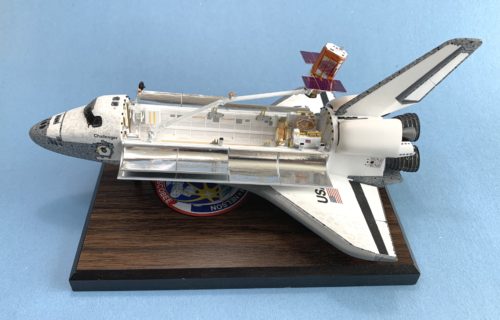
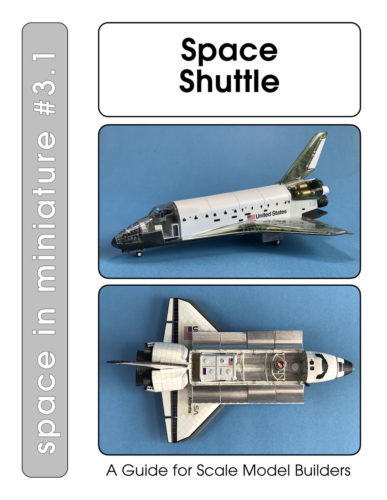
A complete revision of the third installment of the Space In Miniature (SIM) series of reference books for spacecraft modelers is now available. This book has all the information a modeler will need to build an accurate, detailed model of the Space Shuttle. Originally published in 1990, 24 pages have been added to this soft-cover book that now features color covers. Nearly all of the original material has been updated or replaced with new drawings and articles. Due to the increased page count, a few articles have been moved to an upcoming new SIM book on Shuttle payloads.
SIM #3.1 – Space Shuttle focuses on NASA’s reusable spaceplane, featuring scale drawings showing the various thermal protection patterns used on all six Orbiters and how they evolved over the entire 30+ years of Shuttle operations. The 61-page book also includes four detailed articles on building Space Shuttle models, and seven pages of kit reviews and a list of after market parts. There are a total of 78 drawings and photographs, plus several tables and the cover photos.
This book is printed in black and white on coated paper, and is available both as a hard copy as well as a full-color pdf file. This guidebook will be a unique resource for the serious space modeler. A hard copy of SIM #3.1 – Space Shuttle sells for $12 plus shipping, while a pdf download costs $10. A combination package of both the hard copy and digital version is available for only $15 plus shipping. To order, see www.spaceinminiature. com or send an email to mike@spaceinminiature.com. The other titles in the SIM series are still available.
Here is the latest episode in NASA’s Space to Ground weekly report on activities related to the International Space Station:
** Space Station Images Trace Bird Migrations – NASA Johnson
Those who see Earth from the International Space Station often say it provides a new appreciation of our planet. The Avian Migration Aerial Surface Space project, or AMASS, takes advantage of thousands of images captured by astronauts to give people an understanding of the migrations many birds undertake across the planet. Learn more here: https://go.nasa.gov/3b6UXcQ Learn more about the research being conducted on station: https://www.nasa.gov/iss-science Follow Twitter updates on the science conducted aboard the space station: https://twitter.com/iss_research
** NASA’s SpaceX Crew-1 Flight Day Highlights – NASA Video
NASA’s SpaceX Crew-1, consisting of NASA astronauts Michael Hopkins, Victor Glover, and Shannon Walker, and Soichi Noguchi of the Japan Aerospace Exploration Agency (JAXA), began its return to Earth on Saturday, May 1, 2021. With their six-month stay on the space station coming to an end, the crew boarded their SpaceX Crew Dragon spacecraft Resilience, closed the hatches, and undocked from the space station. Hatch closure occurred at 6:26 p.m. EDT, undocking at 8:35 p.m. EDT. Resilience splashed down in the Gulf of Mexico near Panama City, Florida at 2:56 a.m. EDT on Sunday, May 2. Crew-1 is the first of six crewed missions NASA and SpaceX will fly as part of the agency’s Commercial Crew Program, which worked with the U.S. aerospace industry to resume launches with astronauts on American rockets and spacecraft from American soil.
** Expedition 65 inflight with Georgia Tech and WXIA-TV, Atlanta – May 4, 2021 – NASA Video
Aboard the International Space Station, Expedition 65 Commander Aki Hoshide of the Japan Aerospace Exploration Agency (JAXA) and NASA Flight Engineer Shane Kimbrough discussed life and work on board the complex during a pair of in-flight interviews May 3 with the public affairs office at Georgia Tech University and WXIA-TV, Atlanta. Kimbrough, who received a Masters of Science degree in Operations Research from Georgia Tech in 1998, and Hoshide launched to the station April 23 on the SpaceX Falcon 9 rocket aboard the Crew Dragon spacecraft “Endeavour” for a planned six-month mission.
** Expedition 65 Education Inflight with Shine On Project – May 6, 2021 – NASA Video
Aboard the International Space Station, Expedition 65 Flight Engineers Megan McArthur of NASA and Thomas Pesquet of ESA (European Space Agency) discussed life and work aboard the orbital laboratory during an in-flight educational event May 6 with young women who are part of the “Shine On” project sponsored by the State University of New York in Plattsburgh, New York. McArthur and Pesquet launched to the station April 23 on the SpaceX Falcon 9 rocket aboard the Crew Dragon spacecraft “Endeavour” for a planned six-month mission.
A sampling of links to recent space policy, politics, and government (US and international) related space news and resource items that I found of interest (find previous space policy roundups here):
** China Space Station Tianhe Module Launched, Megaconstellation Operator China SatNet Created – Ep 31 – Dongfang Hour – YouTube
Hello and welcome to another episode of the Dongfang Hour China Aero/Space News Roundup! Without further ado, the news update from the week of 26 April – 2 May.
1) Chinese Space Station: launch of the core Module Tianhe on-board Launch March 5B … 2) Creation of a New Space SoE China SatNet … 3) Long March 6 launches a Batch of 9 Smallsats into Orbit, many payloads of interest …
** China plans four crewed missions to space – SciNews
According to Yang Liwei, China’s first astronaut, the China National Space Administration (CNSA) plans for crewed missions to space. A total of 12 astronauts will be launched in 2021 and 2022 to the China Space Station. The Tianhe Core Module, the first component of the China Space Station, is scheduled to be launch this spring. Credit: China Central Television
** Sunday, May.2.2021 – Dr. David Livingston led an open lines program discussion “with multiple callers, lot of subject and topic variety, email questions and more“.
the NSS Ad Astra Special Issue devoted to space settlement which they referred to as living in space. The second part of our program focused on the all virtual and completely free ISDC 2021 toward the end of June this year.
the Russian plans to build a new space station after the ISS agreement expires in 2024. We talked about their new station plans, the use of existing modules though never flown on the ISS, their plans for the existing modules connected to the ISS, their plans to handle the ISS in its final period plus build out the new station, both at the same time. Also discussed was the planned orbit of the new Russian station and what this might mean for ISS activities with the Russians, especially regarding costs. The development of the Chinese space station came up and Anatoly discussed the TRL for China and their space station work.
Dr. Hilde Stenuit is a seasoned researcher and team leader for Space Applications Services working to provide fast and direct access to space for research and technology users through the ICE Cubes, or International Commercial Experiment Cubes program. This program offers cube-sized experiments in microgravity allowing or people on Earth to interact directly with their experiments up in space. This past week, space-interested students Bano Barzingi and Chiara Moenter, sit down with Hilde to discuss her work as well as the factors of space sustainability trends and a need for awareness outside of the space sector.
With over 20 years of experience working within the space industry and an immense passion, Hilde’s experience and knowledge are incredibly valuable. Onboard the International Space Station, Hilde, and her team are using the ICE Cubes to conduct research in microgravity. The first ICE Cube was installed by Alexander Gest in July 2018. Ever since, multiple experiments were conducted in life science, biology, fluid dynamics, agriculture, and many other fields.
So what happens if you take gravity out of the equation?
2. Tuesday, May. 4, 2021; 7 pm PDT (9 pm CDT, 10 pm EDT): We welcome Col. (USAF Ret) Karlton Johnson, the new National Space Society (NSS) Chairman of the Board. We have multiple topics to discuss with our guest.
3. Wednesday, May. 5, 2021: No program scheduled.
4. Thursday, May. 6, 2021; 7-8:30 pm PDT (9-10:30 pm CDT, 10-11:30 pm EDT): No program scheduled.
5. Friday, May.7 2021; 9:30-11 am PDT (11:30 am-1 pm CDT, 12:30-2 pm EDT): We welcome Tom McCarthy of Motiv Space Systems on their technology and hardware for Mars and more.
6. Sunday, May.9, 2021; 12-1:30 pm PDT (3-4:30 pm EDT, 2-3:30 pm CDT): We welcome Dr. Casey Handmer of NASA JPL to discuss his recent blog articles on SLS, SpaceX and more.
Some recent shows:
** Sunday, May.2.2021 – Dr. David Livingston led an open lines program discussion “with multiple callers, lot of subject and topic variety, email questions and more“.
the NSS Ad Astra Special Issue devoted to space settlement which they referred to as living in space. The second part of our program focused on the all virtual and completely free ISDC 2021 toward the end of June this year.
the Russian plans to build a new space station after the ISS agreement expires in 2024. We talked about their new station plans, the use of existing modules though never flown on the ISS, their plans for the existing modules connected to the ISS, their plans to handle the ISS in its final period plus build out the new station, both at the same time. Also discussed was the planned orbit of the new Russian station and what this might mean for ISS activities with the Russians, especially regarding costs. The development of the Chinese space station came up and Anatoly discussed the TRL for China and their space station work.
his new book about the beginning phase of SpaceX, Liftoff: Elon Musk and the Desperate Early Days That Launched SpaceX [Amazon commission link]. Eric responded to multiple questions about Artemis, the recent NASA Human Lander Award and what might come next plus general Elon Musk and SpaceX questions.
** What’s Up: May 2021 Skywatching Tips from NASA – NASA JPL
What are some skywatching highlights in May 2021? Beginning mid-May, find all four inner planets (including Earth!) near the western horizon after sunset. And on May 26, a supermoon total eclipse.
Additional information about topics covered in this episode of What’s Up, along with still images from the video, and the video transcript, are available at https://solarsystem.nasa.gov/whats-up….
In May, we are looking away from the crowded, dusty plane of our own galaxy toward a region where the sky is brimming with distant galaxies. Locate Virgo to find a concentration of roughly 2,000 galaxies and search for Coma Berenices to identify many more. Keep watching for space-based views of galaxies like the Sombrero Galaxy, M87, and M64.
What can you see in the night sky tonight? Astronomers Pete Lawrence and Paul Abel guide us through April’s night sky highlights and reveal the stars, constellations and planets worth looking out for over the coming weeks.
** What’s in the Night Sky May 2021 #WITNS – Alyn Wallace