As NASA marks the 50th anniversary of the Apollo 11 Moon landing, here are five things to know about the Moon that you can share with others: How far away is the Moon? How big is the Moon? What color is the Moon? Why do we always see the same side of the Moon? And what are the dark areas on the Moon?
In July, find the Scorpius constellation to identify the reddish supergiant Antares, which will lead you to discover a trio of globular star clusters. Keep watching for space-based views of these densely packed, spherical collections of ancient stars, as well as three nebulas: the Swan Nebula, the Lagoon Nebula, and the Trifid Nebula.
** Alyn Wallace posts his program on the July 2019 night sky:
The two winning teams will work with engineers, artists and educators from the Playful Learning Lab, in consultation with Blue Origin and OK Go, on flight ready versions of their ideas.
The responses of the winners when informed of their selection were captured in this video:
One of the two winning teams is based in New York and includes students Alexandra Slabakis (16), Grace Clark (16), and Annabelle Clark (12). The team’s project is called “Dark Origin” and will use gravity and magnetism to simulate the origin of planet Earth.
The second winning team is based in Utah and includes students Cameron Trueblood (11), Blake Hullinger (12), and Kellen Hullinger(15). Their design proposes using environmental data taken during the space craft’s flight to create sounds and visual art.
“We were thrilled with the entries to the Art In Space contest – picking winners was so hard!” said OK Go lead singer Damian Kulash. “The submissions were all so imaginative, and really exemplified the type of thinking and creativity that OK Go is always striving for in our own work. The kids, especially our winners, clearly understand the truth that so many adults have lost along the way: there are no borders separating art and science — they’re the same thing. It all comes from curiosity and experimentation, and creativity is really just about exercising those skills.”
*** You can also send your artwork to space and back via a New Shepard. Blue Origin’s public participation initiative, Club for the Future, welcomes your art on the back of postcard
Draw or write your vision of millions of people living and working in space on the blank side of a self-addressed, stamped postcard, and send it to us. We’ll pack the first 10,000 postcards received before July 20, 2019 inside the Crew Capsule on an upcoming New Shepard flight. Your idea will launch into space! Once New Shepard returns to Earth, we’ll send your postcard back to you, officially stamped “flown to space.”
** A CNN article on the space arts covers astronaut and dancer Mae Jemison’s views on the importance of both the arts and STEM in a well-rounded education, the paintings of the Moon by the late Apollo astronaut Alan Bean, astronaut Nicole Stott’s use of art to teach kids about space, and the role of effective illustrations in explaining complex space science and astrophysics phenomena: Art and space: ‘A quest never to end’ – CNN
For the past 15 years at Caltech, the artistic duo of Robert Hurt and Tim Pyle has been creating illustrations of how gravitational waves, myriad exoplanets and even the top of the Milky Way might look if we could see them for ourselves. The images look so realistic that the captions have to remind people that they’re artistic renderings.
A rendering of the TRAPPIST-1 exo-planetary system illustrates the relative sizes of the earth-scale planets, their orbits around their ultra-cool red-dwarf sun, and the habitable zone band where water can be in liquid form rather than steam or ice for a planet with an earth-like atmosphere. Credits: Tim Pyle and Robert Hurt.
1. Monday, July 1, 2019; 7-8:30 pm PDT (9-10:30 pm CDT, 10-11:30 pm EDT): Special show this evening with Aggie Kobrin and Rod Pyle to summarize ISDC 2019 plus NSS and more.
2. Tuesday, July 2, 2019; 7-8:30 pm PDT (9-10:30 pm CDT, 10-11:30 pm EDT): We welcome back we welcome back Dr. John Jurist for a frank discussion on the Jurist perspective regarding space policy, the Moon, rockets, Mars, the Gateway, NASA, budgets, China and much more. Don’t miss it!”
3. Wednesday, July 3, 2019; Hotel Mars. See Upcoming Show Menu and the website newsletter for details. Hotel Mars is pre-recorded by John Batchelor. It is archived on The Space Show site after John posts it on his website.
4. Friday, July 5, 2019; 9:30-11 am PDT (11:30 am -1 pm CDT; 12:30-2 pm EDT): No show today due to the July 4th holiday weekend.
5. Sunday, July 7, 2019; 12-1:30 pm PDT (3-4:30 pm EDT, 2-3:30 pm CDT): No show due to the July 4th holiday weekend.
**Hotel Mars – Wed, 06/26/2019 – Alan Boyle talked with John Batchelor and Dr. David Livingston about “the possible sale of Stratolaunch due to the recent death of Paul Allen”.
** Sun, 06/23/2019 – Loren Grush, space reporter at The Verge, discussed “the upcoming Falcon Heavy STP 2 launch, commercial, getting to and from the Moon, millennials and space, China, aerospace engineering, space journalism, women in space fields, green propellant and so very much more”.
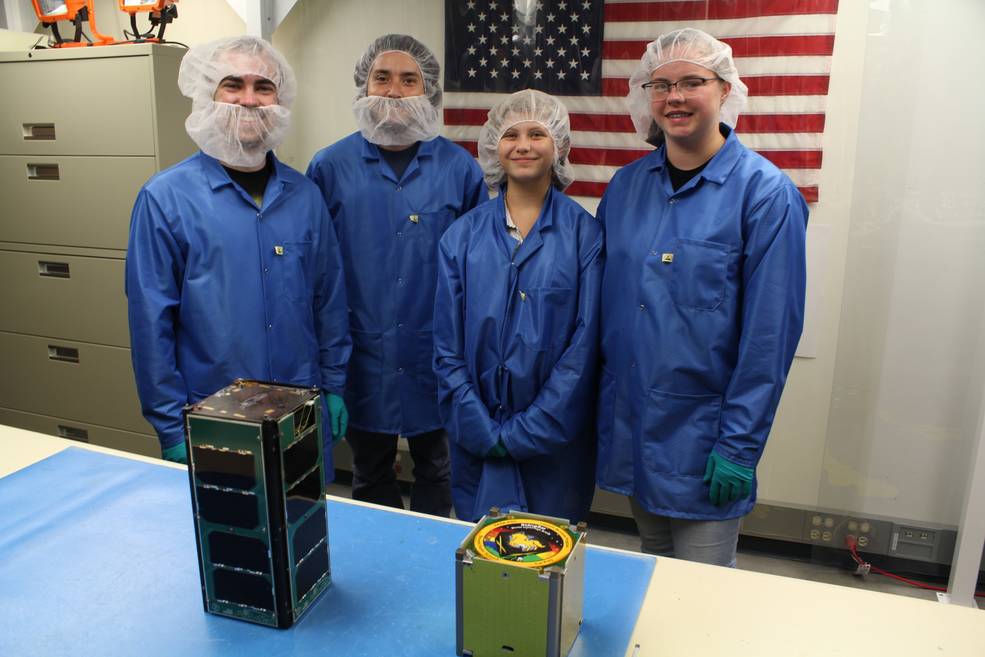
“Merritt Island High School students are photographed at the Kennedy Space Center with StangSat – a cube satellite (CubeSat) that was built and developed by students at the school. StangSat [launched] on a SpaceX Falcon Heavy rocket as part of the Department of Defense Space Test Program-2 mission, managed by the U.S. Air Force Space and Missile Systems Center… Credits: NASA/Shaun Daly”** Georgia Tech’s Prox-1 with LightSail-2 was successfully put into orbit by the Falcon Heavy as well. Prox-1 was built by Georgia Tech students with funding from the University Nanosat Program (UNP) and LightSail-2 was built by a team led by Ecliptic Enterprises and funded by the Planetary Society.
The sail’s cubesat will be ejected from Prox-1 this week:
LightSail 2 team members will soon converge at Cal Poly San Luis Obispo in California, where the spacecraft’s mission control is located. Once LightSail 2 is released from Prox-1 on 2 July, the team will spend several days checking out the CubeSat’s systems before commanding its dual-sided solar panels to deploy. Following that, the spacecraft’s solar sails will be deployed, roughly 2 weeks in total from launch day.
** Students at Cal State Poly at San Luis Obispo were involved closely with LightSail-2 and with LEO (Launch Environment Observer) cubesat also on board the FH:
Designed and built by a team of nine students pursuing a Master’s degree with Space Systems and Technology Concentration, MYSAT-2 features significant upgrades from MYSAT-1. Its primary mission is to enable students to design, implement, and test new Attitude Determination and Control (ADC) Algorithms, developed by the Khalifa University students. The algorithms help determine a CubeSat’s orientation in space, and are estimated to be 15 to 20 percent more power-efficient, in comparison with similar algorithms implemented on other spacecrafts. If successful, the new algorithms will establish the UAE as a contributor to the global space industry.
A sampling of links to recent space policy, politics, and government (US and international) related space news and resource items that I found of interest:
** The Space Show – Sun, 06/23/2019 – Loren Grush, space reporter at The Verge, discussed “the upcoming Falcon Heavy STP 2 launch, commercial, getting to and from the Moon, millennials and space, China, aerospace engineering, space journalism, women in space fields, green propellant and so very much more”.
**The Space Show/Hotel Mars – Wed, 06/26/2019 – Alan Boyle talked with John Batchelor and Dr. David Livingston about “the possible sale of Stratolaunch due to the recent death of Paul Allen”.


 .
 .