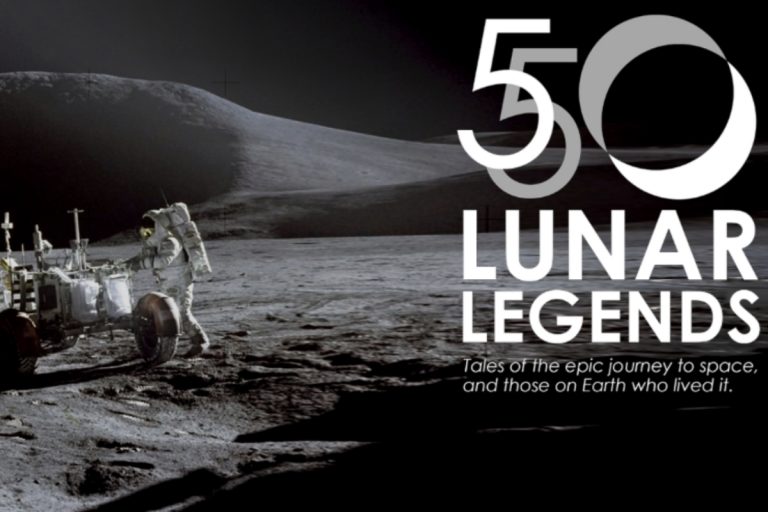
“50/50 Lunar Legends” a new documentary about the 50th anniversary of the moon landing and hidden figures of US space program – from Apollo to these days. We interviewed 50 people at the Florida Space Coast. Those who have contributed or who are actively contributing to space exploration.
Neil Armstrong believed their chances were only 50/50 that the moon landing would be a success. Hence the name of the documentary. It focuses on the actual people who worked behind the scenes at NASA and its contractors to pioneer the science and technology of space exploration and how private companies, such as SpaceX, Blue Origin, and alike now continue to push us further into the future.
The project was non-commercial and accomplished on a shoestring budget.
A Call to Action: The space race created excitement across the nation and within the young engineers and others who got jobs at NASA and moved to the Space Coast of Florida.
50/50 Chances: There is a huge sense of the “unknown” and “doubt” associated with space exploration. This inherently risky business pays off with great rewards for humanity that may also be followed by great tragedy.
A New Incentive: A deep sense of inspiration and dissatisfaction remained as the future of space exploration sat stagnant. Now, new players emerge in the Space business and the power shifts from public to private. The time has come for strategic collaboration as the new golden age for Space arrives.
A tiny satellite under construction at the U.S. Department of Energy’s Princeton Plasma Physics Laboratory (PPPL) could open new horizons in space exploration. Princeton University students are building the device, a cubic satellite or “CubeSat,” as a testbed for a miniaturized rocket thruster with unique capabilities being developed at PPPL.
The CubeSat’s thruster, whose development is led by PPPL physicist Yevgeny Raitses, holds the promise of increased flexibility for the tiny satellites, more than a thousand of which have been launched by universities, research centers and commercial interests around the world. The proposed propulsion device — powered by plasma — could raise and lower the orbits of CubeSats circling the Earth, a capability not broadly available to small spacecraft today, and would hold the potential for exploration of deep space.
“Essentially, we will be able to use these miniature thrusters for many missions,” Raitses said.
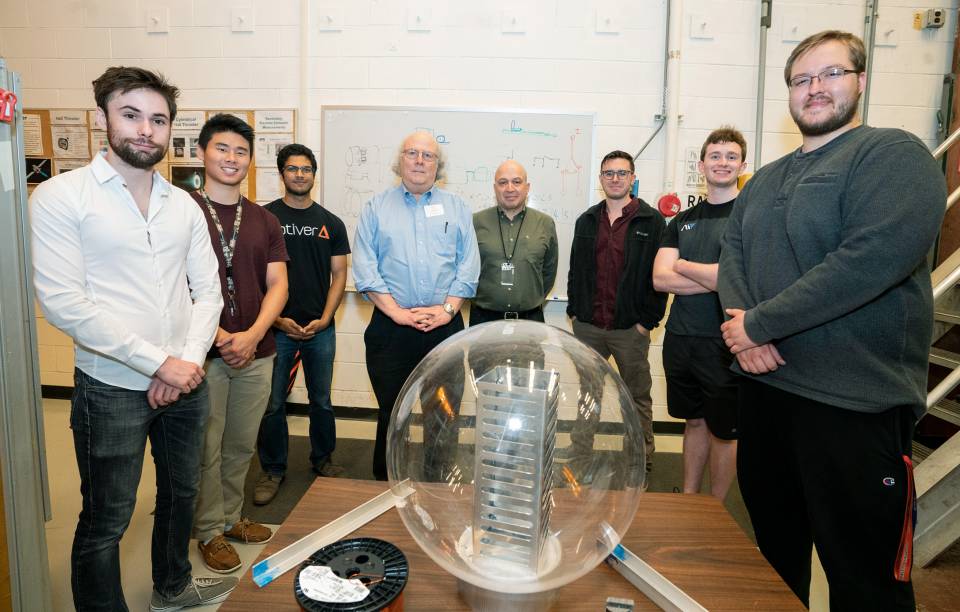
Princeton graduate and undergraduate students gather with advisors around model of the CubeSat chassis. From left: Jacob Simmonds, Jerry Xiang, Nirbhav Chopra, Daniel Marlow, Yevgeny Raitses, Seth Freeman, Matthew Bledsoe and Daniel Piatek (Seton Hall student). Photo byElle Starkman, Princeton Plasma Physics Laboratory
With some help from experts from the Indian Space Research Organisation (Isro), the undergraduate students are inching closer to designing their one-of-its-kind nano-sat equipped with a special camera that will help study the earth’s surface for response during natural hazards and track carbon dioxide (CO2) emissions. Christened Team Anant, the group comprises of students from all engineering branches and batches at the Rajasthan-based institute. So far, the students have developed a prototype for their payload, built one of the antennas for their ground station and integrated it with their transceiver to track signals from the International Space Station.
“Our nano-satellite will be the first in India to use hyperspectral imager. Globally, only two other nano-satellites have used such an imager,” said Kaushley Mehra, a member of the publicity group of Team Anant. The `1 crore project is being funded by BITS, Pilani, while the Isro is expected to bear the `20 lakh cost of satellite launch once an MoU is signed as part of the Union government’s push to encourage research. “The cost of components and basic supplies is borne partly by the institute and by sponsors,” said Mehra, adding that their team is looking for as many sponsors as possible.
The IEEE Microwave Theory and Techniques Society (MTT-S) has announced the MTT-Sat Challenge for groups of students developing RF hardware for CubeSat applications. The MTT-Sat Challenge is a worldwide competition for teams of undergraduate and graduate students to design and build RF hardware for small satellites. The most promising designs will undergo space environmental qualification testing and could be incorporated into an actual CubeSat.
“The main goal of the MTT-Sat Challenge is to advance space RF and microwave education, inspire students to pursue science and engineering education and careers, and prepare tomorrow’s leaders with the interdisciplinary teamwork skills, which are necessary for success,” the society said in announcing the competition. The MTT-Sat Challenge is intended to run over 4 academic years (starting in June 2019) and is divided into several phases spanning overall technology readiness levels. Proposals may be submitted for every single phase.
… students from Colorado and across the world will continue that legacy of exploration via the Great Lunar Expedition for Everyone (GLEE), a space mission led by NASA’s New York and Colorado Space Grant Consortium. Inspired by the Apollo moon landings, the project will send 500 spacecraft small enough to fit in the palm of your hand to the moon by 2023.
These “LunaSats,” each of which will cost less than $200, will collect valuable data on conditions at the lunar surface. They’ll be designed and built by students, said Chris Koehler, director of the Colorado Space Grant Consortium, which is based at CU Boulder.
“As we all celebrate the 50th anniversary of Apollo 11, let us tell the world we are going to the moon with a new mission conducted by students from countries across the globe, and we will be there by 2023,” Koehler said.
Future University (formerly known as Computer Man College), which is the first specialised Information and communications technology university in Sudan, offers undergraduate and graduate programmes in space science and engineering, run by the Faculty of Telecommunications and Space Technology. The University hosts Sudan’s first Space Technology Centre, which was established in 2000. The Centre recently started a CubeSat project, following years of research and development in remote sensing and space physics.
The University of Khartoum(UofK) runs what is arguably Sudan’s most advanced satellite programme. The University’s satellite programme began in October 2010 with a CubeSat project at the Electrical and Electronics Department. In 2014, the University established a specialised Space Research Centre to coordinate all space-related activities across various departments of the University. So far, the University has designed and fabricated two CubeSat prototypes – KN-Sat1 and UOKSat-2 – and has successfully installed an operational ground station to track satellites and analyse geospatial data.
LibertyQube-1 – PocketQube developed by Libertylife LLC of Japan.
Today we announce the 1st PocketQube manifested on Alba Cluster 3, LibertyQube-1 a 1p from Liberty Life LLC in Japan. LibertyQube-1 becomes the first ever Asian PocketQube to be manifested and we are excited to be their launch partner! https://t.co/qZni2Hrf3Apic.twitter.com/ylAeOoOVVl
A sampling of links to recent space policy, politics, and government (US and international) related space news and resource items that I found of interest:
** The Space Show – Tue, 07/23/2019 – Michelle Evans, President of the Orange County Space Society, discussed “Apollo program & Moon landing memories, observations and lessons learned, our future space and Moon plans and our emerging private sector”.
The Starhopper begins moving sideways during its first untethered flight as seen by a drone.
*** Starhopper makes first successful hop within a fiery storm of flame, smoke, and steam. Late Thursday evening, SpaceX’s Starhopper, a Raptor methane engine powered prototype Starship, lifted off the ground untethered for the first time and moved sideways a short distance on the flat pad. The high swirl of smoke and steam hid most of the vehicle during its brief flight. Elon Musk this morning, however, released a video showing a view of the engine from an onboard camera during the hop. Plus he provided a video from a drone where one can see much more of the vehicle during the flight than from the ground videos.
This view from the ground shows an overlay for the location of the vehicle within the cloud:
A grass fire was set off by the exhaust and was still burning this morning. However, local firefighters seem to have it under control.
Elon also said, there will be “200m hop in a week or two”.
Now that the Starhopper has made its first flight, he will soon give a presentation on the latest design and development plans for the Super Heavy Booster/Starship system.
*** Falcon 9 launches Cargo Dragon and booster lands back at the Cape. The Dragon is on its third flight and the first stage booster was on its second. The Dragon is scheduled to berth to the ISS on Saturday morning.
** The Dragon is wearing some ceramic tiles to test them for use as heat shields on the Starship. Tiles appear to be the latest approach to protecting the Starship during reentry. Previously, the plan was to pressure feed water or liquid methane through tiny holes in the steel body panels to soak up the heat to protect the vehicle. The passive tile approach seems more robust to flaws than an active transpiration system. SpaceX testing ceramic Starship heat shield tiles on flight-proven CRS-18 Cargo Dragon – Teslarati
SpaceX announced during its CRS-18 Cargo Dragon webcast that the twice-flown orbital spacecraft will feature a handful of ceramic Starship heat shield tiles, meant to flight-test a critical component of the next-generation SpaceX spacecraft.
…
If Cargo Dragon capsule C108 continues its successful record of orbital missions and recoveries, SpaceX will be able to recover Starship’s prototype ceramic heat shield tiles perfectly intact and thus have access to orbit- and reentry-tested hardware that should provide invaluable data for Starship. It’s unclear where exactly ceramic heat shielding would be used on Starship or if this means that the spacecraft’s transpirationally-cooled steel tiles did not pass muster, but CEO Elon Musk will hopefully provide additional details in a presentation later this month or early next.
The Planetary Society’s LightSail 2 spacecraft has successfully deployed the large, aluminized Mylar sail it will use to raise its orbit solely with sunlight.
Flight controllers at Cal Poly San Luis Obispo in California commanded the spacecraft to deploy its solar sails [on July 23rd] at about 11:47 PDT (18:47 UTC). Images captured during the deployment sequence and downloaded today show the 32-square-meter sail, which is about the size of a boxing ring, deploying as the spacecraft flew south of the continental United States.
** iSpace becomes first commercial Chinese company to put satellites into orbit. The company Beijing Interstellar Glory Space Technology Ltd., which also goes by the shorter name iSpace, put 2 satellites into low earth orbit with the four-stage Hyperbola 1 rocket on Thursday. The lower three stages uses solid-fueled motors while the final stage has a liquid fueled engine..
Beijing-based startup iSpace successfully sent two satellites into the designated orbits with their own rocket on Thursday. It is the first company to complete such a mission in the commercial space industry at a domestic level. The SQX-1 Y1 is the 20.8-meter-tall four-stage solid-propellant carrier rocket carrying two satellites. The rocket blasted off at 1:00 p.m. BJT from a supporting pad in the large desert at the Jiuquan Satellite Launch Center, northwest China. With a liftoff weight of 31 metric tonnes and a diameter of 1.4 meters, the rocket can carry a payload of 260kg into a sun-synchronous orbit 500 km above the Earth. Established in 2015, the startup iSpace is China’s first private company to get a license to develop carrier rockets.
** China launches three remote sensing satellites.
China’s liquid oxygen-methane rocket engine completes key test – ecns.cn :
“80-tonne thrust liquid oxygen-methane engine has completed a full-thrust run test with a duration of 100 seconds, the developer said Tuesday.The engine, named TQ-12, was independently developed by the private rocket company LandSpace and has the third-highest thrust level among liquid oxygen-methane engines globally.“
Kyushu Yunjian (Beijing) Space Technology Co.
Kyushu Yunjian “Lingyun” liquid oxygen methane engine completed the hot test – (Google Translate) – Original: 九州云箭.
“As the first liquid oxygen methane engine in China that truly realizes reusable, multiple start and deep variable thrust capability, the “Lingyun” engine has low-cost rapid maintenance and multiple start-up capability, large-scale change of engine during the development process. A series of bold and difficult explorations and attempts have been made in the adjustment technology of thrust, control technology and the adaptability technology of key assemblies. The successful completion of this round of hot test marks that the Kyushu Yunjian “Lingyun” engine has achieved the pumping type in China. Several effective breakthroughs in the bottleneck technology of cryogenic liquid rocket engines.“
Another day, another methalox engine test for Chinese NewSpace. Jiuzhou Yunjian (九州云箭, est. 2017) testing deep throttling and multiple starts with its ‘Lingyun’ 10-tonne variable thrust liquid oxygen-methane engine. https://t.co/IKEsDK6zJppic.twitter.com/7dQf9896g5
— Andrew Jones (@AJ_FI) July 23, 2019
This week’s episode of NASA’s Space to Ground report on activities related to the International Space Station:
** Explore Your Project Ideas for Space Station
Have a science or technology idea? Flying experiments on the International Space Station is a unique opportunity to eliminate gravity as a variable, provide exposure to vacuum and radiation, and have a clear view of the Earth and universe. For more information on how you can conduct your research in microgravity, visit www.nasa.gov/stationopportunities
** What Launches to Space on SpaceX’s Next Cargo Mission?
SpaceX’s Dragon spacecraft will deliver supplies and critical materials to directly support dozens of the more than 250 science and research investigations that will occur aboard the International Space Station for current and future crews. Learn more about CRS-18: https://go.nasa.gov/2L9ioX7
** NASA’s webcast of the SpaceX CRS-18 cargo mission to the ISS: Includes discussion and reports on ISS R&D.