A sampling of links to recent space policy, politics, and government (US and international) related space news and resource items that I found of interest (find previous space policy roundups here):
** The Space Show – Fri, 11/15/2019 – Dr. Alan Stern discussed “New Horizons and Kuiper Belt updates, what makes a planet a planet regarding the name, exoplanet searches, interstellar objects and lots more”.
1. Monday, Nov. 18, 2019; 7 pm PST (9 pm CST, 10 pm EST): We welcome back Joe Carroll regarding artificial gravity, tethers and more.
2. Tuesday, Nov. 19, 2019; 7-8:30 pm PST (9-10:30 pm CST, 10-11:30 pm EST): We welcome back Christopher Richins for a discussion on LEO satellites, ground stations, and more.
3. Wednesday, Nov. 20, 2019: Pre-recorded Hotel Mars Program with John Batchelor. See Upcoming Show on The Space Show website for details.
4. Thursday, Nov. 21, 2019; 7-8:30 pm PST (9-10:30 pm CST, 10-11:30 pm EST): Dr. David Livingston launches the 2020 Annual Fundraising Campaign with new campaign additions.
5. Friday, Nov. 22, 2019; 9:30-11 am PST (11:30 am-1 pm CST, 12:30-2 pm EST): We welcome Dr. Kirby Runyon from Johns Hopkins University Applied Physics Laboratory to talk about what makes a planet a planet, planetary naming, dwarf planets, the proposed NASA interstellar mission and more.
6. Sunday, Nov. 24, 2019; 12-1:30 pm PST (3-4:30 pm EST, 2-3:30 pm CST): We welcome you to OPEN LINES. Call us and talk about the issues that you want to talk about. All callers welcome, so are all space, STEM, STEAM, economic, and science topics.
Some recent shows:
** Sun, 11/17/2019 – Casey Dreier, Director of Space Policy at the Planetary Society, talked about “his Apollo costing models plus his analysis of key present day space policy issues”.
** Fri, 11/15/2019 – Dr. Alan Stern discussed “New Horizons and Kuiper Belt updates, what makes a planet a planet regarding the name, exoplanet searches, interstellar objects and lots more”.
A sampling of recent articles, press releases, etc. related to student and amateur CubeSat / SmallSat projects and programs (find previous smallsat roundups here):
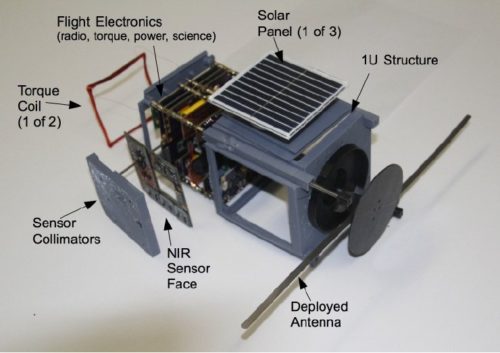
Sonoma State received funding for EdgeCube in June 2016, after physics and astronomy professor Lynn Cominsky wrote a proposal to NASA. The proposal called for monitoring the “red edge” of the chlorophyll spectrum in large patches of homogeneous vegetation using a CubeSat or a small satellite. Since then, approximately 30 students have worked on the project from Sonoma State, Santa Clara University and Morehead State. Professor Matt Clark from SSU’s Department of Geography and Environmental Planning was the originator of the idea to measure the “red edge,” hence the name “EdgeCube”.
** Virginia Tech inspireFly team wins SEDS SAT-2 contest. SEDS (Students for the Exploration and Development of Space), Astranis, and NanoRacks sponsored the competition. The winning team will receive a free ride to the ISS for their CubeSat, which will then be deployed into orbit.
Students for the Exploration and Development of Space (SEDS), the largest student-run space and science advocacy organization in the world, today announced that Virginia Tech’s inspireFly team is the winner of the Astranis SEDS SAT-2 competition. Astranis, a manufacturer and operator of small geostationary satellites, contributed to the cost of the launch, while competition co-sponsor Nanoracks, a leading provider of commercial access to space, will launch and deploy the winning CubeSat on the International Space Station in the next two to three years.
Open to U.S. SEDS chapters, the competition tasked teams with submitting a design for a novel 1U CubeSat. The competition kicked off at SpaceVision in November 2018, where interested teams had the opportunity to attend an Astranis/Nanoracks workshop on designing, building, and integrating a CubeSat for low Earth orbit.
Thirteen chapters from across the country entered the competition and submitted proposals. The judging panel included members of the SEDS-USA Board of Advisors and Directors, as well as employees from Astranis and Nanoracks. Proposals were judged on their technical merits, the non-technical capabilities of the team to develop and support the design, the professionalism of proposal, the novelty of the proposed CubeSat mission, and the demographic makeup of the design team and their mentors.
Virginia Tech’s team was selected as the winner for its ContentCube project, a selfie-stick for space that will take pictures of an external LCD screen–featuring publicly-submitted photos–with Earth in the background.
A sampling of recent articles, videos, and images dealing with space transport (find previous roundups here):
** SpaceX executes successful static firing of Crew Dragon launch escape system. A similar firing last April led to an explosion caused by leaks and other problems in the propellant plumbing. Assuming the data looks OK in closer examination, this firing allows for SpaceX to proceed to the in-flight abort test flight, presumably in December, in which a Crew Dragon will detach from a Falcon 9 upper stage not long after launch to simulate the escape from a failing booster.
Full duration static fire test of Crew Dragon’s launch escape system complete – SpaceX and NASA teams are now reviewing test data and working toward an in-flight demonstration of Crew Dragon’s launch escape capabilities pic.twitter.com/CMHvMRBQcW
Firstly, a Kuaizhou-1A (Y11) launcher sent a remote sensing satellite into low earth orbit from the Jiuquan Satellite Launch Center, Gansu Province in northwest China, on 13 November 2019:
The Jilin-1 satellite constellation was developed on China’s Jilin Province and is the country’s first self-developed remote sensing satellite for commercial use. Data will be provided to commercial clients to help them forecast and mitigate geological disasters, as well as shorten the time scale for the exploration of natural resources.
The satellites were developed by the Chang Guang Satellite Technology Co., Ltd under the Changchun Institute of Optics, Fine Mechanics and Physics, Chinese Academy of Sciences.
And then a Long March-6 sent five small remote-sensing satellites into orbit from Taiyuan Satellite Launch Center in north China’s Shanxi Province:
The new satellites – also designated Zhongzi, were developed by the DFH Satellite Co., Ltd. and the Shanghai Academy of Spaceflight Technology (SAST) – are part of a commercial satellite project financed by the Ningxia Jingui Information Technology Co., Ltd. and will be mainly used for remote sensing detection.
This mission was the first low-inclination orbital launch for the Long March-6 launch vehicles, in response to the mission needs. The rocket was submitted to a series of technical upgrades, including take-off roll, horizontal guidance, new composite material double-walled mount barrel and others.
** UK govt. aims to develop plan for flight-testing Reaction Engines‘ SABRE engine:
The purpose of this call is to produce a roadmap for the next phase in the SABRE development. It is focused on flight-testing the core SABRE air-breathing engine and assessing the potential competitive positioning of future SABRE-powered applications in the future space transportation segment.
** US rocket company Launcher gets $1.5 million for rocket engine development:
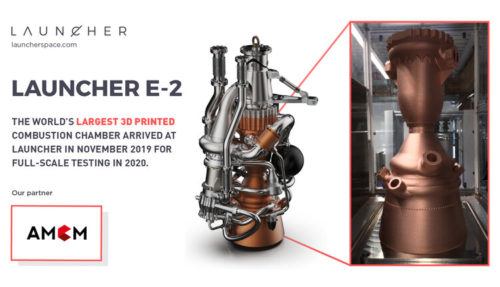
Launcher Inc. has scheduled the first full-scale test of its E-2 rocket engine for mid-2020 after securing a $1.5M award from the U.S. Air Force and taking delivery of the world’s largest 3D printed combustion chamber.
3D printed by AMCM (An EOS Group Company) in Copper Alloy on AMCM’s M4K machine, it is the world’s largest liquid rocket engine combustion chamber 3D printed in a single part. The combustion chamber is 34in (86cm) tall with an exit nozzle diameter of 16in (41cm).
Launcher E-2 engine employs a large 3-D printed combustion chamber.
“We are still in the process of evaluating video and telemetry data; however, it appears a structural failure resulted in an abort and deployment of the recovery system at speeds far beyond its design capability,” the company stated.
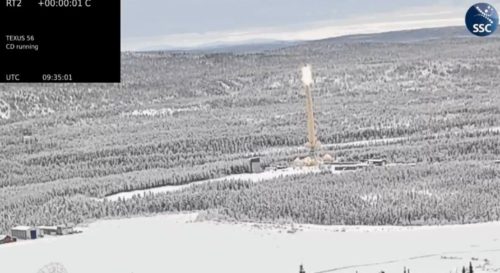
** Airbus team flies TEXUS suborbital rocket from Esrange launch facility near Kiruna in northern Sweden:
Airbus has completed another successful space mission. On 15 November, the TEXUS-56 rocket completed a scientific research flight.
The research rocket took off at 10:35 CET from Kiruna, north Sweden, and gave the scientists involved six minutes of research in microgravity. After the parachute landing of the rocket, the experiments were recovered by a helicopter team. The research teams will now evaluate the results.
“Mission accomplished! Our TEXUS team from Bremen has once again done a great job for our customers, ESA and DLR,” enthuses project manager Detlef Wilde. “With TEXUS, we offer very short preparation times, integrate the payloads and take care of the complete mission execution, including procurement of the rockets – a service that our customers love to use”.
Launch of the Airbus suborbital TEXUS-56 mission from Esrange Space Center in northern Sweden.
Aside from a general improvement to the overall visual fit-and-finish of the v1.0 spacecraft, SpaceX’s official comments on the matter indicated that the most substantial changes between v0.9 and v1.0 were more related to each spacecraft’s advanced electronics and payloads. In the case of Starlink, each satellite’s primary payload is a high-performance suite of electronically-steered phased array antennas. Initially developed to improve the flexibility of tracking and scanning radars used by military fighter aircraft, phased array antennas (and radar) allow multiple beams to be aimed without physically moving the antenna.
SpaceX says that Starlink v1.0 satellites added a number of Ka-band antennas alongside upgraded Ku-band hardware similar to what was installed on Starlink v0.9. Ka and Ku refer to similar but different communications frequencies, with Ku-band generally offering greater reliability and cloud/rain tolerance, while Ka-band is a bit more sensitive to environmental factors but offers a substantially higher theoretical bandwidth.
Known as Kacific-1 or JCSat-18 the massive spacecraft is scheduled to launch no earlier than mid-December and is current set to be SpaceX’s second to last or final launch of 2019. According to tweets published by operator Kacific and satellite manufacturer Boeing, the satellite departed Boeing’s El Segundo, California factory on November 4th and has probably already arrived in Cape Canaveral, Florida.
After arrival, Boeing technicians will inspect the satellite to ensure its road trip caused no damaged and fuel the spacecraft’s bipropellant and xenon propellant tanks. SpaceX technicians will then take over, encapsulating Kacific-1 inside a Falcon 9 payload fairing, transporting the assembly to its Launch Complex 40 pad, and attaching the fairing to an integrated Falcon 9 rocket.
The Boeing Satellite Systems International (Boeing) Factory in California has shipped the Kacific1 satellite. It’s now enroute to SpaceX’s launch operations site in Cape Canaveral, Florida, where it will be prepared for launch atop a Falcon9 rocket. pic.twitter.com/WxoF6wROc2
*** Views of Starship Mk.1 construction activity at Boca Chica Beach, Texas:
Starship Mk1 is now preparing for cryo loading tests in the coming days, which will mark fuel tests ahead of the testing with her three Raptor engines.
*** Latest fly-around the Florida orbital Starship demo construction facility:
Aerial view of Cocoa Facility. Attachment points in the top of the engine section are close to completion so that the top dome can be installed. Three very large containers have arrived at the site who’s purpose is unknown. They are located in various locations. One out front of main facility, one on the side of the facility and one in the small tent on the side of the facility.
Here is the latest episode in NASA’s Space to Ground weekly report on activities related to the International Space Station:
** Expedition 61 AMS Overview Briefing – November 12, 2019
At the Johnson Space Center, space station operations integration manager Kenny Todd and Alpha Magnetic Spectrometer (AMS) project manager Ken Bollweg discuss the activities aboard the International Space Station and the science of the AMS in a briefing on Nov. 12 ahead of a series of spacewalks to repair the particle physics experiment on the outside of the space station. NASA astronaut Andrew Morgan and ESA (European Space Agency) astronaut Luca Parmitano are to conduct all of the complicated spacewalks that are set to begin November 15th.
** Expedition 61 AMS Spacewalk Briefing – November 12, 2019
At the Johnson Space Center, Alpha Magnetic Spectrometer (AMS) spacewalk repair project manager Tara Jochim, spacewalk flight director Jeff Radigan, and lead spacewalk officer John Mularski discuss the preparations and procedures behind a series of spacewalks to repair the particle physics experiment on the outside of the space station during a briefing on Nov. 12. NASA astronaut Andrew Morgan and ESA (European Space Agency) astronaut Luca Parmitano are to conduct all of the complicated spacewalks that are set to begin November 15th.
** Suiting Up for a Spacewalk
On Friday International Space Station commander Luca Parmitano of ESA (European Space Agency) and NASA’s Andrew Morgan start a series of spacewalks to upgrade the cooling system on the Alpha Magnetic Spectrometer. Each of those spacewalk days will start with the lengthy process of getting into the spacesuits that support them as they float in the vacuum of space. Want to see what that looks like? Here’s an accelerated view of the process, taken from an October 2019 spacewalk in which Parmitano helped Morgan and astronaut Christina Koch get ready for their spacewalk.
** Christina Koch and Jessica Meir in-flight interviews from ISS
ISS Expedition 61 In-Flight Interviews with the Kelly Clarkson Show and Elle Magazine’s Digital News Platform with NASA Flight Engineers Christina Koch and Jessica Meir.
** Alpha Magnetic Spectrometer Repair Spacewalk #1, Nov. 15, 2019 – Video of Friday’s spacewalk:
Astronauts Andrew Morgan of NASA and Luca Parmitano of the European Space Agency (ESA) will venture outside the International Space Station starting at ~7:05 a.m. EST to begin repairing the Alpha Magnetic Spectrometer (AMS) instrument. This is the first in a series of repair spacewalks – the most complex of this kind since the servicing of the Hubble Space Telescope. AMS is attached to the outside of the space station, where it has been operating since 2011. It is a particle physics experiment working to help us understand dark matter and the origins of the universe.