Here is the latest episode in NASA’s Space to Ground weekly report on activities related to the International Space Station:
** Expedition 61 Inflight University of New Mexico – December 10, 2019
Aboard the International Space Station, Expedition 61 Flight Engineer Christina Koch of NASA discussed life and research on board the orbital outpost during an in-flight educational event Dec. 10 with students at the University of New Mexico in Albuquerque. Koch is nearing the home stretch of a long-duration mission on the station which is expected to span 328 days by the time she returns to Earth in early February – more days in space than any other woman in history
** Expedition 61 Inflight event with Second Baptist School – December 13, 2019
Aboard the International Space Station, Expedition 61 Flight Engineer Christina Koch of NASA discussed life and research aboard the outpost during an in-flight educational event Dec. 13 with the Second Baptist School in Houston, Texas. The event featured Senator Ted Cruz of Texas who attended the private school and graduated as valedictorian in 1988. Koch is nearing the home stretch of a long-duration mission on the station which is expected to span 328 days by the time she returns to Earth in early February – more days in space than any other woman in history.
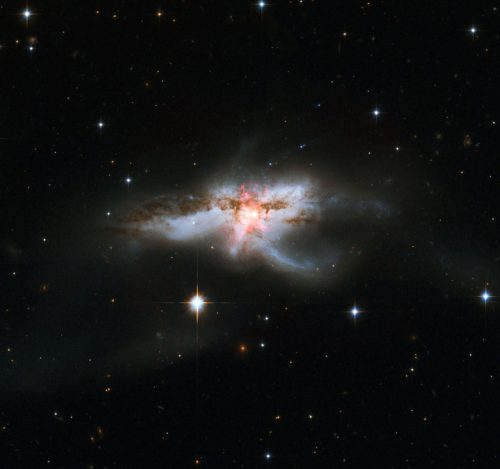
New observations find that NGC 6240 contains three supermassive black holes following the collision of three galaxies. W. Kollatschny et al. Via Carnival of Space.
New Shepard had a wholly successful mission on December 11, 2019.
This mission was another step towards verifying New Shepard for human spaceflight as we continue to mature the safety and reliability of the vehicle.
This was the 6th flight for this particular New Shepard vehicle. Blue Origin has so far reused two boosters five times each consecutively, so today marks a record with this booster completing its 6th flight to space and back.
This particular rocket has been an operational payload vehicle for several flights, meaning there are no more updates to the system.
Here are some videos Blue posted this afternoon:
]
** Blue Origin flew a New Shepard rocket vehicle today on its 6th mission to over 100 kilometers. The launch was postponed from Tuesday due to bad weather. Here is the webcast video (the liftoff is around the 40:15 point):
An earlier statement from Blue announcing the mission:
Blue Origin’s next New Shepard mission (NS-12) is currently targeting liftoff tomorrow, December 10th at 8:30 am CST / 14:30 UCT. Current weather conditions aren’t as favorable as we’d like, but we’re continuing to keep an eye on the forecast.
As we move towards verifying New Shepard for human spaceflight we are continuing to mature the safety and reliability of the vehicle.
It’s the 6th flight for this particular New Shepard vehicle, marking the first time a Blue Origin booster has made this many consecutive flights (the previous booster flew five times consecutively) – all with minimal refurbishment between flights. This particular rocket has been an operational payload vehicle for several flights, meaning there are no more updates to the system.
This will also be the 9th commercial payload mission for New Shepard, and we are proud to be flying our 100th customer on board.
Also on the vehicle are thousands of postcards from students around the world for our nonprofit Club for the Future. The Club’s mission is to inspire future generations to pursue careers in STEM and help visualize the future of life in space.
You can watch the launch live at BlueOrigin.com – the pre-show begins T-30 where Blue will provide more mission details and updates.
To follow the action, we’ll be posting live updates on Instagram and Twitter.
New Shepard Mission NS-12 Notable Payloads Manifested:
OK Go
Earlier this year we partnered with rock band OK Go on a contest called Art in Space, giving high school and middle school students a chance to send art experiments into space on our New Shepard vehicle. We are sending the two winning art projects on NS-12.
Columbia University
One of our educational payloads from Columbia University, designed and built by undergraduate students and advised by Dr. Michael Massimino (an astronaut), will study the acute impacts of microgravity environments on cell biology. This is crucial for humans living and working in space.
OSCAR
OSCAR, which was led by principal investigator Dr. Annie Meier, is a recycling technology payload from NASA’s Kennedy Space Center. It is designed to create a mixture of gasses that could be used for propulsion or life support from common waste on a deep space human exploration mission. This is Blue’s first full-stack payload, meaning there will be more room to do complex studies in flight.
** Several orbital launches took place in the past week.
*** Dec.11: India launched a PSLV (Polar Satellite Launch Vehicle) today with a radar imaging spy satellite on board. Liftoff happens at about 23:55 into this ISRO webcast video:
*** Dec. 7: China launched two Kuaizhou-1A rockets within a few hours, putting a total of seven satellites into orbit. This included the Jilin-1 Gaofen-2B remote sensing satellite for the Jilin constellation on the first launch and six smallsats on the second rocket:
*** Dec. 6: Rocket Lab launched an Electron rocket for the 10th time. Seven satellites were placed into orbit. In addition, the first stage booster remained intact after plummeting back through the atmosphere in a guided flight all the way to splashdown. This is a positive indication for plans to recover the boosters and reuse them. This Electron was also the first to fly with a fully Autonomous Flight Termination System (AFTS).
The USLaunchReport.com team posted this montage of scenes from before and during the Falcon 9 launch, plus they show the booster at Cape Canaveral and the retracting of the legs.
Road to the Space Elevator Era: This International Academy of Astronautics study report (4 years by 30 global space experts) was “released” during the IAC [2019] at the Robert Heinlein Prize Trust Booth (publisher). The report has significant inputs from ISEC and our members. Several of the ISEC concepts from our Chief Architect were accepted into the book and stood tall. These would include several of Fitzer’s Architectural Notes and his concept of a Galactic Harbour being a combination of a transportation infrastructure and an enterprise zone. This internationally endorsed study report again portrays an aggressive approach towards implementation of SEs. ISEC was instrumental in the content of the book and the editing of the content – as such, this year’s distribution of the document at the IAC was a “win-win.”
**** As usual, lots of activities underway across the wide range of SpaceX projects. Here are four upcoming Falcon 9 launches:
Dec. 16: Launch from Cape Canaveral of the Boeing built JCSAT 18/Kacific 1 comm-sat for SKY Perfect JSAT Corp. of Japan and Kacific Broadband Satellites of Singapore.
Late Dec: Starlink-2 launch of a batch of 60 operational Starlink satellites.
Jan.4: A “no-earlier-than’ (NET) date for the in-flight abort test in which a Crew Dragon spacecraft will separate from the Falcon 9 about a minute after to liftoff. This will simulate the
Early Jan: Starlink-3 launch of the third batch of 60 Starlink satellites
**** The Falcon upper stage successfully fired after coasting for a several hours following the release of the Cargo Dragon in last week’s mission discussed above. Such a capability is required for some types of satellite missions, especially for the military.
**** SpaceX plans to provide low cost launch services for smallsats on a fixed schedule. This will mean tough competition for small rocket launch providers. The use of Momentus space tugs will also allow smallsats released from the Falcon to reach a wide array of orbits. SpaceX’s First Rideshare Customer Means Competition for Northrop – Motley Fool
The article exaggerates the threat, though, to Northrop’s Mission Extension Vehicles (MEVs). These are intended to keep large comm-sats in geostationary orbit in operation after they have run out of station-keeping fuel. The SpaceX and Momentus services are focused on low earth orbit missions for smallsats.
12.08.2019 Go Discovery entered the Brazos Santiago at 7:18 AM local time. Spectacular view of SpaceX bulk head and stands being delivered to Boca Chica complex. Dolphins at the bow at 2:00 min mark. All images are explicitly owned by LabPadre Media
Disassembly of Starship Mk1 is in the final stages ahead of the stacking of Mk3. Sunrise. Normal speed disasembly, then additional clips in timelapse. Footage and photos from Mary (@bocachicagal) for NSF.
**** New SpaceX Launch Control Center at Boca Chica, Texas – LabPadre – Dec.3.2019
It appears that SpaceX is breaking ground for their new launch control center here at Boca Chica, Texas. Fast paced progress ahead for the push of MK-3. Video Credit: Maria Pointer
** Florida Starship facility – Aerial view via John Winkopp – Dec.6.2019:
Aerial view, still not much changed, more equipment on the way out. One large piece of wing root has been placed in the blue container for shipping. All of the sheets of steel that was in the On Deck Area has been shipped out.
1. Monday, Dec. 9 2019; 2 pm PST (4 pm CST, 5 pm EST): No special show today.
2. Tuesday, Dec. 10, 2019; 7-8:30 pm PST (9-10:30 pm CST; 10-11:30 pm EST): We welcome back Dr. Charles Lurio of The Lurio Report for his perspective on 2019 and looking forward to 2020.
3. Wednesday, Dec. 11 2019: Pre-recorded Hotel Mars Program with John Batchelor. See Upcoming Show on The Space Show website for details.
5. Friday, Dec. 13, 2019; 9:30-11 am PST (11:30 AM-1 pm CST, 12:30-2 pm EST): We welcome Dr. Morgan Irons will discuss quasi-closed, agro-ecological systems for use in Earth and space environments. Dr. Irons was a presenter at the recently held SSI Space Settlement Conf. in Seattle this past September.
6. Sunday, Dec. 15, 2019; 12-1:30 pm PST (3-4:30 pm EST, 2-3:30 pm CST): We welcome Jeffrey Morris, founder of Futuredude Entertainment regrading his new space science fiction movies in the making.
Some recent shows:
** Sun, 12/08/2019 – Dr. David Livingston led a discussion with listeners “on several Space Show topics in physics and the future of physics, The Space Development Network and space agriculture, important Space Show fundraising efforts for our 2019 campaign, news events of the day and more”.
** Tue, 12/03/2019 – Bryce Meyer discussed “space farms, growing food in space, lunar agriculture, food on Mars, recycling human waste, space farm energy needs and TRL’s”.
** Mon, 12/02/2019 – Dr. Sean Casey gave an “Overview of commercial and NewSpace investment through the present, multiple additional commercial, exploratory, engineering and space related topics”.
** Sun, 12/01/2019 – Dr. Gary Greenberg talked about “special 3D imaging for art with science of sand, lunar sand, Martian dust, 3D Microscopes and much more”.
A sampling of links to recent space policy, politics, and government (US and international) related space news and resource items that I found of interest (find previous space policy roundups here):
As the 2010s come to a close, Marcia Smith, the founder of Space Policy Online, rejoins the show to explore the most significant and impactful space policy decisions of the 2010s. Mat and Casey also discuss the recently-approved European Space Agency budget, and what it means for planetary defense and Mars sample return efforts.
Dr. Mary Lynne Dittmar is the Coalition for Deep Space Exploration president & CEO. Supportive parents & being part of the Apollo generation fostered her love for space. But it wasn’t until later in her career that she believed she could have a professional impact on the industry. Fast forward to today and she’s one of the most renowned strategic thinkers in Space & a highly regarded technical expert with a boldness you’ll respect, admire & love. Discover how she did it & how she continues to pay it forward.
Blue Origin successfully protested the US Air Force’s RFP for the National Security Space Launch program, which will have big implications for the way the current round of contract awards plays out. NASA added five new providers to the Commercial Lunar Payload Services program, including SpaceX and Blue Origin, and I’ve got some thoughts about the inclusion of those options in what is quickly becoming my favorite NASA program.
** Town Hall with Administrator Bridenstine and NASA’s New HEO Associate Administrator Douglas Loverro
NASA held an Agency-wide Town Hall with Administrator Bridenstine and Douglas Loverro, NASA’s new Associate Administrator for the Human Exploration and Operations Mission Directorate, on Tuesday, Dec. 3, at noon EST. During the Town Hall, the Administrator introduced Douglas Loverro, and they answered questions from the agency’s workforce.
** The Space Show – Sun, 12/08/2019 – Dr. David Livingston led a discussion with listeners “on several Space Show topics in physics and the future of physics, The Space Development Network and space agriculture, important Space Show fundraising efforts for our 2019 campaign, news events of the day and more”.
** The Space Show – Tue, 12/03/2019 – Bryce Meyer discussed “space farms, growing food in space, lunar agriculture, food on Mars, recycling human waste, space farm energy needs and TRL’s”.
** The Space Show – Mon, 12/02/2019 – Dr. Sean Casey gave an “Overview of commercial and NewSpace investment through the present, multiple additional commercial, exploratory, engineering and space related topics”.