A sampling of links to recent space policy, politics, and government (US and international) related space news and resource items that I found of interest (find previous space policy roundups here):
3. Wednesday, May 13, 2020 – 3:30 pm PDT (5:30 pm CDT, 6:30 pm EDT) – Hotel Mars/John Batchelor Show: David Livingston and John Batchelor will talk with Dr. Jim Logan about telemedicine on and off Earth.
4. Thursday, May 14, 2020; 7-8:30 pm PDT (9-10:30 pm CDT, 10-11:30 pm EDT): No special programming.
5. Friday, May 15, 2020; 9:30-11 am PDT (11:30 am-1 pm CDT, 12:30-2 pm EDT): We welcome back Michelle Hanlon of For All Moonkind to discuss The Artemis Project, the new E.O. commercial space with property rights and more.
6. Sunday, May 17, 2020; 12-1:30 pm PDT (3-4:30 pm EDT, 2-3:30 pm CDT): We welcome space atty Michael Listner of Space Law & Policy Solutions for his legal perspective on The Artemis Project, the E.O., the new National Space Policy plus some unique ideas on space resource utilization.
** Tues, 05/05/2020 – Dr. Haym Benaroya of Rutgers talked about “Lunar return, costs, wealth building, challenges, needed technology, national policy and more.”
A sampling of recent articles, press releases, etc. related to student and amateur CubeSat / SmallSat projects and programs (find previous smallsat roundups here):
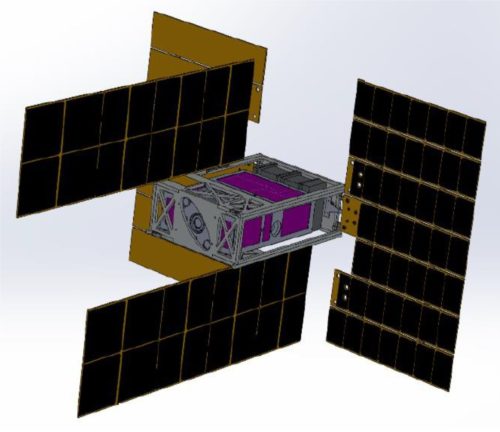
Science aboard an Alabama Space Grant Consortium (ASGC) student-led cube satellite mission called AEGIS could be valuable to developing future human outposts on the moon and in space travel to Mars if NASA gives the go-ahead for a 2022 flight.
Based at The University of Alabama in Huntsville (UAH), ASGC member universities are Alabama A&M University, Auburn University, Tuskegee University, The University of Alabama, The University of Alabama at Birmingham, UAH and the University of South Alabama, and all are involved in AEGIS.
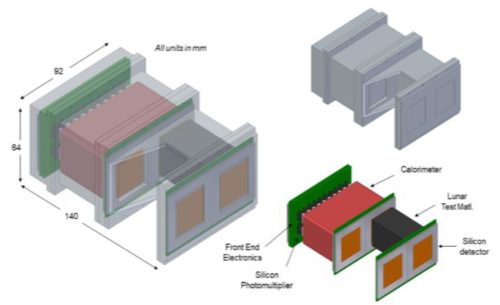
An experiment to test the radiation-shielding properties of simulated lunar soil, or regolith, is aboard the AEGIS CubeSat under development. The science is important to future lunar colonies because transporting shielding materials to the moon will be expensive, says Dr. Michael Briggs, assistant director of UAH’s Center for Space Plasma and Aeronomic Research (CSPAR) and a principle research scientist who is advising the AEGIS science mission.
“In contrast, lunar regolith will be readily available,” he says. “Calculations show that lunar regolith will work well as a shield and NASA is studying its use as a construction material. Our goal is to improve our knowledge of its radiation shielding capacity.”
Future Mars missions could benefit from spacecraft that use lunar regolith as shielding.
“Since the lunar gravity is weaker than the Earth’s,” Dr. Briggs says, “it could be easier to use lunar material for radiation shielding for a spaceflight to Mars.”
ASGC’s 6U CubeSat measures slightly smaller than 4x8x12 inches. The craft will achieve an egg-shaped cislunar orbit that will swing it out from the Earth toward the moon and then back to Earth again.
“It is crucial to test the shielding in a radiation environment equivalent to what astronauts will be exposed to on the surface of the moon or while traveling to Mars,” Dr. Briggs says.
AEGIS mission is funded by NASA’s CubeSat Launch Initiative (CSLI). Over 120 students from Alabama colleges will be involved. The spacecraft will be launched into a high earth orbit as a secondary payload on a SLS mission as early as 2021 or 2022.
“Instrument overview with major elements and dimensions labeled. Two sides of the instrument readout eparately for control and shielded background comparison.” Credits: J.Fuchs & M. Halvorson UAH
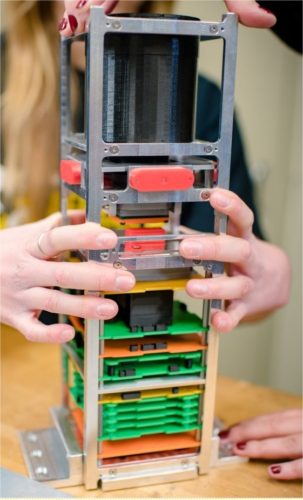
** Michigan Technological University sending second student built satellite to ISS. The Stratus CubeSat will be deployed in March 2021.
Stratus vehicle is a three-axis-stabilized thermal infrared telescope that will be used to image atmospheric clouds. Using asynchronous stereo image processing, the data from Stratus will provide Cloud Fraction, Cloud Top Wind, and Cloud Top Height information that can be used to reconcile climate models. If successful, a number of inexpensive Stratus spacecraft could be deployed in the future to gather hyper-local weather data.
Once successfully deployed, Stratus will be the University’s second orbiting nanosatellite. The first, Oculus-ASR, was launched from Cape Canaveral in June 2019. Another satellite, Auris, designed to monitor communications emissions from geostationary satellites, has cleared system concept review in the design and development phase of the Air Force Research Lab University Nanosatellite Program (AFRL UNP).
Bill Predebon, J.S. Endowed Chair of the Department of Mechanical Engineering-Engineering Mechanics in the College of Engineering, welcomed the news of a second satellite launch with praise for King and Aerospace Enterprise team members. “It is amazing that Michigan Tech will have a second student-built satellite in space next year.”
Development of Stratus has been slowed by the Coronavirus shutdowns but work will soon resume.
“This mission has been in the works for much longer,” he said. “As with Oculus, I estimate more than 200 students and alumni have been part of this mission; it wouldn’t be possible without them. I am delighted to see these years of hard work pay off.”
The 10-by-10-by-30-centimeter, 4.4-kilogram Stratus CubeSat is considerably smaller than the 70-kilogram Oculus-ASR, a microsat which measures 50-by-50-by-80 centimeters. But both, as well as Auris, are classed in the broader category of nanosatellites, the craft that represent an important development in space industry trends.
** Benoit Chamot – CubeSat Attitude Control: ADCS from CubeSpace – Cold Star Project S02E34
Head of Sales & Marketing for CubeSpace Benoit Chamot is on the Cold Star Project, and with host Jason Kanigan we’re looking at attitude determination and control systems (ADCS) for satellites. We discuss:
– how Benoit earned Masters degrees from both Lausanne and MIT, and the projects involved
– the critical ADCS system for satellites, and the components they’re made of such as sun sensors, reaction wheels, PCBs
– why CubeSpace chose to focus on reaction wheels, designing and manufacturing their own CubeWheel product
– why the company encourages South African space industry and opportunities for young engineers
** CubeSat – YouTube: Now includes several videos of presentations at the recent 2020 CubeSat Developers Workshopsuch as, A Standard Micro Propulsion System for CubeSats, by Joe Cardin, Chris Day (VACCO Industries):
This video shows the new AMSAT CubeSatSim, a low cost functional model of a 1U CubeSat nanosatelite. The video shows the boards and frame in the new version and the use of FoxTelem software to decode telemetry.
Here is the latest episode in NASA’s Space to Ground weekly report on activities related to the International Space Station:
** Cross-Cutting Computational Modeling Project – NASA Johnson
** DM-2 Crew Interviews – Douglas Hurley
With the first mission to return human spaceflight launches to American soil now targeted to lift off May 27, NASA astronauts and Demo-2 crew members Bob Behnken and Doug Hurley shared their thoughts and experiences prior to their historic mission. NASA’s SpaceX Demo-2 mission is a flight test with NASA astronauts aboard SpaceX’s Crew Dragon spacecraft set to lift off on a Falcon 9 rocket to the International Space Station from NASA’s Kennedy Space Center in Florida. Interviews were recorded on April 17, 2020.
** DM-2 Crew Interviews – Robert Behnken
With the first mission to return human spaceflight launches to American soil now targeted to lift off May 27, NASA astronauts and Demo-2 crew members Bob Behnken and Doug Hurley shared their thoughts and experiences prior to their historic mission. NASA’s SpaceX Demo-2 mission is a flight test with NASA astronauts aboard SpaceX’s Crew Dragon spacecraft set to lift off on a Falcon 9 rocket to the International Space Station from NASA’s Kennedy Space Center in Florida. Interviews were recorded on April 17, 2020.