A preview from NASA JPL of the December night sky:
And here is more from the Hubble Space Telescope Institute:
====
Einstein’s Monsters: The Life and Times of Black Holes

A preview from NASA JPL of the December night sky:
And here is more from the Hubble Space Telescope Institute:
====
Einstein’s Monsters: The Life and Times of Black Holes
A sampling of links to recent space policy, politics, and government (US and international) related space news and resource items that I found of interest:
Webcasts:
** Property Rights – Rand Simberg – 21st Annual International Mars Society Convention
** A Political History of the Human Mission to Mars Goal in the U.S. – Lou Friedman (Emeritus, The Planetary Society) – FISO
** Heritage Management: Preservation and Property on the Moon – Michelle Hanlon , Center for Remote Sensing, Air & Space Law at the University of Mississippi, For All Moonkind – FISO
====
Chasing New Horizons: Inside the Epic First Mission to Pluto
Here is the latest Space to Ground report from NASA on activities related to the International Space Station:
** A brief item about NASA astronaut Anne McClain:
What does the game of rugby have to do with spaceflight? Former U.S. national rugby team player and current NASA astronaut Anne McClain explains how her time playing rugby has helped her prepare for a space mission.
** Rocket Ranch Podcast E06: Starting Up the Space Station
In this episode, we sit down with the Space Shuttle commander who officially began construction of the ISS in space. Former astronaut Bob Cabana recounts his experiences in being the first American on station and turning on the lights.
====
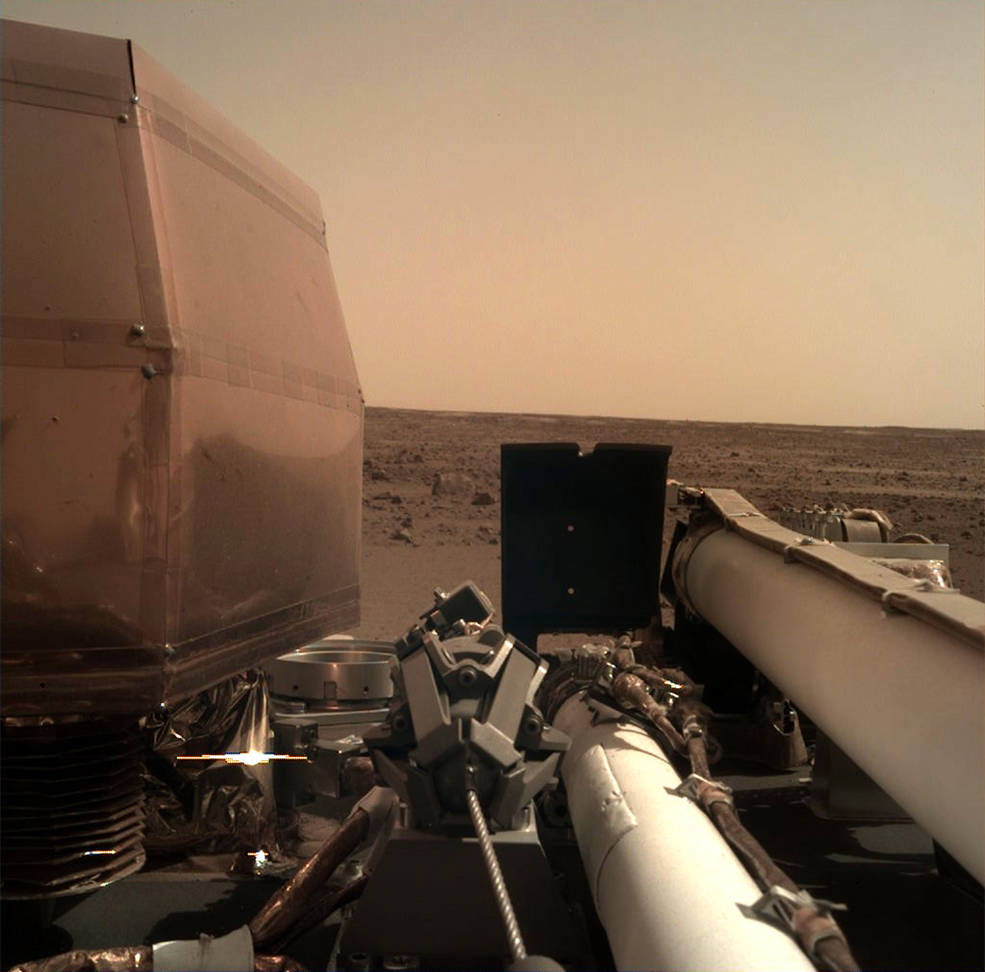
NASA’s Insight lander, which arrived on Mars on Monday, is moving quickly towards operational status. The solar panels have been deployed and in the
… coming days, the mission team will unstow InSight’s robotic arm and use the attached camera to snap photos of the ground so that engineers can decide where to place the spacecraft’s scientific instruments. It will take two to three months before those instruments are fully deployed and sending back data.
In the meantime, InSight will use its weather sensors and magnetometer to take readings from its landing site at Elysium Planitia — its new home on Mars.
More at InSight Is Catching Rays on Mars – NASA JPL.
===
Here’s a report from Bob Zimmerman about the landing: November 27, 2018 Zimmerman/Batchelor podcast | Behind The Black –
===
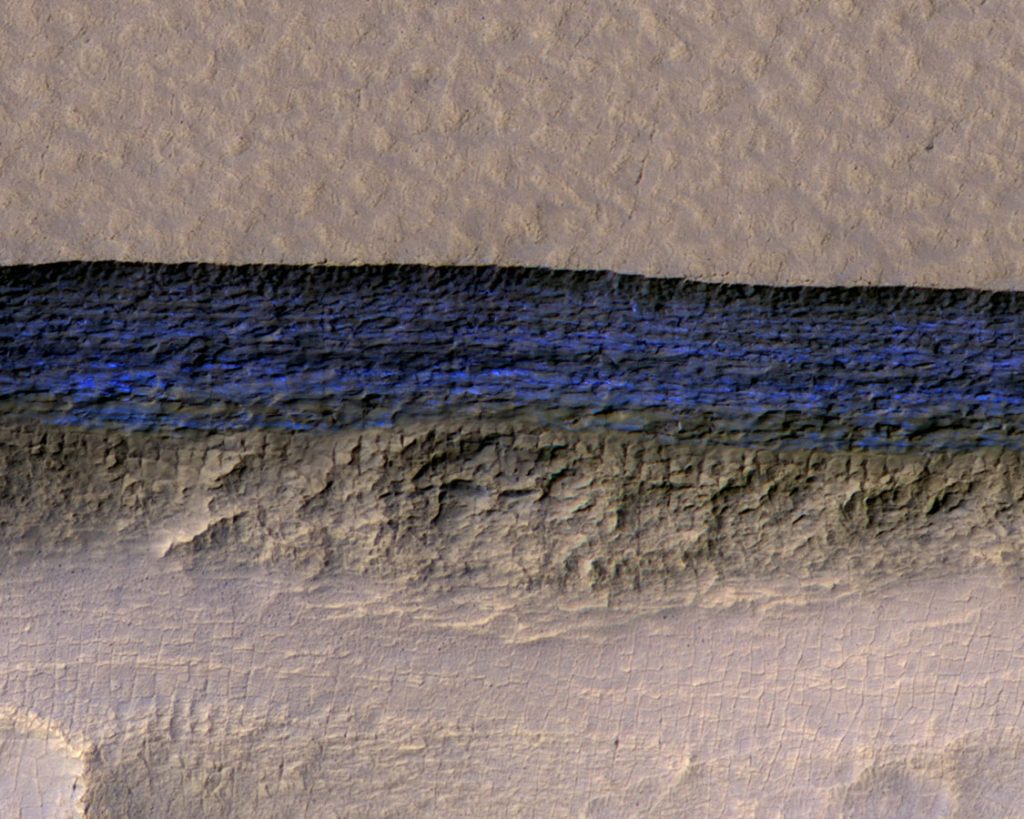
As an aside here, Bob also has an interesting posting about Mars water. While it has been known for many decades that Mars has substantial amounts of water in its surface, much has been learned in recent years about the extent and distribution of that water and much more remains to be discovered. An example of this is the recent finding in Mars orbiter images of layers of water ice exposed on a number of cliffs in the mid-latitudes of the planet:
From the JPL release:
The ice was likely deposited as snow long ago. The deposits are exposed in cross section as relatively pure water ice, capped by a layer one to two yards (or meters) thick of ice-cemented rock and dust. They hold clues about Mars’ climate history. They also may make frozen water more accessible than previously thought to future robotic or human exploration missions.
As Bob notes, such easily accessible water resources will be useful for more than scientific research:
There will come a time when Martian settlers will set up operations here, mining the water for their use. This could very well be extremely valuable real estate on Mars.
===
The CubeSats launched with Insight proved their worth by relaying communications to earth during the lander’s descent and touch down. Furthermore, they have proved the worth of CubeSats for deep space exploration in general, opening up the potential for lower cost and more frequent exploration missions throughout the solar system:
From the NASA JPL release:
Neither of the MarCO CubeSats carry science instruments, but that didn’t stop the team from testing whether future CubeSats could perform useful science at Mars. As MarCO-A flew by, it conducted some impromptu radio science, transmitting signals through the edge of Mars’ atmosphere. Interference from the Martian atmosphere changes the signal when received on Earth, allowing scientists to determine how much atmosphere is present and, to some degree, what it’s made of.
“CubeSats have incredible potential to carry cameras and science instruments out to deep space,” said John Baker, JPL’s program manager for small spacecraft. “They’ll never replace the more capable spacecraft NASA is best known for developing. But they’re low-cost ride-alongs that can allow us to explore in new ways.”
===
Scott Manley gives an overview of the Insight mission:
====
India’s launch of the country’s HysIS Earth observation satellite and 30 secondary small satellites on a PSLV rocket was a success on Wednesday:
See also:
===
The SpaceX Falcon 9 launch of over 60 smallsats previously scheduled for launch on the same day as the PSLV was postponed to next Sunday due to high altitude winds. (See earlier posting about the two missions.)
Now targeting December 2 for launch of Spaceflight SSO-A: SmallSat Express from Vandenberg Air Force Base.
— SpaceX (@SpaceX) November 29, 2018
===
Meanwhile, South Korea successfully carried out a suborbital launch of a single-staged rocket. The goal of the flight was to test a domestically developed 75 ton thrust engine that will be used for the three-stage orbital Korea Space Launch Vehicle-2 (KSLV-2). The kerosene/liquid oxygen powered engine appears to have performed as planned:
See
====


