Video: NASA’s IRIS observes giant solar eruption

A great look at a huge burst of energy and mass from the sun’s corona courtesy of NASA’s Interface Region Imaging Spectrograph (IRIS) :

A First for NASA’s IRIS: Observing a Gigantic
Eruption of Solar Material

A coronal mass ejection, or CME, surged off the side of the sun on May 9, 2014, and NASA’s newest solar observatory caught it in extraordinary detail. This was the first CME observed by the Interface Region Imaging Spectrograph, or IRIS, which launched in June 2013 to peer into the lowest levels of the sun’s atmosphere with better resolution than ever before. Watch the movie to see how a curtain of solar material erupts outward at speeds of 1.5 million miles per hour.

A coronal mass ejection burst off the side of the sun on May 9, 2014.
The giant sheet of solar material erupting was the first CME seen
by NASA’s Interface Region Imaging Spectrograph, or IRIS. The
field of view seen here is about five Earths wide and about
seven-and-a-half Earths tall.
Image Credit:  NASA/LMSAL/IRIS/SDO/Goddard

IRIS must commit to pointing at certain areas of the sun at least a day in advance, so catching a CME in the act involves some educated guesses and a little bit of luck.

“We focus in on active regions to try to see a flare or a CME,” said Bart De Pontieu, the IRIS science lead at Lockheed Martin Solar & Astrophysics Laboratory in Palo Alto, California. “And then we wait and hope that we’ll catch something. This is the first clear CME for IRIS so the team is very excited.”

The IRIS imagery focuses in on material of 30,000 kelvins at the base, or foot points, of the CME. The line moving across the middle of the movie is the entrance slit for IRIS’s spectrograph, an instrument that can split light into its many wavelengths – a technique that ultimately allows scientists to measure temperature, velocity and density of the solar material behind the slit.

The field of view for this imagery is about five Earths wide and about seven-and-a-half Earths tall.

Lockheed Martin Solar & Astrophysics Laboratory designed the IRIS Observatory and manages the mission. NASA’s Ames Research Center in Moffett Field, California, provides mission operations and ground data systems. NASA’s Goddard Space Flight Center in Greenbelt, Maryland, manages the Explorers Program for NASA’s Science Mission Directorate in Washington, D.C.
Citizen science: The Milky Way Project classifies 1M images + New Kepler data for Planet Hunters

The Milky Way Project at the Zooniverse citizen science site has accomplished a lot in a short time: 1,000,000 Classifications and 7 Languages – The Milky Way Project

The Milky Way Project has now passed one million classifications since its relaunch a few months ago. The project is currently 75% complete, meaning there are still many, many images left to classify. Which is fine because in fact the project has become truly international lately – with citizen scientists around the world now able to participate in English, Spanish, German, French, Indonesian, Polish and Danish. There are more languages on the way too!

===

The Kepler Observatory was severely crippled last year due to the failure of a reaction wheel needed to maintain the pointing precision of the space telescope. The Kepler K2 recovery plan will return the observatory to planet finding by taking advantage of solar radiation pressure to maintain the pointing alignment.

This is good news for the Planet Hunters citizen science program, which will now get a stream of new data from the space observatory: Welcome to the Era of K2 – Planet Hunters

Satellite images show changes in earthscapes

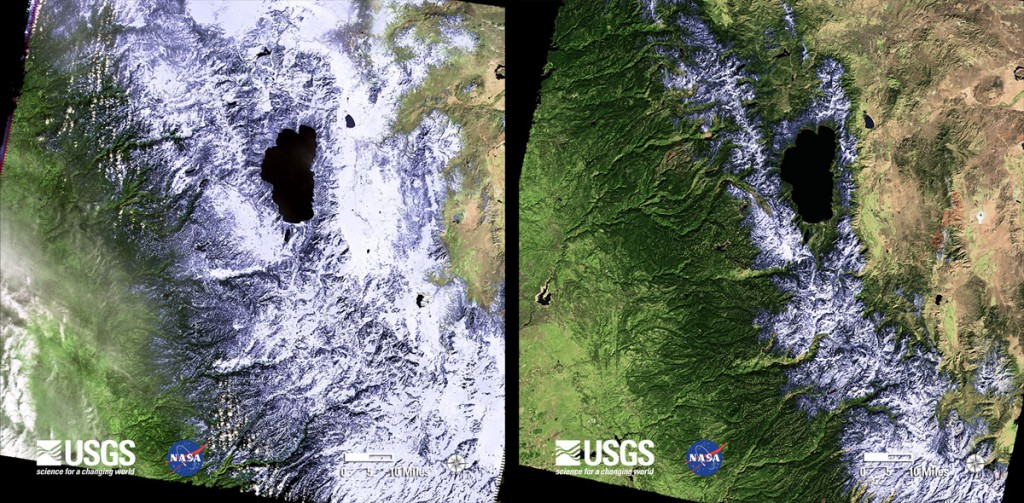
A nice collection of then-and-now satellite images of areas on earth that have experienced major changes: Fascinating Satellite Images of Earth’s Ever-Changing Landscape – Science/WIRED

ca-snowpack-comp-1200The Sierra Nevada mountains of California have far less snow pack this
year (right image)  
compared to earlier years (left image) due to
an extended drought.


Video: NASA Space to Ground update on the ISS

The latest NASA Space to Ground report on the past week of activities on the Int. Space Station

Space policy roundup – May.30.14 [Update]

As he explained in the book Safe Is Not An Option and discussed in a USA Today article recently, Rand Simberg is campaigning for astronaut safety to be put into its proper perspective. A decision to push forward on a dangerous and difficult frontier is a decision to make that frontier more important than safety. He has opened a petition to Congress to push forward on the dangerous and difficult space frontier :

[ Link change: Rand  decided it was best to move the petition to this page: Safety Cannot Be The Highest Priority In NASA Spaceflight – Safe Is Not An Option

]

—

The Onion reports on introducing realism into Space Camp : Modernized Space Camp Allows Kids To Simulate Frustration Over Lack Of Funding – The Onion.

—

More space policy/politics related links:

[ Update:

]

Webcasts:

* The John Batchelor Show Hotel Mars, Wednesday, 5-28-14 – Thespaceshow’s Blog –  Batchelor and David Livingston talk with John Logsdon, former head of the GWU Space Policy Institute, about “U.S.-Russia space cooperation, NASA, RD180 engines, GPS, & more”.

* Wed 5/28/14 Hr 3 | John Batchelor Show –  – Bob Zimmerman (guest 4) reports on space news and policy

* Thurs 5/29/14 Hr 3 | John Batchelor Show – Bob Zimmerman (guest 3) gives another update on space news and policy

Everyone can participate in space