Video: Tim Peake shows the aurora

UK/ESA astronaut Tim Peake posted this impressive extended view of an aurora as seen from the International Space Station:

See also the recent Video: ‘On the shoulders of giants’ – Tim Peake’s Principia mission on the ISS.

Saturn: “Dark Moons, Dark Rings”

Great image from the Cassini probe of two moons above Saturn’s rings:

Dark Moons, Dark Rings

When taking images in directions opposite from the sun, most objects appear dark. Surprisingly, however, some of Saturn’s rings get brighter.
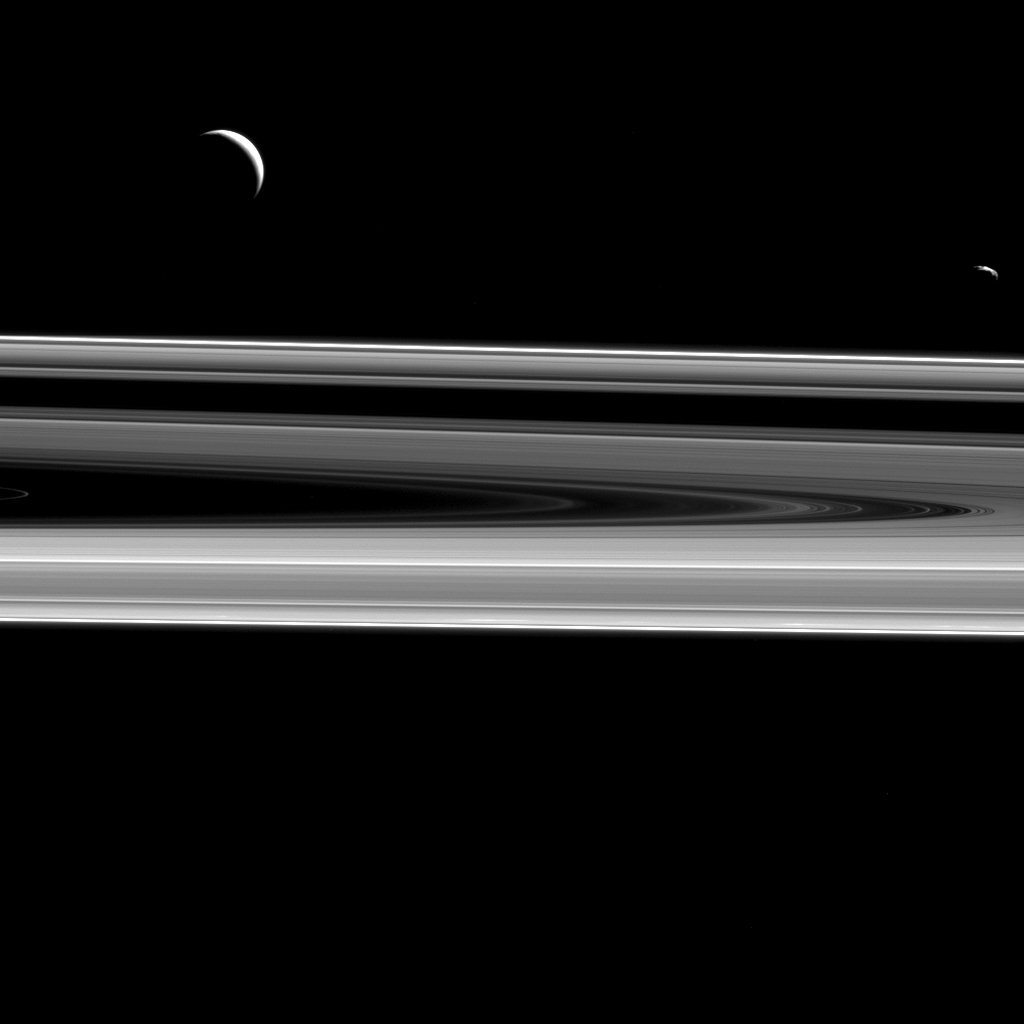
TwoMoonsAboveTheRings-PIA18360_hires

Parts of Saturn’s main rings appear dark in backlit views, particularly the dense B ring (as can been seen in PIA14934). However, some rings are comparatively tenuous and made up of dust particles that tend to scatter light in roughly the original direction it was traveling. This is called “forward scattering.” Because of forward scattering, rings like the F ring, which encircles the outer edge of the main rings, appear to glow brightly at this large viewing angle.

Two moons hover above the rings from this perspective — Enceladus (313 miles or 504 kilometers across), at left, and Janus (111 miles or 179 kilometers across), at right.

This view looks toward the unilluminated side of the rings from about 0.5 degrees below the ring plane. The image was taken in visible light with the Cassini spacecraft narrow-angle camera on Dec. 21, 2015.

The view was acquired at a distance of approximately 750,000 miles (1.2 million kilometers) from Saturn and at a Sun-Saturn-spacecraft, or phase, angle of 136 degrees. Janus’ brightness was enhanced by a factor of two to improve its visibility in this image.

The Cassini mission is a cooperative project of NASA, ESA (the European Space Agency) and the Italian Space Agency. The Jet Propulsion Laboratory, a division of the California Institute of Technology in Pasadena, manages the mission for NASA’s Science Mission Directorate, Washington. The Cassini orbiter and its two onboard cameras were designed, developed and assembled at JPL. The imaging operations center is based at the Space Science Institute in Boulder, Colorado.

For more information about the Cassini-Huygens mission visit saturn.jpl.nasa.gov and www.nasa.gov/cassini. The Cassini imaging team homepage is at ciclops.org.

The Space Show this week – Mar.28.16

The guests and topics of discussion on The Space Show this week:

1. Monday, March 28, 2016: 2-3:30 PM PDT (5-6:30 PM EDT, 4-5:30 PM CDT): We welcome back DR. ROB MANNING of JPL to discuss Mars retro-propulsion landing.

2. Tuesday, March 29, 2016: 7-8:30 PM PDT (10-11:30 PM EDT, 9-10:30 PM CDT): We welcome back HENRY VANDERBILT to discuss and update us with the coming Space Access Society meeting in Phoenix.

3. Friday, April 1, 2016: 2016; 9:30-11AM PDT; (12:30-2 PM EDT; 11:30AM – 1 PM CDT. RICHARD EASTON co-hosts with DR. BLEDDYN BOWEN of the UK to discuss space policy and national security space, military history and space intelligence studies.

4. Sunday, 3 2016: 12-1:30 PM PDT (3-4:30 PM EDT, 2-3:30 PM CDT): JAY WITTNER returns with GARY BICKFORD regarding his company and our sponsor, Integrated Space Analytics.

See also:
* The Space Show on Vimeo – webinar videos
* The Space Show’s Blog – summaries of interviews.
* The Space Show Classroom Blog – tutorial programs

The Space Show is a project of the One Giant Leap Foundation.

Video: Exhibition “outer space” by artist Michael Najjar opens in NYC

I’ve posted a couple of times about photographer Michael Najjar’s space inspired works (see here and here). He has a new show opening in New York City this month:

Here are a couple of his photos plus a video that he made:

[]

[]

[]

[]

—

Here is the press release for the show:

Michael Najjar – outer space – March 31 – May 14, 2016

Benrubi Gallery is pleased to announce German photo and video artist Michael Najjar‘s solo exhibition, outer space – the artist’s first show with the gallery and the first major showing of this series in New York City. outer space explores the latest development in space travel and how it is shaping future life on earth and in near-earth orbit. Informed by Najjar’s training to become the first civilian artist to fly to space, the series of large-scale photographs capture an intense and immersive futuristic world, inspired by cutting-edge aeronautic technologies and the nascent space tourism industry. The potential of the photographic image is pushed to new frontiers as realistic elements fuse with fictitious realities to make visible what is invisible or beyond human perception.

Central to outer space is Najjar’s personal experience with space flight and the performative aspect of the exhibited images. As one of the pioneer astronauts of Richard Branson’s Virgin Galactic, Najjar has been undergoing an intensive, multistage cosmonaut training in Star City, Russia, since 2012, and is scheduled to board SpaceShipTwo in the near future. The artist uses the actual experience of training (zero-g flight, centrifuge training, stratosphere flight, and underwater space walks, to name a few) to create complex and never-before carried out photos that examine vital connections between humans and technology. Reality and simulation are so intertwined that they become indistinguishable, allowing for novel ways of seeing. Video artworks based on Najjar’s extreme training will be shown as part of the exhibition.

The acceleration in aeronautic research and industry and the birth of commercial space travel has brought humanity on the verge of a new era. The images of outer space – the ultra-high resolution telescope “golden eye II,” the world’s largest centrifuge, the first private spaceport, mineral mining on the moon, or space debris orbiting around the earth at fast speed – all address these technological advancements, attempting to elucidate their important cultural implication through artistic transformation. “By leaving our home planet and flying to the moon or other planets, we change our understanding of who we are and where we come from,” Najjar says. “The point is to reflect on our world and what it means to us and the generations to come after us. It’s about the very origins of the self.”

Everyone can participate in space