Next Big Future hosts the latest Carnival of Space.
Carnival of Space #467 – Next Big Future
Next Big Future hosts the latest Carnival of Space.
Next Big Future hosts the latest Carnival of Space.
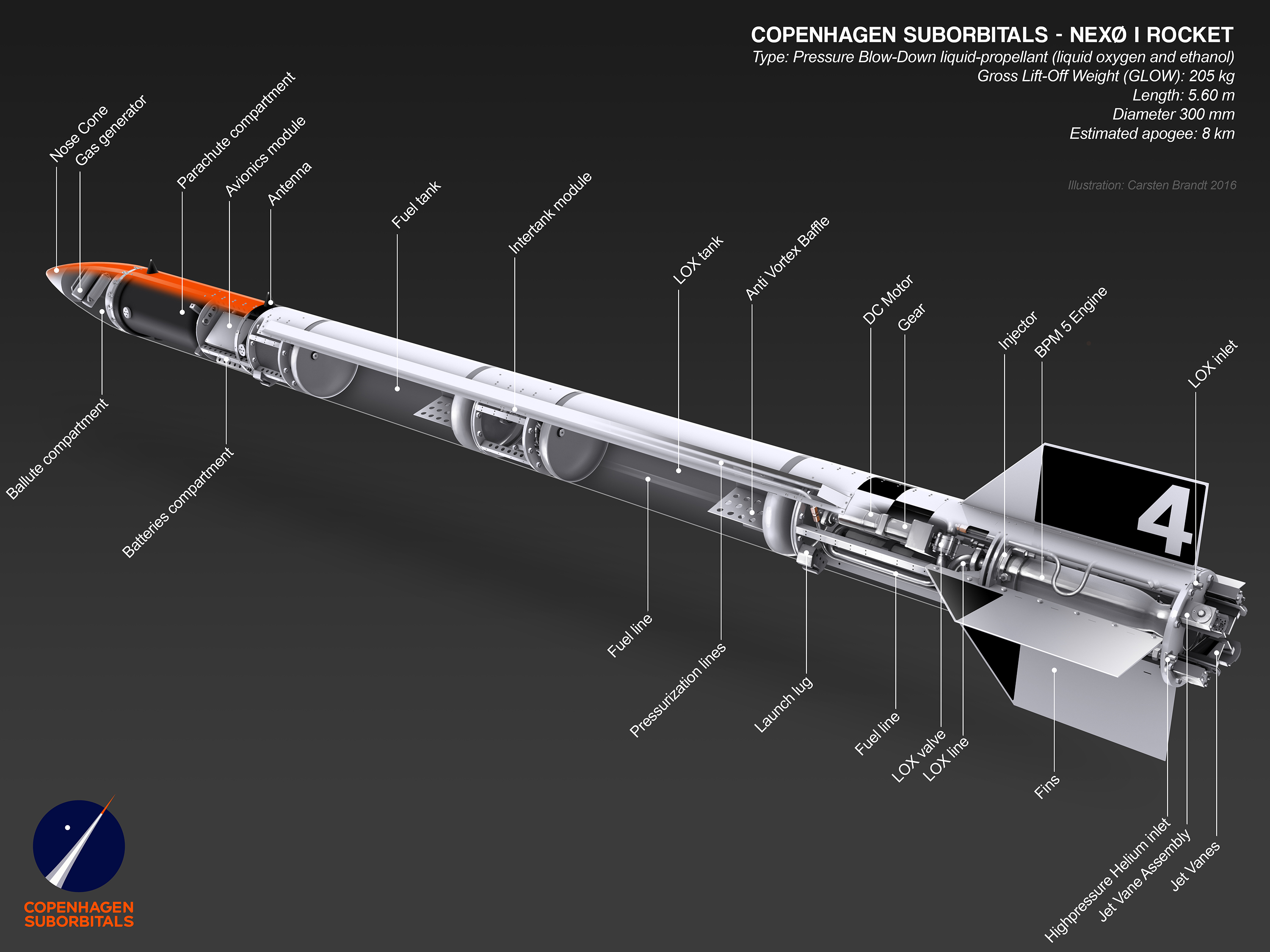
This Saturday Copenhagen Suborbitals will attempt to launch its most ambitious rocket. The Nexø I uses a liquid propellant engine and an active guidance system. Find updates and webcast info at The Nexø I Mission.
Here is the press release:
Danish amateur rocket builders launch their most advanced rocket yet.

“These days everyone is working around the clock to make the mission happen” says Kristian Elof Sørensen, Chairman of Copenhagen Suborbitals. “Nexø I is the most advanced rocket we have ever built, and a successful mission this year is important for our effort to build a rocket big enough to put a man in space.”
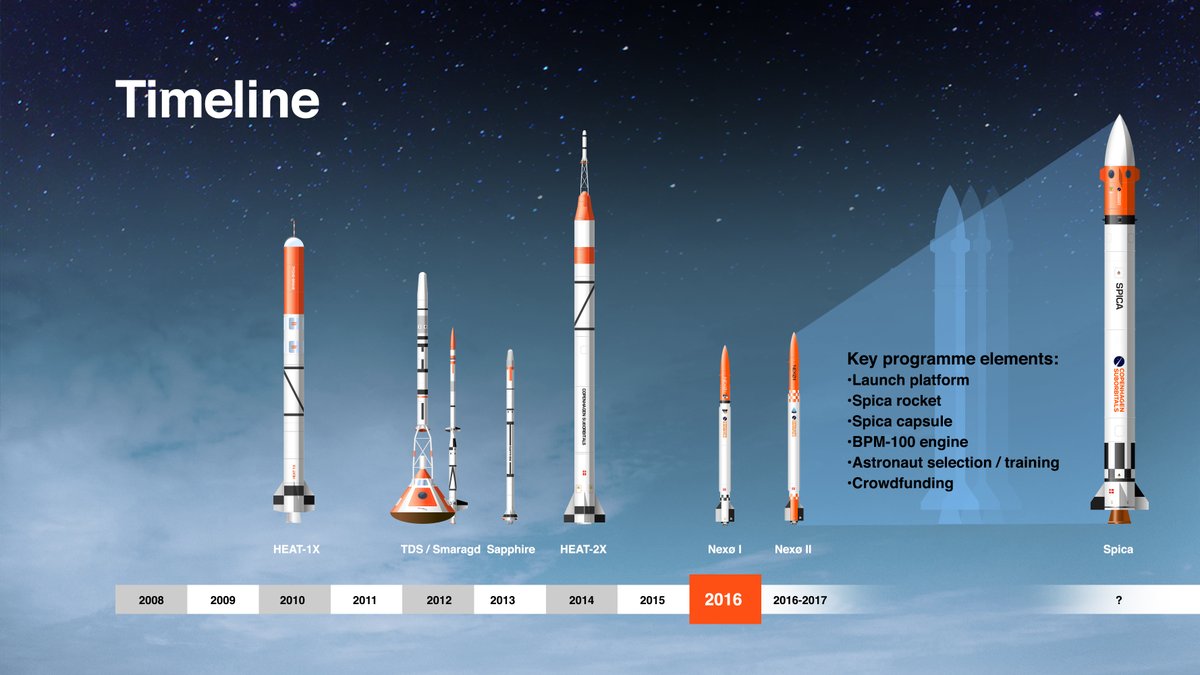
Copenhagen Suborbitals have built and launched rockets from Denmark since 2011, when their HEAT-1X made headlines as the biggest, amateur rocket ever flown. The group is the world’s only manned, amateur space programme, with 55 volunteers building rockets and space capsules in a central copenhagen workshop, all completely crowdfunded.
“Nexø I will not fly into space, but the technologies we are testing are the same needed to build our manned rocket, Spica” says Kristian Elof Sørensen. “The Spica rocket is so big that it makes sense to build smaller rockets first to test the subsystems on a smaller scale.”

Read more – and see the launch live at: copsub.com
====
Here is a video about Final adjustments of the ballute and parachute before launch of the Nexø 1 rocket:
The Kepler space telescope continues to find more planets around other stars:
NASA’s Kepler Confirms 100+ Exoplanets During Its K2 Mission
An international team of astronomers has discovered and confirmed a treasure trove of new worlds using NASA’s Kepler spacecraft on its K2 mission. Among the findings tallying 197 initial planet candidates, scientists have confirmed 104 planets outside our solar system. Among the confirmed is a planetary system comprising four promising planets that could be rocky.

The researchers achieved this extraordinary “roundup” of exoplanets by combining data with follow-up observations by earth-based telescopes including the North Gemini telescope and the W. M. Keck Observatory in Hawaii, the Automated Planet Finder of the University of California Observatories, and the Large Binocular Telescope operated by the University of Arizona. The discoveries are published online in the Astrophysical Journal Supplement Series.
Both Kepler and its K2 mission discover new planets by measuring the subtle dip in a star’s brightness caused by a planet passing in front of its star. In its initial mission, Kepler surveyed just one patch of sky in the northern hemisphere, determining the frequency of planets whose size and temperature might be similar to Earth orbiting stars similar to our sun. In the spacecraft’s extended mission in 2013, it lost its ability to precisely stare at its original target area, but a brilliant fix created a second life for the telescope that is proving scientifically fruitful.
After the fix, Kepler started its K2 mission, which has provided an ecliptic field of view with greater opportunities for Earth-based observatories in both the northern and southern hemispheres. Additionally, the K2 mission is entirely community-driven with all targets proposed by the scientific community.
Because it covers more of the sky, the K2 mission is capable of observing a larger fraction of cooler, smaller, red-dwarf type stars, and because such stars are much more common in the Milky Way than sun-like stars, nearby stars will predominantly be red dwarfs.
“An analogy would be to say that Kepler performed a demographic study, while the K2 mission focuses on the bright and nearby stars with different types of planets,” said Ian Crossfield. “The K2 mission allows us to increase the number of small, red stars by a factor of 20, significantly increasing the number of astronomical ‘movie stars’ that make the best systems for further study.”
To validate candidate planets identified by K2, the researchers obtained high-resolution images of the planet-hosting stars as well as high-resolution optical spectroscopy. By dispersing the starlight as through a prism, the spectrographs allowed the researchers to infer the physical properties of a star — such as mass, radius and temperature — from which the properties of any planets orbiting it can be inferred.
These observations represent a natural stepping stone from the K2 mission to NASA’s other upcoming exoplanet missions such as the Transiting Exoplanet Survey Satellite and James Webb Space Telescope.
“This bountiful list of validated exoplanets from the K2 mission highlights the fact that the targeted examination of bright stars and nearby stars along the ecliptic is providing many interesting new planets,” said Steve Howell, project scientist for the K2 mission at NASA’s Ames Research Center in Moffett Field, California. “These targets allow the astronomical community ease of follow-up and characterization, providing a few gems for first study by the James Webb Space Telescope, which could perhaps tell us about the planets’ atmospheres.”
This work was performed in part under contract with the Jet Propulsion Laboratory (JPL) funded by NASA through the Sagan Fellowship Program executed by the NASA Exoplanet Science Institute.
NASA Ames manages the Kepler and K2 missions for NASA’s Science Mission Directorate. NASA’s Jet Propulsion Laboratory in Pasadena, California, managed Kepler mission development. Ball Aerospace & Technologies Corporation operates the flight system with support from the Laboratory for Atmospheric and Space Physics at the University of Colorado at Boulder.
For more information on the Kepler and the K2 mission, visit: www.nasa.gov/kepler
For more information about exoplanets, visit: exoplanets.nasa.gov/
The guests and topics of discussion on The Space Show this week:
1. Monday, July18 , 2016: 2-3:30 PM PDT (5-6:30 PM EDT, 4-5:30 PM CDT): No show as am at conference.
2. Tuesday, July 19, 2016: 7-8:30 PM PDT (10-11:30 PM EDT, 9-10:30 PM CDT) No show as am at conference.
SPECIAL SHOW: 3. Wednesday, July 20, 2016: 7-8:30 PM PDT (10-11:30 PM EDT, 9-10:30 PM CDT) Evoloterra with Rand Simberg and Bill Simon. Visit www.evoloterra.com.
4. Friday, July 22, 2016: 2016; 9:30-11AM PDT; (12:30-2 PM EDT; 11:30 AM – 1 PM CDT) Richard Rocket, CEO of New Space Global, is back with us for an updated analysis of the commercial space industry.
5. Sunday, July 24, 2016: 12-1:30 PM PDT (3-4:30 PM EDT, 2-3:30 PM CDT): Dr. Jeff Bell is back with us for more interesting perspective about commercial space and space development.
See also:
* The Space Show on Vimeo – webinar videos
* The Space Show’s Blog – summaries of interviews.
* The Space Show Classroom Blog – tutorial programs
The Space Show is a project of the One Giant Leap Foundation.
Here’s a cool GIF animation of images of the sun from the Solar Dynamics Observatory (SDO):
Sun-Watching SDO Does a Somersault
On July 6, 2016, engineers instructed NASA’s Solar Dynamics Observatory, or SDO, to roll 360 degrees on one axis. SDO dutifully performed the seven-hour maneuver, while producing some dizzying data: For this period of time, SDO images – taken every 12 seconds – appeared to show the sun spinning, as if stuck on a pinwheel. This video was taken by SDO’s Atmospheric Imaging Assembly instrument in extreme ultraviolet wavelengths that are typically invisible to our eyes, but was colorized here in gold for easy viewing.

This maneuver happens twice a year to help SDO’s Helioseismic and Magnetic Imager, or HMI, instrument take precise measurements of the solar limb, the outer edge of the sun as seen by SDO. Were the sun perfectly spherical, this would be a much simpler task. But the solar surface is dynamic, leading to occasional distortions. This makes it hard for HMI to find the sun’s edge when it’s perfectly still. HMI’s biannual roll lets each part of the camera look at the entire perimeter of the sun, helping it map the sun’s shape much more precisely.
HMI tracks variations in the solar limb over time to help us understand how the shape of the sun changes with respect to the solar cycle, the sun’s 11-year pattern of solar activity. The more we know about what drives this activity – activity that can include giant eruptions of solar material and radiation that can create hazards for satellites and astronauts – the better we may someday predict its onset.